

This Week's Show
Air Date: October 30, 2026
FULL SHOW
SEGMENTS
Microplastics, Inflammation, and Your Health
View the page for this story
Plastics have been widely adopted in all sorts of products from food packaging to toys to medical devices, in part because they don’t tend to chemically react. But new research challenges that notion when it comes to microplastics, finding that contact with water releases unstable molecules which in the human body are linked to inflammation. Dr. Leonardo Trasande, a pediatrician who directs the NYU Center for the Investigation of Environmental Hazards, tells Host Aynsley O’Neill about the health risks of tiny chips of plastic and ways to reduce them. (10:36)

BirdNote®: Spooky Spearwaters
/ Michael SteinView the page for this story
At Halloween, we think of ghoulies and ghosties and long-leggitty beasties – indeed, you may even get some of them at your door demanding candy. And as Michael Stein tells us in today’s BirdNote®, some of our avian acquaintances would fit right in. (02:09)
50,000 Dead from Europe’s 2026 Heat
View the page for this story
As greenhouse gases from fossil fuels continue to spike our planet’s average temperature, it’s pushing into more dangerous territory for humans. This summer, heat-related deaths in European urban areas scorched by heat waves totaled 50,000, according to a new study which also concludes that human-induced climate change was a significant contributor to the high mortality rate. Shouro Dasgupta, an environmental economist at the Euro-Mediterranean Center on Climate Change, talks with Host Jenni Doering about ways to keep people cool, and why adaptation must be paired with mitigation to slow global warming. (08:46)

Wolf Seeks Revenge on Humans in Novel Blacktail
View the page for this story
This year, bookstores have a nature-based tale in the “eco-horror” genre to feature: Blacktail by Scott Hawkins. The novel tells the story of one wolf’s quest for vengeance on the humans who have wronged him. And to get his revenge, he’ll have to find and wake the Forest God. Author Scott Hawkins joins Host Aynsley O’Neill in this spoiler-free chat. (11:09)
Note on Emerging Science: Spring-Loaded Spider Trap
/ Don LymanView the page for this story
Late summer into early fall is spider season, when you seem to find spiders everywhere, spinning their silk masterpieces or lurking in a dark corner. In this week’s note on emerging science, Living on Earth’s Don Lyman reports on a particularly impressive Australian spider that builds a spring-loaded trap to catapult unwitting ants into its web for dinner. (02:27)
Big Bug ‘Down Under’
View the page for this story
The Wētāpunga is the heaviest known insect on the planet, weighing as much as a mouse. They’re found only in New Zealand and were recently endangered, but thanks to an innovative breeding program, they’re making a comeback. Chris Green, an honorary researcher at the New Zealand Department of Conservation, tells Host Jenni Doering about the conservation effort and why he believes these giant cricket-like insects deserve our respect and care. (11:48)
Show Credits and Funders
Show Transcript
261030 Transcript
HOSTS: Jenni Doering, Aynsley O’Neill
GUESTS: Shouro Dasgupta, Chris Green, Scott Hawkins, Leonardo Trasande
REPORTERS: Don Lyman, Michael Stein
[THEME]
DOERING: From PRX – this is Living On Earth.
[THEME]
DOERING: I’m Jenni Doering
O’NEILL: And I’m Aynsley O’Neill.
A study hints at why microplastics seem to take such a toll on our bodies.
TRASANDE: When we talk about oxidative stress or inflammation being increased in the human body as a result of plastic exposures, that by definition is not inert, means that these plastics are quite biologically active.
DOERING: Also, a big bug down under is a conservation success.
GREEN: They’ve got every right to be here just the way we have! If humans let every other species go extinct, I think we’d have problems. So, unwittingly, we do admire and we want to have that diversity in the system. That includes bugs, you know.
DOERING: That and more, this week on Living on Earth. Stick around!
[NEWSBREAK MUSIC: Boards Of Canada “Zoetrope” from “In A Beautiful Place Out In The Country” (Warp Records 2000)]
[THEME]
Microplastics, Inflammation, and Your Health
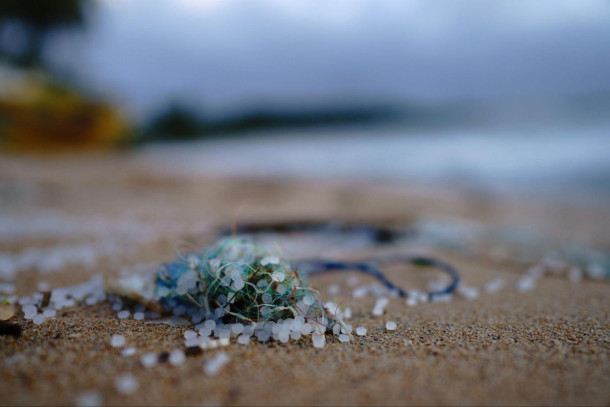
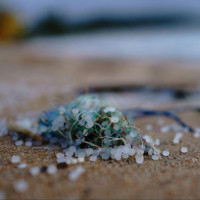
A recent study published in the journal Nature found that microplastics are not entirely chemically inert, despite this being a known quality of many larger plastics. (Photo: Unsplash, Unsplash license)
DOERING: From PRX and the Jennifer and Ted Stanley Studios at the University of Massachusetts Boston, this is Living on Earth. I’m Jenni Doering.
O’NEILL: And I’m Aynsley O’Neill.
Plastics have been widely adopted in all sorts of products from food packaging to toys to medical devices, in part because they are shown to be chemically inert, meaning they don’t easily undergo chemical reactions when in contact with other substances. But a recent study challenges that notion when it comes to microplastics. The study published in the journal Nature looked at several kinds of microplastics in a lab and found that when they came into contact with water, it essentially acted as a catalyst to create free radicals. Those are unstable molecules which in the human body are linked to inflammation and disease. Unlike larger, intact pieces of plastic, microplastics have far more surface area as compared to their volume, creating the conditions for chemical reactions to occur. Here to explain is Dr. Leonardo Trasande, a pediatrician who directs the NYU Center for the Investigation of Environmental Hazards and was not part of the study. Dr. Trasande welcome back to Living on Earth!
TRASANDE: It’s great to be back. Thank you.
O’NEILL: So, Dr. Trasande, when we say that plastic is considered chemically inert, what exactly does that mean, and what did this new study find to change our understanding of that?
TRASANDE: So, when plastic is inert in the notion of human physiology, it means it doesn’t do anything or interact with the human body. It goes, enters, and leaves unseen essentially, from a human health perspective. And what this study reveals is that plastic is not inert, particularly micro and nanoplastics. The assumption was that micro nanoplastics don’t get transformed or cause any interaction with the human body. What this study found was that inflammation, the body’s response to a variety of exposures, was increased, and the inflammation in the human body is important because it underlies many different medically important conditions, particularly cardiovascular disease but I can think a host of others. Just to use cardiovascular disease as an analogy, we know that inflammation in the coronary arteries promotes the acceleration of plaque, narrowing, and ultimately, conditions like heart attack and even stroke. And so, when we talk about oxidative stress or inflammation being increased in the human body as a result of plastic exposures, that by definition is not inert. Means that these plastics are quite biologically active. To be clear, we’re not even talking about the chemicals added to plastic materials or the chemical impurities that exist in plastic materials. This was simply focusing on one aspect of the multi-dimensional threat that’s posed by plastic to human health.
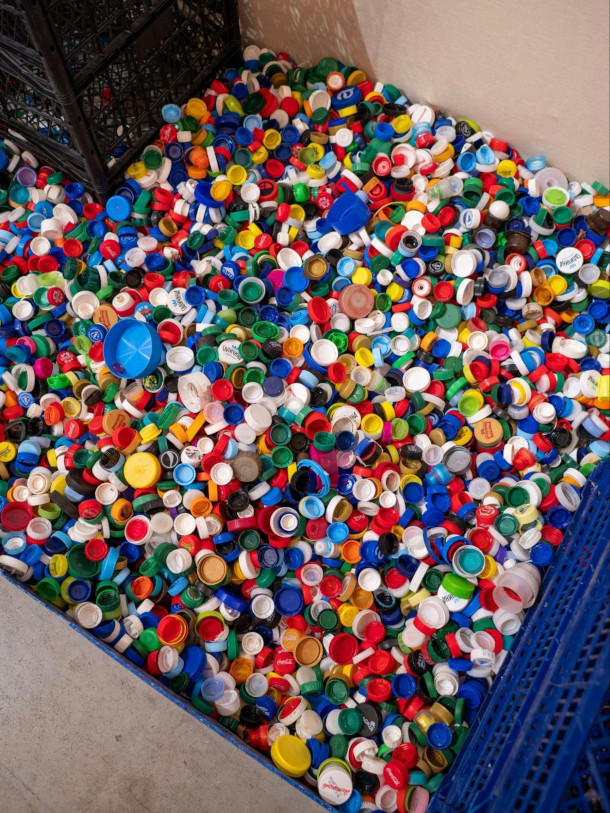
The study on microplastics conducted by Columbia University and UC Berkeley tested six common plastics, including polyethylene and polypropylene, a plastic commonly used in water bottle caps. (Photo: cameraobscura2000, Unsplash)
O’NEILL: Now, microplastics are fairly ubiquitous in the world these days, and as we were saying, they’ve already been linked to health concerns like inflammation, hormone disruption, to name a few. To what extent does this research simply explain why microplastics have these effects versus give us new health concerns to consider?
TRASANDE: So, if I can pick up the cardiovascular disease issue, the New England Journal of Medicine a couple years back had published a study looking at the carotid artery, which is the artery that provides large amounts of blood flow to the brain and essentially the head and neck, and what it found was that polyvinyl and polyethylene micro nanoplastics, the levels thereof in those carotid arteries, these are patients who underwent a procedure called endarterectomy to essentially clean out the carotid artery, the plaques, and the microplastic concentrations in those plaques were associated with a fourfold increase in the composite of heart attack, stroke, and death. So, what this study does is further unravels a mechanism that may directly explain why those microplastics were associated with such a steep increase in a major human health condition.
O’NEILL: Now, what if anything does this study tell us about why microplastics are acting differently than their macro counterparts?

Microplastics have been accumulating on land, water, and even within our bodies. This new research offers a possible mechanism for why micro and nanoplastics have been tied to various human health concerns. (Photo: Jonathan Chng, Unsplash)
TRASANDE: So, microplastics may do one of two things: they may deliver chemicals of concern to human tissue, or they themselves can be human wrecking balls, or otherwise cause inflammation by just their interaction and physical properties. This study suggests a little bit more that the latter is the case, but it doesn’t preclude the fact that chemicals that are coming along for the ride may further exacerbate the inflammation that was observed in relationship to micro nanoplastics.
O’NEILL: And we’ve talked about a few of the health concerns here. Which of these would you say is stand out one to you?
TRASANDE: Well, oxidative stress and inflammation is such a common thread throughout so many human health conditions that it’s hard to pick any one. Let’s even take hormone disruption for example. Inflammation can further contribute to endocrine disruption. Inflammation can just contribute to immune dysfunction. So I can go condition by condition across the lifespan, and this study indirectly reveals a link that hadn’t been previously described. It’s not to say that microplastics are the cause of everything and anything under the sun, or not the totality of chronic disease. I’m still always going to say that diet and physical activity are important risk factors for obesity and cardiovascular disease, just to name those two. But this study adds further basis for considering a third leg to that stool, and those are environmental exposures that may be impactful.
O’NEILL: Well, Dr. Trasande, we’re throwing around some pretty concerning health conditions here. If listeners are listening and they themselves are concerned, what can they do to reduce their exposure to microplastics?
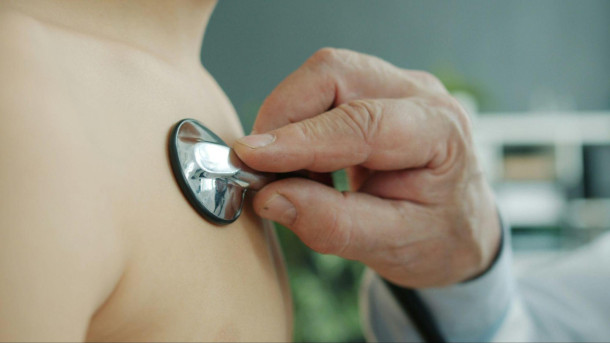
Recent studies published in the European Heart Journal show that micro- and nanoplastics can be detected in the blood and arterial tissues of cardiovascular patients. (Photo: Vitaly Gariev, Unsplash)
TRASANDE: So there are safe and simple steps that we can all take to reduce our plastic exposure. We can use more glass than stainless steel. So, for example, if I’m getting on a plane, I’ll bring an empty water bottle, clear security, and fill that water bottle out on the other end. We can avoid microwaving or machine dishwashing plastics. Maybe we can use more fresh fruits and vegetables and cook our food at home and bring it into the workplace. We can avoid non-stick cooking and use cast iron or stainless steel, which a little bit of a different category of the plastics compared to those that were chiefly studied here. Those are typically what we call fluoropolymers, forever chemicals. And we need to be the force of consumers that drives the change that we seek. That’s a very powerful thing. We forget back about 15 years ago when BPA baby bottles and sippy cups were the source of outrage among many moms, it was not science that drove the action to get BPA banned by the FDA. It was consumer activism that led the industry to run to the FDA and insist on getting that out in the first place. So we forget the power of the consumer in driving the change, both at a company level but also at a public policy level.
O’NEILL: And I do want to talk a little bit about public policy. I’m curious, what can you tell us about where U.S. regulation on plastic stands?

Dr. Leonardo Trasande is a pediatrician who directs the NYU Center for the Investigation of Environmental Hazards. (Photo: Cheryl Stockton)
TRASANDE: Well, the United States uses a lot of plastic in its day-to-day manufacturing. So do many industrialized countries. So I wouldn’t say that our plastic production per unit capita is particularly outlandish. It’s been accelerated by the modern lifestyle, but that doesn’t mean we don’t have the responsibility to be the proverbial change we seek. The Make America Healthy Again movement has really sparked further conversations about microplastic and nanoplastic, as well as chemicals in plastic materials. There have been efforts to increase federal investment in research to understand the effects of micro nanoplastic. This study is just an early stage, but important step in the right direction to know where microplastics are going in the body and ultimately doing harm. But we’ve had 50 years of evidence that plastic chemicals, particularly hack our hormones, are signaling molecules that underlie so many basic biological functions like temperature, metabolism, salt, sugar, and even sex. We know that plastic chemicals cost the U.S. economy 250 billion dollars, that’s billion, in disease burden. That’s 1.2 percent of our gross domestic product out the window. The reality is that we’ve misbalanced our priorities. Adam Smith, the father of modern economics, would be rolling over in his grave because this is creating externalities, this is creating harms that we bear, even though we did not buy or sell the material involved in many cases, and so the way to regulating our economy and putting it back in the more optimal line is through actions to reduce exposure to plastic, and that can come through individual action as well as regulatory action.
O’NEILL: Dr. Leonardo Trasande is a pediatrician who directs the NYU Center for the Investigation of Environmental Hazards. Dr. Trasande thank you so much for joining us today.
TRASANDE: It’s always a pleasure to be with you. Thank you.
Related links:
- Read the study published in Nature: “Intrinsic physicochemical activity at microplastic–water interfaces”
- ScienceAlert | “Microplastics Aren't Inert After All: In Water, They Make DNA-Damaging Free Radicals”
- Smithsonian Magazine | “Microplastics Have Been Linked With Myriad Human Health Problems. Scientists May Have Finally Figured Out How They Harm the Body”
- Learn more about Dr. Leonardo Trasande
[BIRDNOTE THEME]
BirdNote®: Spooky Spearwaters

The Wedge-tailed Shearwater’s unusual moaning call once terrified sailors from Europe. (Photo: Dan Hutcheson)
DOERING: At Halloween, we think of ghoulies and ghosties and long-leggitty beasties – indeed, you may even get some of them at your door demanding candy. And as Michael Stein tells us in today’s BirdNote®, some of our avian acquaintances would fit right in.
BirdNote®
The Spooky Shearwaters
Imagine yourself an 18th Century sailor, rowing out from your boat at night toward a remote Pacific island. You’re heading to the island to find fresh water for the ship, only to be greeted by this frightful moaning.
[Wedge-tailed Shearwaters wailing]
Some early sailors feared this ungodly wailing meant they had been tricked ashore at the gates of Hell itself, when in truth they stood shuddering among courting pairs of seabirds called Wedge-tailed Shearwaters.
[Wedge-tailed Shearwaters wailing]
Dark, gull-sized seabirds with long, thin, tapering wings, Wedge-tailed Shearwaters nest on islands in the tropical Pacific and Indian Oceans, from Hawaii to western Australia to Madagascar. Most dig burrows to nest in, two to six feet deep with a bend that allows the incubating birds to rest unseen. From dusk to midnight during courtship, pairs of Wedge-tailed Shearwaters sit facing one another on the ground, and puff up their throats to perform long duets of eerie wailing – sometimes sending spooked sailors rowing in panic back to their ship for a ration of grog.

Wedge-tailed Shearwaters nest on the ground. Their range stretches from Hawaii and the Pacific all the way to the beaches of Madagascar. (Photo: US Fish and Wildlife Service)
[Wedge-tailed Shearwaters wailing]
I’m Michael Stein.
###
Written by Bob Sundstrom
Call of the Wedge-tailed Shearwaters provided by The Macaulay Library of Natural Sounds at the Cornell Lab of Ornithology, Ithaca, New York. Wedge-tailed Shearwater 1801 recorded by F.N. Robinson
Ambient ocean sound recorded by John Kessler
BirdNote's theme music was composed and played by Nancy Rumbel and John Kessler
Producer: John Kessler
Executive Producer: Dominic Black
© 2005-2017 Tune In to Nature.org October 2017 Narrator: Michael Stein
DOERING: These birds may sound scary, but they’re cute as a button, so for pictures, soar on over to the Living on Earth website, loe dot org.
Related link:
The “Spooky Shearwaters” story on the BirdNote® website
[MUSIC: The Salt and the Squall]
O’NEILL: Coming up, more frightful fun including an “eco-horror” novel to add to your reading list this spooky season. Keep listening to Living on Earth!
ANNOUNCER: Support for Living on Earth comes from the Waverley Street Foundation, working to cultivate a healing planet with community-led programs for better food, healthy farmlands, and smarter building, energy and businesses.
[CUTAWAY MUSIC: Dmitriy Sevostyanov, “Quirky Fairytale” Single, 3809040 Records DK]
50,000 Dead from Europe’s 2026 Heat
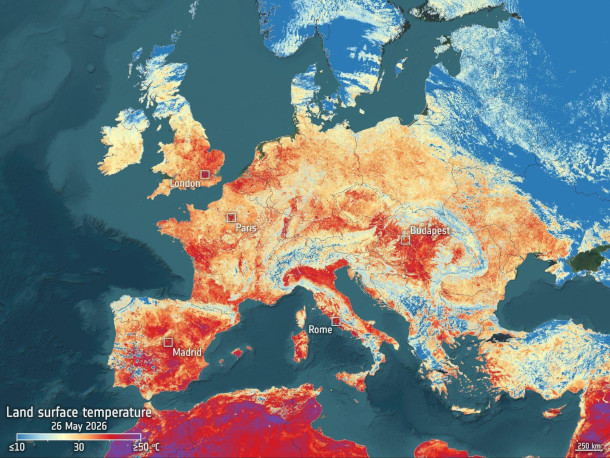
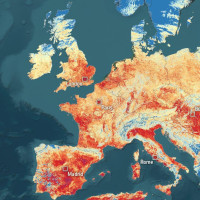
According to new research, heat-related deaths in Europe during the summer of 2026 totaled over 50,000. The above image shows land surface temperature in Europe in May 2026. Contains modified Copernicus Sentinel data 2026. (Photo: European Space Agency, Wikimedia Commons, CC BY-SA 3.0 IGO)
O’NEILL: It’s Living on Earth, I’m Aynsley O’Neill
DOERING: And I’m Jenni Doering.
Since the 1990’s, climate disruption has intensified and global heat-related deaths have increased by 23 percent, now killing around 500,000 people a year. And while under resourced regions like Southeast Asia and sub-Saharan Africa struggle to cope with extreme heat, Europe remains the fastest warming continent on the planet. Just this summer, according to a new study published in Nature Health, heat-related deaths in European urban areas totaled 50,000. Researchers looked at more than 800 urban centers across 30 countries, including Italy, France, and the UK, which were among the nations with the highest death tolls. And the study concludes that human-induced climate change was a significant contributor to the high mortality rate. Dr. Shouro Dasgupta is an Environmental economist at the Euro-Mediterranean Center on Climate Change and a Visiting Senior Fellow at the Grantham Research Institute at the London School of Economics, and he’s here now. Welcome to Living on Earth, Shouro!
DASGUPTA: Well, thank you for inviting me. It's great to be here.
DOERING: What was your reaction to the recent study published in Nature Health that found extreme heat killed around 50,000 people in European cities this summer?
DASGUPTA: Very important question to begin with. It's what we expected. It's good to see the robust evidence being published in peer-reviewed journals. We know heat is a silent killer, and the heat wave we experienced in Europe this summer has been extraordinary in the worst possible sense. And at that time, we knew this would have a devastating effect on human health, but seeing the numbers in a top journal is depressing indeed.
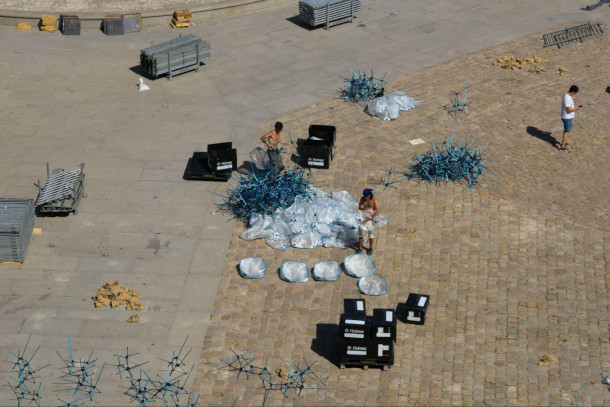
Construction workers assembling chairs during the 2026 European heatwaves, in Paris, France. Outdoor workers are among the most vulnerable populations during extreme heat events. (Photo: Julian Lupyan, Wikimedia Commons, Public Domain)
DOERING: You know, to what extent can we attribute those deaths and the extreme heat events to climate change?
DASGUPTA: Attribution science in the context that looks into climate change-induced extreme events, including heat waves and floods, have developed tremendously in the recent years, right? So we can confidently say climate change has resulted in increasing frequency and the intensity of heat waves, as we have seen in Europe this summer. There are two parts to this. First, researchers attributed the heat waves this summer to climate change, and the results show that climate change significantly contributed to these heat waves occurrences. And the second part is the researchers took into account this attribution and then looked into how these climate change-induced heat waves resulted in this excess mortality during this summer, and more than 60% of these deaths can be attributed to climate change.
DOERING: That's a huge toll. I mean, we're talking 30,000 people that would still be around probably if this hadn't happened.
DASGUPTA: Yeah, absolutely. Climate change induced extreme events, especially heat waves, are without a doubt causing excess mortality.

Parker’s Piece, a park in Cambridge, England, during the June heatwave. (Photo: Mr Addlepated, Wikimedia Commons, CC BY-SA 2.0)
DOERING: And Shoro, beyond mortality, how does heat affect our health? I mean, some people are dying; other people are are getting sick because of it.
DASGUPTA: Climate change-induced heat and, of course, other stressors, has been shown to increase both incidences and spread of infectious diseases such as dengue and chikungunya, leishmaniasis, tick-borne diseases. Climate change has been known, including in Europe, to expand and extend both the temporal and spatial coverage of these infectious diseases. Heat, specifically, of course, in addition affects food insecurity, access to food, but also increases malnutrition and undernutrition, especially among children. It affects how the human body utilizes food, right? And of course, the occupational health, the cardiovascular diseases, kidney-related diseases. So, climate change is the biggest public health failure we have seen. Climate change threatens to reverse many of the health-related gains that have been achieved in the last 50 years or so. I'll give one example from Bangladesh, where I'm from. Bangladesh has been one of the top achievers in reducing child mortality and maternal mortality. Climate change threatens to reverse much of those gains, and this is not just the case of Bangladesh. This is being experienced all over the world.
DOERING: That's staggering. And which populations are most vulnerable when it comes to extreme heat?
DASGUPTA: This would be the very young, the elderly, the marginalized population, low-income groups, outdoor workers are at substantially high risk, especially those working in agriculture, construction, but also in the informal sectors because they do not have sufficient protection, not just in terms of adaptation strategies, but also safety nets to fall back on. These population groups have been shown over and over again to be the most vulnerable when it comes to climate change impacts.
DOERING: I understand that you've actually done quite a lot of research on how to protect those outdoor workers in extreme heat events. What are some of your findings, and what can be done to prevent catastrophic health outcomes?
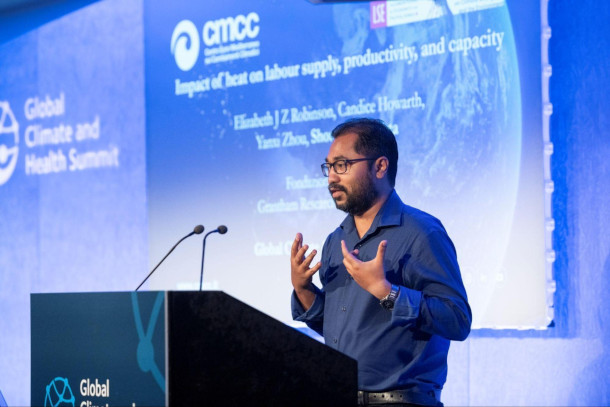
Dr. Shouro Dasgupta is an environmental economist at the Euro-Mediterranean Center on Climate Change and a Visiting Senior Fellow at the Grantham Research Institute at the London School of Economics. (Photo: The Physiological Society (UK))
DASGUPTA: Yeah, so impacts on the labor force is my main area of research and interest, and just talk about some of the research we have done in the UK over the last three years. But to focus on just the heat wave of this summer, our research shows that the June heat wave resulted in 24 million lost working hours and a 1.15 billion pound hit to the economy. So we are calling this climate change's heat tax on the UK economy, and what we found is that this burden falls disproportionately on outdoor workers and those in physically demanding jobs, many of whom are among the lowest paid. Think about agriculture workers, right? So heat is making existing inequality worse within countries and, of course, between them, and of course, a substantial part of our research here deals with protecting workers. What we found is that workers who received advance warning of heat episodes or extreme heat episodes, they're substantially less likely to suffer from negative heat-induced health effects such as excess sweating, cardiovascular diseases, and in worst case scenarios, heat strokes. We found that workers who have access to potable drinking water, they suffer less. Where employers have implemented mandatory rest breaks either on the hour or every two hours on high heat days, these simple adaptation strategies are very effective in protecting workers from high heat.
DOERING: So we've been talking about some adaptations, some things that can be done to protect workers and vulnerable populations. But we can only adapt so fast to a rapidly warming world. So, I mean, what can be done to slow the progression of extreme heat?
DASGUPTA: Mitigate, mitigate, mitigate. All the evidence that we have discussed, we know what works in terms of adaptation. But the rate at which the world is warming right now, and the projections we have on hand, the impact of future climate change on health, labor force outcomes, no matter which one you talk about, no adaptation strategy can protect us from the devastating effects of warming at the rate of warming we're hurtling towards. So the message is going to be yes, we need to adapt, but what we really need is mitigate, mitigate, mitigate.
DOERING: Dr. Shouro Dasgupta is an environmental economist at the Euro-Mediterranean Center on Climate Change and a visiting senior fellow at the Grantham Research Institute of the London School of Economics. Thank you so much, Shouro.
DASGUPTA: Thank you for inviting me. It's great to be on the podcast.
Related links:
- Imperial College London | “Heat-Related Urban Mortality Attributable to Human-Induced Climate Change in Europe in Summer 2026”
- London School of Economics Global School of Sustainability | “Climate Change’s Heat Tax on the UK’s Labour Force and Economy”
- World Health Organization | “Climate Inaction Is Claiming Millions of Lives Every Year, Warns New Lancet Countdown Report”
[MUSIC: Hot Sun, Dry Earth]
Wolf Seeks Revenge on Humans in Novel Blacktail
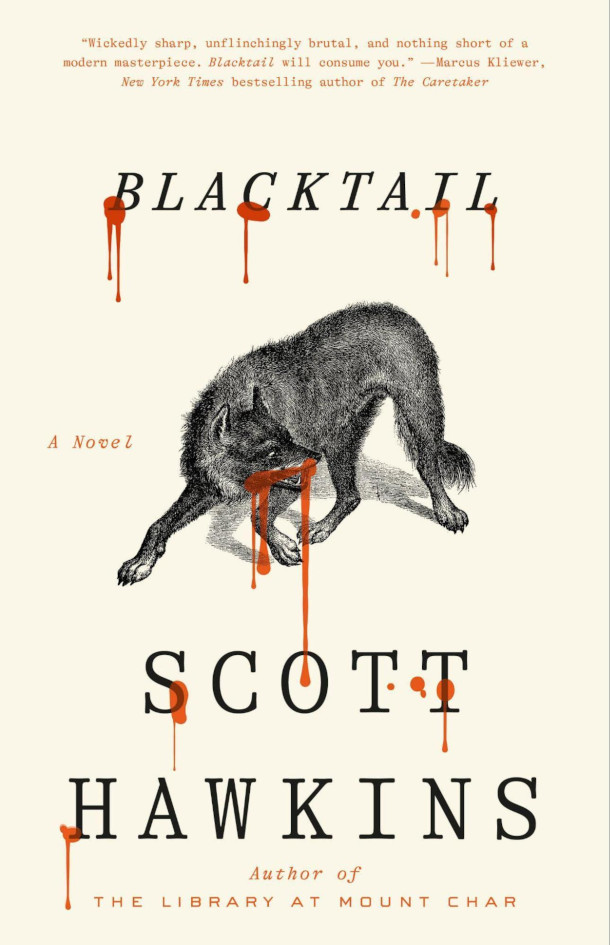
Scott Hawkins’ latest novel, Blacktail. (Photo: Courtesy of Scott Hawkins)
O’NEILL: Spooky stories are all around us this time of year, whether that be trailers for the latest horror film or haunted houses open for visits. Bookstores, too, are highlighting some of their scariest titles. And this year, they have a nature-based tale in the “eco-horror” genre to feature: Blacktail by Scott Hawkins. The novel tells the story of one wolf’s quest for vengeance on the humans who have wronged him. And to get his revenge, he’ll have to find and wake the Forest God. Author Scott Hawkins joins me now to talk about Blacktail and his Forest God. Scott, welcome to Living on Earth!
HAWKINS: Thank you so much for having me. Pleasure to be here.
O'NEILL: Now, Scott, I know it's no easy task to sum up a 300-page book, but for listeners who haven't yet gotten a chance to even check out the dust jacket, how would you describe Blacktail?
HAWKINS: Blacktail is a fantasy set in the modern world, kind of a quest novel about a wolf who's had some bad luck with human beings, and decides to set out to the south to find his Forest God and see if the Forest God can help him out with the human problem, as he comes to think of it. Wackiness ensues.
O'NEILL: Well, I'm hoping you might share a short section from the book right after that first incident with the human problem, shall we say. So, if you could start with “Blacktail stood vigil over the body of Renren" and read through to the end of that chapter, please.
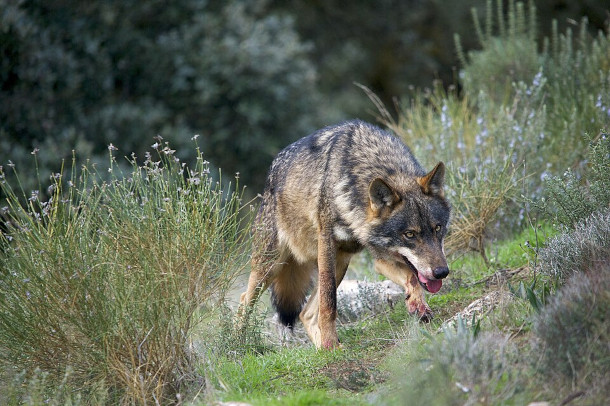
Blacktail tells the story of a grieving wolf who sets out on a quest for revenge, Hawkins says. (Photo: Arturo de Frias Marques, Wikimedia Commons, CC BY-SA 4.0)
HAWKINS: Of course. "Blacktail stood vigil over the body of Renren as he had once done for his mother. For now, there was only grief. Once, when he was younger, he'd torn out one of his foreclaws while climbing a rock. This felt like that. Everything he touched hurt. When he looked at the wall of the garden, he knew Renren would not climb it beside him. The memory of his den on the hill was haunted by the ghost of puppies that would never play there. He knew he would never again sniff the breeze without hoping for her scent. It crossed his mind then to lie down and wait for the end. For too long, some two legs will come along and kill me. They kill everything that matters sooner or later. I doubt I'll even have to wait long. The idea was not entirely without its attractions. He had seen the look of death many times in the eyes of his prey, and he thought that whatever came next would at least be peaceful. The red moon still shone high in his mind, if not quite so bright as before. Blacktail stood. He shook the clotting blood from his fur. He crouched to leap the garden wall one last time, then paused. Then, in the first light of dawn, he walked back to the den of men and laid his own scent on it, saying, "God may forgive them for this, but if so, I will kill Him too." The rising sun brought a gray sky and fat snowflakes that clung to his fur. Winter had begun."
O'NEILL: Thank you. Well, so this book is written from the perspective of animals, often Blacktail, but sometimes other animals he comes across, and now some might originally hear that, and if they aren't hearing the part about the horror, they might think of Watership Down or, from my childhood, the Warrior Cats series. But this is definitely not a children's book. What inspired this premise for Blacktail?

Hawkins loves dogs, and says working at an animal shelter and keeping dogs at home inspired him to write this novel. Above, a photo of Hawkins’ dogs in 2012. (Photo: Courtesy of Scott Hawkins)
HAWKINS: Well, I was always a big fan of Watership Down, so I knew it was possible to do adult fiction that was, you know, animal-centric and have people buy it. Because as much as we want to talk about pure art, there's always a commercial consideration. If you're going to spend two years working on a project, you want at least have the theoretical hope that somewhere at the end there's an audience. So, with that in mind, I've always been a very big dog person. I worked with an animal rescue. In addition to having, I think the peak in house at any one time that were you know quote unquote our dogs was seven, which is a lot of big dogs to have in the house. And then if you count the fosters, I think the most we ever had in house at one time was 16, which is a lot of dogs. You're basically an unlicensed kennel at that point, and so anyway, so I've I've had a lot of dogs, and that's always been part of my day to day life. And so when I thought about writing a new novel, it was kind of natural for an animal story to occur to me, and the fact that at least one other person had done it and was able to find an adult audience for it was something else because I'm not the right person to write a children's book. I'll put it that way.
O'NEILL: And now, how did you get into the mindset of these different animals throughout the writing process?
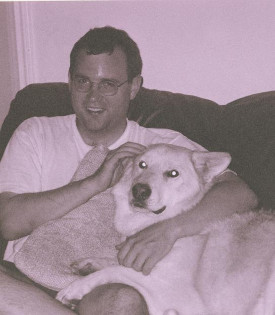
Hawkins says humans aren't meant to see animals as beneath us, but rather as companions we look after and take care of. Above, Hawkins with a half-wolf named Lobo. (Photo: Shannea Maggio)
HAWKINS: Well, that's easy. So, with like I said, we had a lot of dogs in house, and just honestly, just to amuse myself, they all had their own little personalities and voices, and I would have them, you know, like debate between one another about you know whose turn it was to sleep on the bed tonight or whatever. So, they all had their own very distinct little personalities, and we had a lot of turnover in our fosters. So I had to do it every couple of weeks sometimes to come up with a new personality for a new dog who might or might not stick around. And so I was very used to that. And when I sat down to write Blacktail, honestly, it really wasn't particularly difficult. It just came naturally to me.
O'NEILL: Was there any zoological or biological or environmental research that you did during the crafting of this novel?
HAWKINS: Oh, absolutely. Yeah. Once I settled down to write it seriously, I read a lot of natural history books on wolves, and I'm not going to claim to be an expert in this kind of stuff. It's it's very much its own specialty, and there's a lot of people out there, even at the casual level, who know more than I do. But I did make an effort. One of the ones that stuck out for me was Barry Lopez's book. Barry Lopez, he's a naturalist writer, and he's written on a lot of stuff. But Of Wolves and Men, I thought was absolutely phenomenal. Very accessible. And I would recommend it to any reader who's even moderately interested in the topic of wolves because I thought it was just a phenomenal achievement. As are you know I would say every other book by him that I've read. So Barry Lopez for the win.
O'NEILL: Blacktail has a pretty complex religious system within the pages of it, which I understand is similar to your previous book, The Library at Mount Char, talk to me about, in this novel, the Forest God.
HAWKINS: Oh gosh, he's never really explicitly spelled out on purpose. When I approach the Forest God or really any kind of theology, I feel like it's a lot of times it's stronger to not specify in too much detail the attributes and qualities of a particular deity or demigod or whatever, but rather to let the reader fill in the blanks for whatever they think of as godlike or powerful. So the Forest God is kind of deliberately left vague, and as with in Library at Mount Char, one of the characters in there who was very godlike was kind of again deliberately left vague. We didn't really go into a whole lot of detail about what exactly he could and couldn't do. We just know that when they talk about the character, they're like, "Ooh!" You're getting more from their reaction than you are from any explicitly listed out set of attributes." So that's kind of where that came from.
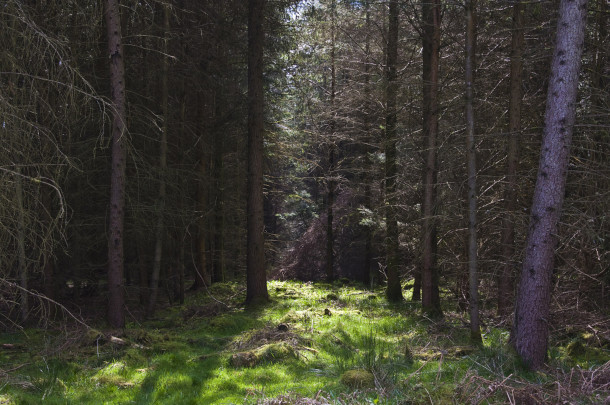
The Forest God, whom Blacktail seeks for advice, is a character whose power Hawkins alludes to but doesn’t explicitly spell out. (Photo: Stuart Wilding, Wikimedia Commons, CC BY-SA 2.0)
O'NEILL: Well, and I found that that also became a quality of Blacktail at a certain point in time that he attained his own mythos in the animal kingdom as his journey progressed.
HAWKINS: Yes, that was absolutely on purpose, and it wasn't a direct copy and paste from the Christian Bible. But some of the storytelling techniques, I guess, if that's something you can say about the Bible, are similar. Like the Gospels are the same story told from what 12 different points of view. And Blacktail towards the end, it's not so much in his head because I mean, there's no way to write what's going on inside Blacktail's head at that point, in his journey, his transformation that wouldn't be disappointing, I think. So as a writer, I wanted to take a step back, and although we're not getting what's going through his head very much in the end, we're getting the reactions of people around him, and so we're trying to build the myth without specifying too much.
O'NEILL: And while this book deals with violence and revenge against humans, we do also touch on the love between animals and humans. And Scott, you were saying you've owned many dogs throughout your life, but the character of Blacktail, from his perspective, pets are slaves. So, how did you approach writing about domesticated animals?
HAWKINS: That was a tricky one. I really wrestled with that for a long time because, as you say, when I was writing this, I think that was actually the period at which I had my 16 dogs in house or whatever, and I'm like, you know, Scott, you're you're kind of indicting yourself here. Reconciling that was non-trivial. And I think you can be well-intentioned about your pets or even your working animals without necessarily doing the best thing for them.
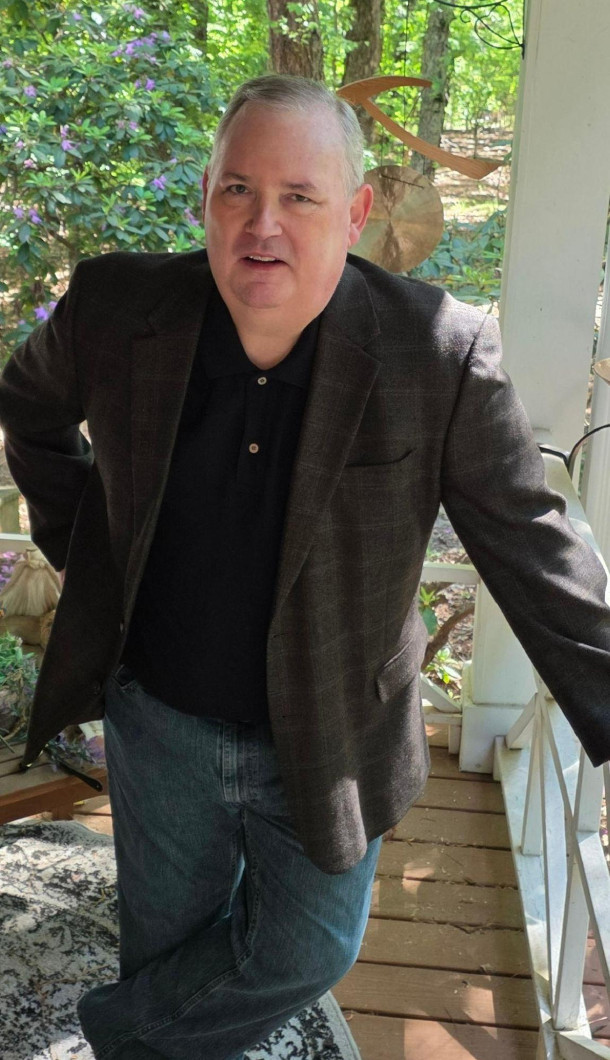
Scott Hawkins is a writer and technologist based outside of Atlanta, Georgia. (Photo: Heather Hawkins)
But I do think good intentions count for something, but it's a tricky subject. I wanted to acknowledge in one particular chapter that there were people out there who did genuinely love and care for their animals and would do anything they could for them. But it's also that sort of person and that sort of relationship is more the exception than the rule, I think. And I count myself in this. Ethically, I ought to be a vegetarian, and I'm not. I'm considering it, but I've been considering it for years now, and I haven't done much on it. So you know that any animal I've eaten over the last week, I'm sure, won't take much comfort from my considering becoming a vegetarian. That's a tricky question, and I don't think any of us measure up to—If we're honest with ourselves–I certainly don't measure up to my own kind of ethical standards or the presumptive ethical standards of the Forest God or even the Christian God. You know, there's a line in the Bible about God gives man dominion over the birds of the air and the beasts of the field, and it's been taken to mean that we can do anything we want to them with no consequences because they're just animals. But I don't think if you read the text, it doesn't really sound like that's where the Bible was headed. It sounds like more, you know, take care of them, like a shepherd taking care of their flock, kind of thing, rather than just factory farming. There's a difference.
O'NEILL: Scott, what do you hope readers take away from this book in terms of how they think about nature and the animal world?
HAWKINS: I would like. I mean, this is awfully pretentious to say that this is my desire. It's a book. It's a story. People are going to move on with their lives, but if they take just a moment to kind of reflect on things that they might do a little bit better in their relationship with the natural world, because it's time. I mean, all you got to do is watch the news. If it's not already too late, it's certainly getting that way. And the problems that we're facing now aren't just going to victimize the cats and the deer who are getting driven out of their homesteads by you know the next data center or the next shopping mall. And it's not just going to be in Malaysia where we're getting flooded. It's coming to everybody, and it's coming sooner rather than later. And to whatever degree this book encourages people to think about what they can do in regards to that set of problems, I would be pleased by it. At the same time, I want it to be an enjoyable story that they kind of walk away with feeling, yeah, that was kind of a rousing good romp. So those are my goals, I guess.
O'NEILL: Scott Hawkins is the author of the nationally best-selling novel Blacktail. Scott, thank you so much for joining us today.
HAWKINS: Thank you for having me.
Related links:
- Visit Scott Hawkins’ website
- Purchase Blacktail and support Living on Earth and independent booksellers
[MUSIC: Where Wolves Dream]
DOERING: Just ahead after the break, Wee beasties and creepy crawlies… And for now, some haunting wolf howls, of course.
[WOLF HOWLS https://www.youtube.com/watch?v=op7fRsvWowA]
DOERING: Keep listening to Living on Earth.
ANNOUNCER: Support for Living on Earth comes from Hansjörg Wyss in honor of Rosamund Stone Zander. Celebrated painter, environmentalist, and author of The Art of Possibility, who inspired others to see the profound interconnectedness of all living things, and to act with courage and creativity on behalf of our planet. Support also comes from Sailors for the Sea and Oceana. Helping boaters race clean, sail green and protect the seas they love. More information at sailorsforthesea.org
[CUTAWAY MUSIC: Dmitriy Sevostyanov, “Island of Spells” Single, 2024 Dmitriy Sevostyanov]
Note on Emerging Science: Spring-Loaded Spider Trap
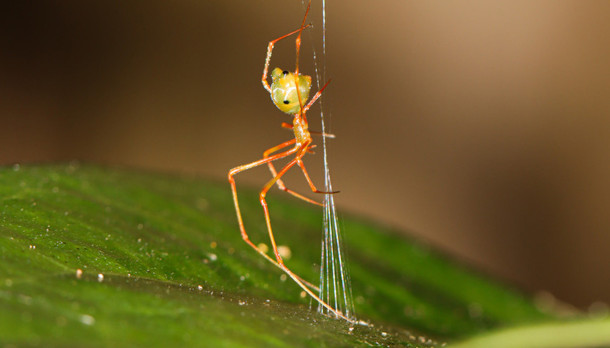
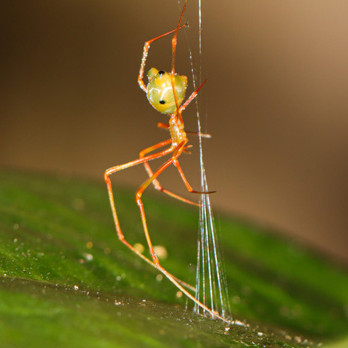
The ballista spider uses a unique hunting technique that catapults their prey onto their web after it chews on the web’s base. (Photo: Ajay Narendra, Pranav Joshi, Daniele Liprandi, Gregory J Anderson, Jonas Wolff, Wikimedia Commons, CC BY-SA 4.0)
DOERING: It’s Living on Earth, I’m Jenni Doering
O’NEILL: And I’m Aynsley O’Neill.
Late summer into early fall is spider season, when you seem to find spiders everywhere, spinning their silk masterpieces or lurking in a dark corner. Living on Earth’s Don Lyman reports on a particularly impressive spider in this week’s note on emerging science.
[SCIENCE NOTE THEME]
LYMAN: Scientists recently reported in the journal Current Biology, that a newly discovered species of spider from the rainforests of North Queensland, Australia, constructs a special type of trap to ensnare its prey. While most spiders spin a standard web, the 0.2 inch long, greenish-yellow ballista spider, constructs a silk spring-loaded cone that catapults foraging tree ants into the spider’s main web. The cones are about a quarter of an inch long, with a diameter of around 0.09 inches at the base. When a tree ant bites the base of the trap, the silk strands release and the cone-shaped structure flings the ant upward toward the waiting spider. Lead study author Ajay Narendra, biology professor at Macquarie University in Sydney, explained it this way, quote: “The snare is perhaps most effective because it releases energy so rapidly that, relative to its size, it produces thousands of times more power than muscle can generate.”
Interestingly, scientists say the green tree ant is the only species of ant that is drawn to the spider trap. These abundant, aggressive ants live in trees, and readily attack other ants and predators. And the ballista spider is the only spider known to hunt just one prey species. Scientists think that the spider’s unique hunting strategy may have evolved to exploit the tree ant’s aggressive behavior. The slingshot silk cone also flings the ant from its foraging area, which, the researchers hypothesized, decreases the chance of the ballista spider being attacked by other ants. But it’s still a mystery as to why the green tree ant, but not other ant species, attack the spider’s silk trap. Scientists speculate that perhaps the spiders somehow apply pheromones to the catapult that incite only green tree ants to attack the silk cone and spring the trap. With this week’s note on emerging science, I’m Don Lyman.
Related link:
Read this study in Current Biology
[SCIENCE NOTE THEME]
Big Bug ‘Down Under’
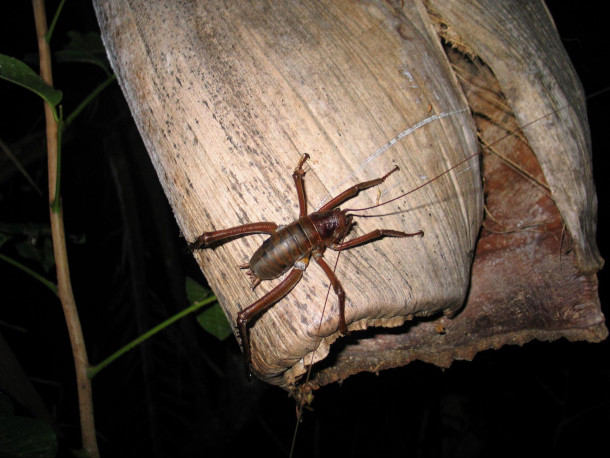
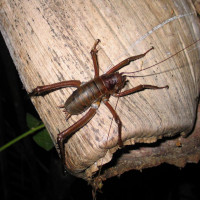
Wētāpunga are flightless, cricket-like insects endemic to New Zealand. (Photo: Courtesy of Chris Green)
DOERING: We’ll stay “down under” to celebrate another unusual arthropod: a giant insect that weighs as much as a mouse! It’s called the Wētāpunga, and it’s the heaviest known insect on the planet. Wētāpunga are found only in New Zealand and were recently endangered, but thanks to an innovative breeding program, they’re making a comeback. Here to talk to us about the effort is Chris Green, an honorary researcher at the New Zealand Department of Conservation who’s been involved with the program for decades. Hi Chris and welcome to Living on Earth!
GREEN: Thank you. Good to talk.
DOERING: So we're talking to you today about the Wētāpunga, the heaviest known insect in the world. For people who haven't gotten a chance to see the Wētāpunga, can you describe it for us?
GREEN: Yes, it's a very large cricket-like insect. It's got very long legs, and the size of it would fit nicely across all of your hand, and the legs would stretch much further than your hand. But the body itself sits, for an adult female, across the size of your hand, so it's a very large insect.
DOERING: I mean, we thought we would cover this story around Halloween because a lot of people might be afraid of these creepy crawlies. I've seen a picture, and those back legs are really spiky. But how dangerous are they to people, if at all?
GREEN: They're very gentle, actually. So it's quite easy to have it walking across your hand, with no thought of it trying to bite you at all. And they can't sting; they don't have a stinger, so it's it's just biting or nothing.
DOERING: Wow! So how did they get to be so big? I mean, they're the heaviest known insect in the world.
GREEN: The history in New Zealand has the development of a lot of giant things. We have the largest flightless parrot in the world, the Kākāpō. There were a lot of flightless birds in our history. The Moa, which is a very large flightless rat-eyed bird, now extinct, but that was the case of New Zealand history, and so it's not unexpected. We would have very large insects as well.
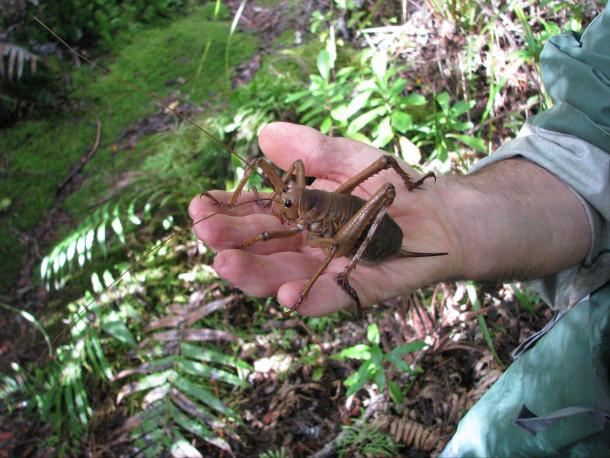
Although wētāpunga may look scary, they are entirely harmless to humans. (Photo: Courtesy of Chris Green)
DOERING: And why is that? It's just a feature of the isolation?
GREEN: Yes, we think so. New Zealand was isolated from Gondwana land very early on in the breakup, so we have a very high rate of endemism in New Zealand. Something like 90% of our species we have here are endemic to New Zealand. They're not found anywhere else, so that's just part and parcel of our makeup, if you like.
DOERING: Just to clarify, we're talking about one particular species of wētā, but there are a lot of different types of wētā in New Zealand. Is that correct?
GREEN: Yes. So we have giant wētā. We have 11 species of giant wētā. Then we have tree wētā. We've got some of those, then cave wētās and ground wētās. Now the name wētā is a Maori name from our indigenous people, but the same sort of species of orthopteron occurs in other southern hemisphere countries. So South America, Australia, and South Africa have got very similar species. They're not called wētā because they don't have the Maori name, but they might be called king crickets or flightless crickets.
DOERING: So I understand that the breeding program that you were a part of actually brought this Wētāpunga back from the brink of extinction. Why were they at risk in the first place?
GREEN: Good question. They were endangered because, although initially when humans arrived in New Zealand, they were spread throughout two regions in the northern half of the North Island. Over a period of time, Europeans introduced mammals, rats, mustelids, cats, etc., and slowly they basically took toll on this wētā species. It doesn't have defense mechanisms against these foreign invaders, and the population started to decline, as well as that there was habitat loss because we were clearing the land for farming. So those two things led to the species ultimately declining down to a population in just one single offshore island, and as a single island population, the Department of Conservation was very concerned that if there was a single disaster on that island, then we would lose the species. So it was on the brink in that extent.
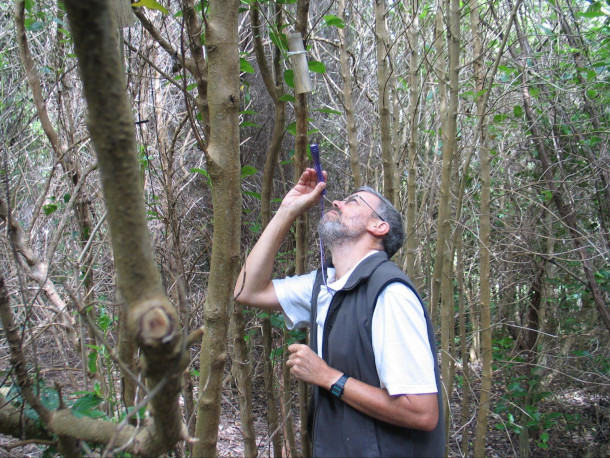
Wētāpunga evolved to be so large in part because New Zealand’s isolation enabled many species to grow very large without much competition. Pictured above is Chris Green, evaluating one of New Zealand’s unique habitats. (Photo: Courtesy of Chris Green)
DOERING: Oh my goodness! So, how did you go about this breeding program, and what makes your program different from other insect conservation programs?
GREEN: So, typically in New Zealand, this has been repeated with a lot of bird species, lizards, etc., where the only surviving members of a species might be on an island, and we need to start new populations. And typically, we take those individuals from the source island and move them directly to a new island that's been predator-free. So it's a question of the numbers: how many can we take to start those new populations? For invertebrates, we need higher numbers because some will die. There'll be natural mortality through predation. So we're aiming for 50 to 100 wētā. But the Wētāpunga, unfortunately, the population was not high enough to be able to sustain removal of that number. So therefore, we went into captive rearing as the method to produce high numbers for seeding into new populations. So from 2008 onwards, small numbers were taken from the island every three four years, and those were used to found the breeding colonies, which produced then 1000s of wētā for release.
DOERING: So, at the end of the day, how many Wētāpunga were you dealing with, and were you able to actually release into the wild?
GREEN: So, over the 15-year program up until last year, from 2010, there were over 11,000 Wētāpunga released. It's a colossal achievement, really. And of those that started, 10 new populations, so eight on predator-free islands, and we've got some predator-free fenced areas on the mainland, which we put them in there as well to see how they go.
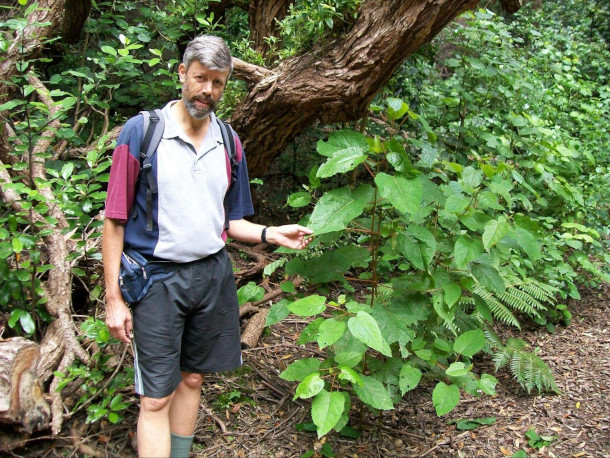
Wētāpunga became endangered when their population was limited to a single island. Worried that a single disaster could wipe the entire species out, Chris Green and his team bred 11,000 wētāpunga for release around New Zealand. Above, Green evaluates a potential new habitat for the insect. (Photo: Courtesy of Chris Green)
DOERING: That's amazing. So it sounds like some of this kind of method, you know, taking a species from one population and being able to found a new population somewhere else, like that's been done with other species. But what do you hope other researchers can learn from your project?
GREEN: Well, the idea really is that invertebrate insects lend themselves to captive rearing programs to increase their numbers, and that allows you to, I think, speed up the process when you've got low numbers to start with. Now, this is why we were doing it. We had a species that was on the brink of extinction. The numbers were not great, and that's often the conundrum that is faced by invertebrate conservationists trying to protect a species from extinction. So to be able to rear up large numbers gives you that certainty of re-establishing new ones. That's the advantage of this program, I think, over a lot of others.
DOERING: That must feel incredible to have been a part of this and to bring this species back.
GREEN: Yes, very satisfying. All the more satisfying because I retired partway through it.
DOERING: So, Chris, insects are often integral to the ecosystems they're in. I mean, even mosquitoes that cause lots of problems for us humans. They feed many birds. So, what ecological niche does the Wētāpunga fill?
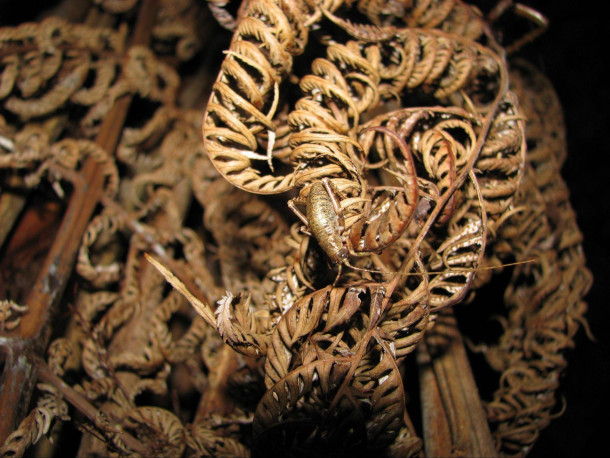
Part of what makes wētāpunga so crucial to local ecosystems is their very long life cycles. Because the insects go through so many stages of growth, they serve as prey for different-sized predators throughout their lives. Above is a 4-month old wētāpunga, which is considered equivalent to a human teenager. (Photo: Courtesy of Chris Green)
GREEN: Yes, that's a good question. It kind of fills two main niches, we think. It's a big insect. It's mostly a herbivore. It eats a lot of tree leaves, and therefore recycles the nutrients of those tree leaves over the period that the wētā is growing up. The nymphal stages, before it becomes adult, last about 15 months or so, so it's well over a year of munching going on here, which produces a lot of droppings, which fertilize the forest. So that's one of the key things: is nutrient recycling. And the other thing is that Wētāpunga produce a lot of offspring. Wētāpunga can lay up to three, four, five hundred eggs during its lifetime. And as they grow up, they are food for all the other species that are predators in the ecosystem. Initially, when they're tiny, beetles and spiders might grab them. Then they grow a bit bigger, and lizards will grab them, and then birds, etc. So as they progress, if you like, they become food for different elements in the ecosystem, and because there were three or 400 to start with, and we only need two of them to reach adult for a self-sustaining population, one male and one female, so all the rest of them, if you like, are available as food. I like to refer to invertebrates as the engine room of the ecosystem, because they're providing all this food and resource for everybody else, if you like.
DOERING: So, Chris, when we talk about conservation, we often focus on what are sometimes called charismatic megafauna. You know, pandas, elephants, tigers. Why should people care about saving a giant bug?
GREEN: Well, you have to think about the other way round. They've got every right to be here, just the way we have. Around the world, you've got agencies that are responsible for trying to maintain diversity in the environment. If there wasn't diversity in the environment, if humans let every other species go extinct, I think we'd have problems. You know, so unwittingly we do admire and we want to have that diversity in the system. That includes bugs. You know.
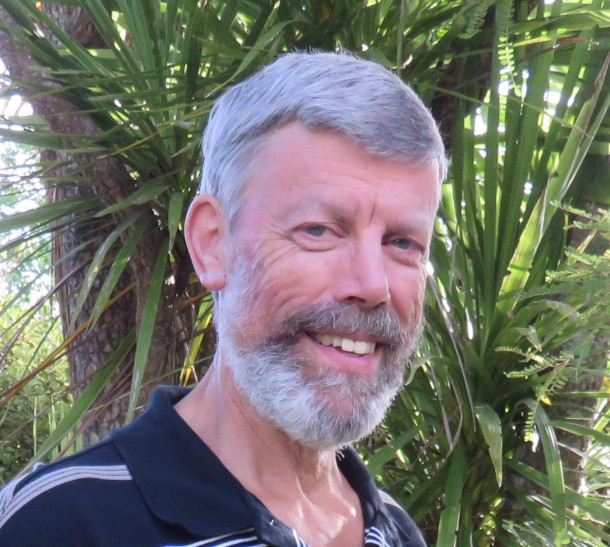
Chris Green is an honorary researcher at the Department of Conservation in New Zealand. (Photo: Courtesy of Chris Green)
DOERING: Right. Some people may not find them so cute, but but I don't know. What about you? Do you think they're cute?
GREEN: Absolutely. I I thought they were cute right from my childhood. So, I've been a budding entomologist right from the start. Yes.
DOERING: Wow. And before you go, what are your hopes for the future of the Wētāpunga?
GREEN: Well, I hope to be able to see it all the time when I go out to visit these islands. We've got that with the first two islands, basically that was put on. You can go out to these islands now, and you're pretty much guaranteed to be able to see a Wētāpunga while you're there, and that is just tremendous. When it became apparent that was happening on one of the islands, Tiritiri Matangi, which is frequently visited by New Zealanders and overseas tourists, that they could see these things even out in the daytime, it just really blew me away. It happened years earlier than I anticipated, but that was because we put high numbers on the island, and hugely satisfying. So I expect more of that to come.
DOERING: Chris Green is an honorary researcher at the Department of Conservation in New Zealand. Thank you so much, Chris.
GREEN: Thank you. It's been great to talk.
Related links:
- Read the original wētāpunga research paper.
- Learn more about New Zealand’s conservation efforts.
[MUSIC: Bug Hunt]
O’NEILL: Living on Earth is produced by the World Media Foundation. Our crew includes Naomi Arenberg, Paloma Beltran, Claire Brandes, Abby Edgecumbe, Swayam Gagneja, Mark Kausch, Mark Seth Lender, Don Lyman, Ashanti Mclean, Nhung Nguyen, Sophia Pandelidis, Andrew Skerritt, Bella Smith, Jake Rego and El Wilson.
DOERING: Tom Tiger engineered our show. Allison Lirish Dean composed our themes. You can hear us anytime at loe.org, Apple Podcasts and YouTube Music, and like us please, on our Facebook page, Living on Earth. Find us on Instagram, Threads and BlueSky @livingonearthradio. And we always welcome your feedback at comments@loe.org. Steve Curwood is our Executive Producer. I’m Jenni Doering
O’NEILL: And I’m Aynsley O’Neill. Thanks for listening and Happy Halloween!
ANNOUNCER: Funding for Living on Earth comes from you, our listeners, and from the University of Massachusetts, Boston, in association with its School for the Environment, developing the next generation of environmental leaders. And from the Grantham Foundation for the protection of the environment, supporting strategic communications and collaboration in solving the world’s most pressing environmental problems.
ANNOUNCER 2: PRX.
Living on Earth wants to hear from you!
Living on Earth
62 Calef Highway, Suite 212
Lee, NH 03861
Telephone: 617-287-4121
E-mail: comments@loe.org
Newsletter [Click here]
Donate to Living on Earth!
Living on Earth is an independent media program and relies entirely on contributions from listeners and institutions supporting public service. Please donate now to preserve an independent environmental voice.
NewsletterLiving on Earth offers a weekly delivery of the show's rundown to your mailbox. Sign up for our newsletter today!
 Sailors For The Sea: Be the change you want to sea.
 The Grantham Foundation for the Protection of the Environment: Committed to protecting and improving the health of the global environment.
 Contribute to Living on Earth and receive, as our gift to you, an archival print of one of Mark Seth Lender's extraordinary wildlife photographs. Follow the link to see Mark's current collection of photographs.
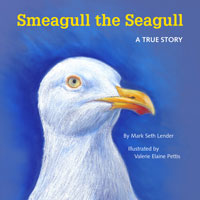 Buy a signed copy of Mark Seth Lender's book Smeagull the Seagull & support Living on Earth
© Copyright World Media Foundation. All Rights Reserved
Home | Contact | RSS | Donate | Newsletter