
Big Bug ‘Down Under’
Air Date: Week of October 30, 2026
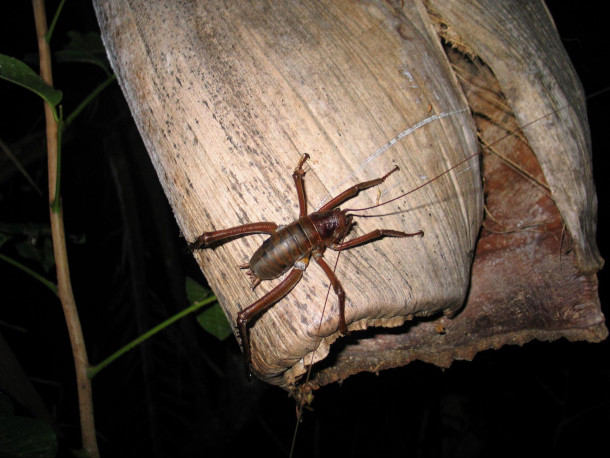
Wētāpunga are flightless, cricket-like insects endemic to New Zealand. (Photo: Courtesy of Chris Green)
The Wētāpunga is the heaviest known insect on the planet, weighing as much as a mouse. They’re found only in New Zealand and were recently endangered, but thanks to an innovative breeding program, they’re making a comeback. Chris Green, an honorary researcher at the New Zealand Department of Conservation, tells Host Jenni Doering about the conservation effort and why he believes these giant cricket-like insects deserve our respect and care.
Transcript
DOERING: We’ll stay “down under” to celebrate another unusual arthropod: a giant insect that weighs as much as a mouse! It’s called the Wētāpunga, and it’s the heaviest known insect on the planet. Wētāpunga are found only in New Zealand and were recently endangered, but thanks to an innovative breeding program, they’re making a comeback. Here to talk to us about the effort is Chris Green, an honorary researcher at the New Zealand Department of Conservation who’s been involved with the program for decades. Hi Chris and welcome to Living on Earth!
GREEN: Thank you. Good to talk.
DOERING: So we're talking to you today about the Wētāpunga, the heaviest known insect in the world. For people who haven't gotten a chance to see the Wētāpunga, can you describe it for us?
GREEN: Yes, it's a very large cricket-like insect. It's got very long legs, and the size of it would fit nicely across all of your hand, and the legs would stretch much further than your hand. But the body itself sits, for an adult female, across the size of your hand, so it's a very large insect.
DOERING: I mean, we thought we would cover this story around Halloween because a lot of people might be afraid of these creepy crawlies. I've seen a picture, and those back legs are really spiky. But how dangerous are they to people, if at all?
GREEN: They're very gentle, actually. So it's quite easy to have it walking across your hand, with no thought of it trying to bite you at all. And they can't sting; they don't have a stinger, so it's it's just biting or nothing.
DOERING: Wow! So how did they get to be so big? I mean, they're the heaviest known insect in the world.
GREEN: The history in New Zealand has the development of a lot of giant things. We have the largest flightless parrot in the world, the Kākāpō. There were a lot of flightless birds in our history. The Moa, which is a very large flightless rat-eyed bird, now extinct, but that was the case of New Zealand history, and so it's not unexpected. We would have very large insects as well.
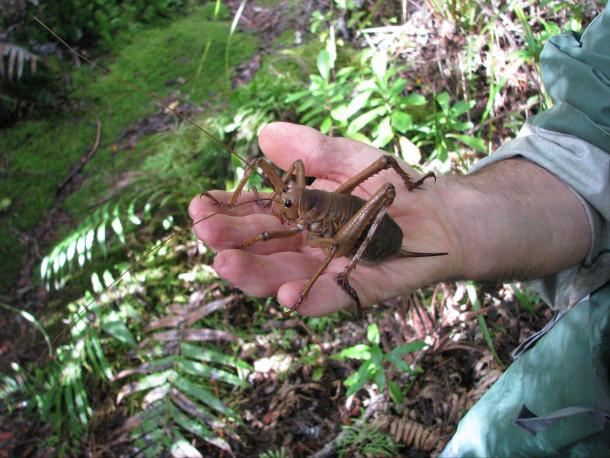
Although wētāpunga may look scary, they are entirely harmless to humans. (Photo: Courtesy of Chris Green)
DOERING: And why is that? It's just a feature of the isolation?
GREEN: Yes, we think so. New Zealand was isolated from Gondwana land very early on in the breakup, so we have a very high rate of endemism in New Zealand. Something like 90% of our species we have here are endemic to New Zealand. They're not found anywhere else, so that's just part and parcel of our makeup, if you like.
DOERING: Just to clarify, we're talking about one particular species of wētā, but there are a lot of different types of wētā in New Zealand. Is that correct?
GREEN: Yes. So we have giant wētā. We have 11 species of giant wētā. Then we have tree wētā. We've got some of those, then cave wētās and ground wētās. Now the name wētā is a Maori name from our indigenous people, but the same sort of species of orthopteron occurs in other southern hemisphere countries. So South America, Australia, and South Africa have got very similar species. They're not called wētā because they don't have the Maori name, but they might be called king crickets or flightless crickets.
DOERING: So I understand that the breeding program that you were a part of actually brought this Wētāpunga back from the brink of extinction. Why were they at risk in the first place?
GREEN: Good question. They were endangered because, although initially when humans arrived in New Zealand, they were spread throughout two regions in the northern half of the North Island. Over a period of time, Europeans introduced mammals, rats, mustelids, cats, etc., and slowly they basically took toll on this wētā species. It doesn't have defense mechanisms against these foreign invaders, and the population started to decline, as well as that there was habitat loss because we were clearing the land for farming. So those two things led to the species ultimately declining down to a population in just one single offshore island, and as a single island population, the Department of Conservation was very concerned that if there was a single disaster on that island, then we would lose the species. So it was on the brink in that extent.
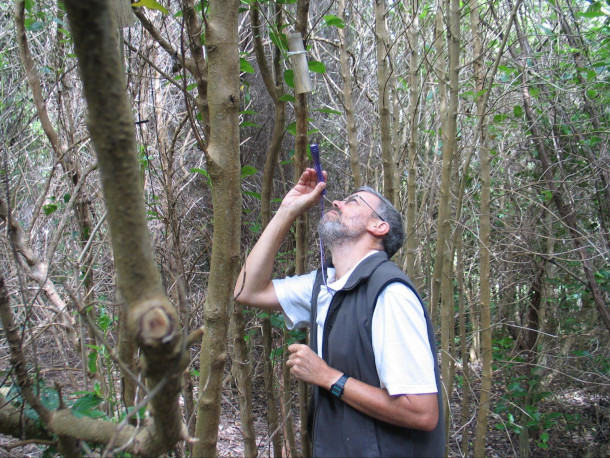
Wētāpunga evolved to be so large in part because New Zealand’s isolation enabled many species to grow very large without much competition. Pictured above is Chris Green, evaluating one of New Zealand’s unique habitats. (Photo: Courtesy of Chris Green)
DOERING: Oh my goodness! So, how did you go about this breeding program, and what makes your program different from other insect conservation programs?
GREEN: So, typically in New Zealand, this has been repeated with a lot of bird species, lizards, etc., where the only surviving members of a species might be on an island, and we need to start new populations. And typically, we take those individuals from the source island and move them directly to a new island that's been predator-free. So it's a question of the numbers: how many can we take to start those new populations? For invertebrates, we need higher numbers because some will die. There'll be natural mortality through predation. So we're aiming for 50 to 100 wētā. But the Wētāpunga, unfortunately, the population was not high enough to be able to sustain removal of that number. So therefore, we went into captive rearing as the method to produce high numbers for seeding into new populations. So from 2008 onwards, small numbers were taken from the island every three four years, and those were used to found the breeding colonies, which produced then 1000s of wētā for release.
DOERING: So, at the end of the day, how many Wētāpunga were you dealing with, and were you able to actually release into the wild?
GREEN: So, over the 15-year program up until last year, from 2010, there were over 11,000 Wētāpunga released. It's a colossal achievement, really. And of those that started, 10 new populations, so eight on predator-free islands, and we've got some predator-free fenced areas on the mainland, which we put them in there as well to see how they go.
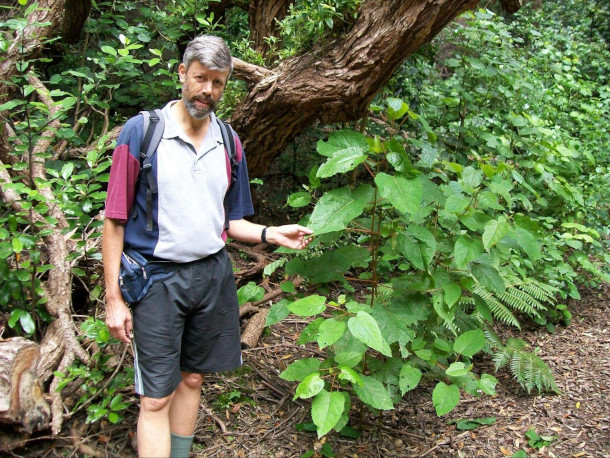
Wētāpunga became endangered when their population was limited to a single island. Worried that a single disaster could wipe the entire species out, Chris Green and his team bred 11,000 wētāpunga for release around New Zealand. Above, Green evaluates a potential new habitat for the insect. (Photo: Courtesy of Chris Green)
DOERING: That's amazing. So it sounds like some of this kind of method, you know, taking a species from one population and being able to found a new population somewhere else, like that's been done with other species. But what do you hope other researchers can learn from your project?
GREEN: Well, the idea really is that invertebrate insects lend themselves to captive rearing programs to increase their numbers, and that allows you to, I think, speed up the process when you've got low numbers to start with. Now, this is why we were doing it. We had a species that was on the brink of extinction. The numbers were not great, and that's often the conundrum that is faced by invertebrate conservationists trying to protect a species from extinction. So to be able to rear up large numbers gives you that certainty of re-establishing new ones. That's the advantage of this program, I think, over a lot of others.
DOERING: That must feel incredible to have been a part of this and to bring this species back.
GREEN: Yes, very satisfying. All the more satisfying because I retired partway through it.
DOERING: So, Chris, insects are often integral to the ecosystems they're in. I mean, even mosquitoes that cause lots of problems for us humans. They feed many birds. So, what ecological niche does the Wētāpunga fill?
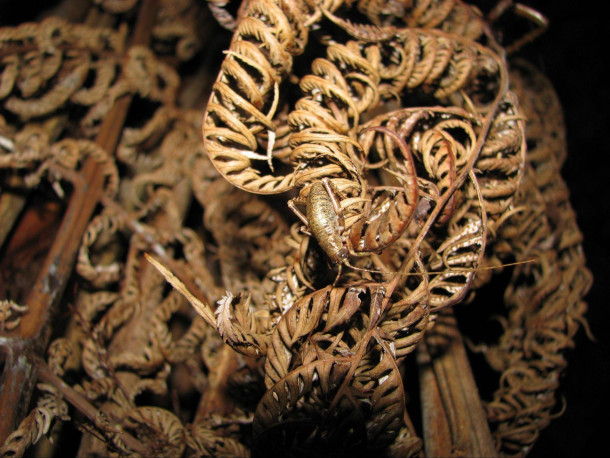
Part of what makes wētāpunga so crucial to local ecosystems is their very long life cycles. Because the insects go through so many stages of growth, they serve as prey for different-sized predators throughout their lives. Above is a 4-month old wētāpunga, which is considered equivalent to a human teenager. (Photo: Courtesy of Chris Green)
GREEN: Yes, that's a good question. It kind of fills two main niches, we think. It's a big insect. It's mostly a herbivore. It eats a lot of tree leaves, and therefore recycles the nutrients of those tree leaves over the period that the wētā is growing up. The nymphal stages, before it becomes adult, last about 15 months or so, so it's well over a year of munching going on here, which produces a lot of droppings, which fertilize the forest. So that's one of the key things: is nutrient recycling. And the other thing is that Wētāpunga produce a lot of offspring. Wētāpunga can lay up to three, four, five hundred eggs during its lifetime. And as they grow up, they are food for all the other species that are predators in the ecosystem. Initially, when they're tiny, beetles and spiders might grab them. Then they grow a bit bigger, and lizards will grab them, and then birds, etc. So as they progress, if you like, they become food for different elements in the ecosystem, and because there were three or 400 to start with, and we only need two of them to reach adult for a self-sustaining population, one male and one female, so all the rest of them, if you like, are available as food. I like to refer to invertebrates as the engine room of the ecosystem, because they're providing all this food and resource for everybody else, if you like.
DOERING: So, Chris, when we talk about conservation, we often focus on what are sometimes called charismatic megafauna. You know, pandas, elephants, tigers. Why should people care about saving a giant bug?
GREEN: Well, you have to think about the other way round. They've got every right to be here, just the way we have. Around the world, you've got agencies that are responsible for trying to maintain diversity in the environment. If there wasn't diversity in the environment, if humans let every other species go extinct, I think we'd have problems. You know, so unwittingly we do admire and we want to have that diversity in the system. That includes bugs. You know.
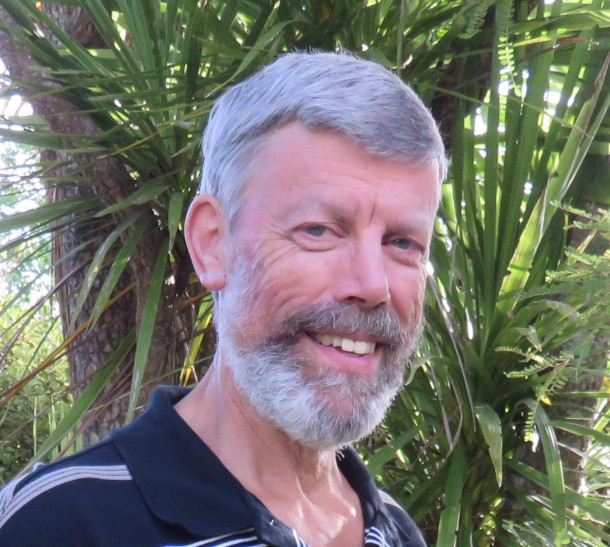
Chris Green is an honorary researcher at the Department of Conservation in New Zealand. (Photo: Courtesy of Chris Green)
DOERING: Right. Some people may not find them so cute, but but I don't know. What about you? Do you think they're cute?
GREEN: Absolutely. I I thought they were cute right from my childhood. So, I've been a budding entomologist right from the start. Yes.
DOERING: Wow. And before you go, what are your hopes for the future of the Wētāpunga?
GREEN: Well, I hope to be able to see it all the time when I go out to visit these islands. We've got that with the first two islands, basically that was put on. You can go out to these islands now, and you're pretty much guaranteed to be able to see a Wētāpunga while you're there, and that is just tremendous. When it became apparent that was happening on one of the islands, Tiritiri Matangi, which is frequently visited by New Zealanders and overseas tourists, that they could see these things even out in the daytime, it just really blew me away. It happened years earlier than I anticipated, but that was because we put high numbers on the island, and hugely satisfying. So I expect more of that to come.
DOERING: Chris Green is an honorary researcher at the Department of Conservation in New Zealand. Thank you so much, Chris.
GREEN: Thank you. It's been great to talk.
Links
Living on Earth wants to hear from you!
Living on Earth
62 Calef Highway, Suite 212
Lee, NH 03861
Telephone: 617-287-4121
E-mail: comments@loe.org
Newsletter [Click here]
Donate to Living on Earth!
Living on Earth is an independent media program and relies entirely on contributions from listeners and institutions supporting public service. Please donate now to preserve an independent environmental voice.
NewsletterLiving on Earth offers a weekly delivery of the show's rundown to your mailbox. Sign up for our newsletter today!
 Sailors For The Sea: Be the change you want to sea.
 The Grantham Foundation for the Protection of the Environment: Committed to protecting and improving the health of the global environment.
 Contribute to Living on Earth and receive, as our gift to you, an archival print of one of Mark Seth Lender's extraordinary wildlife photographs. Follow the link to see Mark's current collection of photographs.
 Buy a signed copy of Mark Seth Lender's book Smeagull the Seagull & support Living on Earth
© Copyright World Media Foundation. All Rights Reserved
Home | Contact | RSS | Donate | Newsletter