

Note on Emerging Science: Spring-Loaded Spider Trap
Air Date: Week of October 30, 2026
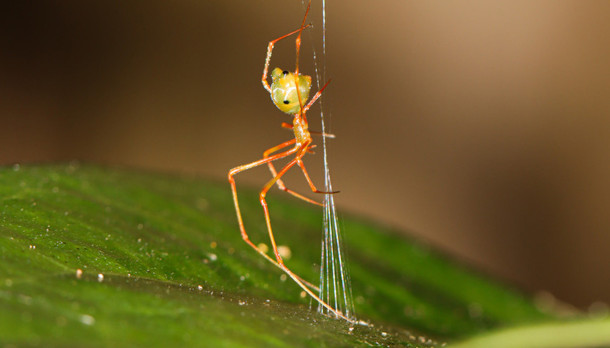
The ballista spider uses a unique hunting technique that catapults their prey onto their web after it chews on the web’s base. (Photo: Ajay Narendra, Pranav Joshi, Daniele Liprandi, Gregory J Anderson, Jonas Wolff, Wikimedia Commons, CC BY-SA 4.0)
Late summer into early fall is spider season, when you seem to find spiders everywhere, spinning their silk masterpieces or lurking in a dark corner. In this week’s note on emerging science, Living on Earth’s Don Lyman reports on a particularly impressive Australian spider that builds a spring-loaded trap to catapult unwitting ants into its web for dinner.
Transcript
DOERING: It’s Living on Earth, I’m Jenni Doering
O’NEILL: And I’m Aynsley O’Neill.
Late summer into early fall is spider season, when you seem to find spiders everywhere, spinning their silk masterpieces or lurking in a dark corner. Living on Earth’s Don Lyman reports on a particularly impressive spider in this week’s note on emerging science.
[SCIENCE NOTE THEME]
LYMAN: Scientists recently reported in the journal Current Biology, that a newly discovered species of spider from the rainforests of North Queensland, Australia, constructs a special type of trap to ensnare its prey. While most spiders spin a standard web, the 0.2 inch long, greenish-yellow ballista spider, constructs a silk spring-loaded cone that catapults foraging tree ants into the spider’s main web. The cones are about a quarter of an inch long, with a diameter of around 0.09 inches at the base. When a tree ant bites the base of the trap, the silk strands release and the cone-shaped structure flings the ant upward toward the waiting spider. Lead study author Ajay Narendra, biology professor at Macquarie University in Sydney, explained it this way, quote: “The snare is perhaps most effective because it releases energy so rapidly that, relative to its size, it produces thousands of times more power than muscle can generate.”
Interestingly, scientists say the green tree ant is the only species of ant that is drawn to the spider trap. These abundant, aggressive ants live in trees, and readily attack other ants and predators. And the ballista spider is the only spider known to hunt just one prey species. Scientists think that the spider’s unique hunting strategy may have evolved to exploit the tree ant’s aggressive behavior. The slingshot silk cone also flings the ant from its foraging area, which, the researchers hypothesized, decreases the chance of the ballista spider being attacked by other ants. But it’s still a mystery as to why the green tree ant, but not other ant species, attack the spider’s silk trap. Scientists speculate that perhaps the spiders somehow apply pheromones to the catapult that incite only green tree ants to attack the silk cone and spring the trap. With this week’s note on emerging science, I’m Don Lyman.
Links
Living on Earth wants to hear from you!
Living on Earth
62 Calef Highway, Suite 212
Lee, NH 03861
Telephone: 617-287-4121
E-mail: comments@loe.org
Newsletter [Click here]
Donate to Living on Earth!
Living on Earth is an independent media program and relies entirely on contributions from listeners and institutions supporting public service. Please donate now to preserve an independent environmental voice.
NewsletterLiving on Earth offers a weekly delivery of the show's rundown to your mailbox. Sign up for our newsletter today!
 Sailors For The Sea: Be the change you want to sea.
 The Grantham Foundation for the Protection of the Environment: Committed to protecting and improving the health of the global environment.
 Contribute to Living on Earth and receive, as our gift to you, an archival print of one of Mark Seth Lender's extraordinary wildlife photographs. Follow the link to see Mark's current collection of photographs.
 Buy a signed copy of Mark Seth Lender's book Smeagull the Seagull & support Living on Earth
© Copyright World Media Foundation. All Rights Reserved
Home | Contact | RSS | Donate | Newsletter