

Wolf Seeks Revenge on Humans in Novel Blacktail
Air Date: Week of October 30, 2026
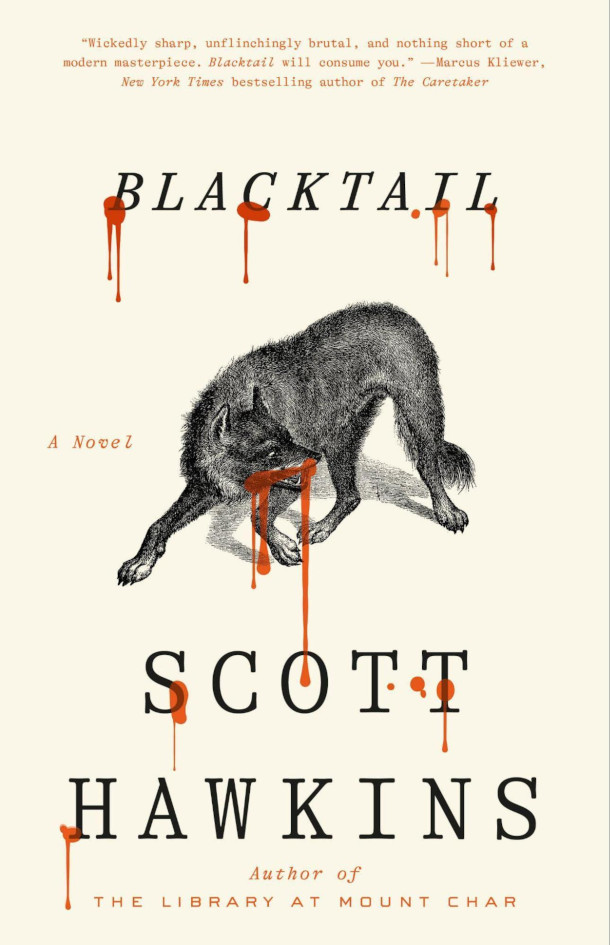
Scott Hawkins’ latest novel, Blacktail. (Photo: Courtesy of Scott Hawkins)
This year, bookstores have a nature-based tale in the “eco-horror” genre to feature: Blacktail by Scott Hawkins. The novel tells the story of one wolf’s quest for vengeance on the humans who have wronged him. And to get his revenge, he’ll have to find and wake the Forest God. Author Scott Hawkins joins Host Aynsley O’Neill in this spoiler-free chat.
Transcript
O’NEILL: Spooky stories are all around us this time of year, whether that be trailers for the latest horror film or haunted houses open for visits. Bookstores, too, are highlighting some of their scariest titles. And this year, they have a nature-based tale in the “eco-horror” genre to feature: Blacktail by Scott Hawkins. The novel tells the story of one wolf’s quest for vengeance on the humans who have wronged him. And to get his revenge, he’ll have to find and wake the Forest God. Author Scott Hawkins joins me now to talk about Blacktail and his Forest God. Scott, welcome to Living on Earth!
HAWKINS: Thank you so much for having me. Pleasure to be here.
O'NEILL: Now, Scott, I know it's no easy task to sum up a 300-page book, but for listeners who haven't yet gotten a chance to even check out the dust jacket, how would you describe Blacktail?
HAWKINS: Blacktail is a fantasy set in the modern world, kind of a quest novel about a wolf who's had some bad luck with human beings, and decides to set out to the south to find his Forest God and see if the Forest God can help him out with the human problem, as he comes to think of it. Wackiness ensues.
O'NEILL: Well, I'm hoping you might share a short section from the book right after that first incident with the human problem, shall we say. So, if you could start with “Blacktail stood vigil over the body of Renren" and read through to the end of that chapter, please.
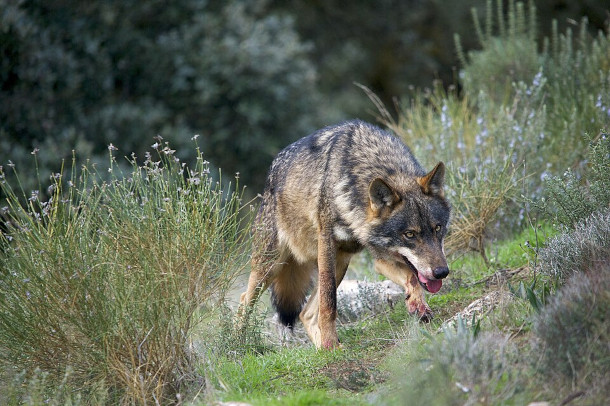
Blacktail tells the story of a grieving wolf who sets out on a quest for revenge, Hawkins says. (Photo: Arturo de Frias Marques, Wikimedia Commons, CC BY-SA 4.0)
HAWKINS: Of course. "Blacktail stood vigil over the body of Renren as he had once done for his mother. For now, there was only grief. Once, when he was younger, he'd torn out one of his foreclaws while climbing a rock. This felt like that. Everything he touched hurt. When he looked at the wall of the garden, he knew Renren would not climb it beside him. The memory of his den on the hill was haunted by the ghost of puppies that would never play there. He knew he would never again sniff the breeze without hoping for her scent. It crossed his mind then to lie down and wait for the end. For too long, some two legs will come along and kill me. They kill everything that matters sooner or later. I doubt I'll even have to wait long. The idea was not entirely without its attractions. He had seen the look of death many times in the eyes of his prey, and he thought that whatever came next would at least be peaceful. The red moon still shone high in his mind, if not quite so bright as before. Blacktail stood. He shook the clotting blood from his fur. He crouched to leap the garden wall one last time, then paused. Then, in the first light of dawn, he walked back to the den of men and laid his own scent on it, saying, "God may forgive them for this, but if so, I will kill Him too." The rising sun brought a gray sky and fat snowflakes that clung to his fur. Winter had begun."
O'NEILL: Thank you. Well, so this book is written from the perspective of animals, often Blacktail, but sometimes other animals he comes across, and now some might originally hear that, and if they aren't hearing the part about the horror, they might think of Watership Down or, from my childhood, the Warrior Cats series. But this is definitely not a children's book. What inspired this premise for Blacktail?
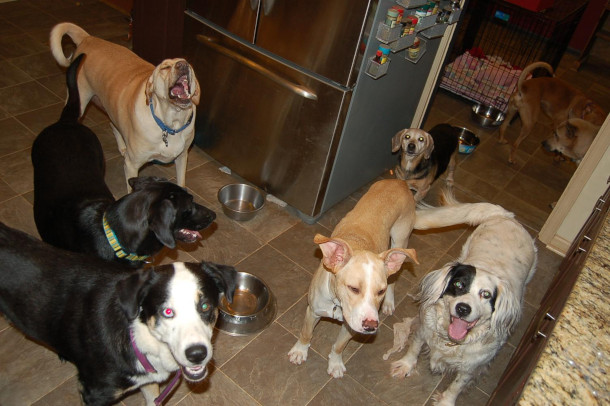
Hawkins loves dogs, and says working at an animal shelter and keeping dogs at home inspired him to write this novel. Above, a photo of Hawkins’ dogs in 2012. (Photo: Courtesy of Scott Hawkins)
HAWKINS: Well, I was always a big fan of Watership Down, so I knew it was possible to do adult fiction that was, you know, animal-centric and have people buy it. Because as much as we want to talk about pure art, there's always a commercial consideration. If you're going to spend two years working on a project, you want at least have the theoretical hope that somewhere at the end there's an audience. So, with that in mind, I've always been a very big dog person. I worked with an animal rescue. In addition to having, I think the peak in house at any one time that were you know quote unquote our dogs was seven, which is a lot of big dogs to have in the house. And then if you count the fosters, I think the most we ever had in house at one time was 16, which is a lot of dogs. You're basically an unlicensed kennel at that point, and so anyway, so I've I've had a lot of dogs, and that's always been part of my day to day life. And so when I thought about writing a new novel, it was kind of natural for an animal story to occur to me, and the fact that at least one other person had done it and was able to find an adult audience for it was something else because I'm not the right person to write a children's book. I'll put it that way.
O'NEILL: And now, how did you get into the mindset of these different animals throughout the writing process?
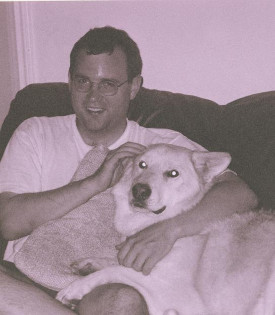
Hawkins says humans aren't meant to see animals as beneath us, but rather as companions we look after and take care of. Above, Hawkins with a half-wolf named Lobo. (Photo: Shannea Maggio)
HAWKINS: Well, that's easy. So, with like I said, we had a lot of dogs in house, and just honestly, just to amuse myself, they all had their own little personalities and voices, and I would have them, you know, like debate between one another about you know whose turn it was to sleep on the bed tonight or whatever. So, they all had their own very distinct little personalities, and we had a lot of turnover in our fosters. So I had to do it every couple of weeks sometimes to come up with a new personality for a new dog who might or might not stick around. And so I was very used to that. And when I sat down to write Blacktail, honestly, it really wasn't particularly difficult. It just came naturally to me.
O'NEILL: Was there any zoological or biological or environmental research that you did during the crafting of this novel?
HAWKINS: Oh, absolutely. Yeah. Once I settled down to write it seriously, I read a lot of natural history books on wolves, and I'm not going to claim to be an expert in this kind of stuff. It's it's very much its own specialty, and there's a lot of people out there, even at the casual level, who know more than I do. But I did make an effort. One of the ones that stuck out for me was Barry Lopez's book. Barry Lopez, he's a naturalist writer, and he's written on a lot of stuff. But Of Wolves and Men, I thought was absolutely phenomenal. Very accessible. And I would recommend it to any reader who's even moderately interested in the topic of wolves because I thought it was just a phenomenal achievement. As are you know I would say every other book by him that I've read. So Barry Lopez for the win.
O'NEILL: Blacktail has a pretty complex religious system within the pages of it, which I understand is similar to your previous book, The Library at Mount Char, talk to me about, in this novel, the Forest God.
HAWKINS: Oh gosh, he's never really explicitly spelled out on purpose. When I approach the Forest God or really any kind of theology, I feel like it's a lot of times it's stronger to not specify in too much detail the attributes and qualities of a particular deity or demigod or whatever, but rather to let the reader fill in the blanks for whatever they think of as godlike or powerful. So the Forest God is kind of deliberately left vague, and as with in Library at Mount Char, one of the characters in there who was very godlike was kind of again deliberately left vague. We didn't really go into a whole lot of detail about what exactly he could and couldn't do. We just know that when they talk about the character, they're like, "Ooh!" You're getting more from their reaction than you are from any explicitly listed out set of attributes." So that's kind of where that came from.
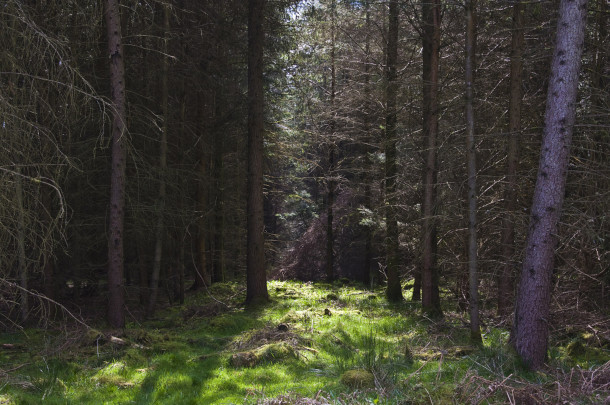
The Forest God, whom Blacktail seeks for advice, is a character whose power Hawkins alludes to but doesn’t explicitly spell out. (Photo: Stuart Wilding, Wikimedia Commons, CC BY-SA 2.0)
O'NEILL: Well, and I found that that also became a quality of Blacktail at a certain point in time that he attained his own mythos in the animal kingdom as his journey progressed.
HAWKINS: Yes, that was absolutely on purpose, and it wasn't a direct copy and paste from the Christian Bible. But some of the storytelling techniques, I guess, if that's something you can say about the Bible, are similar. Like the Gospels are the same story told from what 12 different points of view. And Blacktail towards the end, it's not so much in his head because I mean, there's no way to write what's going on inside Blacktail's head at that point, in his journey, his transformation that wouldn't be disappointing, I think. So as a writer, I wanted to take a step back, and although we're not getting what's going through his head very much in the end, we're getting the reactions of people around him, and so we're trying to build the myth without specifying too much.
O'NEILL: And while this book deals with violence and revenge against humans, we do also touch on the love between animals and humans. And Scott, you were saying you've owned many dogs throughout your life, but the character of Blacktail, from his perspective, pets are slaves. So, how did you approach writing about domesticated animals?
HAWKINS: That was a tricky one. I really wrestled with that for a long time because, as you say, when I was writing this, I think that was actually the period at which I had my 16 dogs in house or whatever, and I'm like, you know, Scott, you're you're kind of indicting yourself here. Reconciling that was non-trivial. And I think you can be well-intentioned about your pets or even your working animals without necessarily doing the best thing for them.
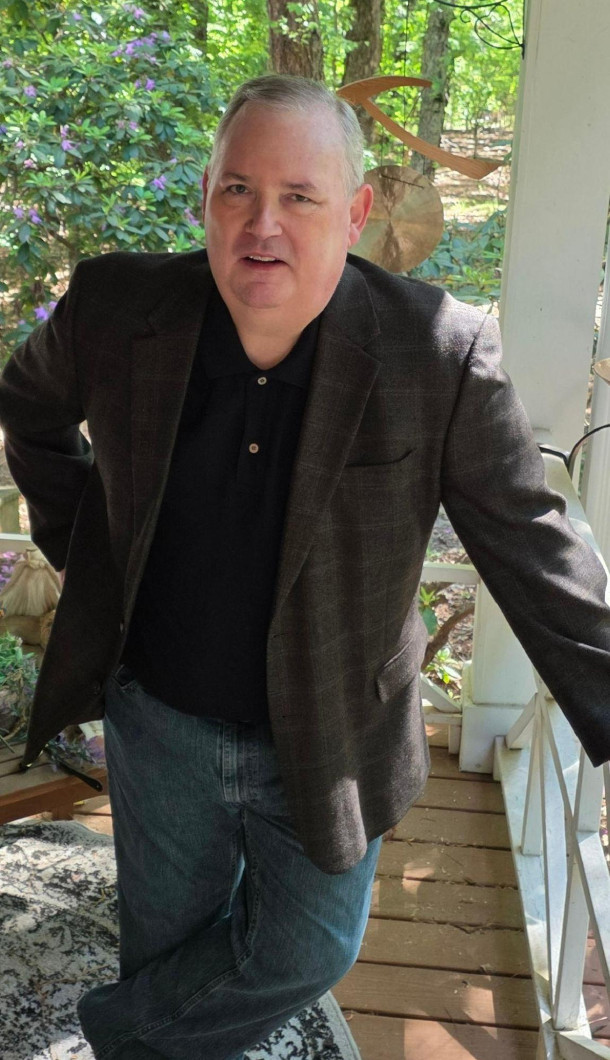
Scott Hawkins is a writer and technologist based outside of Atlanta, Georgia. (Photo: Heather Hawkins)
But I do think good intentions count for something, but it's a tricky subject. I wanted to acknowledge in one particular chapter that there were people out there who did genuinely love and care for their animals and would do anything they could for them. But it's also that sort of person and that sort of relationship is more the exception than the rule, I think. And I count myself in this. Ethically, I ought to be a vegetarian, and I'm not. I'm considering it, but I've been considering it for years now, and I haven't done much on it. So you know that any animal I've eaten over the last week, I'm sure, won't take much comfort from my considering becoming a vegetarian. That's a tricky question, and I don't think any of us measure up to—If we're honest with ourselves–I certainly don't measure up to my own kind of ethical standards or the presumptive ethical standards of the Forest God or even the Christian God. You know, there's a line in the Bible about God gives man dominion over the birds of the air and the beasts of the field, and it's been taken to mean that we can do anything we want to them with no consequences because they're just animals. But I don't think if you read the text, it doesn't really sound like that's where the Bible was headed. It sounds like more, you know, take care of them, like a shepherd taking care of their flock, kind of thing, rather than just factory farming. There's a difference.
O'NEILL: Scott, what do you hope readers take away from this book in terms of how they think about nature and the animal world?
HAWKINS: I would like. I mean, this is awfully pretentious to say that this is my desire. It's a book. It's a story. People are going to move on with their lives, but if they take just a moment to kind of reflect on things that they might do a little bit better in their relationship with the natural world, because it's time. I mean, all you got to do is watch the news. If it's not already too late, it's certainly getting that way. And the problems that we're facing now aren't just going to victimize the cats and the deer who are getting driven out of their homesteads by you know the next data center or the next shopping mall. And it's not just going to be in Malaysia where we're getting flooded. It's coming to everybody, and it's coming sooner rather than later. And to whatever degree this book encourages people to think about what they can do in regards to that set of problems, I would be pleased by it. At the same time, I want it to be an enjoyable story that they kind of walk away with feeling, yeah, that was kind of a rousing good romp. So those are my goals, I guess.
O'NEILL: Scott Hawkins is the author of the nationally best-selling novel Blacktail. Scott, thank you so much for joining us today.
HAWKINS: Thank you for having me.
Links
Purchase Blacktail and support Living on Earth and independent booksellers
Living on Earth wants to hear from you!
Living on Earth
62 Calef Highway, Suite 212
Lee, NH 03861
Telephone: 617-287-4121
E-mail: comments@loe.org
Newsletter [Click here]
Donate to Living on Earth!
Living on Earth is an independent media program and relies entirely on contributions from listeners and institutions supporting public service. Please donate now to preserve an independent environmental voice.
NewsletterLiving on Earth offers a weekly delivery of the show's rundown to your mailbox. Sign up for our newsletter today!
 Sailors For The Sea: Be the change you want to sea.
 The Grantham Foundation for the Protection of the Environment: Committed to protecting and improving the health of the global environment.
 Contribute to Living on Earth and receive, as our gift to you, an archival print of one of Mark Seth Lender's extraordinary wildlife photographs. Follow the link to see Mark's current collection of photographs.
 Buy a signed copy of Mark Seth Lender's book Smeagull the Seagull & support Living on Earth
© Copyright World Media Foundation. All Rights Reserved
Home | Contact | RSS | Donate | Newsletter