

50,000 Dead from Europe’s 2026 Heat
Air Date: Week of October 30, 2026
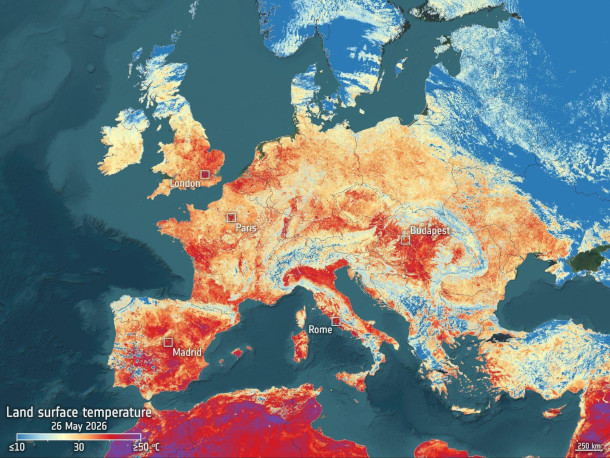
According to new research, heat-related deaths in Europe during the summer of 2026 totaled over 50,000. The above image shows land surface temperature in Europe in May 2026. Contains modified Copernicus Sentinel data 2026. (Photo: European Space Agency, Wikimedia Commons, CC BY-SA 3.0 IGO)
As greenhouse gases from fossil fuels continue to spike our planet’s average temperature, it’s pushing into more dangerous territory for humans. This summer, heat-related deaths in European urban areas scorched by heat waves totaled 50,000, according to a new study which also concludes that human-induced climate change was a significant contributor to the high mortality rate. Shouro Dasgupta, an environmental economist at the Euro-Mediterranean Center on Climate Change, talks with Host Jenni Doering about ways to keep people cool, and why adaptation must be paired with mitigation to slow global warming.
Transcript
O’NEILL: It’s Living on Earth, I’m Aynsley O’Neill
DOERING: And I’m Jenni Doering.
Since the 1990’s, climate disruption has intensified and global heat-related deaths have increased by 23 percent, now killing around 500,000 people a year. And while under resourced regions like Southeast Asia and sub-Saharan Africa struggle to cope with extreme heat, Europe remains the fastest warming continent on the planet. Just this summer, according to a new study published in Nature Health, heat-related deaths in European urban areas totaled 50,000. Researchers looked at more than 800 urban centers across 30 countries, including Italy, France, and the UK, which were among the nations with the highest death tolls. And the study concludes that human-induced climate change was a significant contributor to the high mortality rate. Dr. Shouro Dasgupta is an Environmental economist at the Euro-Mediterranean Center on Climate Change and a Visiting Senior Fellow at the Grantham Research Institute at the London School of Economics, and he’s here now. Welcome to Living on Earth, Shouro!
DASGUPTA: Well, thank you for inviting me. It's great to be here.
DOERING: What was your reaction to the recent study published in Nature Health that found extreme heat killed around 50,000 people in European cities this summer?
DASGUPTA: Very important question to begin with. It's what we expected. It's good to see the robust evidence being published in peer-reviewed journals. We know heat is a silent killer, and the heat wave we experienced in Europe this summer has been extraordinary in the worst possible sense. And at that time, we knew this would have a devastating effect on human health, but seeing the numbers in a top journal is depressing indeed.
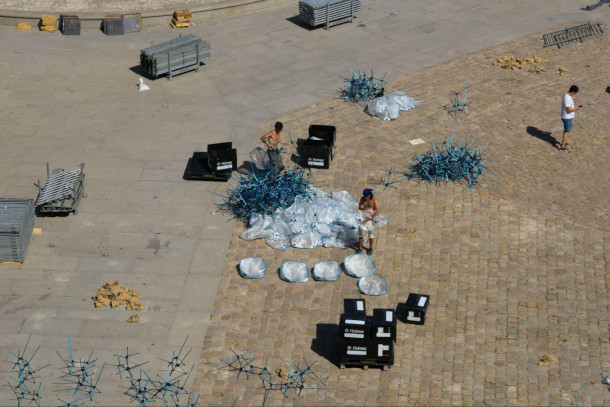
Construction workers assembling chairs during the 2026 European heatwaves, in Paris, France. Outdoor workers are among the most vulnerable populations during extreme heat events. (Photo: Julian Lupyan, Wikimedia Commons, Public Domain)
DOERING: You know, to what extent can we attribute those deaths and the extreme heat events to climate change?
DASGUPTA: Attribution science in the context that looks into climate change-induced extreme events, including heat waves and floods, have developed tremendously in the recent years, right? So we can confidently say climate change has resulted in increasing frequency and the intensity of heat waves, as we have seen in Europe this summer. There are two parts to this. First, researchers attributed the heat waves this summer to climate change, and the results show that climate change significantly contributed to these heat waves occurrences. And the second part is the researchers took into account this attribution and then looked into how these climate change-induced heat waves resulted in this excess mortality during this summer, and more than 60% of these deaths can be attributed to climate change.
DOERING: That's a huge toll. I mean, we're talking 30,000 people that would still be around probably if this hadn't happened.
DASGUPTA: Yeah, absolutely. Climate change induced extreme events, especially heat waves, are without a doubt causing excess mortality.

Parker’s Piece, a park in Cambridge, England, during the June heatwave. (Photo: Mr Addlepated, Wikimedia Commons, CC BY-SA 2.0)
DOERING: And Shoro, beyond mortality, how does heat affect our health? I mean, some people are dying; other people are are getting sick because of it.
DASGUPTA: Climate change-induced heat and, of course, other stressors, has been shown to increase both incidences and spread of infectious diseases such as dengue and chikungunya, leishmaniasis, tick-borne diseases. Climate change has been known, including in Europe, to expand and extend both the temporal and spatial coverage of these infectious diseases. Heat, specifically, of course, in addition affects food insecurity, access to food, but also increases malnutrition and undernutrition, especially among children. It affects how the human body utilizes food, right? And of course, the occupational health, the cardiovascular diseases, kidney-related diseases. So, climate change is the biggest public health failure we have seen. Climate change threatens to reverse many of the health-related gains that have been achieved in the last 50 years or so. I'll give one example from Bangladesh, where I'm from. Bangladesh has been one of the top achievers in reducing child mortality and maternal mortality. Climate change threatens to reverse much of those gains, and this is not just the case of Bangladesh. This is being experienced all over the world.
DOERING: That's staggering. And which populations are most vulnerable when it comes to extreme heat?
DASGUPTA: This would be the very young, the elderly, the marginalized population, low-income groups, outdoor workers are at substantially high risk, especially those working in agriculture, construction, but also in the informal sectors because they do not have sufficient protection, not just in terms of adaptation strategies, but also safety nets to fall back on. These population groups have been shown over and over again to be the most vulnerable when it comes to climate change impacts.
DOERING: I understand that you've actually done quite a lot of research on how to protect those outdoor workers in extreme heat events. What are some of your findings, and what can be done to prevent catastrophic health outcomes?
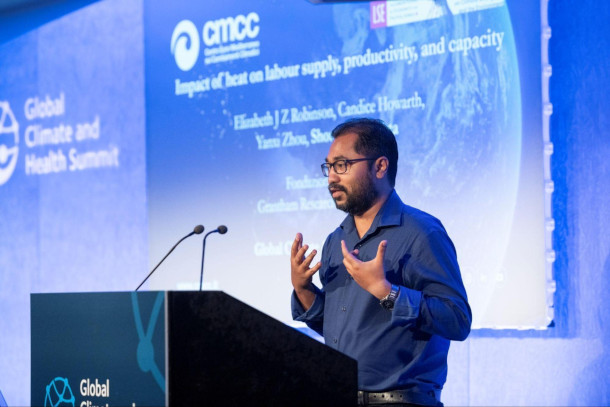
Dr. Shouro Dasgupta is an environmental economist at the Euro-Mediterranean Center on Climate Change and a Visiting Senior Fellow at the Grantham Research Institute at the London School of Economics. (Photo: The Physiological Society (UK))
DASGUPTA: Yeah, so impacts on the labor force is my main area of research and interest, and just talk about some of the research we have done in the UK over the last three years. But to focus on just the heat wave of this summer, our research shows that the June heat wave resulted in 24 million lost working hours and a 1.15 billion pound hit to the economy. So we are calling this climate change's heat tax on the UK economy, and what we found is that this burden falls disproportionately on outdoor workers and those in physically demanding jobs, many of whom are among the lowest paid. Think about agriculture workers, right? So heat is making existing inequality worse within countries and, of course, between them, and of course, a substantial part of our research here deals with protecting workers. What we found is that workers who received advance warning of heat episodes or extreme heat episodes, they're substantially less likely to suffer from negative heat-induced health effects such as excess sweating, cardiovascular diseases, and in worst case scenarios, heat strokes. We found that workers who have access to potable drinking water, they suffer less. Where employers have implemented mandatory rest breaks either on the hour or every two hours on high heat days, these simple adaptation strategies are very effective in protecting workers from high heat.
DOERING: So we've been talking about some adaptations, some things that can be done to protect workers and vulnerable populations. But we can only adapt so fast to a rapidly warming world. So, I mean, what can be done to slow the progression of extreme heat?
DASGUPTA: Mitigate, mitigate, mitigate. All the evidence that we have discussed, we know what works in terms of adaptation. But the rate at which the world is warming right now, and the projections we have on hand, the impact of future climate change on health, labor force outcomes, no matter which one you talk about, no adaptation strategy can protect us from the devastating effects of warming at the rate of warming we're hurtling towards. So the message is going to be yes, we need to adapt, but what we really need is mitigate, mitigate, mitigate.
DOERING: Dr. Shouro Dasgupta is an environmental economist at the Euro-Mediterranean Center on Climate Change and a visiting senior fellow at the Grantham Research Institute of the London School of Economics. Thank you so much, Shouro.
DASGUPTA: Thank you for inviting me. It's great to be on the podcast.
Links
Living on Earth wants to hear from you!
Living on Earth
62 Calef Highway, Suite 212
Lee, NH 03861
Telephone: 617-287-4121
E-mail: comments@loe.org
Newsletter [Click here]
Donate to Living on Earth!
Living on Earth is an independent media program and relies entirely on contributions from listeners and institutions supporting public service. Please donate now to preserve an independent environmental voice.
NewsletterLiving on Earth offers a weekly delivery of the show's rundown to your mailbox. Sign up for our newsletter today!
 Sailors For The Sea: Be the change you want to sea.
 The Grantham Foundation for the Protection of the Environment: Committed to protecting and improving the health of the global environment.
 Contribute to Living on Earth and receive, as our gift to you, an archival print of one of Mark Seth Lender's extraordinary wildlife photographs. Follow the link to see Mark's current collection of photographs.
 Buy a signed copy of Mark Seth Lender's book Smeagull the Seagull & support Living on Earth
© Copyright World Media Foundation. All Rights Reserved
Home | Contact | RSS | Donate | Newsletter