

This Week's Show
Air Date: January 30, 2026
FULL SHOW
SEGMENTS

Hot Prospects for Geothermal Energy
View the page for this story
As geothermal heating and cooling slowly spreads in the U.S., some communities and utilities are looking to grow small pilot projects into much larger networks of pipes and heat pumps that extract and store heat in the earth to warm and cool homes and businesses as needed. Inside Climate News journalist Phil McKenna joins Host Jenni Doering to discuss the bipartisan interest in geothermal and describe a large geothermal HVAC system that demonstrates the possibilities and benefits of scaling up. (09:17)

Punxsutawney Phil and Earlier Springtimes
View the page for this story
While Punxsutawney Phil of Groundhog Day correctly predicts when spring will come only around 40% of the time, he has been predicting earlier springs more often in recent decades, trending with the reality of climate change. (02:20)
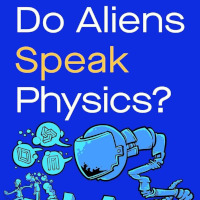
Do Aliens Speak Physics?
View the page for this story
Classic science fiction tends to assume that if aliens visit Earth, they will have done so thanks to using math and science that’s like our own. But physicist Daniel Whiteson and cartoonist Andy Warner aren’t so sure. They speak with Host Steve Curwood about their book Do Aliens Speak Physics? And Other Questions About Science and the Nature of Reality. (21:02)
Global Health Under Trump
View the page for this story
The current Trump administration has in its first year cut off the World Health Organization, dismantled the United States Agency for International Development or USAID, and overhauled vaccination recommendations, just to name a few decisions impacting health. Physician and Harvard public health professor Vanessa Kerry is also WHO Special Envoy for Climate Change and Health. She talks with Host Steve Curwood about the lives that could be lost as the US retreats from global health. (13:11)
Show Credits and Funders
Show Transcript
260130 Transcript
HOSTS: Steve Curwood, Jenni Doering
GUESTS: Vanessa Kerry, Andy Warner, Daniel Whiteson
REPORTER: Phil McKenna
[THEME]
CURWOOD: From PRX – this is Living on Earth.
[THEME]
CURWOOD: I’m Steve Curwood.
DOERING: And I’m Jenni Doering.
The deadly consequences of the US retreat from the global stage.
KERRY: We have poured billions of dollars into ending a historic pandemic of HIV over the years, and we were on the cusp of extraordinary progress, and all of that has been threatened and dismantled, which means the billions we've spent will have been wasted.
CURWOOD: Also, finding common ground in harnessing heat and energy from the earth.
MCKENNA: There’s a lot of crossover and a lot of interest in geothermal among the Republican Party in that there’s a lot of crossover with oil and gas. You’re essentially doing the same drilling; it’s also 24/7, constant energy unlike wind or solar.
CURWOOD: Plus, exploring whether aliens speak physics, and lots of other questions about the nature of reality. That and more, this week on Living on Earth. Stay tuned!
[NEWSBREAK MUSIC: Boards Of Canada “Zoetrope” from “In A Beautiful Place Out In The Country” (Warp Records 2000)]
[THEME]
Hot Prospects for Geothermal Energy

Pictured above is the Epic Systems Cassiopeia 'culinary venue', which is part of a massive 1,670-acre campus with geothermal HVAC systems. (Photo: Mandy Aalderink, Wikimedia Commons, CC BY-SA 4.0)
CURWOOD: From PRX and the Jennifer and Ted Stanley Studios at the University of Massachusetts Boston, this is Living on Earth. I’m Steve Curwood.
DOERING: And I’m Jenni Doering.
As brutal cold has gripped much of the US and increased heating demands, natural gas prices have soared as much as 60%. But the day-to-day cost of geothermal heating is steady as a rock. Geothermal uses pipes and a liquid such as water to tap the Earth's steady temperature of around 55 degrees underground, using heat pumps to extract heat from the rocks for warming and pumping it back underground for cooling. Unlike the political divide over wind and solar renewable energy sources, there is strong bipartisan support for renewable geothermal systems. Proponents include U.S. Secretary of Energy Chris Wright, the former CEO of a company that has invested millions in geothermal energy. Phil Mckenna is a journalist with our media partner Inside Climate News who keeps a close eye on geothermal and he joins me now. Welcome back to Living on Earth, Phil!
MCKENNA: Thanks for having me.
DOERING: So, Phil, in recent months, I know that you've had the opportunity to tour through the Midwest and you visited several different geothermal projects. What did you see? What were some of the highlights there?
MCKENNA: Yeah, so I went to three sites in three days in three different states, Iowa, Wisconsin and Minnesota. One of the reasons I went is, there's a lot of interest here in New England in geothermal and these thermal networks but a big concern I hear from a lot of people is, you know, sounds great, but do these systems really work? So I went to check out a couple that have been in, one for 20 years, one for 15 years, to talk to people there to see how they're working. I went to West Union, Iowa, very small system, town of about 2500 people, small farm town in Northeastern Iowa that uses geothermal to heat and cool about a dozen office buildings in its downtown. And then I went to St. Paul, Minnesota to a mixed-use housing development called “The Heights,” that will use aquifers underground for their heating and cooling. Another one I went to was the corporate campus of Epic Systems, which is one of the largest private tech companies in the country, medical records company that employs about 12,000 people at their campus and across these 400 acres they heat and cool all of their buildings with a very large, likely the largest in the world, geothermal network that they have, I believe, 6000 bore holes in the ground, which is just orders of magnitude larger than anything that like the utility companies are now looking at as they do their initial pilot projects.
DOERING: Yeah, it sounds like a huge project and I know it's not the point of the story, but I loved that you wove in a little bit of detail in your writing about the themes of this campus. Some pretty fun building themes.
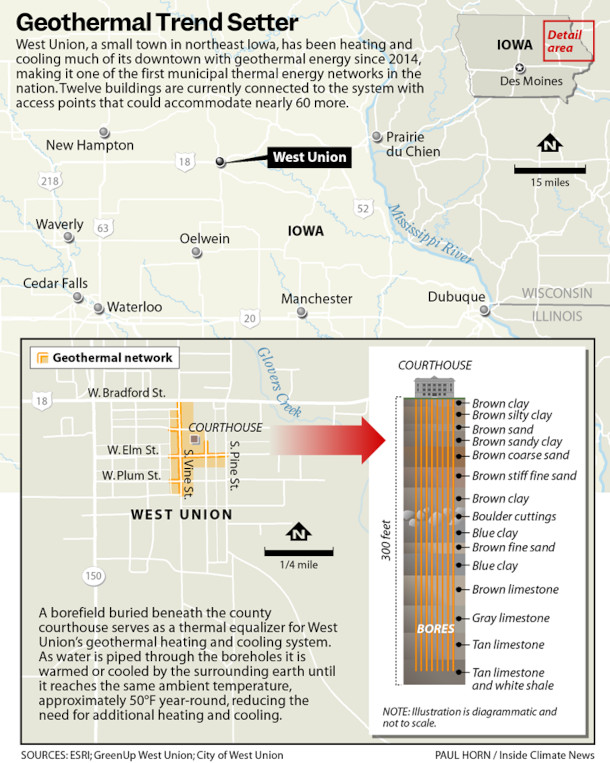
A graphic shows the location of West Union, Iowa, as well as its underground geothermal network and a corresponding diagram of the earth’s makeup under the local courthouse. (Image: Paul Horn, Inside Climate News)
MCKENNA: Yeah, the whole theme of the campus, it's these fantasy theme buildings are sub campuses within a larger campus. So there's Willy Wonka's chocolate factory, there's the Emerald City of Oz, there's Hogwarts Castle, but to me, what was the most interesting is, you know, what's going on underneath all of this. Something that really hadn't gotten a lot of attention, and I don't think most people know about, but they've been doing it since 2006. Their buildings use one quarter the amount of energy for heating and cooling as the average office building. And they trust their system. They've been doing it for a long time, and they know that it's going to work like they expect it to.
DOERING: So I want to ask you more about this plant in Wisconsin at the Epic Systems campus. What actually got this started some 20 years ago?
MCKENNA: They started 20 years ago, I think, really looking at what is the best way to heat and cool our buildings, what is the most efficient system? And there had been prior to that some geothermal heating and cooling ground source heat pumps. So a lot of people have them in their homes, not a lot, but some, and they have for decades, and yeah, just a really efficient way to heat and cool your home. And what they realized early on is that as you scale up, as you build a larger network, you see increases in efficiency, decreases in costs. Part of that's just the usual economy of scale as you build something bigger, you get more efficient at building it, but part of it is as you add different buildings with different heating and cooling loads, the efficiency of the system overall goes up because you're no longer having to generate new heating or new cooling. You're able to just kind of pass off, push from one building to another, or from one room to another, that heat or that cold. So kind of a classic example, if you're doing this in a residential area, you might have homes that in the wintertime are going to need a lot of heating, but if you have an ice rink in that neighborhood as well that's going to need a lot of cooling, and if you can connect to those two in a network, you can push that heating and cooling between the two and get a much larger efficiency.
DOERING: Now, what challenges has this large geothermal project in Wisconsin, at the Epic campus, faced?
MCKENNA: I think it's the same for all geothermal heating and cooling networks in that the upfront cost is significant. The efficiency of the system, you know, about 75% more efficient than conventional heating and cooling, means that you're not going to be spending much on the system once it's operating but there is that hurdle, very significant hurdle, of that upfront cost. And I think that is a challenge now, as communities, as utility companies, look to either pile up these systems or deploy these systems. They know that it's going to work well, they know that's going to be very efficient, but you've still got to come up with the initial money to make the project happen.
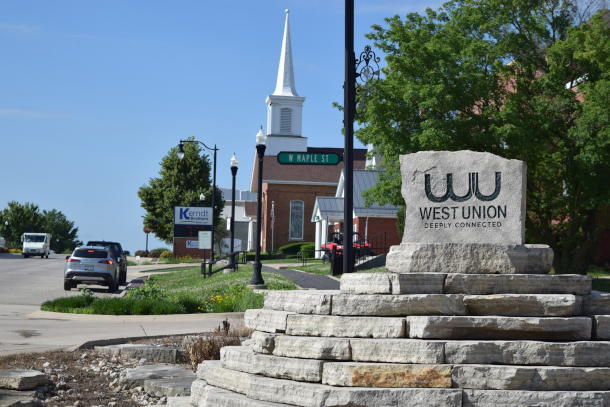
West Union, Iowa, relies on geothermal energy to provide high-efficiency, fossil-free heating and cooling for a dozen buildings in its downtown. (Photo: Phil McKenna, Inside Climate News)
DOERING: So Phil, the 2022 Inflation Reduction Act included incentives for installing geothermal. Where do those benefits stand now with the Trump administration?
MCKENNA: It's interesting, so incentives for wind, solar, for EVs, all got cut or even clawed back, but the incentives for geothermal have remained largely intact. In addition, here in Massachusetts, Framingham, which had the first utility-led geothermal heating and cooling system in Framingham, Massachusetts, in 2024, at the end of the Biden administration, they were given a $9 million grant to build phase two, essentially to double the size of their thermal network, and then at the beginning of the Trump administration that funding was really in question. No one knew if it was going to continue, if they were going to get the money, but late last year, the contracts were finalized and that project will move forward. And not only is there continued support in geothermal, as this project goes forward, it will double in size at half the cost of the initial project.
DOERING: And Phil, why do you think geothermal has escaped some of the opposition that wind and solar have faced from the Trump administration?
MCKENNA: It's very oil and gas adjacent. If you are drilling for oil and gas to transition to drilling for geothermal. It's a lot of the same industry, a lot of the same jobs, a lot of the same equipment you're using. I think there's strong interest in the oil and gas industry to also pursue geothermal energy. And, you know, I mean, it is as there's a lot of talk about energy independence. It is the energy, the heat beneath our feet, that can be tapped here in the US, same as oil and gas.
My latest, for @insideclimatenews.org & @bostonglobe.com;
— Phil McKenna (@mckennapr.bsky.social) December 4, 2025 at 10:26 AM
A first-in-the-nation clean energy project will soon double in size as the Trump administration moves forward with a Biden-era grant for geothermal www.bostonglobe.com/2025/12/03/s...
[image or embed]
DOERING: What are you keeping your eye on when it comes to geothermal in the year ahead?
MCKENNA: I think in the coming year, there's going to be a continuation of these utility pilot projects. Thirteen states in recent years have passed legislation that either requires utilities to do a pilot project or incentivizes them through grants and other funding to make it easier to fund them. So there are now 26 pilot projects led by utilities that are either in some form of development, or in the case of Framingham, have been completed. States that I'm keeping a close eye on are New York State and Colorado, along with Massachusetts, really seem to be leading on this. But even states like Texas have passed legislation, a red state that you wouldn't think would be doing a lot of clean energy development, but again, very similar to oil and gas, a lot of oil and gas drilling in Texas. And I guess I'd add one more thing is having gone to Epic Systems and seeing such a large system, 6000 bores, compared to Framingham at about 90 bores, orders of magnitude larger. To me, it was an interesting place to visit because it seems to me as a model or potential model, of how these systems could really scale up from what we're seeing now by the utilities as these initial pilot projects that are relatively small could be going much larger. Epic’s campus employs about 12,000 people on site, really getting to the town or small city level.

Eversource, a natural gas company, is investing in geothermal to diversify its business model. Shown above is a geothermal construction site in Framingham, MA. (Photo: Provided by Eversource)
DOERING: Phil McKenna is a reporter for our media partner Inside Climate News. Thanks again, Phil.
MCKENNA: Thanks for having me.
Related links:
- InsideClimateNews | “Rare Win for Renewable Energy: Trump Administration Funds Geothermal Network Expansion”
- InsideClimateNews | “Decades After the U.S. Government Conducted Research Beneath This City, a Promising Clean Energy Technology Returns to Its Roots”
- InsideClimateNews | “One of the World’s Largest Geothermal Networks Is Buried Beneath a Corporate Campus in Rural Wisconsin”
- InsideClimateNews | “This Town Was One of the First in the Nation to Install a Geothermal Network. Now Others Are Warming Up to the Idea.”
[MUSIC: Gene Wilder, “Pure Imagination – From “Willy Wonka & The Chocolate Factory” on Willy Wonka & The Chocolate Factory, Geffen Records]
Punxsutawney Phil and Earlier Springtimes
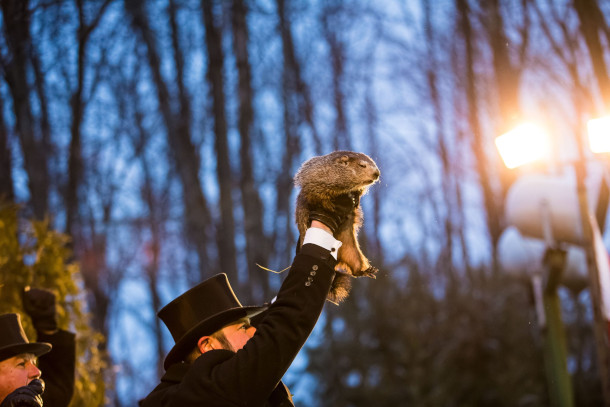
Punxsutawney Phil is perhaps the world’s most famous weather-groundhog. February 2, 2026, marks the 140th celebration of Phil's emergence and prediction based on the presence or absence of his shadow. (Photo: Chris Flook, Wikimedia Commons, CC BY-SA 4.0)
DOERING: Well, now let’s go from Reporter Phil to Punxsutawney Phil, the famous groundhog of Gobbler’s Knob, Pennsylvania with a weather forecast. On February 2nd or Groundhog Day, Punxsutawney Phil emerges from hibernation to either a cloudy day where he doesn’t see his shadow and “predicts” an early spring, or a confrontation with his own shadow that sends him back into his burrow to wait out 6 more weeks of winter. Though it can be exceptionally fun to watch a cute rodent open his eyes for the first time in months, when it comes to accurate predictions for an early spring, Groundhog Day may be an antiquated holiday and hilariously repetitive Bill Murray movie at best. In fact, data from the National Oceanic and Atmospheric Administration shows that Punxsutawney Phil is only accurate about 40% of the time, worse than a coin toss. But the non-profit organization Climate Central finds that in the last 50 years, Punxsutawney Phil has been predicting earlier springs much more often. That's a total of 14 times compared to just 5 times in the nearly 75 years before. And that does trend with reality. A 2020 analysis of hundreds of US cities showed that 93% experienced an early spring in the 6 weeks following the groundhog’s prediction. And that’s not good news for the natural world. Early spring can mean the springtime green-up of buds and bugs happens before migratory birds return to their nesting grounds, so food starts to run short in the breeding season. And early rising temperatures can prompt emerging groundhogs to jump the gun on the mating season, so their little ones might not find enough to eat when they’re weaned. And while an extended growing season might sound like good news for farmers, crops that sprout early in our volatile climate are at higher risk of being killed off by late-season frost. No matter what the groundhog is predicting this year, you can find more data-driven forecasts for when spring should arrive in your city thanks to the National Phenology Network, and we’ll link to that on the Living on Earth website, loe.org. So hopefully you can plan your gardening endeavors and outdoor adventures with a bit more success than Punxsutawney Phil, without a shadow of a doubt!
Related links:
- National Phenology Network: Learn about the “Status of Spring”, 2026.
- Visit The Punxsutawney Groundhog Club website
[MUSIC: Caity Gyorgy, Kyle Pogline, “It Might as Well Be Spring” Single, La Reserve Records, LLC]
CURWOOD: Coming up, if we ever encounter extra-terrestrials perhaps, they can tell us more about the nature of reality, though we may not be able to understand. Stay tuned. That’s next on Living on Earth.
ANNOUNCER: Support for Living on Earth comes from the Waverley Street Foundation, working to cultivate a healing planet with community-led programs for better food, healthy farmlands, and smarter building, energy and businesses.
[CUTAWAY MUSIC: Joshua Redman, “It Might as Well Be Spring” on Timeless Tales [For Changing Times], Warner Records Inc.]
Do Aliens Speak Physics?
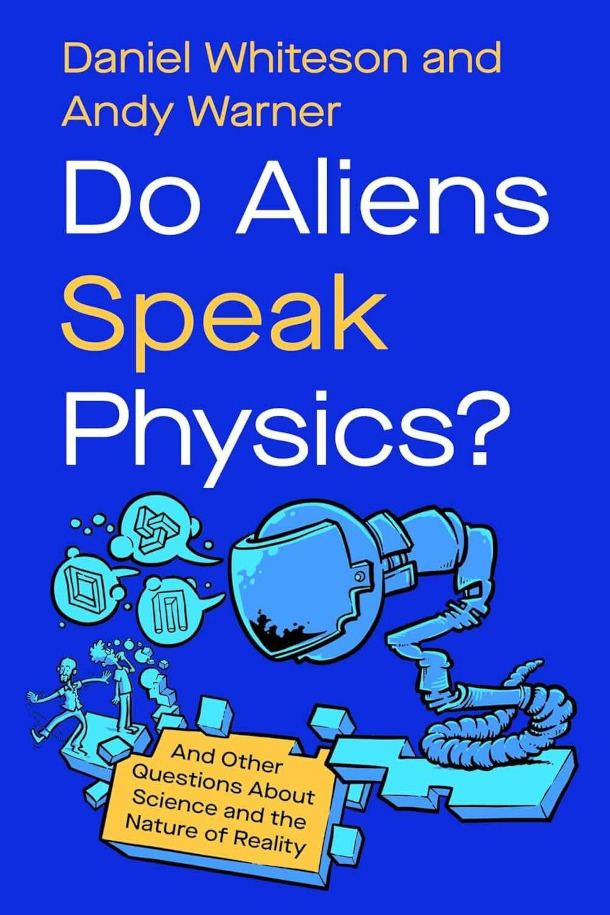
Written by Daniel Whiteson and Andy Warner, “Do Aliens Speak Physics?” questions the universality of physics and science, blending humor and philosophy. (Image: Andy Warner)
DOERING: It’s Living on Earth, I’m Jenni Doering.
CURWOOD: And I’m Steve Curwood.
In a classic science fiction film, A UFO Lands, soldiers and scientists swarm the craft, and after some confusion, a political crisis or two, and a romantic subplot, there comes the “ah hah!” moment when the beings reveal some key secret of the universe that saves or destroys humanity. But physicist Daniel Whiteson and cartoonist Andy Warner doubt such a scenario. They’re the authors of the book Do Aliens Speak Physics? And Other Questions About Science and the Nature of Reality. In their minds, we can't assume our mathematics and chemistry will make sense to visitors from another planet or star system. To ask these questions, Whiteson and Warner took their scientific and historical knowledge and combined it with their love of dad jokes and donuts to write a book about what ETs might teach us about living on Earth. They join us now. Welcome to Living on Earth!
WHITESON: Thank you. It's a pleasure to be here on Earth.
WARNER: Yeah, at least for now.
CURWOOD: Well, it is one of the better planets, isn't it?
WHITESON: It's the coziest planet we have found so far, for sure.
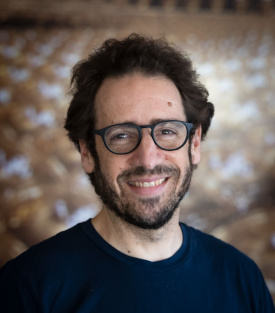
Daniel Whiteson is a professor of Physics and Astronomy at University of California, Irvine. He is interested in using machine learning to understand particle collisions. (Photo: Courtesy of Andy Warner)
CURWOOD: So let's start with you, Daniel, this book asks such a broad range of deep philosophical questions, covering everything from whether math is real to whether science is necessary to develop technology. So what inspired you to write such an expansive book?
WHITESON: Well, the reason that I got into physics, originally, as a young kid interested in many broad questions in science, was its universality. It seemed to me that physics was about more than just questions about life here on Earth, or, you know, geological formations under our feet, that it asked questions that apply to the whole universe. How big is the universe? What is it made out of? How did it begin? These I thought were questions that would be asked on Earth and also asked in around Alpha Centauri and in other galaxies. And I fantasized about one day meeting those aliens and going to an interstellar or intergalactic physics conference and connecting with them about this. And this is a theme you see in science fiction all the time that you meet an alien species, and you use math or physics to connect with them because it's surely something we will have in common with aliens. But, as a professor here at UC Irvine, I often spend some time in the philosophy department, where they welcome random people to come into their seminars. And I was surprised to learn that philosophers are much more skeptical of this notion, this fantasy that physicists have, that the way we describe the universe is the only way to do it, and that aliens must arrive at similar structures and similar mental concepts to tackle these broad questions.
CURWOOD: Big questions, indeed. And hey, I understand that, Daniel, you reached out to Andy to illustrate this book. What drew you to his work?
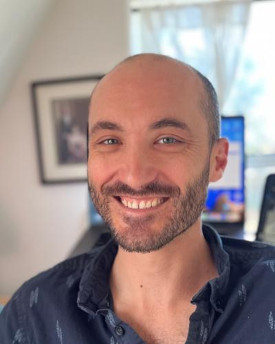
Andy Warner is a writer and cartoonist. His work has been published everywhere from Slate and Popular Science to The Center for Constitutional Rights and UNICEF. (Photo: Courtesy of Andy Warner)
WHITESON: Well, this, as you say, is sort of a weighty topic, but it's also a lot of opportunity for humor. And my strategy when digging into these questions is to balance big ideas, deep concepts with jokes because your brain needs a break sometimes, and I like an interplay between text on the page and visual elements, if it makes for more of a conversational back and forth. And so I was a fan of Andy's work. I've read his nonfiction comics for a long time. And so, I reached out to him and said, "Hey, you want to write a book about aliens?" And I was worried he would think I was a random internet crackpot, but I'm sort of a non-random internet crackpot. So I was very glad that he answered my message.
CURWOOD: So Andy, what was your first reaction when you opened Daniel's email?
WARNER: Well, once I figured out that he was not an internet crackpot, it was yes. I mean, imagine getting approached by a physicist to do a book about aliens. It's a dream. My work delves into all sorts of different ideas, different places, and a lot of it is science. I'm the child of scientists. I grew up on marine biology research stations. And so the idea of taking this really weighty topic, like the philosophy of math, the philosophy of science, and then using aliens, and especially using kind of the way that aliens might have evolved in contrast to us? I mean, I was hooked from the first paragraph. A pitch like that is really hard to say no to. And then emailing back and forth with Daniel, it immediately became apparent that not only did he know his stuff, but he's really funny, easy to work with. We just got off to a roaring start, pretty much from the get-go, I would say.
CURWOOD: By the way, there's a theme in your book: donuts. Talk to me about why you bring the donut machine into this discussion.
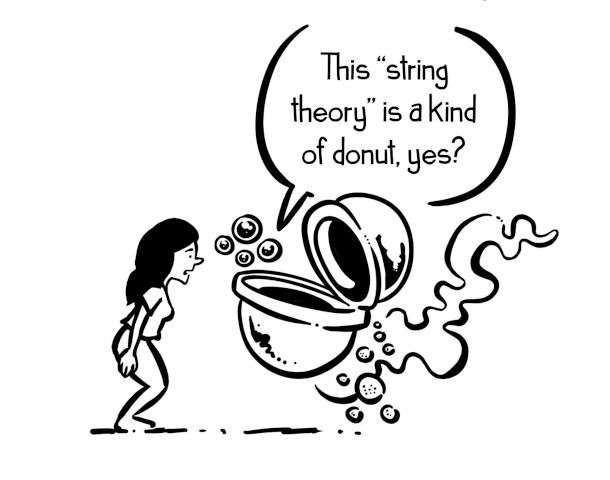
Through humorous cartoons, the writers make difficult physics, science, and philosophy topics accessible. (Image: Andy Warner)
WHITESON: Well, you know, we like to balance deep ideas with silly concepts and jokes. It's actually a lesson I learned in an essay from one of my favorite human writers, Dave Barry, who said that, look, some words are just funny and you should work them into your writing, words like weasel or booger. And so we tried to use the word donut as a theme. And it actually is quite helpful in some cases. For example, we're imagining how one might reverse engineer a donut machine, what's going on inside the machine, as a metaphor for trying to understand the universe. We are experiencing the universe. We are trying to reverse engineer its fundamental workings. And we and aliens might come up with different explanations for what's going on behind the scenes, in the same way that two engineers given a crazy donut machine might come up with two different ways to imagine its internal blueprints.
WARNER: I have a distinct memory of during the editing process going through and replacing various nouns with the word donut.
CURWOOD: Now, you assume that we haven't made contact with aliens yet. What if they're here now, but they don't want to say?
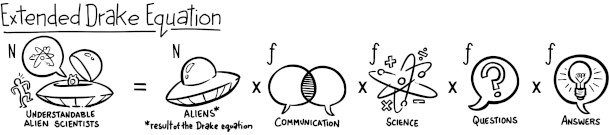
For the writers, thinking about aliens became a way to investigate deeper questions about how humans understand the universe and how science develops. (Image: Andy Warner)
WHITESON: That's certainly possible. And there's lots of creative theories you could have about various aliens that have found us and don't want to communicate with us, or already here or dropped off instructions for building pyramids 1000s of years ago, etc, etc. But, you know, there's no evidence for that, and so it's hard to know how to proceed with a theory like that without any concrete evidence. I imagine instead, the scenario where aliens show up and they want to talk to us. They want to communicate with us. They land in Central Park and they are ready to have a conversation because, otherwise, I don't know how we get started with a conversation with somebody who doesn't want to talk to us.
WARNER: One of the things that initially grabbed me about the book — and I think that kind of answers your question a little bit — is that it's about aliens, but it's also really about these deeper questions, right? The aliens are a way to get at the questions that's like fun and inviting and draws people in because it lets me draw really big boopy monsters in all these different fashions. But the book is really about the way that we are thinking about the universe, thinking about ourselves, the way that science develops, and the aliens is a doorway into those questions. And so, you know, it's sort of a broader question than why would they not talk to us? It's, could they talk to us if they wanted to? It sort of pushes it past that.
CURWOOD: All right, you have many fun questions in this book, and one of your chapters, “Can Aliens Taste Electrons?” explores what senses aliens may or may not have. I mean, how might an alien species sensory experience influence their scientific process, do you think? Assuming they have a scientific process.

Do aliens have the same five senses as humans? Do they share our curiosity traits? Those are some of the questions the book asks about aliens. (Image: Kevin Dooley, Flickr, CC BY 2.0)
WHITESON: Yeah, it's a really fun question. On one hand, you might say, "Look, we have a base sense of ways to interact with the universe, our five senses, but we've augmented those. We have gone beyond the limit of our eyeballs. And we have infrared telescopes. And we can detect dark matter and neutrinos and all things that our ancestors never could have interacted with." So that might lead you to assume that any technologically advanced civilization is going to end up experiencing the full sense of the universe, and we can talk to them about all of these things on a level playing field. But I think that misses something really important, which is that, while we extend our senses technologically, we always end up translating those new experiences back into an intuitive language of our minds. Like, when the James Webb Space Telescope takes a picture in the infrared, they don't show it to you in the infrared. They color shift it into the visible spectrum, so that you can see it. And when we measure gravitational waves, ripples in space time, they translate those into sound waves so you can hear it. And that's because we tend to think in a certain intuitive language that I think is strongly influenced by our biological senses. We are visual. We are auditory. We are sensory in the ways that our biology sort of defines. So I think that aliens, if they start out with a different fundamental set of senses, because their evolutionary situation is different, they could have a different sense for what makes sense to them. Even if they have technology to go beyond their senses, their mental language might be fundamentally incompatible with ours. Some explanation that makes sense to us because it's visual in some clever way that clicks in your mind might make them go, "Huh? That doesn't make sense at all."
CURWOOD: So, Andy, you've written a lot about history of science, and of course, a large part of that history and what indeed guides human science is curiosity. A lot of the discussion in your book around the first contact assumes that the aliens are going to be curious, just the way we humans are. But I'm not sure your book really supports that. Talk to me about it.
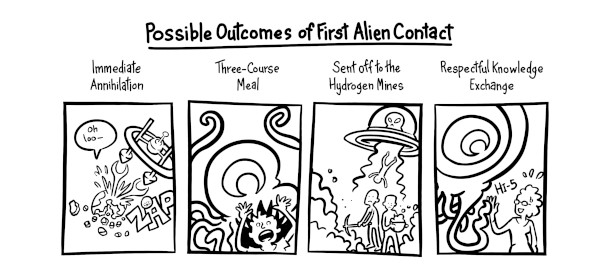
The book hypothesizes over what contact between aliens and humans could be like. In one of those scenarios, extraterrestrials might answer scientific mysteries related to gravity, black holes, and time, for example. (Image: Andy Warner)
WARNER: Yeah. Curiosity is foundational to how we do science. It's really what drives humans to explore different directions. And the idea that science is this path, this singular path that moves in one direction, is false. It's more like a river with tributaries and waterfalls. And the way that human science moves forward just by human fixation on something, like one person becoming really, really into something, and then, frankly, devoting their life to something that might seem trivial to another human is one of the main drivers as a collective unit of what pushes us forward, or pushes our science forward. And a lot of it comes down to our basic human fascinations. What are humans interested in? Even things like our basic anatomy, the fact that we walk around on two legs and so our neck cranes up, that makes us interested in the stars, right? We were putting together constellation theories long before we even realized anything about what they were about. And so, the way that our basic anatomy, the way that our brains work, our hands work, our eyes work, actually governs the way that our science is put together, patchwork by patchwork in this big quilt. And you don't even know what's in between one patch and another. Maybe it's a formless void and you can't stitch it. We don't know that yet, but those patches will be different with any other intelligent species. I mean, they would be different for dolphins and dogs, and we evolved alongside them. I mean, frankly, we evolved dogs for us, right? But like a lot of where science takes us is based around us. It's based around our very humanness. And humans are curious. We don't know if other aliens will be curious, or if they are curious, in what way they will be curious.
CURWOOD: There's one topic you don't really have in your book. But if I had aliens and they were willing to talk to me about things, I might ask, "How does consciousness fit into our understanding of existence, this universe?" What might they say if they're willing to talk to us about it?
WHITESON: Yeah, well, they might start by saying, "Well, what do you mean by consciousness, exactly?" That's the way all philosophical conversations end up, disagreeing about terms. It's a really hard question, and it's a great example of something we have not been able to tackle. We have no scientific explanation for why you are having an experience right now, why you have a rich internal life. There is no explanation for that. And we don't know how, for example, tiny particles, “to-ing and fro-ing,” at the most basic level, somehow work together to emerge, to make our universe and classical physics and our experience of music and all this kind of stuff. We cannot explain that. And some philosophers I talked to said, "You know, that maybe we're just going about it the wrong way. Maybe it doesn't emerge from the microscopic “to-s and fro-s” in some complicated way we haven't figured out yet. Maybe it follows its own rules, right? Maybe there aren't rules only at the most basic level, and then everything bubbles up from that. Maybe every level of the universe, hurricanes and brains and particles, has its own set of rules." That flies in the face of sort of the traditional approach of Western science, reductionist approach, to go from the bottom up, but philosophers are much more willing to consider what you might think are crazy ideas. You know, that's not ruled out. It's certainly possible. It's consistent with everything we see out there in the universe. And so consciousness is a great example of a problem that we have not been able to solve, and it may be that the whole approach that we're taking is not one that's going to lead to an answer.
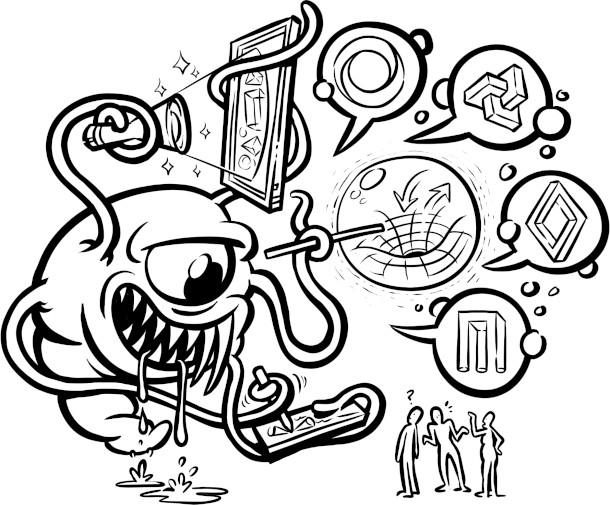
Warner and Whiteson also propose that ETs might help us learn a lot more about what it means to be human and how our curiosity has propelled our discovery of the universe. (Image: Andy Warner)
CURWOOD: So let's say the aliens were here to teach us a bit about things. What might they tell us about things that have us scratching our heads, like time and gravity?
WHITESON: Yeah, great question. One of the possible scenarios for aliens arriving is that they are doing science the way that we are, that there is one path through science. Daniel's original dream comes true, where we get to be like educated by super advanced aliens. And that's so exciting because there are so many big questions that are open in our understanding of the universe. You know, how big is the universe? Is it finite, or is it infinite? What's inside a black hole? Why does time flow forwards? These are questions that, like everybody wants to know the answer to because they're really basic questions about the nature of the universe we live in. It's sort of shocking that we don't understand them. You know, we might, in 1000 years, figure them out, and then look back at this time and think, "Wow, what was it like to be so ignorant, to live in a time when you didn't know the answer to these like, fairly basic things about the nature of your own existence." And so it's exciting that aliens could show up, and they just know these answers that we don't have to struggle for 1000 years, and they could just deliver them to us, and we could leap forward into our scientific future. And I'm not arguing against that. I am all for that, and I want to be on that mission to go talk to the aliens and get up at the chalkboard with them and their tentacles. The book is about tempering our expectations because it could be that what we learn is not just about super advanced science and quantum gravity and all sorts of stuff about the way time works. It could also be something about ourselves, about the human lens through which we've seen the universe, and how that has colored our expectations and our explanations. And that's not supposed to be a downer. That's just another thing we might learn. It might be just as revealing and just as fascinating as learning the secrets of quantum gravity.
CURWOOD: I want to look at this from a slightly different angle. What do you think is the biggest false assumption that people have made when thinking about first contact with aliens?
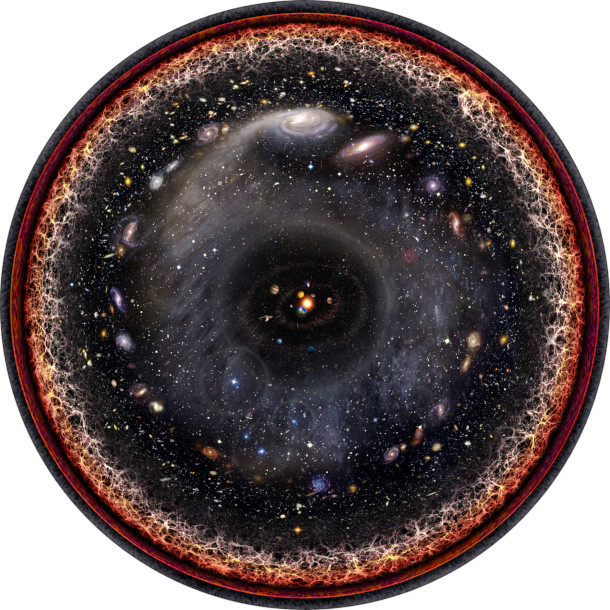
The book challenges readers to take a more expansive approach to science, considering what might happen if we consider the universe from different vantage points. Shown above is a circular representation of the observable universe, shown on a logarithmic scale, with our solar system at the center and enlarged images of various celestial objects. (Photo: Pablo Carlos Budassi, Wikimedia Commons, CC BY-SA 3.0)
WHITESON: I think a major theme in alien contact stories is that we get a message from space, not that aliens have arrived, but that we receive a message from them, and that we sit down and puzzle over it, and crank it through the computers, and we decode it, and we understand what it means. And, if you talk to linguists and philosophers of language, they all think that's probably impossible because every time you get a message, anytime you communicate, you're taking this step where you have your ideas in your mind and you transform them into symbols, which you can then communicate, and then the person at the receiving end transforms those symbols back into ideas. If it's a language we both understand, that works really well. And if I'm thinking in a way that you might be able to understand, but I write in code, you might be able to figure it out. You might be able to crack that code by thinking through the various possibilities. And when you get it right, you can see my original idea, right? It makes sense to you. But if you are talking to an alien intelligence that's thinking things that might be very, very alien, and using some other way to transcribe those ideas into symbols, the chance that you're going to figure out how to reverse that encoding without their help and recognize when you figured it out, seem very, very slim. And even the much simpler task of understanding human languages from ancient civilizations that are long gone, we don't have a great track record there either. I mean, we decoded Egyptian hieroglyphics, but only because we got this amazing cheat sheet, the Rosetta Stone, and it still took 20 years. And we never decoded Etruscan or other human languages. So the chances of getting an alien message and decoding it, I think, are quite amplified in science fiction, which is why in the book, we focused instead on the scenario that the aliens arrive, and they can help us actually build communication by having a context in common, by pointing at donuts or dolphins or apples and learning the symbols for those together.
WARNER: Yeah, just to jump on that, one of the things that Daniel does best is to always turn this around and look at it from a human perspective. And so we have tried to send those messages out into space, right? We've done the opposite, and we have a pretty poor track record of that. Not to dump on Sagan. I love Sagan, but the Golden Record, one of the interesting things is that Pluto's in it, right? So it's a map to our solar system that involves this definition of a planet that we no longer agree on, even after we sent out the Golden Record out. So it's not only is any attempt at communication from a long distance, a difficult code, but it's also a snapshot in time, right? And that may radically change by the time it gets any attempt at decoding it.
CURWOOD: Andy, by the way, you refer to the Golden Record that was put, I think, on the Voyager spacecraft, yes?
WARNER: Yeah, yeah.
CURWOOD: Actually, on both of them, right? And there were all kinds of interesting recordings from Earth at that time. Remind us of what's in it.
WARNER: Sure. They put music on it. There's pictures of your standard male and female human, which just so happened to look very like European clothing models. There's a map to Earth, useful for any future alien invasion. There's a hydrogen atom. There's, what they say is, the brain waves of, that they recorded when they told a woman to think about love. But we can't actually read minds, so we don't know what she was thinking about.
WHITESON: Maybe it was donuts.
WARNER: Maybe it was donuts. It is a real record, and it is really made out of gold, and we did really send it out into space.
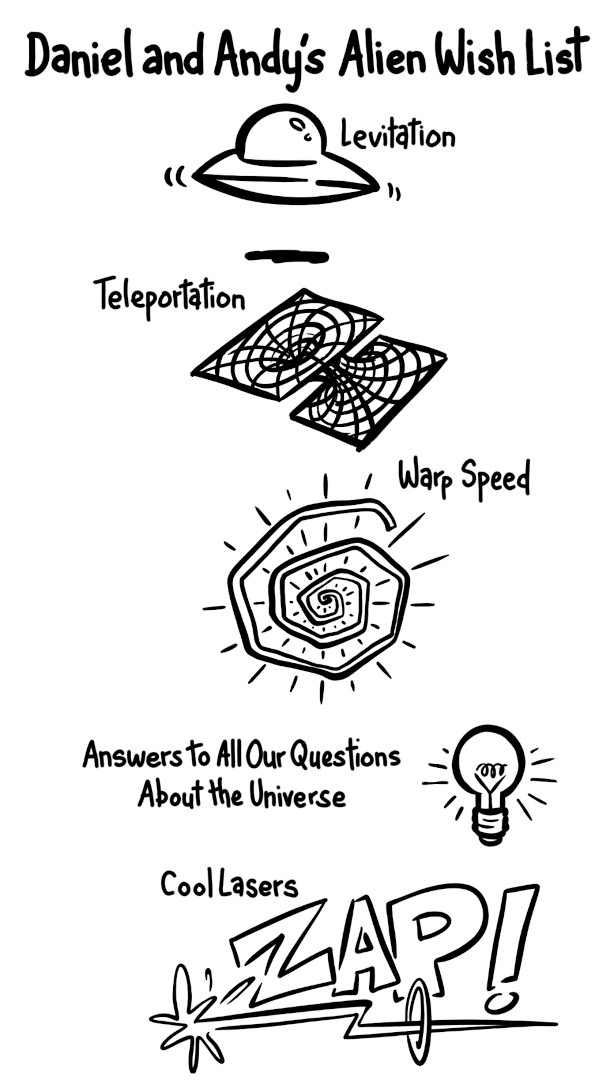
The book features over 300 black and white illustrations. (Image: Andy Warner)
CURWOOD: So let's zoom out. What can we learn about ourselves by thinking about aliens?
WHITESON: I think that by thinking about aliens, we can start to understand the way our culture or our biology, or something about our human nature has affected the way we explain the universe. And even without the aliens coming, I hope that that gives us an opportunity to take a second look at those assumptions and wonder, is there another way to do this? Can we break out of our assumptions and think about other ways to explore the universe that might help us understand things that have remained understandable to us? Science shouldn't just be one thread, and isn't one thread, but it should be broad, and we should consider explanations from all various angles because we don't know which one is going to be successful. So we hope, by writing this book, we help people crack some of those assumptions and think about the universe from lots of different angles, as Andy says, "We should be our own aliens."
CURWOOD: And then Andy, what's the benefit of us thinking differently then? What's the dividend that we reap from going through this process?
WARNER: Well, again, it's curiosity, to come back to that foundational thing that makes human science human, that makes humans human. It inspires greater curiosity. It sparks us to push into new places that two generations ago would not have been dreamed of. There's all these moments in human history where somebody leaves something in a drawer, and it gets exposed to a chemical, or somebody has a conversation, and it sparks a little bit of imagination, and the arc of science as we understand it changes. And it takes a while for that arc to change. There's a lot of arguments and stuff like that, but a lot of this comes from just moments of human curiosity, and that curiosity comes from thinking in different directions than you would expect to, to explore the unexpected. That’s what we hope for.
CURWOOD: Daniel Whiteson and Andy Warner are the authors of Do Aliens Speak Physics? And Other Questions About Science and the Nature of Reality. Thank you both for joining us.
WHITESON: Thank you very much for having us on and for the great questions.
WARNER: Thanks, Steve.
Related links:
- Daniel Whiteson’s website
- Andy Warner’s website
- Purchase a copy of Do Aliens Speak Physics? (Affiliate link supports Living on Earth and local bookstores)
[MUSIC: David Bowie, “Starman” on The Rise and Fall of Ziggy Stardust and the Spiders from Mars (2012 Remaster), Jones/Tintoretto Entertainment Co, LLC]
DOERING: Just ahead, how turning inward as a nation can make us less healthy. Stay tuned to Living on Earth!
ANNOUNCER: Support for Living on Earth comes from the estate of Rosamund Stone Zander - celebrated painter, environmentalist, and author of The Art of Possibility – who inspired others to see the profound interconnectedness of all living things, and to act with courage and creativity on behalf of our planet. Support also comes from Sailors for the Sea and Oceana. Helping boaters race clean, sail green and protect the seas they love. More information @sailorsforthesea.org.
[CUTAWAY MUSIC: Doug Smith, “Rocket Man” on Elton John – Instrumental Hits, Northquest]
Global Health Under Trump
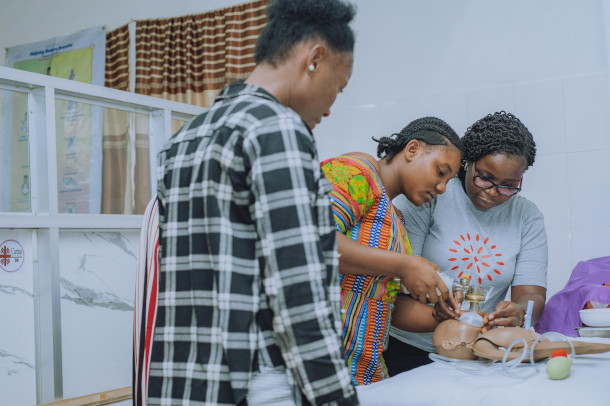
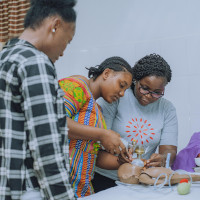
Seed Global Health educator Chisomo Kumwenda (right) demonstrating neonatal resuscitation to midwifery students in the skills lab at School of Midwifery Bo, Sierra Leone. (Photo: Courtesy of Seed Global Health)
DOERING: It’s Living on Earth, I’m Jenni Doering.
CURWOOD: And I’m Steve Curwood.
From its very first days the current Trump administration began to drastically remake how the United States interacts with the rest of the world, especially when it comes to health. The United States Agency for International Development or USAID was quickly dismantled as it fired or laid off aid workers around the globe and abruptly ended lifesaving efforts to fight famine and HIV. And just as the Trump White House has severed ties with global organizations that address the climate emergency and its related health issues, the US has cut off the World Health Organization, a move that critics say could weaken pandemic surveillance efforts. Today, we continue our conversation with Vanessa Kerry, who was on the program last time discussing air pollution and climate change. She is a physician who teaches public health at Harvard and co-founder of Seed Global Health, which works in underserved parts of Africa. She is also WHO Special Envoy for Climate Change and Health. Dr. Kerry, welcome back to Living on Earth!
VANESSA KERRY: Thank you so much. I'm really honored to be here with you.
CURWOOD: Some would say that the global health landscape has changed as a result of the Trump administration's actions.
KERRY: “Some would say?” I think that's an undeniable fact now.
CURWOOD: So I mean, internationally, we're looking at the ending of foreign aid. Let's talk about that for a moment. It's a year after we, we shut down.
KERRY: It's not quite a year. We're at 51 weeks. Who's counting?
CURWOOD: So, what's your assessment after this approximately a year?
KERRY: No, sorry, I'm teasing, because it's been a long year in the global health sphere, and you're 100 percent right. It's been a year that has been extraordinarily tumultuous, profoundly damaging, but is not without hope or opportunity. Almost a year ago, the U.S. administration decided to pull out from the WHO and essentially cut off U.S. funding for global health, and that meant that almost half of the external health aid to countries in the Global South and elsewhere that relied on that aid disappeared, and it was followed by other countries that subsequently cut their aid as well. So it created a bit of a cascade effect. Number one, what it does is it is killing people. There are an estimated 14 million people that are going to die directly from these results. We know that it is going to disrupt and dismantle health system delivery, because the U.S. did provide a certain series of services that were critically important.
CURWOOD: Excuse me for just, did I hear you say 14 million people are dying from cutting what USAID used to do in terms of helping health around the world? I just want to be sure that my ears are working.

Boxes of the personal items of USAID employees in February 2025, soon after the Trump administration began dismantling the organization. A study published in The Lancet estimates that over 14 million people are projected to die by 2030 because of the end of USAID. (Photo: Ted Eytan, Flickr, CC BY-SA 2.0)
KERRY: Yeah, the estimation of the trackers and the models were that 14.5 million people would die from this. And we have heard that in our partner countries, where Seed Global Health works, is that there has definitely been a lack of services in places where people are coming in and more extremists, people are dying, that there were services completely cut off. We know that rates of HIV are going to go back up, which also means that beyond just the devastation of delivery systems, you're also seeing progress lost. We have poured billions of dollars into ending a historic pandemic of HIV over the years, and we were on the cusp of extraordinary progress, and all of that has been threatened and dismantled, which means the billions we've spent will have been wasted, and while we have had to learn a lot of lessons along the way, it is counterintuitive to cut things off at the knees in the way they are, the way this has been done has been profoundly destructive and in lives, in systems and very disheartening. We're very privileged that the Ministries of Health and ministries of health and ministries of finance and heads of state in the countries where Seed works, which are in Sub-Saharan Africa, are very committed, actually, to thinking through, how do we take the limited resources we have and build strong, resilient health systems that can stand up for pandemic preparedness, that can manage climate resilience, that can still deliver babies? And we've actually seen through our own work, that with smart investment that meets the requests and the needs of the countries and goes behind country priorities, you actually can be transformative to lives saved. So in Sierra Leone, year and a half of education and training of health workers and really working with the government to advocate for blood in the blood bank, over 60 percent drop in mortality in the districts where we work. In Malawi, where we have helped support the government's goal for midwifery-led maternal ward, zero deaths, zero maternal deaths in over two years. So these are possible with smart investments, but these are the same health workers that can pivot and manage cholera if there's a cholera outbreak, or who are managing hypertension and strokes and they're on the front line of triage and emergency services. There are smart investments that we can do that are actually leapfrog the ability to close some of these healthcare gaps.
CURWOOD: I'll take you back for a moment to what happened with USAID and the health impacts of that. What relationship, if any, does the decision to shut down the services that were being offered through USAID for health resonate with what happened in this country a century ago with the eugenics movement? Some say that that movement opposed widespread public health support to accelerate the demise of people, people of color, that weren't wanted, that there's a strong racial component to all of this.
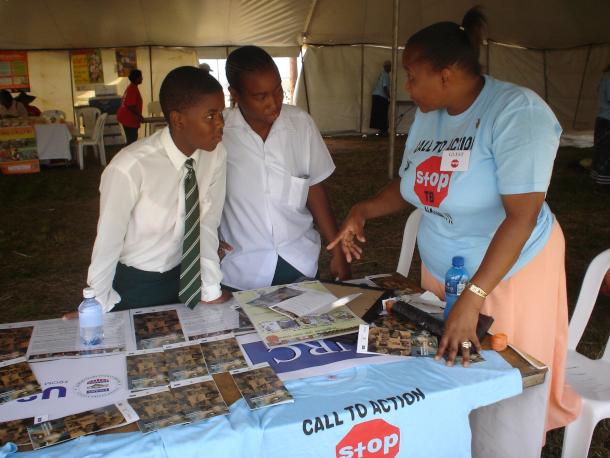
A USAID workshop on HIV/AIDS and tuberculosis takes place in South Africa, 2006. Our guest, Dr. Vanessa Kerry, says HIV rates will increase as aid from organizations like USAID is cut off, slashing decades of progress. (Photo: USAID U.S. Agency for International Development, Wikimedia Commons, public domain)
KERRY: I think overall, we're living in a time in a world where unfortunately, the legacy of colonialism and racism remains far too entrenched and far too present, and it's been very painful to me to talk with some of my friends of color, either, you know, who are totally American born and or those that are from other parts of this world to and to hear what they're experiencing and living right now. We're seeing old patterns repeated, without question. I just taught this year at Harvard, and my first lecture is about the fact that we're reliving old patterns every day in different ways, and so it is complicated. I think we are at a moment, though, again, where we can really reshape our values. I am a big believer in data and bringing the data forward to help debunk some of the old legacies that preserve people's power and to help us find a path forward that moves us to a better place.
CURWOOD: I want to drill down on a bit of the portfolio that you've encountered at the World Health Organization, and that is, what's the threat to global surveillance as a result of the USA to work with WHO, I mean, what are some of the infectious diseases being monitored? And just to be clear, why should Americans care?

Dr. Kerry warns that increasing vaccine skepticism around the world poses a serious threat to global health. (Photo: Focal Foto, Flickr, CC BY-NC 2.0)
KERRY: So I think people really, the World Health Organization has taken a heavy hit from some of the negative PR that has been put up against it, and I think people see it as very bureaucratic. And what does it do? The World Health Organization plays a powerful role in creating norms, providing profound technical assistance, and really helping to provide some of the diplomatic negotiation we need to keep our world safe. And I think when you look at the history of pandemics in the past around SARS or the bird flu and other things, there is a really powerful role the WHO has played to help cross diplomatic barriers. So if you could imagine, there was an outbreak of something in Iran, and we're dealing with also part of that outbreak in the US. There's no real formal diplomatic relations between the two countries to negotiate information sharing, what is the genetics of the virus? And I think the WHO can broker that, and they have in the past. Investing in strong health systems, investing in the WHO in this technical capacity, investing in public health is critical, because it is our surveillance and our prevention against pandemic preparedness. And I'm sorry, malaria doesn't just stop at the border between Rwanda and Burundi, right? I mean, I think these things transcend borders. This is what we seem to misunderstand, is that these things, diseases, are transnational in this day and age of globalization. We saw that in COVID. If you look at the maps of the spread of COVID over the course of a week, throughout the beginning days of the pandemic, it moved really fast and really globally, very quickly, and it disrupted everything.
CURWOOD: Recently, the Trump administration instituted some new vaccine rules. And you know, as somebody who worked in an ICU with patients during the pandemic, that said, I wish I'd taken the vaccine. We're seeing measles outbreak in South Carolina. What are the implications for public health in the U.S.? How worried should we be? What's the way forward globally, given this growth of vaccine skepticism now? What's the risk for contagion? Meaning the skepticism spreading as well?
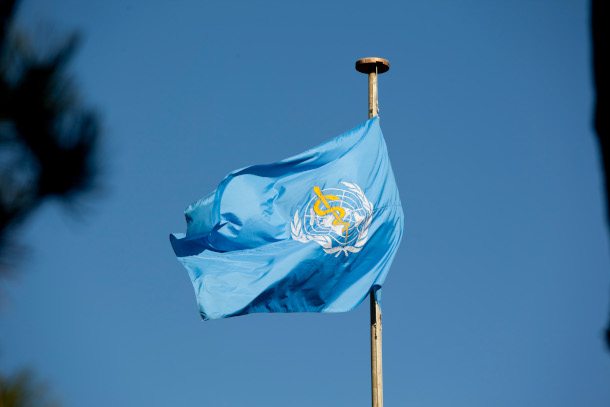
The United States withdrew from the World Health Organization (WHO) in January of 2025. Dr. Kerry says WHO plays a critical diplomatic role in promoting public health across borders. (Photo: United States Mission Geneva, Wikimedia Commons, CC BY 2.0)
KERRY: The contagion of skepticism is very real. So it's interesting, right? We've learned this, whether it's in politics or in vaccines, that when you create confusion around something, you sow distrust. So you don't even have to necessarily give the wrong information. You can just create confusion or lack of clarity about what needs to be done. And we're seeing that consistently across public health measures. It's profoundly dangerous. Vaccines work, and there has been lots of science that has demonstrated the efficacy of vaccines, and further, the primary studies that have been used to argue that vaccines are not safe have been debunked and actually removed and retracted from the literature. So to cite them, still, it's dishonest candidly, and it's sort of peddling false information. I take a fairly hard stance on this, because, for me, because vaccines are so unequivocally lifesaving, that if you are providing information that is dishonest about them, I think people have the right to, you know, people can make a choice, because that is a tenant of our country, but to be, make a choice, at least with the correct information and the honest information. And so if you're giving misinformation that, to me, is really tantamount to causing harm, and we are seeing that sort of spread like wildfire around the country. The new vaccine recommendations that have come out of the CDC are terrifying, because what they're going to do is they're going to cause a huge amount of pain and suffering for families, a huge amount of pain and suffering for children who don't have the right to make the choices for their own protection and well-being. Measles kills, flu kills, COVID kills. We see this. We just had a flu death in Massachusetts recently of a young child. So we are going to see people die. It's incredibly dangerous, and vaccines work through herd immunity, which means that you get enough people immune to the disease, you actually extinguish the presence of the disease. The second that erodes, you can have the disease present and it can pass. Disease like measles is so contagious that you could be in a waiting room for a few minutes with measles. You can leave, and you can be long gone for an hour, and somebody else comes in the waiting room, and they will contract the measles that you had. That is very dangerous, and it puts a lot of people who have any kind of disability or immune compromise or something at risk. It puts young children at risk. So the vaccine policy, to me, is dereliction of duty. It is irresponsible, and it is putting people in harm, and I think that you'll see a judgment on that in the future. And I'm very grateful for those like the American Pediatric Association and others who are coming forward to try to uphold the correct vaccinations and get that information out there.
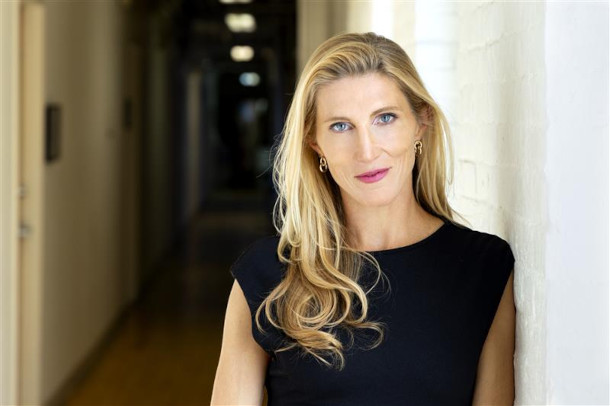
Dr. Vanessa Kerry is the CEO and founder of the nonprofit Seed Global Health. She currently serves as WHO Special Envoy for Climate and Health and a Director of Global Health and Climate Policy at Harvard T.H. Chan School of Public Health. (Photo: Courtesy of Seed Global Health)
CURWOOD: So in these challenging times, with these huge challenges coming at us, what gives you hope?
KERRY: What gives me hope is there's a lot of really amazing people out there who are unafraid of this moment and thinking very much about, how do we break through and what needs to happen in a way that we can actually help make sense, communicate better, protect lives. I see great hope in the fact that health is starting to take a more central conversation in economics and politics and security conversation is being better understood for the profound foundation it provides and its deep link to these other sectors in a way that we will hopefully start to promote health better. I am an optimist, and I think there is really, really powerful paths forward here, and I think that it is incumbent on all of us to be engaged in meaningful debate, not argument, to be, step outside of our traditional communities and silos, and listen to somebody who has a very different opinion, and understand what motivates them, understand what drives them, and then find that shared common experience. So I think we can do it, but I do think it's going to take all of us to be engaged and to be global citizens in this moment.
CURWOOD: Vanessa Kerry is a critical care trained physician and Director of Global Health and Climate Policy at the Department of Environmental Health at the Harvard T.H. Chan School of Public Health, and co-founder and CEO of Seed Global Health. Thank you so much, Dr Kerry, for taking the time with us today.
KERRY: Thank you so much.
Related links:
- The Lancet | “Evaluating the Impact of Two Decades of USAID Interventions and Projecting the Effects of Defunding on Mortality Up to 2030: A Retrospective Impact Evaluation and Forecasting Analysis”
- The White House | “Withdrawal from Wasteful, Ineffective, or Harmful International Organizations”
- The White House | “Withdrawing the United States from the World Health Organization”
- Visit Seed Global Health’s Website
- Learn more about Vanessa Kerry
[MUSIC: Omar Sosa, Seckou Keita, “Dary” on Transparent Water, Ota Records]
DOERING: Save the date for our next Living on Earth Book Club event on Thursday, February 26th! Acclaimed nature writer and New York Times bestselling author Terry Tempest Williams will join us on Zoom to discuss her new book The Glorians: Visitations from the Holy Ordinary, and you can be part of the conversation. In a time of political fragility and climate chaos, the author of Refuge again turns to the natural world for glimmers of hope. From an ant ferrying a coyote willow blossom to its queen, to a black bear cub fleeing a wildfire, Terry Tempest Williams invites us to witness and learn from the fellow inhabitants of our sacred, threatened home. So, join us online Thursday, February 26th at 6:30 pm Eastern. Check out loe.org/events to learn more and register for this free event! That's loe.org/events!
[MUSIC: The Hit Crew, “Mercy Mercy Me (The Ecology) – Instrumental” on Drew’s Famous Instrumental R&B And Hip-Hop Collection (Vol.50), A Universal Enterprise Release]
DOERING: Next time on Living on Earth, “Father of Environmental Justice” Dr. Robert Bullard.
BULLARD: America is segregated and so is pollution. There’s no reason why the asthma death rate for Black children is 8x that of white children.
DOERING: Tune in next time for Robert Bullard and more on our Black History Month special.
[MUSIC: The Hit Crew, “Mercy Mercy Me (The Ecology) – Instrumental” on Drew’s Famous Instrumental R&B And Hip-Hop Collection (Vol.50), A Universal Enterprise Release]
CURWOOD: Living on Earth is produced by the World Media Foundation. Our crew includes Naomi Arenberg, Paloma Beltran, Sophie Bokor, Swayam Gagneja, Mark Kausch, Mark Seth Lender, Don Lyman, Ashanti Mclean, Nana Mohammed, Aynsley O’Neill, Sophia Pandelidis, Jake Rego, Andrew Skerritt, Bella Smith, Julia Vaz, El Wilson, and Hedy Yang.
DOERING: Tom Tiger engineered our show. Alison Lirish Dean composed our themes. You can hear us anytime at L-O-E dot org, Apple Podcasts and YouTube Music, and like us please, on our Facebook page, Living on Earth. Find us on Instagram, Threads and BlueSky @livingonearthradio. And we always welcome your feedback at comments @loe.org. I’m Jenni Doering
CURWOOD: And I’m Steve Curwood. Thanks for listening!
ANNOUNCER: Funding for Living on Earth comes from you, our listeners, and from the University of Massachusetts, Boston, in association with its School for the Environment, developing the next generation of environmental leaders. And from the Grantham Foundation for the protection of the environment, supporting strategic communications and collaboration in solving the world’s most pressing environmental problems.
ANNOUNCER 2: PRX.
Living on Earth wants to hear from you!
Living on Earth
62 Calef Highway, Suite 212
Lee, NH 03861
Telephone: 617-287-4121
E-mail: comments@loe.org
Newsletter [Click here]
Donate to Living on Earth!
Living on Earth is an independent media program and relies entirely on contributions from listeners and institutions supporting public service. Please donate now to preserve an independent environmental voice.
NewsletterLiving on Earth offers a weekly delivery of the show's rundown to your mailbox. Sign up for our newsletter today!
 Sailors For The Sea: Be the change you want to sea.
 The Grantham Foundation for the Protection of the Environment: Committed to protecting and improving the health of the global environment.
 Contribute to Living on Earth and receive, as our gift to you, an archival print of one of Mark Seth Lender's extraordinary wildlife photographs. Follow the link to see Mark's current collection of photographs.
 Buy a signed copy of Mark Seth Lender's book Smeagull the Seagull & support Living on Earth
© Copyright World Media Foundation. All Rights Reserved
Home | Contact | RSS | Donate | Newsletter