

Hot Prospects for Geothermal Energy
Air Date: Week of January 30, 2026
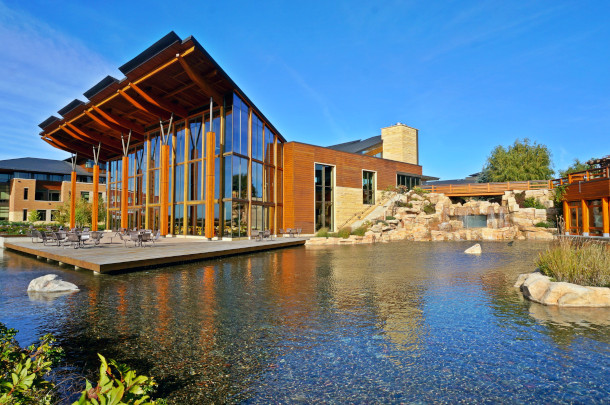
Pictured above is the Epic Systems Cassiopeia 'culinary venue', which is part of a massive 1,670-acre campus with geothermal HVAC systems. (Photo: Mandy Aalderink, Wikimedia Commons, CC BY-SA 4.0)
As geothermal heating and cooling slowly spreads in the U.S., some communities and utilities are looking to grow small pilot projects into much larger networks of pipes and heat pumps that extract and store heat in the earth to warm and cool homes and businesses as needed. Inside Climate News journalist Phil McKenna joins Host Jenni Doering to discuss the bipartisan interest in geothermal and describe a large geothermal HVAC system that demonstrates the possibilities and benefits of scaling up.
Transcript
CURWOOD: From PRX and the Jennifer and Ted Stanley Studios at the University of Massachusetts Boston, this is Living on Earth. I’m Steve Curwood.
DOERING: And I’m Jenni Doering.
As brutal cold has gripped much of the US and increased heating demands, natural gas prices have soared as much as 60%. But the day-to-day cost of geothermal heating is steady as a rock. Geothermal uses pipes and a liquid such as water to tap the Earth's steady temperature of around 55 degrees underground, using heat pumps to extract heat from the rocks for warming and pumping it back underground for cooling. Unlike the political divide over wind and solar renewable energy sources, there is strong bipartisan support for renewable geothermal systems. Proponents include U.S. Secretary of Energy Chris Wright, the former CEO of a company that has invested millions in geothermal energy. Phil Mckenna is a journalist with our media partner Inside Climate News who keeps a close eye on geothermal and he joins me now. Welcome back to Living on Earth, Phil!
MCKENNA: Thanks for having me.
DOERING: So, Phil, in recent months, I know that you've had the opportunity to tour through the Midwest and you visited several different geothermal projects. What did you see? What were some of the highlights there?
MCKENNA: Yeah, so I went to three sites in three days in three different states, Iowa, Wisconsin and Minnesota. One of the reasons I went is, there's a lot of interest here in New England in geothermal and these thermal networks but a big concern I hear from a lot of people is, you know, sounds great, but do these systems really work? So I went to check out a couple that have been in, one for 20 years, one for 15 years, to talk to people there to see how they're working. I went to West Union, Iowa, very small system, town of about 2500 people, small farm town in Northeastern Iowa that uses geothermal to heat and cool about a dozen office buildings in its downtown. And then I went to St. Paul, Minnesota to a mixed-use housing development called “The Heights,” that will use aquifers underground for their heating and cooling. Another one I went to was the corporate campus of Epic Systems, which is one of the largest private tech companies in the country, medical records company that employs about 12,000 people at their campus and across these 400 acres they heat and cool all of their buildings with a very large, likely the largest in the world, geothermal network that they have, I believe, 6000 bore holes in the ground, which is just orders of magnitude larger than anything that like the utility companies are now looking at as they do their initial pilot projects.
DOERING: Yeah, it sounds like a huge project and I know it's not the point of the story, but I loved that you wove in a little bit of detail in your writing about the themes of this campus. Some pretty fun building themes.
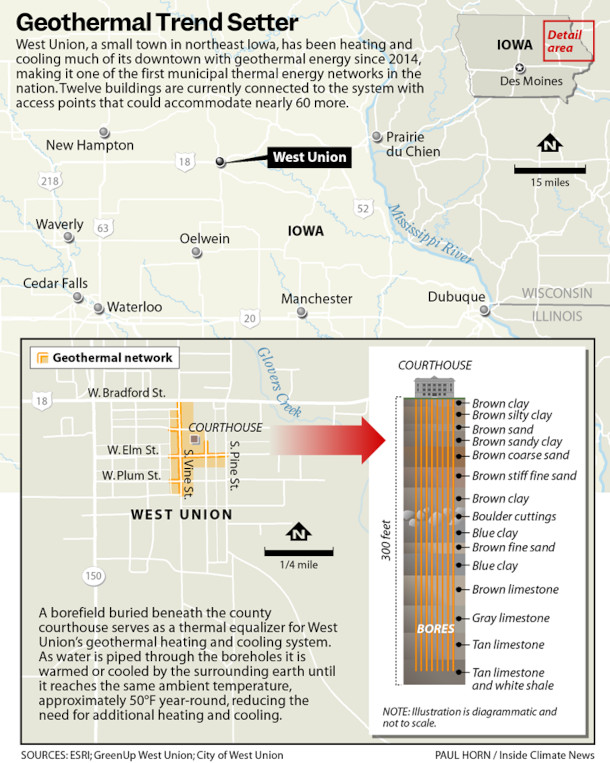
A graphic shows the location of West Union, Iowa, as well as its underground geothermal network and a corresponding diagram of the earth’s makeup under the local courthouse. (Image: Paul Horn, Inside Climate News)
MCKENNA: Yeah, the whole theme of the campus, it's these fantasy theme buildings are sub campuses within a larger campus. So there's Willy Wonka's chocolate factory, there's the Emerald City of Oz, there's Hogwarts Castle, but to me, what was the most interesting is, you know, what's going on underneath all of this. Something that really hadn't gotten a lot of attention, and I don't think most people know about, but they've been doing it since 2006. Their buildings use one quarter the amount of energy for heating and cooling as the average office building. And they trust their system. They've been doing it for a long time, and they know that it's going to work like they expect it to.
DOERING: So I want to ask you more about this plant in Wisconsin at the Epic Systems campus. What actually got this started some 20 years ago?
MCKENNA: They started 20 years ago, I think, really looking at what is the best way to heat and cool our buildings, what is the most efficient system? And there had been prior to that some geothermal heating and cooling ground source heat pumps. So a lot of people have them in their homes, not a lot, but some, and they have for decades, and yeah, just a really efficient way to heat and cool your home. And what they realized early on is that as you scale up, as you build a larger network, you see increases in efficiency, decreases in costs. Part of that's just the usual economy of scale as you build something bigger, you get more efficient at building it, but part of it is as you add different buildings with different heating and cooling loads, the efficiency of the system overall goes up because you're no longer having to generate new heating or new cooling. You're able to just kind of pass off, push from one building to another, or from one room to another, that heat or that cold. So kind of a classic example, if you're doing this in a residential area, you might have homes that in the wintertime are going to need a lot of heating, but if you have an ice rink in that neighborhood as well that's going to need a lot of cooling, and if you can connect to those two in a network, you can push that heating and cooling between the two and get a much larger efficiency.
DOERING: Now, what challenges has this large geothermal project in Wisconsin, at the Epic campus, faced?
MCKENNA: I think it's the same for all geothermal heating and cooling networks in that the upfront cost is significant. The efficiency of the system, you know, about 75% more efficient than conventional heating and cooling, means that you're not going to be spending much on the system once it's operating but there is that hurdle, very significant hurdle, of that upfront cost. And I think that is a challenge now, as communities, as utility companies, look to either pile up these systems or deploy these systems. They know that it's going to work well, they know that's going to be very efficient, but you've still got to come up with the initial money to make the project happen.
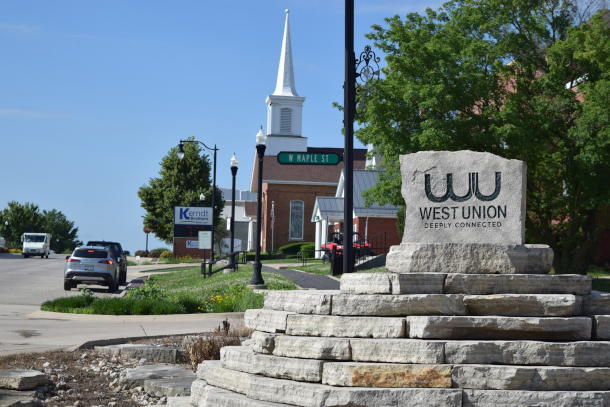
West Union, Iowa, relies on geothermal energy to provide high-efficiency, fossil-free heating and cooling for a dozen buildings in its downtown. (Photo: Phil McKenna, Inside Climate News)
DOERING: So Phil, the 2022 Inflation Reduction Act included incentives for installing geothermal. Where do those benefits stand now with the Trump administration?
MCKENNA: It's interesting, so incentives for wind, solar, for EVs, all got cut or even clawed back, but the incentives for geothermal have remained largely intact. In addition, here in Massachusetts, Framingham, which had the first utility-led geothermal heating and cooling system in Framingham, Massachusetts, in 2024, at the end of the Biden administration, they were given a $9 million grant to build phase two, essentially to double the size of their thermal network, and then at the beginning of the Trump administration that funding was really in question. No one knew if it was going to continue, if they were going to get the money, but late last year, the contracts were finalized and that project will move forward. And not only is there continued support in geothermal, as this project goes forward, it will double in size at half the cost of the initial project.
DOERING: And Phil, why do you think geothermal has escaped some of the opposition that wind and solar have faced from the Trump administration?
MCKENNA: It's very oil and gas adjacent. If you are drilling for oil and gas to transition to drilling for geothermal. It's a lot of the same industry, a lot of the same jobs, a lot of the same equipment you're using. I think there's strong interest in the oil and gas industry to also pursue geothermal energy. And, you know, I mean, it is as there's a lot of talk about energy independence. It is the energy, the heat beneath our feet, that can be tapped here in the US, same as oil and gas.
My latest, for @insideclimatenews.org & @bostonglobe.com;
— Phil McKenna (@mckennapr.bsky.social) December 4, 2025 at 10:26 AM
A first-in-the-nation clean energy project will soon double in size as the Trump administration moves forward with a Biden-era grant for geothermal www.bostonglobe.com/2025/12/03/s...
[image or embed]
DOERING: What are you keeping your eye on when it comes to geothermal in the year ahead?
MCKENNA: I think in the coming year, there's going to be a continuation of these utility pilot projects. Thirteen states in recent years have passed legislation that either requires utilities to do a pilot project or incentivizes them through grants and other funding to make it easier to fund them. So there are now 26 pilot projects led by utilities that are either in some form of development, or in the case of Framingham, have been completed. States that I'm keeping a close eye on are New York State and Colorado, along with Massachusetts, really seem to be leading on this. But even states like Texas have passed legislation, a red state that you wouldn't think would be doing a lot of clean energy development, but again, very similar to oil and gas, a lot of oil and gas drilling in Texas. And I guess I'd add one more thing is having gone to Epic Systems and seeing such a large system, 6000 bores, compared to Framingham at about 90 bores, orders of magnitude larger. To me, it was an interesting place to visit because it seems to me as a model or potential model, of how these systems could really scale up from what we're seeing now by the utilities as these initial pilot projects that are relatively small could be going much larger. Epic’s campus employs about 12,000 people on site, really getting to the town or small city level.

Eversource, a natural gas company, is investing in geothermal to diversify its business model. Shown above is a geothermal construction site in Framingham, MA. (Photo: Provided by Eversource)
DOERING: Phil McKenna is a reporter for our media partner Inside Climate News. Thanks again, Phil.
MCKENNA: Thanks for having me.
Links
Living on Earth wants to hear from you!
Living on Earth
62 Calef Highway, Suite 212
Lee, NH 03861
Telephone: 617-287-4121
E-mail: comments@loe.org
Newsletter [Click here]
Donate to Living on Earth!
Living on Earth is an independent media program and relies entirely on contributions from listeners and institutions supporting public service. Please donate now to preserve an independent environmental voice.
NewsletterLiving on Earth offers a weekly delivery of the show's rundown to your mailbox. Sign up for our newsletter today!
 Sailors For The Sea: Be the change you want to sea.
 The Grantham Foundation for the Protection of the Environment: Committed to protecting and improving the health of the global environment.
 Contribute to Living on Earth and receive, as our gift to you, an archival print of one of Mark Seth Lender's extraordinary wildlife photographs. Follow the link to see Mark's current collection of photographs.
 Buy a signed copy of Mark Seth Lender's book Smeagull the Seagull & support Living on Earth
© Copyright World Media Foundation. All Rights Reserved
Home | Contact | RSS | Donate | Newsletter