
Global Health Under Trump
Air Date: Week of January 30, 2026
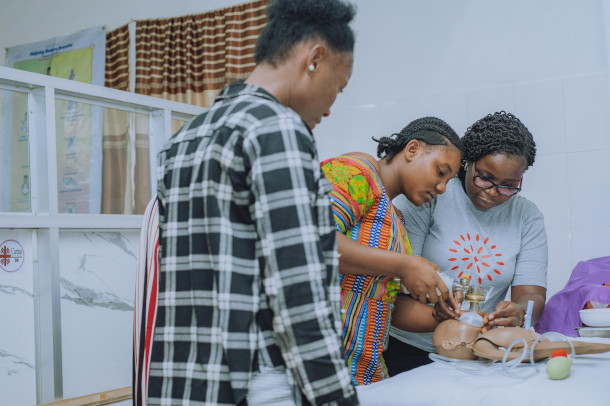
Seed Global Health educator Chisomo Kumwenda (right) demonstrating neonatal resuscitation to midwifery students in the skills lab at School of Midwifery Bo, Sierra Leone. (Photo: Courtesy of Seed Global Health)
The current Trump administration has in its first year cut off the World Health Organization, dismantled the United States Agency for International Development or USAID, and overhauled vaccination recommendations, just to name a few decisions impacting health. Physician and Harvard public health professor Vanessa Kerry is also WHO Special Envoy for Climate Change and Health. She talks with Host Steve Curwood about the lives that could be lost as the US retreats from global health.
Transcript
DOERING: It’s Living on Earth, I’m Jenni Doering.
CURWOOD: And I’m Steve Curwood.
From its very first days the current Trump administration began to drastically remake how the United States interacts with the rest of the world, especially when it comes to health. The United States Agency for International Development or USAID was quickly dismantled as it fired or laid off aid workers around the globe and abruptly ended lifesaving efforts to fight famine and HIV. And just as the Trump White House has severed ties with global organizations that address the climate emergency and its related health issues, the US has cut off the World Health Organization, a move that critics say could weaken pandemic surveillance efforts. Today, we continue our conversation with Vanessa Kerry, who was on the program last time discussing air pollution and climate change. She is a physician who teaches public health at Harvard and co-founder of Seed Global Health, which works in underserved parts of Africa. She is also WHO Special Envoy for Climate Change and Health. Dr. Kerry, welcome back to Living on Earth!
VANESSA KERRY: Thank you so much. I'm really honored to be here with you.
CURWOOD: Some would say that the global health landscape has changed as a result of the Trump administration's actions.
KERRY: “Some would say?” I think that's an undeniable fact now.
CURWOOD: So I mean, internationally, we're looking at the ending of foreign aid. Let's talk about that for a moment. It's a year after we, we shut down.
KERRY: It's not quite a year. We're at 51 weeks. Who's counting?
CURWOOD: So, what's your assessment after this approximately a year?
KERRY: No, sorry, I'm teasing, because it's been a long year in the global health sphere, and you're 100 percent right. It's been a year that has been extraordinarily tumultuous, profoundly damaging, but is not without hope or opportunity. Almost a year ago, the U.S. administration decided to pull out from the WHO and essentially cut off U.S. funding for global health, and that meant that almost half of the external health aid to countries in the Global South and elsewhere that relied on that aid disappeared, and it was followed by other countries that subsequently cut their aid as well. So it created a bit of a cascade effect. Number one, what it does is it is killing people. There are an estimated 14 million people that are going to die directly from these results. We know that it is going to disrupt and dismantle health system delivery, because the U.S. did provide a certain series of services that were critically important.
CURWOOD: Excuse me for just, did I hear you say 14 million people are dying from cutting what USAID used to do in terms of helping health around the world? I just want to be sure that my ears are working.
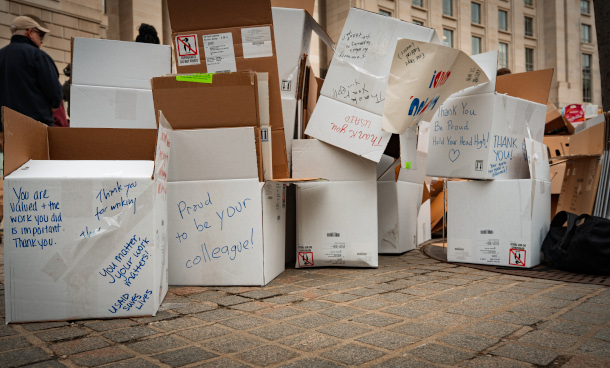
Boxes of the personal items of USAID employees in February 2025, soon after the Trump administration began dismantling the organization. A study published in The Lancet estimates that over 14 million people are projected to die by 2030 because of the end of USAID. (Photo: Ted Eytan, Flickr, CC BY-SA 2.0)
KERRY: Yeah, the estimation of the trackers and the models were that 14.5 million people would die from this. And we have heard that in our partner countries, where Seed Global Health works, is that there has definitely been a lack of services in places where people are coming in and more extremists, people are dying, that there were services completely cut off. We know that rates of HIV are going to go back up, which also means that beyond just the devastation of delivery systems, you're also seeing progress lost. We have poured billions of dollars into ending a historic pandemic of HIV over the years, and we were on the cusp of extraordinary progress, and all of that has been threatened and dismantled, which means the billions we've spent will have been wasted, and while we have had to learn a lot of lessons along the way, it is counterintuitive to cut things off at the knees in the way they are, the way this has been done has been profoundly destructive and in lives, in systems and very disheartening. We're very privileged that the Ministries of Health and ministries of health and ministries of finance and heads of state in the countries where Seed works, which are in Sub-Saharan Africa, are very committed, actually, to thinking through, how do we take the limited resources we have and build strong, resilient health systems that can stand up for pandemic preparedness, that can manage climate resilience, that can still deliver babies? And we've actually seen through our own work, that with smart investment that meets the requests and the needs of the countries and goes behind country priorities, you actually can be transformative to lives saved. So in Sierra Leone, year and a half of education and training of health workers and really working with the government to advocate for blood in the blood bank, over 60 percent drop in mortality in the districts where we work. In Malawi, where we have helped support the government's goal for midwifery-led maternal ward, zero deaths, zero maternal deaths in over two years. So these are possible with smart investments, but these are the same health workers that can pivot and manage cholera if there's a cholera outbreak, or who are managing hypertension and strokes and they're on the front line of triage and emergency services. There are smart investments that we can do that are actually leapfrog the ability to close some of these healthcare gaps.
CURWOOD: I'll take you back for a moment to what happened with USAID and the health impacts of that. What relationship, if any, does the decision to shut down the services that were being offered through USAID for health resonate with what happened in this country a century ago with the eugenics movement? Some say that that movement opposed widespread public health support to accelerate the demise of people, people of color, that weren't wanted, that there's a strong racial component to all of this.
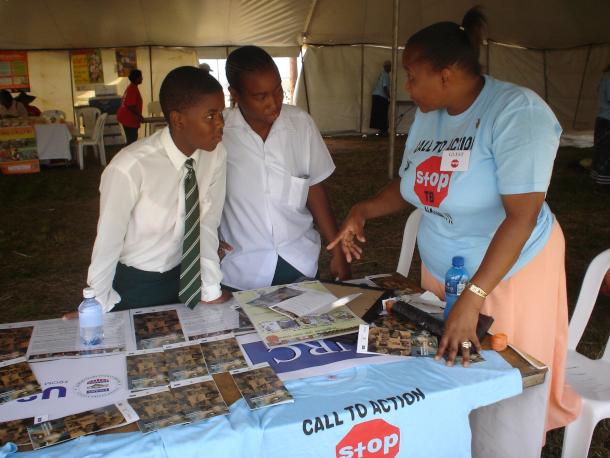
A USAID workshop on HIV/AIDS and tuberculosis takes place in South Africa, 2006. Our guest, Dr. Vanessa Kerry, says HIV rates will increase as aid from organizations like USAID is cut off, slashing decades of progress. (Photo: USAID U.S. Agency for International Development, Wikimedia Commons, public domain)
KERRY: I think overall, we're living in a time in a world where unfortunately, the legacy of colonialism and racism remains far too entrenched and far too present, and it's been very painful to me to talk with some of my friends of color, either, you know, who are totally American born and or those that are from other parts of this world to and to hear what they're experiencing and living right now. We're seeing old patterns repeated, without question. I just taught this year at Harvard, and my first lecture is about the fact that we're reliving old patterns every day in different ways, and so it is complicated. I think we are at a moment, though, again, where we can really reshape our values. I am a big believer in data and bringing the data forward to help debunk some of the old legacies that preserve people's power and to help us find a path forward that moves us to a better place.
CURWOOD: I want to drill down on a bit of the portfolio that you've encountered at the World Health Organization, and that is, what's the threat to global surveillance as a result of the USA to work with WHO, I mean, what are some of the infectious diseases being monitored? And just to be clear, why should Americans care?
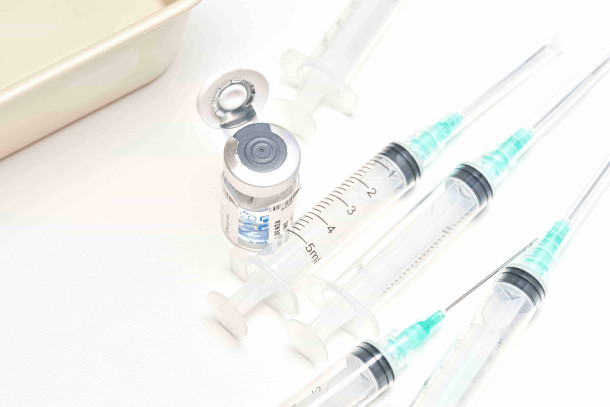
Dr. Kerry warns that increasing vaccine skepticism around the world poses a serious threat to global health. (Photo: Focal Foto, Flickr, CC BY-NC 2.0)
KERRY: So I think people really, the World Health Organization has taken a heavy hit from some of the negative PR that has been put up against it, and I think people see it as very bureaucratic. And what does it do? The World Health Organization plays a powerful role in creating norms, providing profound technical assistance, and really helping to provide some of the diplomatic negotiation we need to keep our world safe. And I think when you look at the history of pandemics in the past around SARS or the bird flu and other things, there is a really powerful role the WHO has played to help cross diplomatic barriers. So if you could imagine, there was an outbreak of something in Iran, and we're dealing with also part of that outbreak in the US. There's no real formal diplomatic relations between the two countries to negotiate information sharing, what is the genetics of the virus? And I think the WHO can broker that, and they have in the past. Investing in strong health systems, investing in the WHO in this technical capacity, investing in public health is critical, because it is our surveillance and our prevention against pandemic preparedness. And I'm sorry, malaria doesn't just stop at the border between Rwanda and Burundi, right? I mean, I think these things transcend borders. This is what we seem to misunderstand, is that these things, diseases, are transnational in this day and age of globalization. We saw that in COVID. If you look at the maps of the spread of COVID over the course of a week, throughout the beginning days of the pandemic, it moved really fast and really globally, very quickly, and it disrupted everything.
CURWOOD: Recently, the Trump administration instituted some new vaccine rules. And you know, as somebody who worked in an ICU with patients during the pandemic, that said, I wish I'd taken the vaccine. We're seeing measles outbreak in South Carolina. What are the implications for public health in the U.S.? How worried should we be? What's the way forward globally, given this growth of vaccine skepticism now? What's the risk for contagion? Meaning the skepticism spreading as well?
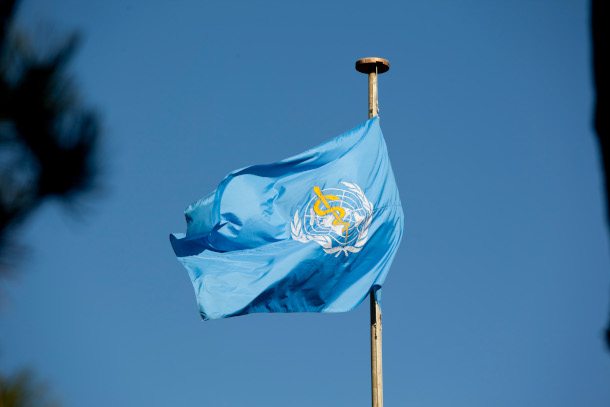
The United States withdrew from the World Health Organization (WHO) in January of 2025. Dr. Kerry says WHO plays a critical diplomatic role in promoting public health across borders. (Photo: United States Mission Geneva, Wikimedia Commons, CC BY 2.0)
KERRY: The contagion of skepticism is very real. So it's interesting, right? We've learned this, whether it's in politics or in vaccines, that when you create confusion around something, you sow distrust. So you don't even have to necessarily give the wrong information. You can just create confusion or lack of clarity about what needs to be done. And we're seeing that consistently across public health measures. It's profoundly dangerous. Vaccines work, and there has been lots of science that has demonstrated the efficacy of vaccines, and further, the primary studies that have been used to argue that vaccines are not safe have been debunked and actually removed and retracted from the literature. So to cite them, still, it's dishonest candidly, and it's sort of peddling false information. I take a fairly hard stance on this, because, for me, because vaccines are so unequivocally lifesaving, that if you are providing information that is dishonest about them, I think people have the right to, you know, people can make a choice, because that is a tenant of our country, but to be, make a choice, at least with the correct information and the honest information. And so if you're giving misinformation that, to me, is really tantamount to causing harm, and we are seeing that sort of spread like wildfire around the country. The new vaccine recommendations that have come out of the CDC are terrifying, because what they're going to do is they're going to cause a huge amount of pain and suffering for families, a huge amount of pain and suffering for children who don't have the right to make the choices for their own protection and well-being. Measles kills, flu kills, COVID kills. We see this. We just had a flu death in Massachusetts recently of a young child. So we are going to see people die. It's incredibly dangerous, and vaccines work through herd immunity, which means that you get enough people immune to the disease, you actually extinguish the presence of the disease. The second that erodes, you can have the disease present and it can pass. Disease like measles is so contagious that you could be in a waiting room for a few minutes with measles. You can leave, and you can be long gone for an hour, and somebody else comes in the waiting room, and they will contract the measles that you had. That is very dangerous, and it puts a lot of people who have any kind of disability or immune compromise or something at risk. It puts young children at risk. So the vaccine policy, to me, is dereliction of duty. It is irresponsible, and it is putting people in harm, and I think that you'll see a judgment on that in the future. And I'm very grateful for those like the American Pediatric Association and others who are coming forward to try to uphold the correct vaccinations and get that information out there.
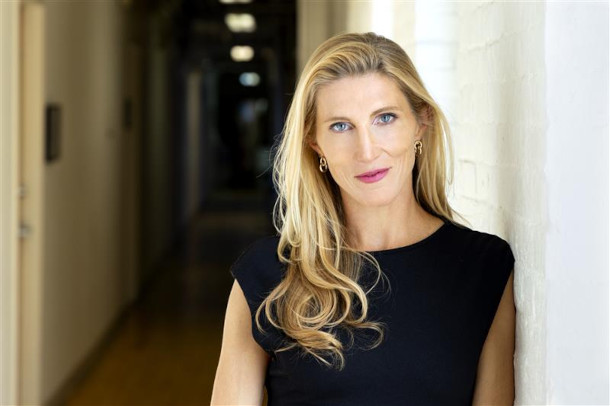
Dr. Vanessa Kerry is the CEO and founder of the nonprofit Seed Global Health. She currently serves as WHO Special Envoy for Climate and Health and a Director of Global Health and Climate Policy at Harvard T.H. Chan School of Public Health. (Photo: Courtesy of Seed Global Health)
CURWOOD: So in these challenging times, with these huge challenges coming at us, what gives you hope?
KERRY: What gives me hope is there's a lot of really amazing people out there who are unafraid of this moment and thinking very much about, how do we break through and what needs to happen in a way that we can actually help make sense, communicate better, protect lives. I see great hope in the fact that health is starting to take a more central conversation in economics and politics and security conversation is being better understood for the profound foundation it provides and its deep link to these other sectors in a way that we will hopefully start to promote health better. I am an optimist, and I think there is really, really powerful paths forward here, and I think that it is incumbent on all of us to be engaged in meaningful debate, not argument, to be, step outside of our traditional communities and silos, and listen to somebody who has a very different opinion, and understand what motivates them, understand what drives them, and then find that shared common experience. So I think we can do it, but I do think it's going to take all of us to be engaged and to be global citizens in this moment.
CURWOOD: Vanessa Kerry is a critical care trained physician and Director of Global Health and Climate Policy at the Department of Environmental Health at the Harvard T.H. Chan School of Public Health, and co-founder and CEO of Seed Global Health. Thank you so much, Dr Kerry, for taking the time with us today.
KERRY: Thank you so much.
Links
The White House | “Withdrawal from Wasteful, Ineffective, or Harmful International Organizations”
The White House | “Withdrawing the United States from the World Health Organization”
Living on Earth wants to hear from you!
Living on Earth
62 Calef Highway, Suite 212
Lee, NH 03861
Telephone: 617-287-4121
E-mail: comments@loe.org
Newsletter [Click here]
Donate to Living on Earth!
Living on Earth is an independent media program and relies entirely on contributions from listeners and institutions supporting public service. Please donate now to preserve an independent environmental voice.
NewsletterLiving on Earth offers a weekly delivery of the show's rundown to your mailbox. Sign up for our newsletter today!
 Sailors For The Sea: Be the change you want to sea.
 The Grantham Foundation for the Protection of the Environment: Committed to protecting and improving the health of the global environment.
 Contribute to Living on Earth and receive, as our gift to you, an archival print of one of Mark Seth Lender's extraordinary wildlife photographs. Follow the link to see Mark's current collection of photographs.
 Buy a signed copy of Mark Seth Lender's book Smeagull the Seagull & support Living on Earth
© Copyright World Media Foundation. All Rights Reserved
Home | Contact | RSS | Donate | Newsletter