

July 31, 2026
Air Date: July 31, 2026
FULL SHOW
SEGMENTS
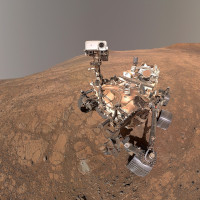
Hints of Life on Mars
View the page for this story
On Mars, our planet’s rocky twin, NASA’s Perseverance Rover is seeking signs of past life in Jezero Crater. Now, scientists say they may have uncovered some of the most compelling evidence yet, in the form of complex carbon molecules in Martian mudstones. Planetary scientist Dr. Kevin Hand of the Jet Propulsion Laboratory joins Host Aynsley O’Neill to explain the buzz about these “potential biosignatures.” (11:04)

Molten, Mushy Planet - Note on Emerging Science
View the page for this story
35 light years away from Earth is a planet a bit bigger than ours that’s probably not hospitable to life -- because it’s molten. Scientists have known about L98-59d for years, but new observations from the James Webb Space Telescope helped reveal an atmosphere rich in hydrogen sulfide, which could only be explained if the planet was in a rare molten state. Living on Earth’s El Wilson and Bella Smith teamed up on this note on emerging science. (02:31)
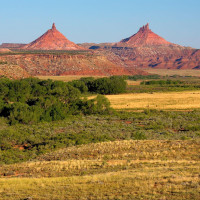
Trump Attempts to Shrink Bears Ears -- Again
View the page for this story
On July 13, 2026, President Trump issued a proclamation reducing the Bears Ears and Grand Staircase-Escalante national monuments in southern Utah by about 90 percent, to remove almost 3 million acres from monument status. Matthew Campbell, Deputy Director of the Native American Rights Fund, joined Living on Earth’s Paloma Beltran to discuss the significance of these places to several local tribes who co-manage them, and why in their view the President lacks the authority to slash monuments. (09:28)
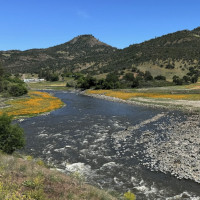
Saving the Klamath, Salmon, and Yurok Culture
View the page for this story
The Yurok tribe has inhabited the lower stretches of the Klamath River in Northern California since time immemorial, and their culture is deeply intertwined with the river’s salmon. So, when toxic conditions caused by the dams on the river resulted in a massive fish kill, the Yurok people sprang into action. Yurok attorney Amy Bowers Cordalis joins Host Jenni Doering to talk about the historic removal of Klamath dams and her 2026 book, The Water Remembers: My Indigenous Family’s Fight to Save a River and a Way of Life. (24:11)
Show Credits and Funders
Show Transcript
260731 Transcript
HOSTS: Jenni Doering, Aynsley O’Neill
GUESTS: Matthew Campbell, Amy Bowers Cordalis, Kevin Hand, Harrison Nicholls
REPORTERS: Bella Smith
[THEME]
DOERING: From PRX – this is Living On Earth.
[THEME]
DOERING: I’m Jenni Doering.
O’NEILL: And I’m Aynsley O’Neill. Tantalizing signs of past life on Mars.
HAND: When we look out at our solar system and beyond, biology might actually be a universal phenomenon, not just a singularity of some curious conditions that occurred here on planet Earth.
DOERING: Also, how the Yurok tribe and partners saved a dying Klamath river and its salmon.
CORDALIS: We were able, with the dam removal, to use grassroots, use the law, policy, and leadership to enter into a $500 million settlement agreement that equally valued the rights of nature, business, and Indigenous peoples.
DOERING: That and more, this week on Living on Earth. Stick around!
[NEWSBREAK MUSIC: Boards Of Canada “Zoetrope” from “In A Beautiful Place Out In The Country” (Warp Records 2000)]
[THEME]
Hints of Life on Mars
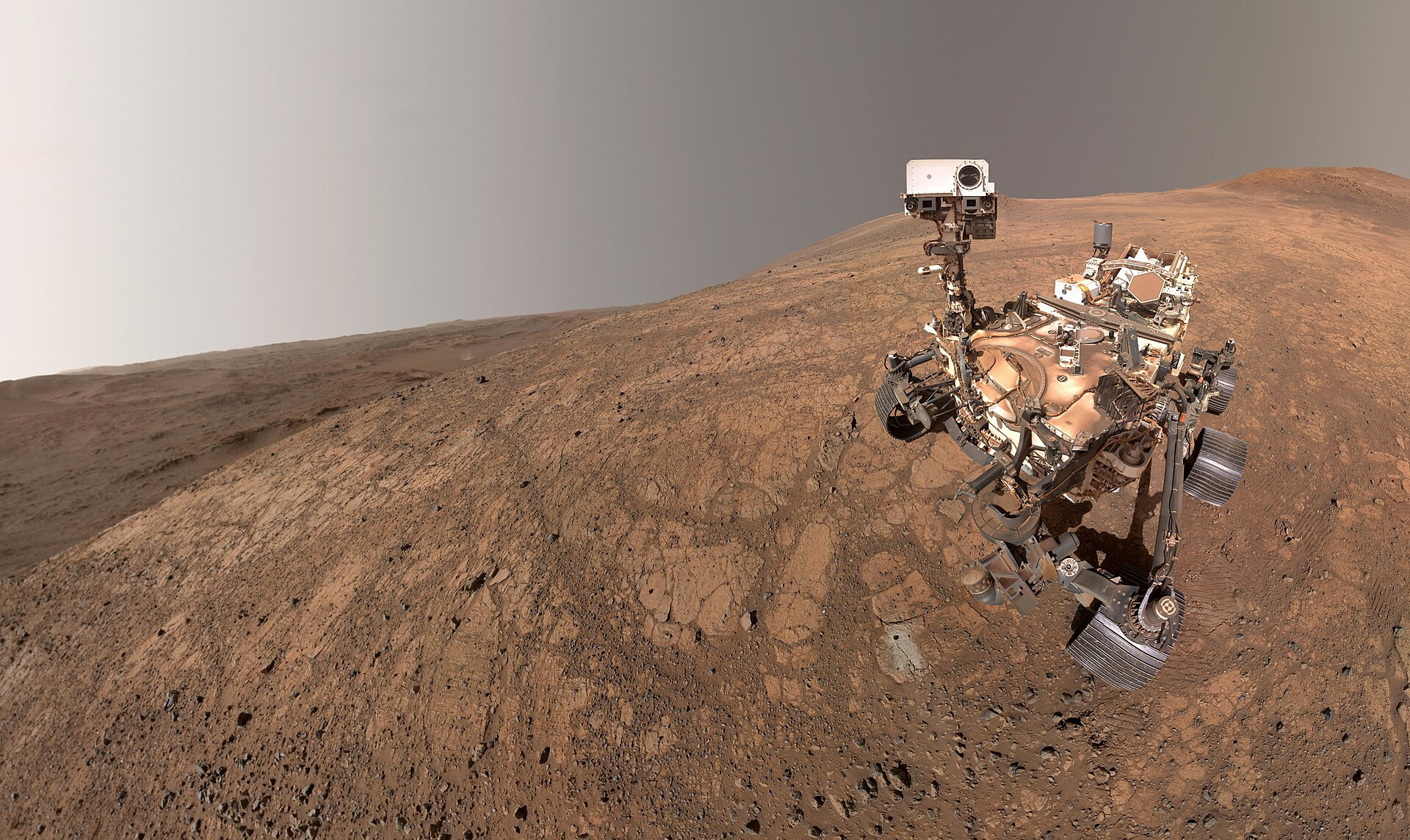
NASA’s Perseverance rover has been roaming Mars since February 2021. The rover took this “selfie” in May 2025. (Photo: NASA/JPL-Caltech, Wikimedia Commons, Public Domain)
DOERING: From PRX and the Jennifer and Ted Stanley Studios at the University of Massachusetts Boston, this is Living on Earth. I’m Jenni Doering
O’NEILL: And I’m Aynsley O’Neill.
On our planet’s rocky twin Mars, NASA’s Perseverance Rover is seeking signs of past life in Jezero Crater. Now, scientists say they may have uncovered some of the most compelling evidence yet. In late June, Perseverance detected complex carbon molecules in Martian mudstones using an instrument called the Sherloc spectrometer. The tool works by shining a laser onto ancient rocks to analyze the molecules within. And this time, the molecules within were organic compounds, which were later classified as potential biosignatures. For more, we turn to planetary scientist Dr. Kevin Hand of the Jet Propulsion Laboratory, who is the Principal Investigator of the Sherloc spectrometer on the Perseverance Rover. Kevin, welcome to Living on Earth!
HAND: Thank you so much, Aynsley.
O'NEILL: So, for those of us who don't remember our chemistry classes, what's the significance of organic carbon here?
HAND: So, when it comes to the search for life beyond Earth, we've got a few different kind of mantras. The highest level one is “follow the water.” All life on Earth depends on liquid water, and so when we look beyond Earth for places that might have been habitable or that are currently inhabited, the first thing we're looking for is liquid water. Beyond that, once we've found worlds like Mars where there's evidence of past liquid water, then it's kind of “follow the carbon” because life on Earth is built on carbon, built with carbon, and so when we are roving around on Mars, our spectrometer is looking for those hints of carbon, and in particular carbon-carbon bonds, as an indicator of complex organics and compounds that may be indicative of past life on Mars. Now, just because you find organics or carbon compounds doesn't mean that they have any connection to past life on Mars or past life on any of these worlds we're investigating. We see plenty of complex organics in material returned from asteroids, and we see it in the interstellar media, etc. But what was particularly intriguing about the organics that the Sherloc spectrometer found and detected on Mars is that we found these compounds in an ancient riverbed. So context matters a lot in this case.
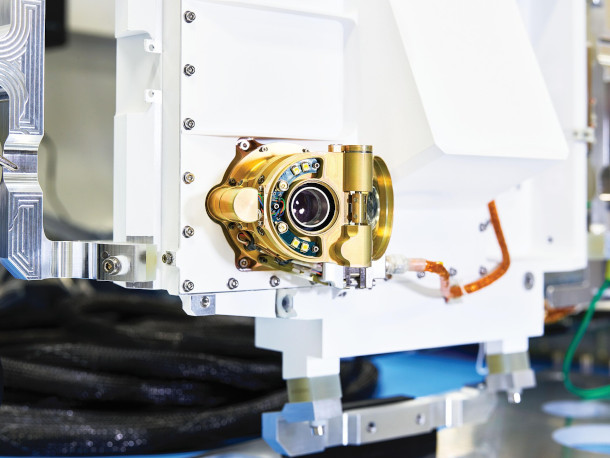
A close-up of the Sherloc spectrometer tool, which is used to detect organic compounds. (Photo: NASA/JPL-Caltech, Wikimedia Commons, Public Domain)
O'NEILL: So tell me about this phrase, potential biosignatures. Why is this the wording that you use here?
HAND: So with such an extraordinary claim, as the search for life often results in, you want to be really cautious with the language. And so, let me give you an example of just a biosignature that everyone would know and love and appreciate. You walk out into, let's say the desert of Utah and you stumble across a dinosaur bone, right? That is, that's a biosignature, and you'd have a really hard time explaining a skeleton structure of a dinosaur non-biologically. But when it comes to microbes and when we talk about the search for life on Mars, we really are talking about the search for evidence of past microbial life, and the signatures that microbes leave are often much more subtle than, say, a dinosaur bone.
O’NEILL: Mhm.
HAND: And so, what did we actually find in Neretva Vallis on Mars? Well, from a mineralogy standpoint, we found these curious ringed structures that we endearingly refer to as poppy seeds and leopard spots. And the key point that you need to understand with these ring structures is that there's a gradient in the mineralogy. In other words, there's energy to be harnessed by exchange of electrons across these various minerals. And what we know about life on Earth is that life, microbial life, loves to utilize that kind of geochemistry. So we found some really compelling mineralogy in the rocks at Bright Angel, which is that outcrop in Neretva Vallis. And then coupled with that, on the Sherloc team, we found with our spectroscopy this evidence of organic carbon and, in particular, macromolecular carbon, large organics, and here you can kind of think of chicken wire, that sort of hexagonal network that visually looks like chicken wire. Well, what we found with Sherloc was that kind of chicken wire structure, but in a jumbled mess. So a lot of carbon connected to other carbon atoms, and that, coupled with the mineralogy, really sets the stage, especially when you put it in an ancient river valley, for us concluding that this could qualify as a potential biosignature.

Jezero Crater, above, was chosen as Perseverance’s landing site because of its history as an ancient riverbed, where organic materials are more likely to be found. (Photo: NASA, Wikimedia Commons, Public Domain)
O'NEILL: Well, I imagine that operating the data-gathering instruments on Perseverance is just tricky. You know, the distance, the time difference that needs to happen when you're sending a set of commands from Earth all the way to Mars. And of course, if something goes wrong, you can't exactly just fix it by opening up a panel and grabbing a wrench. So, what kind of difficulties have you seen as you try and gather this data?
HAND: Yeah, well, there's one very big challenge that we on the the Sherloc team encountered, and so January of 2024, my colleague and deputy Kyle Uckert and I wake up to a message from the downlink, the communication system, that on the Sherloc instrument, our dust cover did not open. What does that mean? Well, Mars is quite a dusty place. There's dust devils and winds and stuff. Some instruments have covers that open and close to make sure that no dust gets in. So we had commanded the dust cover to open, but there was an indication that that command had not worked. Now normally, that's not a huge deal. Small things happen on the rover all the time, but then it did not work again, and we tried again and again and again, it didn't work. So that, in and of itself, Aynsley, was pretty stressful.
O'NEILL: Oh, I bet.
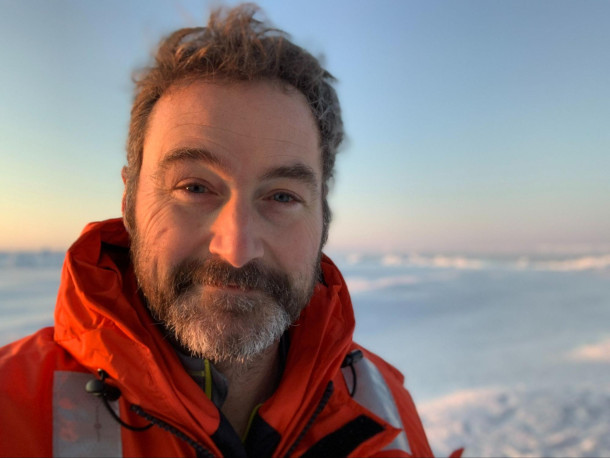
Dr. Kevin P. Hand is the Principal Investigator of the Sherloc spectrometer on the Perseverance Rover. (Photo: Kevin Hand)
HAND: [LAUGHS] But meanwhile, Perseverance rover had been making progress up the delta of Jezero Crater. Part of the whole reason that we landed in Jezero Crater is because we could see these bright deposits right in this ancient riverbed, and the whole team was excited to get down into this valley and look for minerals and organics indicative of past life. So the rover is making progress to this valley. Meanwhile, Kyle and I and our full team are sweating it out each day because if the cover doesn't open by the time we get to these really compelling rocks, we're not going to be able to search for organics. So the weeks go on, the months go on. We gradually figure out how to get the cover a little bit open, a few degrees at a time, but then Mother Nature and Mars helped us out a bit. As we kind of got up on the southern rim of the river valley, the terrain got incredibly rocky, and it slowed down the pace of Perseverance by a lot. So the rover planners and the rest of the science team on the full mission, they were all quite frustrated that progress was slowed. Meanwhile, on my team, on the Sherloc team, we were breathing a huge sigh of relief because that meant we had more time to figure out this anomaly and try and get the dust cover all the way open. And so, by June of 2024, the rover arrived down in the valley, and we had just managed to get our dust cover to be almost fully open, or at least open enough that we could continue to do spectroscopy. And so, if Mars had not been challenging as we tried to rove to the river, we might well have arrived in this valley without the capability to collect some of the key data that was so central to our conclusion that we might actually be looking at potential biosignatures on Mars.
O'NEILL: Well, so how might these findings from Perseverance help us understand our own planet better?
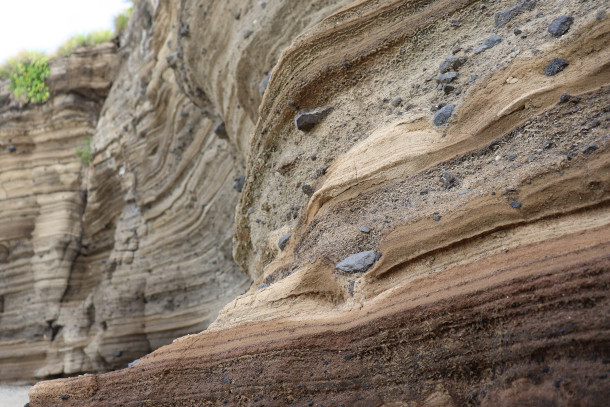
Geochronology is the science of dating rocks and fossils. Looking at rock layers is one method commonly used to find a sample’s relative age. (Photo: Irvin Parco Sto. Tomas, Wikimedia Commons, CC BY-SA 4.0)
HAND: Yeah. Well, first we got to get these samples back so that we can better study the detailed chemistry of these rocks. And so, in my dream of dreams, and the dreams of many of my colleagues, we get these rocks back to Earth. We better understand whether or not the rocks do contain evidence of, of past life on Mars, and coupled with that, we also can do a lot of what's called geochronology. In other words, studying various minerals and elemental ratios to figure out how old the rocks are on Mars. Why is that important? Well, let's say we do get the rocks back, and we arrive at the conclusion that these rocks do contain evidence of past life on Mars, and then imagine that we do the dating of these rocks, and we find that they are 3.6 or 3.8 billion years old. Now we have got an entirely separate planet, Mars, where some of the same conditions on early Mars were what we had here on Earth, and at about the same time we see that life arises on Mars as it did on Earth, and to me, that is so exciting because it means that possibly as soon as a planet becomes habitable, life might arise and the planet becomes inhabited. In other words, when we look out at our solar system and beyond, biology might actually be a universal phenomenon, not just a singularity of some curious conditions that occurred here on planet Earth. So I find that super exciting and, and really kind of captivating when it comes to this ultimate question of, of are we alone?
O'NEILL: Dr. Kevin Hand is the Principal Investigator of the Sherloc spectrometer on the Perseverance rover. Kevin, thank you so much for taking the time with me today.
HAND: Thanks, Aynsley. A pleasure talking with you.
Related links:
- The Guardian | “NASA Rover Detects Potential Signatures of Ancient Microbial Life on Mars”
- Read the original study in Science Advances
- Learn more about Kevin Hand
[MUSIC: Stellar Drift]
Molten, Mushy Planet - Note on Emerging Science

New information about exoplanet L98-59d suggests it has a global magma ocean and possibly a molten core. Above, an artist’s rendering of a liquid, molten planet. (Photo: Merikanto, Wikimedia Commons, CC BY-SA 4.0)
SMITH: Scientists have been studying exoplanets, or planets beyond our solar system, for decades. But a 2026 study published in Nature Astronomy found that one exoplanet is unlike anything we’ve seen before. This planet is called L98-59d, and it’s about 1.6 times the size of Earth and 35 light years away from us. What makes it so special is that, unlike other exoplanets of a similar size and density, it’s neither a rocky planet surrounded by gas, nor a water world. It’s…mushy.
NICHOLLS: It's more like you see those videos of people like poking magma when they go visit Iceland or something like that, it's like a molasses, like a honey type viscosity, you could attempt to walk on it, and given the density of rock, you would not sink, but it would be like walking on molten lava.
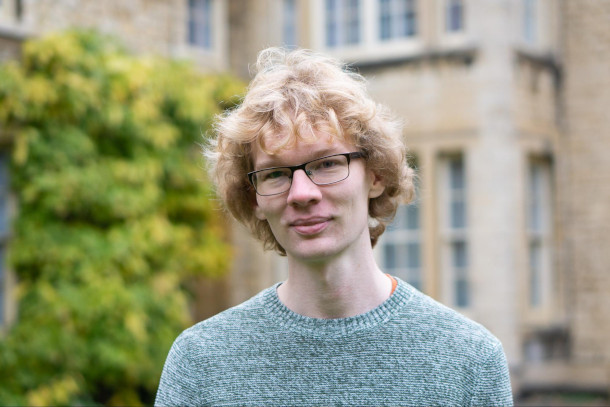
Dr. Harrison Nicholls is a postdoctoral researcher at the University of Cambridge’s Institute of Astronomy and co-author of the study. (Photo: Harrison Nicholls)
SMITH: That’s Harrison Nicholls, a postdoctoral research assistant at the University of Cambridge and co-author of the study. He said scientists had known about this planet for years, but new observations from the James Webb Space Telescope revealed that its atmosphere is rich in hydrogen sulfide. In order to sustain such a volatile atmosphere, they concluded the planet must be in a liquid, molten state. Nicholls and his colleagues then used computer simulations to reconstruct the planet’s history. They found that L98-59d likely has a global magma ocean, hundreds of miles deep, and possibly a molten core as well. Planets form through an incredibly energy-intensive process, so young planets are extremely hot and cool over time. But a sulfur-rich atmosphere trapped this planet’s internal heat, preventing it from cooling. So it stayed in this molten, mushy state – even though it’s about 4.5 billion years old. And that hydrogen sulfide atmosphere would likely come with another defining feature: the overwhelming smell of rotten eggs. While this planet is almost certainly uninhabitable, Nicholls is excited about what this new discovery could mean.
NICHOLLS: I think we're going to keep in mind that there's going to be a big diversity of worlds out there, beyond anything we see in the solar system, because planets start molten, and that includes the earth, so by looking at these molten worlds, we can to some extent, look at Earth when it was just born.
SMITH: For Living on Earth, I’m Bella Smith.
Related links:
- The Guardian | “‘A Molten, Mushy State’: Scientists May Have Found a New Type of Liquid Planet”
- Read the original study in Nature Astronomy
- Explore NASA’s visualization of L98-59d
- Learn more about Harrison Nicholls
[SCIENCE NOTE THEME]
O’NEILL: Just ahead, déjà vu as President Trump again attempts to shrink Bears Ears national monument. Stay tuned to Living on Earth!
ANNOUNCER: Support for Living on Earth comes from the Waverley Street Foundation, working to cultivate a healing planet with community-led programs for better food, healthy farmlands, and smarter building, energy and businesses.
[CUTAWAY MUSIC: Andrew Gialanella, “Another Year” single, Andrew Gialanella]
Trump Attempts to Shrink Bears Ears -- Again
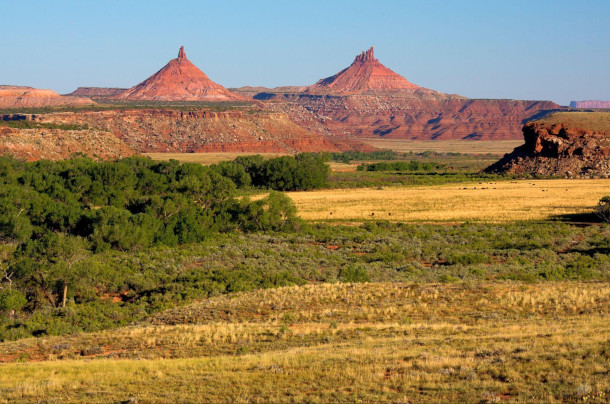
Indian Creek, pictured above, is the northernmost section of the Bears Ears National Monument in San Juan County, Utah. (Photo: US Bureau of Land Management, public domain, via Wikimedia Commons)
DOERING: It’s Living on Earth, I’m Jenni Doering
O’NEILL: And I’m Aynsley O’Neill.
In southern Utah, the Bears Ears and Grand Staircase-Escalante national monuments include dramatic landscapes of deep canyons, rocky cliffs, and vast plateaus. But beyond their natural beauty, these places are also the ancestral homelands of several indigenous peoples, including the Navajo Nation or Diné, the Hopi Tribe, Pueblo of Zuni, the Ute Mountain Ute Tribe, and the Ute Indian Tribe. On July 13, 2026, President Trump issued a proclamation reducing the two monuments by about 90 percent, to remove almost 3 million acres from monument status. President Trump made a similar proclamation back in 2017 during his first term, though it was made moot by President Biden in 2021. The Native American Rights Fund has been representing three of the tribal nations since 2017 in a lawsuit against President Trump for his initial efforts to shrink the monuments. Matthew Campbell is their Deputy Director, and he joined Living on Earth’s Paloma Beltran.
BELTRAN: So, give us a sense of place here, you know, of these two national monuments, Bears Ears and Grand Staircase-Escalante. What do these landscapes look like, and why are they so significant for the indigenous tribes in the region?
CAMPBELL: Yeah, both Bears Ears and Grand Staircase are immensely important for the tribal nations of the region, you know, it's a place where the tribal nations and their members go to have ceremony. It's a place where they continue to go to collect different medicines, herbs, and berries and things like that. And it's a place where their ancestors are buried and and where they have prayers that are imbued with the land there. You know, there are different petroglyphs. There are different ceremonial sites. For example, the Ute Mountain Utes still have a bear dance every year within the Bears Ears region, and so, immensely important places, sacred places. They're connected to their histories, their past, and who they are still to this day.
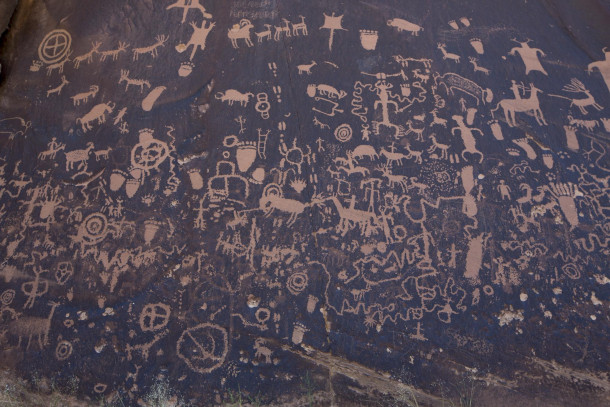
The petroglyphs on Newspaper Rock in Bears Ears can be attributed to the ancient Puebloan people and the Ute people who continue to live in the region. Bears Ears remains a sacred landscape to many tribes in the southwestern United States. (Photo: Bob Wick, Utah Bureau of Land Management, via Wikimedia Commons)
BELTRAN: I mean, it's their ancestral homeland.
CAMPBELL: Yeah, absolutely.
BELTRAN: So President Trump moved to reduce Bears Ears and Grand Staircase-Escalante, what exactly does the proclamation say, and what does it mean?
CAMPBELL: Well, I want to say 90% of Bear's Ears was revoked, and I think that it was close for Grand Staircase as well to that number. That is an immense amount of land, but one of the biggest things that was most devastating, in addition to removing the lands and the protections that go with that, was purporting to terminate and disband the Bears Ears Tribal Commission that was established to work closely with the United States on managing the monuments.
BELTRAN: So, what does terminating the commission, the tribal commission, mean in this case?
CAMPBELL: Yeah, well, the commission was created and recognized by both President Obama and President Biden, and it was really created to build up and lift up the government-to-government relationship that the United States has with tribal nations, and ensure that they have a really important say in how the monument is managed. And so, the previous proclamations and the land use plans that were adopted as part of those proclamations in 2025 required the United States to collaborate with the tribal nations on a number of things in terms of implementing the management plan. So it really was recognizing the sovereign status of the tribal nations and that historical government-to-government relationship, and building it up and providing more meat on the bones to that relationship and requirements on the United States. It was a very big deal and something that the tribal nations, all five tribal nations that are part of the commission, had been advocating for for quite some time.
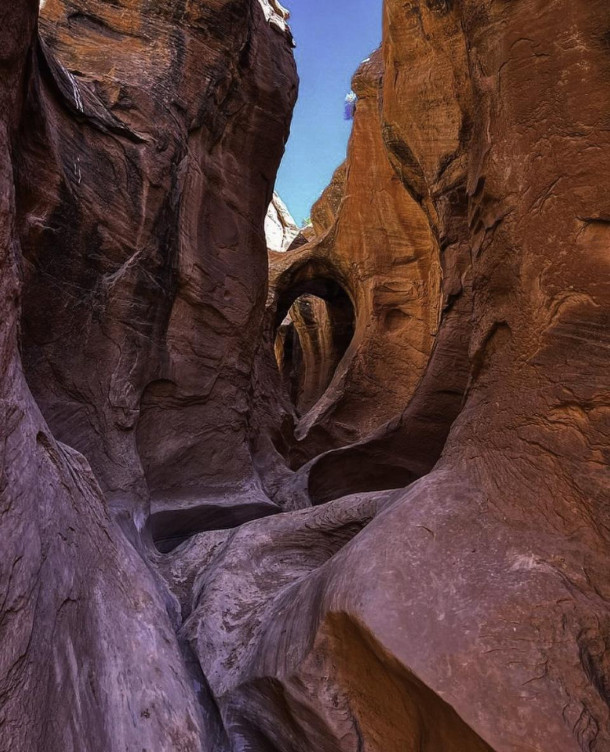
The slot canyons in Grand Staircase-Escalante National Monument have become a popular recreation area for hikers visiting the monument. (Photo: Utah Bureau of Land Management, via Wikimedia Commons)
BELTRAN: So, President Trump moved to eliminate the Bears Ears Commission, which ensures that Indigenous tribes get a say in the management of Bears Ears. To what extent is that legal?
CAMPBELL: Well, our view is that that is not legal, and that what actually governs is what has been adopted within the land management plan, the promises that were made within the governmental agreement between the United States and the tribes, and I think important to lift up, one of the promises was that the United States would consult with the tribe before changing any of the boundaries of the monument, and that did not happen here, so we've already seen a breach of those promises that have been made. But our view is that no, the land management plan and the governmental agreement that has been entered into is what still governs, and that of course that the president more broadly doesn't have authority to revoke national monuments. The Antiquities Act of 1906 was a statute that Congress passed in order to protect historic and scientific objects and other historic landmarks and structures. And our view is that the Antiquities Act and the language of the statute is very clear. It authorizes presidents to declare national monuments and reserve lands as part of them, but what it doesn't do is authorize the president to do the exact opposite or undeclare a monument and unreserve lands. I think, in our view, and as Congress has understood, it's a one-way street. It allows presidents to create monuments to protect objects, but the statute reserved to Congress the authority to undo monuments if it so chooses.
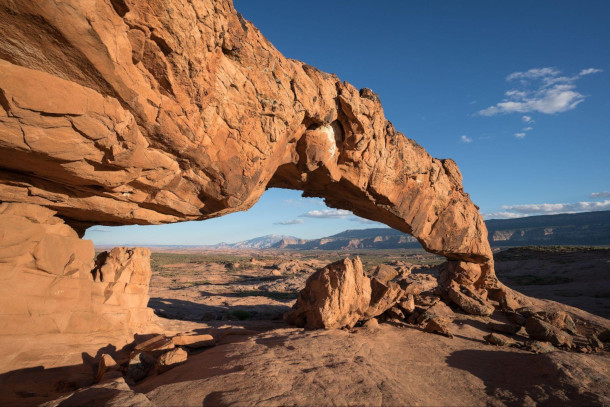
The Grand Staircase-Escalante National Monument would be 90% smaller if President Trump’s modification proclamation of July of 2026 goes into effect. (Photo: Utah Bureau of Land Management, Wikimedia Commons, public domain)
BELTRAN: And Matthew, what happens if these massive reductions go through? What will change for these landscapes?
CAMPBELL: Yeah. Some of the biggest things that are really important is the reduction of the protections for over 90% of the lands, and one of the biggest removals of protections is opening up these lands for different mining and other oil and gas development. So these national monuments and lands within those are protected from mining operations. But now that President Trump has purported to remove those protections, there will be the opportunity for businesses and mining companies, oil and gas companies, to now go in and stake claims and and try and begin operations within these lands, so that's one of the biggest concerns I think the tribes have, and, and others. Uranium mining was a major concern for the tribal nations within the Bears Ears region, but also with things like off-road vehicle use, grave robbing, and looting has been a concern in the past as well. I think those are some of the biggest concerns with regard to these protections now being removed.
BELTRAN: And to what extent or how might legal action put a pause or at least a stay on the opening up of these lands?
CAMPBELL: Yeah, absolutely. I think the proclamation itself has a 60-day period that no activity can happen within 60 days, and then after that, we will be monitoring closely the situation on the ground to see if there are any imminent harms that are happening. And then, if that is the case, we likely would be asking the court to put a hold to any of those activities.
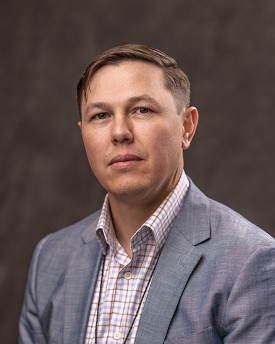
Matthew Campbell is Deputy Director of the Native American Rights Fund, an organization focused on legal advocacy for tribal rights and sovereignty. (Photo: Courtesy of Matthew Campbell)
BELTRAN: And Matthew, you represent the people who have lived there since time immemorial. How do they feel about this? What have you been hearing from them?
CAMPBELL: Yeah, absolutely. Well, I think there has been a real sense of grief. There was real shock when the proclamation was announced just a few weeks ago, and the Bears Ears tribal nations and the tribal commission have put in close to a decade in terms of developing a very respectful plan for managing these lands that recognizes the cultural and traditional importance of them. And so there was a sense of grief when the commission was purportedly terminated. It was almost as if we were at a funeral. Everyone was really down, and in a sense of shock as to what had taken place, given the role that they had been having in managing these lands with the federal government. So yeah, there was the grieving period and shock, but also a sense of resolve that you know they've been fighting to protect these lands for centuries, and their communities have, and that they will continue that fight.
O’NEILL: That’s Native American Rights Fund Deputy Director Matthew Campbell, speaking with Living on Earth’s Paloma Beltran. A Department of the Interior spokesperson provided a statement that reads in part, “The Obama and Biden administrations repeatedly weaponized the Antiquities Act to lock up millions of acres of Utah's public lands over the explicit objections of the state's elected leaders…
President Trump is rectifying this wrong.” We’ll link to the full statement on the Living on Earth website, loe dot org.
Related links:
- Read President Trump’s proclamation aimed at modifying Bears Ears National Monument
- Read President Trump’s proclamation aimed at modifying Grand Staircase-Escalante National Monument
- Learn more about the Native American Rights Fund
- Read NARF’s statement following President Trump’s proclamations to shrink Bears Ears National Monument
- Learn more about Matthew Campbell
[MUSIC: Sand and Solace]
Saving the Klamath, Salmon, and Yurok Culture
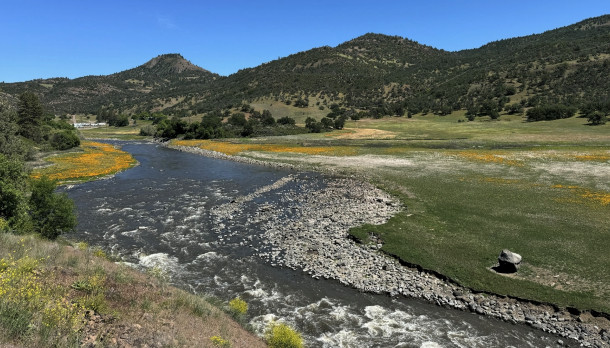
The Klamath River is approximately 257 to 263 miles long, stretching from its headwaters near Upper Klamath Lake and Lake Ewauna in southern Oregon emptying into the Pacific Ocean in northern California. For indigenous peoples like the Yurok, Karuk, the Klamath River is a sacred life force. (Photo: Ridges to Riffles)
DOERING: The Klamath River flows for roughly 260 miles through south-central Oregon and northern California. Dams went up along the river starting in the early 1900s, separating migrating salmon from spawning grounds and creating toxic river conditions that killed many fish. For the Yurok tribe, which has inhabited the lower stretches of the Klamath River since time immemorial, the problems caused by the dams created an existential crisis. Their culture is deeply intertwined with the salmon, and the Yurok saw a sacred obligation to protect them. Amy Bowers Cordalis is a Yurok mother, fisherwoman, and attorney who co-founded Ridges to Riffles Indigenous Conservation Group. As General Counsel for the Yurok Tribe, Amy helped lead the legal and community movement that achieved an unprecedented dam removal and river restoration project on the Klamath. She’s written a wonderful 2026 book telling the story of this effort, called The Water Remembers: My Indigenous Family’s Fight to Save a River and a Way of Life. Amy Bowers Cordalis, welcome to Living on Earth!
BOWERS CORDALIS: Ayakui. Thank you for having me.
DOERING: You don't hold back in this book. I mean, you don't try to wash over some really horrible things that happened. And I think that history is really important for people to know and understand because your people have survived a lot of stuff. And part of the point of this story is, it was standing up and continuing to live your traditional ways that actually helped preserve your culture in the end.
BOWERS CORDALIS: Yeah, and thank you for framing it all that way. There was a lot of privilege to be able to write a book like this, and you know I remember after the fish kill, feeling so marginalized and like nobody cared about our river, about our culture, the salmon, and then also that what had caused the fish kill was essentially by decisions made in D.C., things off our reservation, and so it felt pretty helpless. Like, how are we going to heal the river if nobody cares, and so in writing this book, I get the privilege of telling the story from our perspective. And this is of course my family's story, but there are many families, indigenous families on the Klamath of all different tribal nations, whose family stories are very similar to the one that I wrote here, and I really hope that by putting my story out there, that we can uplift those unspoken, those uncelebrated heroes who fought for generations just to be who they were.
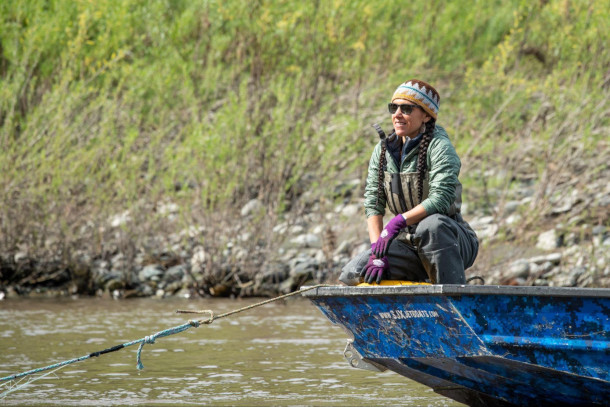
Amy Bowers Cordalis on a fishing trip with her family. She is an attorney and Yurok Tribe member, as well as the author of The Water Remembers: My Indigenous Family's Fight to Save a River and a Way of Life. (Photo: Swiftwater Films, Courtesy of Amy Bowers Cordalis.)
DOERING: Well, one of the ways that your family has tried to preserve and successfully, I would say, preserved a lot of the culture and traditions of the Yurok people is through song and dance medicine. You come from a long line of dance and song medicine people. One of those people is your great grandmother Geneva, so I would love to hear about her and the role that she played in protecting life on the river.
BOWERS CORDALIS: She was a force, and she was a very petite woman. She had a phenomenal life, and just the time and what was happening in the world during her lifespan. So she was born in 1904 and passed away in 1986, and I knew her, but she was raised by her grandparents, and so they only spoke Yurok. They lived a completely Yurok Aboriginal life of subsistence, of hunting, gathering, and then through her life transitioned in some ways to a more modern lifestyle. But really, at her core, maintained those Indian values and an Indian perspective. And in the book, you know, I refer to it as the Indian way, and she was tested many times in her life. You know, and one of the stories in the book– and, and that's like one of my most favorite stories too– is just how there's so many times in life where she prayed. She prayed all the time, and she deeply believed in her Indian way, yet it was tested all the time through trying to be a bootleg salmon fishing people and get salmon out the river to go, you know, sell, all these sort of like just tests. And every time her Indian way protected her, and so she grew up, and even as she, you know, as an adult and later in her life, she deeply believed in the Indian way, and then she taught it to the family, and so in many ways, that's how that like passing down of the knowledge was carried forward through some of the hardest times of colonization. Many families, many indigenous families, didn't have that same sort of passing of the knowledge because people were killed or you know whatever happened and so, so she just played a critical role in passing down the knowledge and you know there were people who acknowledged that too, and there were these great transcripts of her oral interviews and I tapped into those for many of the stories in the book, and it was really such a treasure chest, right? Because I could hear these stories. Many of them I had heard as a very small girl, but they were filled in with more detail and context through these transcripts. But she was so powerful, you know, like the story about when they were doing the fishing, the protest, and you know the feds coming with full riot gear and machine guns just to pull her and my grandma off the river, and was getting really violent, uncle Ray was coming in, there were people yelling along the shore, and that easily could have turned into a situation where someone got shot. And she knew that, and so she just stood up in the boat and started singing a Yurok song and called in the birds from all over, and they just swarmed around her and the boat and the feds, and the feds got so freaked out they just hightailed it out of there. [LAUGH] And I love...
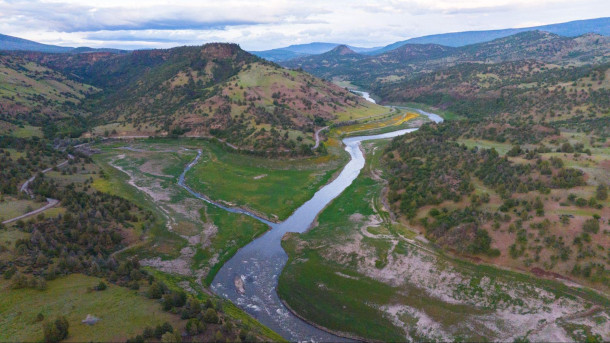
A bird’s-eye view of the Klamath River, once the third largest salmon producing river in the continental U.S. Many Indigenous peoples along the river, including the Yurok Tribe, have led efforts to protect and restore its waters through the removal of major dams. (Photo: Ridges to Riffles)
DOERING: They were not prepared for that. Yeah. [LAUGH]
BOWERS CORDALIS: No, no, they no! I mean, like, had somebody pulled out a gun, they would have been ready for that. But like, some deep, you know, like cultural nature power like no, they were totally freaked out, and then they never came back. You know, so that's how powerful she was, that she could control things. And I really enjoy sharing that story with people because it reflects the deep power, the deep relationship of the Indian way that Yurok people have, and I think it's important for folks to know that that kind of relationship is possible between humans and nature. It's possible through ceremony and ritual and prayer and living a really good life, and it's not gone. You know, it's not gone.
[MUSIC: Redwood Solitude]
DOERING: We’re speaking with Amy Bowers Cordalis, Yurok author of The Water Remembers: My Indigenous Family’s Fight to Save a River and a Way of Life. We’ll be back with more right after the break. Keep listening to Living on Earth!
ANNOUNCER: Support for Living on Earth comes from Hansjörg Wyss in honor of Rosamund Stone Zander. Celebrated painter, environmentalist, and author of The Art of Possibility, who inspired others to see the profound interconnectedness of all living things, and to act with courage and creativity on behalf of our planet. Support also comes from Sailors for the Sea and Oceana. Helping boaters race clean, sail green and protect the seas they love. More information at SailorsForTheSea.org
[CUTAWAY MUSIC: R. Carlos Nakai, Black Lodge, William Eaton, “Beyond The Edge” on Ancestral Voices, Canyon Records]
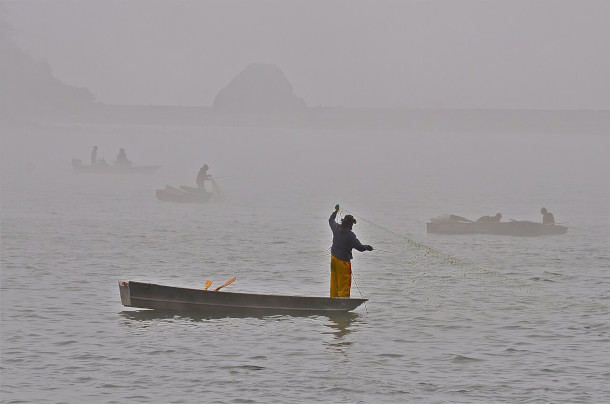
Yurok fishermen on the Klamath River. The tribe’s culture and livelihood for generations have been connected to the salmon runs, with the spring fishing season long serving as a time of gathering and unity for the community. (Photo: Linda Tanner, Wikimedia Commons, CC BY-SA 2.0.)
O’NEILL: It’s Living on Earth, I’m Aynsley O’Neill.
DOERING: And I’m Jenni Doering.
We’re back with more from my conversation with Amy Bowers Cordalis, Yurok author of The Water Remembers: My Indigenous Family’s Fight to Save a River and a Way of Life. The Yurok people are known as “the salmon people,” and I asked Amy to describe that relationship.
BOWERS CORDALIS: Yeah, our whole way of life to this day revolves around the salmon runs. You know, there's three salmon runs now in the Klamath. There's Spring Chinook, Fall Chinook, and then a Coho run. And when the salmon are running, many people come down to the river. They go to their traditional fish holes. They bring their family and they fish. You know, and that's a great moment of like, unity and commonality. And it's just a very healthy thing to go and do, right? Like you're outside. You're working together as a family. You're catching food for your family in this place where you know, your family has been fishing since the beginning of time. So it's so deep and powerful just on that level, and then you add the element of fun. When the fish are running, it is just fun, like you know, it's just a good, good time. And I tried to write about that experience, in a chapter in the book, you know, I talked about how my generation, you know, my sisters and brother and mom, dad, we used to call ourselves Team Fishhog, and we were sort of a well-oiled machine where everybody knew their role and just felt good doing it, and it's really fun just being out there.
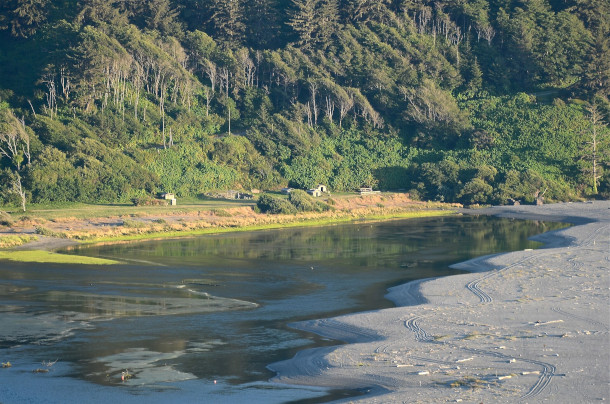
The Klamath River estuary, featuring a number of structures on the bank that are part of a Yurok Tribe ceremonial site. Photo: Linda Tanner, Wikimedia Commons, CC BY-SA 2.0)
DOERING: You're pulling in, you're pulling in these nets, and then untangling the fish, and they're like flapping around, and yeah, it sounds amazing. It sounds fun.
BOWERS CORDALIS: Well, yeah, and your adrenaline is pumping because you know these salmon are large salmon, and when you do everything right, you catch them when they first get caught in the net, and so they're still alive, and they're fighting for their lives. And literally, you're checking the net, and you're pulling the net up out of the water. And when you find the salmon, you have to lean over the side of the boat and do a hefty lift to get the salmon in the boat, and it's flopping around and then you got to untangle it. And you know the thing that my dad taught us too was, you always thank the fish for giving its life so that you can continue yours. And so there's this deep respect for the fish, and we always make sure that we use almost every piece of the salmon to honor that salmon. And then a big thing too, you know, I should share is that the Yurok tribe heavily regulates its fishery to try to ensure sustainable practices. We haven't had a commercial fishery in over 10 years because the salmon runs are so compromised, and so we've greatly reduced our catch and limited our livelihoods in order to protect the salmon because that's our responsibility to it. a]And I think that's really important to appreciate is like yes, we have this great privilege of being the beneficiaries of these iconic salmon runs, but we also have this responsibility of caring for them, and we try to do that in a multitude of ways. By restoring the river, by limiting our fishing practices, all the things. So it's a symbiotic relationship.
DOERING: Yeah, and you took it all the way to court, and well, you took it into this partnership with actually the company that owned the dams itself. You wanted to help restore the river in a way that would mean that the river could flow for the first time in more than 100 years. So, just remind us why are these dams so damaging to the salmon ecosystem? Like, why, you know, why was this so important? These dams were for a while; they were making electricity. It's very expensive to take them out. So, why is that so important?
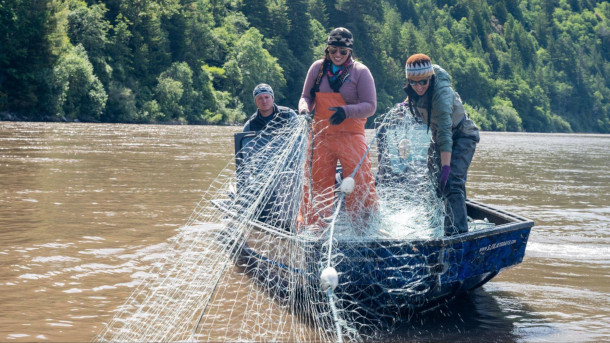
Amy Bowers Cordalis, right, aboard a fishing boat with her sister Ashley Bowers, center. Cordalis’s family used to spend spring fishing together on the Klamath River. In her book, Amy Bowers Cordalis recollects on these trips and the bonds they forged in her book. (Photo: Swiftwater Films, Courtesy of Amy Bowers Cordalis)
BOWERS CORDALIS: Yeah, excellent place to start. So, in a little more context, the Klamath River was historically the third largest salmon-producing river in the continental U.S. and in part that's because of the stewardship of the indigenous peoples on the Klamath, right? Like we actively managed it so that the salmon could grow and the river was healthy, and then of course when colonization happened, all that changed. So, there were four dams that were built in the mid part of the Klamath between 1913 and 1964, and they blocked salmon from spawning. They were built without fish ladders. So Iron Gate Dam was literally an iron gate that blocked any salmon from passing, and if you go, even in my lifetime, if you went to Iron Gate Dam, it looked like a salmon graveyard. There were carcasses of rotting salmon who had died trying to get past the dam and failed because there's no fish passage, so that was one big reason why they were harmful. But then the other one is that behind the dams there were, so four dams, and then there were about 2000 acres of reservoirs that were created by the dams. And underneath those reservoirs there were several cold water springs that used to come up and flow down the river and chill the entire 173 miles of the river from the point of Iron Gate all the way down to the mouth of the river, and so that cold water was blocked. And then on top of that, there was agricultural runoff that came off the Klamath Reclamation Project, which is one of the largest reclamation projects in the whole country, and that was built, the construction started in 1905, and essentially they drained about 2,000 acres of wetlands that were connected to the Klamath system.
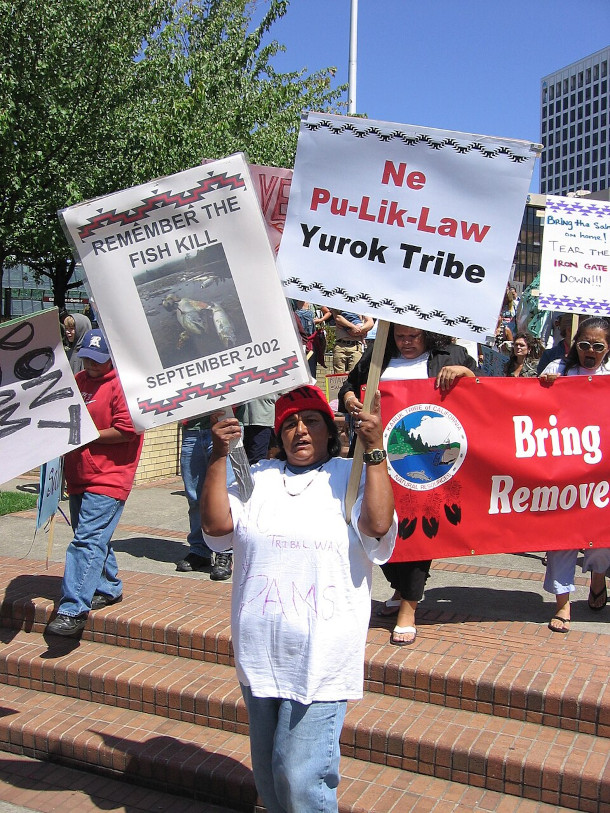
Members of Klamath Basin Tribes joined by the commercial fishing and conservation groups rallied outside the bi-annual meeting of the international hydropower industry -- Hydrovision 2006. They were calling for the removal of PacifiCorp’s four Klamath River dams as part of efforts to restore the river’s salmon runs. Photo taken on August 2nd, 2006. (Photo: Patrick McCully, Wikimedia Commons, CC BY-SA 2.0)
They drained Lower Klamath Lake, they built canals and then diverted a bunch of water out to the fields, and as a result of having been built on wetlands, you apply agricultural chemicals, and then that went into the river, which eventually pooled behind these dams in the 2000 acres of reservoirs. And so, what happened was that the water quality was terrible, and the water temperatures just skyrocketed, and every year we would have outbreaks of toxic blue-green algae, which would then go down the river. And then there's this other interesting thing too, is that the dams disrupted the natural sort of flow of sediment down the river, such that like below the dams you didn't have a natural riverbed with sediment, and that's really important because that sediment usually like it's almost like a scrub brush that cleans the bottom of the river, and so the conditions the dams were creating were one, they were blocking salmon passage, and then two, it was poisoning the water that came below, and then the water was poisoned and hot, and then you didn't have the little you know sediment scrubbing the bottom, and so the bottom of the river got really dirty, so think about like the nastiest dishwater you've ever been in that is like turning toxic green and bubbling and toiling like that's, that's, that was essentially what was happening. And then the dams, in many ways, were becoming obsolete because they were producing a very very small percentage of Pacificorp, the owners eventual owners, overall power portfolio, and then eventually we got to a FERC hearing about relicensing the dam, and at that point they would have required installation of fish ladders and other significant updates in order to comply with existing law, and so it just didn't make sense to keep them in anymore.
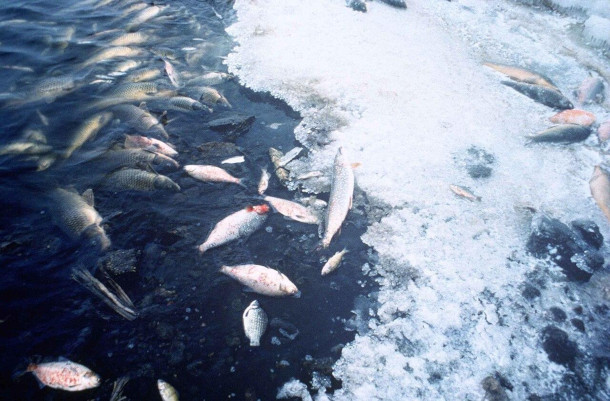
A fish kill, like that shown above, is a mass die-off of a local fish population. While the above fish kill came from a drop in dissolved oxygen thanks to cold temperatures, there are a variety of causes behind a fish die-off. The Yurok tribe has documented several fish kills in the Klamath River. One of the worst fish kills documented was in 2002 when 34,000 to over 70,000 adult Chinook salmon died. (Photo: United States Fish and Wildlife Service, Public Domain)
DOERING: And Amy, it took tragically this fish kill crisis that you mentioned to wake up the world to all of these problems. Like, who could imagine that so many different problems could come from you know one structure from– well four of these dams on this river. So you were there when this fish kill happened, but it sounds like from your book, in the end, I think you kind of came to recognize that death was, was necessary, that it led to new life for the river. So tell us about that horrible moment, and then what followed.
BOWERS CORDALIS: Yeah, it um, it was heavy. And it was, all of this has been a part of the indigenous peoples on the Klamath recovering from colonization. And so, what had happened, and I write about this in the book, was that we hosted a world renewal ceremony that hadn't been done in 100 years, and in its resurrection, there were questions about whether it could be done right, and also an acknowledgement that the medicine was so powerful it could be fatal, and it could be fatal to people, it could be fatal to salmon.
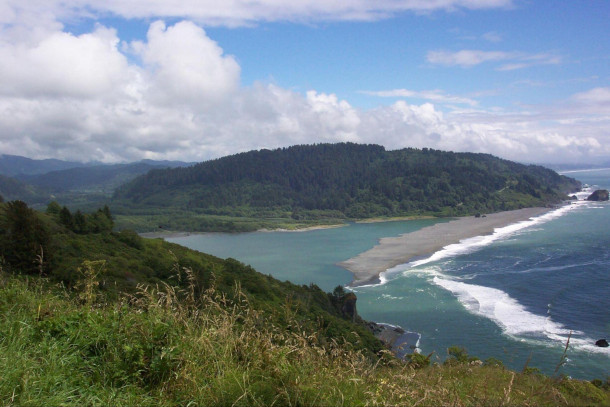
Shown above is the mouth of the Klamath River where it meets the Pacific Ocean. (Photo: Jennifer Silveira, USFWS, Public Domain)
So, the salmon started dying on the last day of that dance, the day they, you know, were closing it up, and it's a 10-day dance, and then the salmon started dying, and so, you know, at the time, it was so tragic, and there's different estimates. The Yurok tribe says it's somewhere about 70,000 salmon that died. It was completely caused by illegal water diversions that caused the river water levels to drop lowest they'd ever been on record, right at a time when a very large salmon run returned to the river. And so it was like this perfect storm of low flows, big salmon run, and also it was hot and a drought, and so a fish disease spread and killed all those salmon, and the fish disease was called ick. And once it starts, it's very difficult to stop it, and so that's why so many salmon died, and we didn't know, like, was that the ceremony's medicine, and how was it working? And in any event, the fish kill launched, you know, myself, but also a whole new generation of Yurok people, of Indigenous people from the Klamath and our allies into the fight to protect the river. And it was an eye opener because I think the whole– well, all the people who worked on the Klamath realized like we can't keep managing this river the same way we had been, and we really needed to figure out a path to restoring the river. Otherwise, it was gonna die right before our eyes. And at Yurok, one, there's our relationship to the river, our responsibilities, our relationship to the salmon. But also, there's a myth that says if the Klamath salmon die, so too will the Yurok people, because there will be no more purpose for us on Earth. And so, seeing those salmon die in such large quantities, and also seeing our river just filled with dead salmon bodies, and it smelled like a war zone. You know, for us, it's literally we're witnessing the end of the world. It was an existential crisis, and so we all responded with that level of urgency. And many people went and got degrees, me including. But you know, there was people who became scientists. There were people who led grassroots movements. There were people that went into tribal leadership, and it really launched the undam the Klamath movement that led to the undamming of the Klamath. And so now I, I look back, and it is undeniable that the medicine of that first world renewal ceremony was very powerful. And I, in the book, you know, write about how maybe there was an agreement between the creator and the, and the salmon, where the creator said, "We'll take this one for the team". [LAUGH] You know, sort of like a martyr.
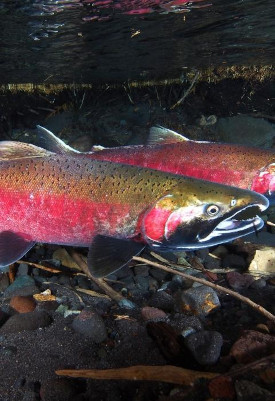
Two coho salmon swimming. (Photo: Roger Tabor/USFWS, Flickr, Public Domain)
DOERING: It'll, it'll be bad for a bit and a while, and then it will get better. What is the health of the river now? Can you share an update for us on the Klamath River since the dam removal was completed?
BOWERS CORDALIS: Yeah, so the river is healing. Water quality has improved, water temperatures have dropped, and following the first year of dam removal, even more salmon came home and went even further into the tributaries up in Oregon, past Upper Klamath Lake. And we also had a nice outmigration of babies from the places that they spawned, and so it's an exciting time to be watching the, the sort of– and we don't use the word recolonization, but that is like the the technical word that they use when you reintroduce salmon. We're like, no... [LAUGH]
DOERING: You don't want to be seen as, as colonizers, right? I get that.
BOWERS: [LAUGH] No we're not recolonizing. But they're you know they're they're replenishing and going home and creating their homes and growing, let's say that. So that's pretty remarkable. We've been able to reduce carbon emissions significantly. Those reservoirs were emitting a lot of methane, and so by removing the dams, we have reduced the carbon footprint significantly on the river. We've returned land to the Shasta Indian Nations, so that's pretty exciting. We've got people, Indians too, going home to and back to their traditional lands, so that's been encouraging.
DOERING: Lands that were flooded by these reservoirs.
BOWERS CORDALIS: Yeah, exactly, yeah. The Yurok tribe has planted over 20 billion, billion with a B, native seeds throughout the whole project area, and are rebuilding ecosystems with traditional foods like acorns and hazels and different basket making materials. And with those new ecosystems, all the creatures that survive and live off them are also coming back. And it's all about fixing the world, and putting things back together so that everything can play their role, so that the balance is restored. And I think when the balance is restored, that's when that Indian way becomes so powerful. You know, we're talking about Geneva, and it's not something that has to just be limited to us. This could be an approach, a model, a way of thinking that the world gets behind. And that was one of the points that I tried to make in the book, ss you know, Klamath dam removal and the work we did was really a model for how we can heal the planet and bring a lot of social, political, and economic stability to the Earth.
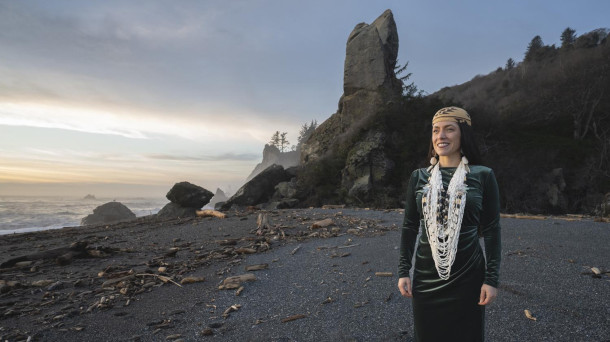
Amy Bowers Cordalis is the author of The Water Remembers: My Indigenous Family's Fight to Save a River and a Way of Life. (Photo: Courtesy of Amy Bowers Cordalis)
We were able, with the dam removal, to use grassroots, use the law, policy, and leadership to enter into a $500 million settlement agreement that equally valued the rights of nature, business, and indigenous peoples. And dam removal, at the end of the day, it was profitable. Like there was a, you know, a company that came in and did the dam removal and made money. They wouldn't have been there had it not been profitable. But then also, it was huge for protecting our way of life, huge for restoring the river and the salmon. And so what that tells me is, if we can do it on the Klamath, it could be replicated anywhere. And if you can bring about that kind of, like, stability, and still use some of our dominant, you know, modes of being, capitalism, for example, like there's a way forward where we can really change the trajectory and honor the earth, restore the earth, honor indigenous cultures, and still, you know, be in business. Sure, we have to make some adjustments, but there's a model there that starts on the Klamath.
DOERING: Amy Bowers Cordalis is the author of The Water Remembers: My Indigenous Family's Fight to Save a River and a Way of Life. Thank you so much, Amy.
BOWERS CORDALIS: Well, thank you, wokhleř, to you and to the audience for being here, it's really a pleasure.
Related links:
- Learn more about Amy Bowers Cordalis
- Purchase a copy of The Water Remembers: My Indigenous Family's Fight to Save a River and a Way of Life on Bookshop, which supports indie bookstores and nonprofits like LOE
- Learn more about Ridges to Riffles Conservation Group
- Watch the full live virtual event here
[MUSIC: Redwood Morning]
O’NEILL: Living on Earth is produced by the World Media Foundation. Our crew includes Naomi Arenberg, Paloma Beltran, Mia DiLorenzo, Abby Edgecumbe, Swayam Gagneja, Mark Kausch, Mark Seth Lender, Don Lyman, Ashanti Mclean, Nhung Nguyen, Sophia Pandelidis, Jake Rego, Andrew Skerritt, Bella Smith, and El Wilson.
DOERING: Tom Tiger engineered our show. Allison Lirish Dean composed our themes.
You can hear us anytime at L-O-E dot org, Apple Podcasts and YouTube Music, and like us please, on our Facebook page, Living on Earth. Find us on Instagram, Threads and BlueSky at Living on Earth radio. And we always welcome your feedback at comments at loe.org. Steve Curwood is our Executive Producer. I’m Jenni Doering.
O’NEILL: And I’m Aynsley O’Neill. Thanks for listening!
ANNOUNCER: Funding for Living on Earth comes from you, our listeners, and from the University of Massachusetts, Boston, in association with its School for the Environment, developing the next generation of environmental leaders. And from the Grantham Foundation for the protection of the environment, supporting strategic communications and collaboration in solving the world’s most pressing environmental problems.
ANNOUNCER 2: PRX.
Living on Earth wants to hear from you!
Living on Earth
62 Calef Highway, Suite 212
Lee, NH 03861
Telephone: 617-287-4121
E-mail: comments@loe.org
Newsletter [Click here]
Donate to Living on Earth!
Living on Earth is an independent media program and relies entirely on contributions from listeners and institutions supporting public service. Please donate now to preserve an independent environmental voice.
NewsletterLiving on Earth offers a weekly delivery of the show's rundown to your mailbox. Sign up for our newsletter today!
 Sailors For The Sea: Be the change you want to sea.
 The Grantham Foundation for the Protection of the Environment: Committed to protecting and improving the health of the global environment.
 Contribute to Living on Earth and receive, as our gift to you, an archival print of one of Mark Seth Lender's extraordinary wildlife photographs. Follow the link to see Mark's current collection of photographs.
 Buy a signed copy of Mark Seth Lender's book Smeagull the Seagull & support Living on Earth
© Copyright World Media Foundation. All Rights Reserved
Home | Contact | RSS | Donate | Newsletter