
Trump Attempts to Shrink Bears Ears -- Again
Air Date: Week of July 31, 2026
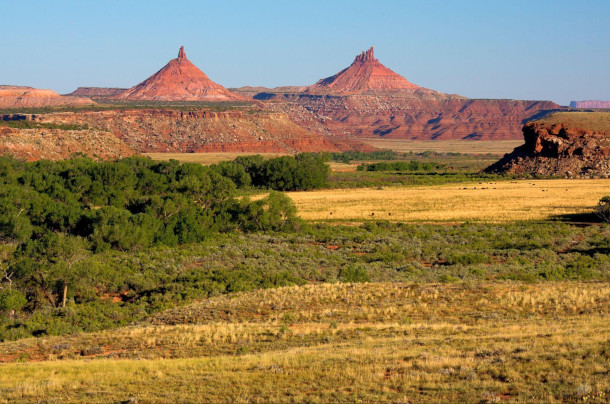
Indian Creek, pictured above, is the northernmost section of the Bears Ears National Monument in San Juan County, Utah. (Photo: US Bureau of Land Management, public domain, via Wikimedia Commons)
On July 13, 2026, President Trump issued a proclamation reducing the Bears Ears and Grand Staircase-Escalante national monuments in southern Utah by about 90 percent, to remove almost 3 million acres from monument status. Matthew Campbell, Deputy Director of the Native American Rights Fund, joined Living on Earth’s Paloma Beltran to discuss the significance of these places to several local tribes who co-manage them, and why in their view the President lacks the authority to slash monuments.
Transcript
DOERING: It’s Living on Earth, I’m Jenni Doering
O’NEILL: And I’m Aynsley O’Neill.
In southern Utah, the Bears Ears and Grand Staircase-Escalante national monuments include dramatic landscapes of deep canyons, rocky cliffs, and vast plateaus. But beyond their natural beauty, these places are also the ancestral homelands of several indigenous peoples, including the Navajo Nation or Diné, the Hopi Tribe, Pueblo of Zuni, the Ute Mountain Ute Tribe, and the Ute Indian Tribe. On July 13, 2026, President Trump issued a proclamation reducing the two monuments by about 90 percent, to remove almost 3 million acres from monument status. President Trump made a similar proclamation back in 2017 during his first term, though it was made moot by President Biden in 2021. The Native American Rights Fund has been representing three of the tribal nations since 2017 in a lawsuit against President Trump for his initial efforts to shrink the monuments. Matthew Campbell is their Deputy Director, and he joined Living on Earth’s Paloma Beltran.
BELTRAN: So, give us a sense of place here, you know, of these two national monuments, Bears Ears and Grand Staircase-Escalante. What do these landscapes look like, and why are they so significant for the indigenous tribes in the region?
CAMPBELL: Yeah, both Bears Ears and Grand Staircase are immensely important for the tribal nations of the region, you know, it's a place where the tribal nations and their members go to have ceremony. It's a place where they continue to go to collect different medicines, herbs, and berries and things like that. And it's a place where their ancestors are buried and and where they have prayers that are imbued with the land there. You know, there are different petroglyphs. There are different ceremonial sites. For example, the Ute Mountain Utes still have a bear dance every year within the Bears Ears region, and so, immensely important places, sacred places. They're connected to their histories, their past, and who they are still to this day.
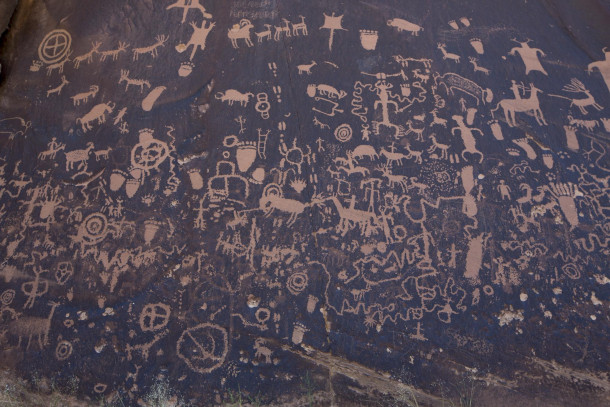
The petroglyphs on Newspaper Rock in Bears Ears can be attributed to the ancient Puebloan people and the Ute people who continue to live in the region. Bears Ears remains a sacred landscape to many tribes in the southwestern United States. (Photo: Bob Wick, Utah Bureau of Land Management, via Wikimedia Commons)
BELTRAN: I mean, it's their ancestral homeland.
CAMPBELL: Yeah, absolutely.
BELTRAN: So President Trump moved to reduce Bears Ears and Grand Staircase-Escalante, what exactly does the proclamation say, and what does it mean?
CAMPBELL: Well, I want to say 90% of Bear's Ears was revoked, and I think that it was close for Grand Staircase as well to that number. That is an immense amount of land, but one of the biggest things that was most devastating, in addition to removing the lands and the protections that go with that, was purporting to terminate and disband the Bears Ears Tribal Commission that was established to work closely with the United States on managing the monuments.
BELTRAN: So, what does terminating the commission, the tribal commission, mean in this case?
CAMPBELL: Yeah, well, the commission was created and recognized by both President Obama and President Biden, and it was really created to build up and lift up the government-to-government relationship that the United States has with tribal nations, and ensure that they have a really important say in how the monument is managed. And so, the previous proclamations and the land use plans that were adopted as part of those proclamations in 2025 required the United States to collaborate with the tribal nations on a number of things in terms of implementing the management plan. So it really was recognizing the sovereign status of the tribal nations and that historical government-to-government relationship, and building it up and providing more meat on the bones to that relationship and requirements on the United States. It was a very big deal and something that the tribal nations, all five tribal nations that are part of the commission, had been advocating for for quite some time.
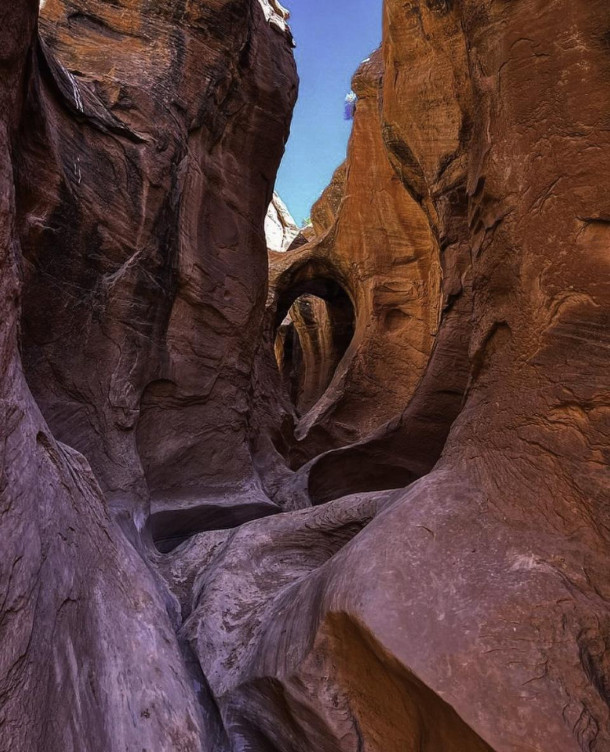
The slot canyons in Grand Staircase-Escalante National Monument have become a popular recreation area for hikers visiting the monument. (Photo: Utah Bureau of Land Management, via Wikimedia Commons)
BELTRAN: So, President Trump moved to eliminate the Bears Ears Commission, which ensures that Indigenous tribes get a say in the management of Bears Ears. To what extent is that legal?
CAMPBELL: Well, our view is that that is not legal, and that what actually governs is what has been adopted within the land management plan, the promises that were made within the governmental agreement between the United States and the tribes, and I think important to lift up, one of the promises was that the United States would consult with the tribe before changing any of the boundaries of the monument, and that did not happen here, so we've already seen a breach of those promises that have been made. But our view is that no, the land management plan and the governmental agreement that has been entered into is what still governs, and that of course that the president more broadly doesn't have authority to revoke national monuments. The Antiquities Act of 1906 was a statute that Congress passed in order to protect historic and scientific objects and other historic landmarks and structures. And our view is that the Antiquities Act and the language of the statute is very clear. It authorizes presidents to declare national monuments and reserve lands as part of them, but what it doesn't do is authorize the president to do the exact opposite or undeclare a monument and unreserve lands. I think, in our view, and as Congress has understood, it's a one-way street. It allows presidents to create monuments to protect objects, but the statute reserved to Congress the authority to undo monuments if it so chooses.
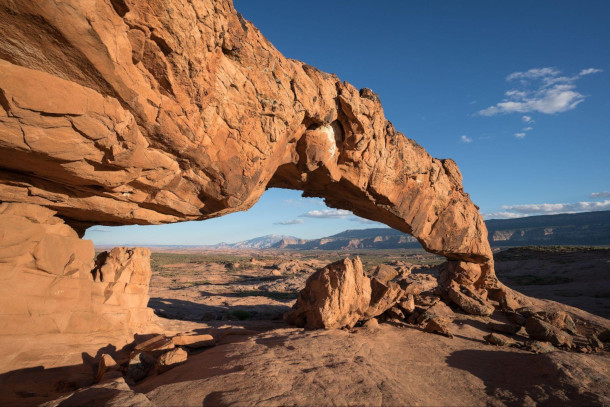
The Grand Staircase-Escalante National Monument would be 90% smaller if President Trump’s modification proclamation of July of 2026 goes into effect. (Photo: Utah Bureau of Land Management, Wikimedia Commons, public domain)
BELTRAN: And Matthew, what happens if these massive reductions go through? What will change for these landscapes?
CAMPBELL: Yeah. Some of the biggest things that are really important is the reduction of the protections for over 90% of the lands, and one of the biggest removals of protections is opening up these lands for different mining and other oil and gas development. So these national monuments and lands within those are protected from mining operations. But now that President Trump has purported to remove those protections, there will be the opportunity for businesses and mining companies, oil and gas companies, to now go in and stake claims and and try and begin operations within these lands, so that's one of the biggest concerns I think the tribes have, and, and others. Uranium mining was a major concern for the tribal nations within the Bears Ears region, but also with things like off-road vehicle use, grave robbing, and looting has been a concern in the past as well. I think those are some of the biggest concerns with regard to these protections now being removed.
BELTRAN: And to what extent or how might legal action put a pause or at least a stay on the opening up of these lands?
CAMPBELL: Yeah, absolutely. I think the proclamation itself has a 60-day period that no activity can happen within 60 days, and then after that, we will be monitoring closely the situation on the ground to see if there are any imminent harms that are happening. And then, if that is the case, we likely would be asking the court to put a hold to any of those activities.
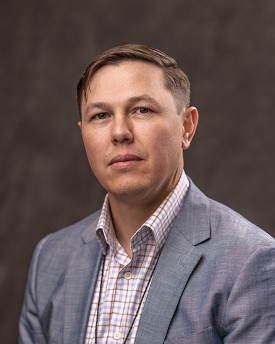
Matthew Campbell is Deputy Director of the Native American Rights Fund, an organization focused on legal advocacy for tribal rights and sovereignty. (Photo: Courtesy of Matthew Campbell)
BELTRAN: And Matthew, you represent the people who have lived there since time immemorial. How do they feel about this? What have you been hearing from them?
CAMPBELL: Yeah, absolutely. Well, I think there has been a real sense of grief. There was real shock when the proclamation was announced just a few weeks ago, and the Bears Ears tribal nations and the tribal commission have put in close to a decade in terms of developing a very respectful plan for managing these lands that recognizes the cultural and traditional importance of them. And so there was a sense of grief when the commission was purportedly terminated. It was almost as if we were at a funeral. Everyone was really down, and in a sense of shock as to what had taken place, given the role that they had been having in managing these lands with the federal government. So yeah, there was the grieving period and shock, but also a sense of resolve that you know they've been fighting to protect these lands for centuries, and their communities have, and that they will continue that fight.
O’NEILL: That’s Native American Rights Fund Deputy Director Matthew Campbell, speaking with Living on Earth’s Paloma Beltran. A Department of the Interior spokesperson provided a statement that reads in part, “The Obama and Biden administrations repeatedly weaponized the Antiquities Act to lock up millions of acres of Utah's public lands over the explicit objections of the state's elected leaders…
President Trump is rectifying this wrong.” We’ll link to the full statement on the Living on Earth website, loe dot org.
Links
Read President Trump’s proclamation aimed at modifying Bears Ears National Monument
Read President Trump’s proclamation aimed at modifying Grand Staircase-Escalante National Monument
Living on Earth wants to hear from you!
Living on Earth
62 Calef Highway, Suite 212
Lee, NH 03861
Telephone: 617-287-4121
E-mail: comments@loe.org
Newsletter [Click here]
Donate to Living on Earth!
Living on Earth is an independent media program and relies entirely on contributions from listeners and institutions supporting public service. Please donate now to preserve an independent environmental voice.
NewsletterLiving on Earth offers a weekly delivery of the show's rundown to your mailbox. Sign up for our newsletter today!
 Sailors For The Sea: Be the change you want to sea.
 The Grantham Foundation for the Protection of the Environment: Committed to protecting and improving the health of the global environment.
 Contribute to Living on Earth and receive, as our gift to you, an archival print of one of Mark Seth Lender's extraordinary wildlife photographs. Follow the link to see Mark's current collection of photographs.
 Buy a signed copy of Mark Seth Lender's book Smeagull the Seagull & support Living on Earth
© Copyright World Media Foundation. All Rights Reserved
Home | Contact | RSS | Donate | Newsletter