

Hints of Life on Mars
Air Date: Week of July 31, 2026
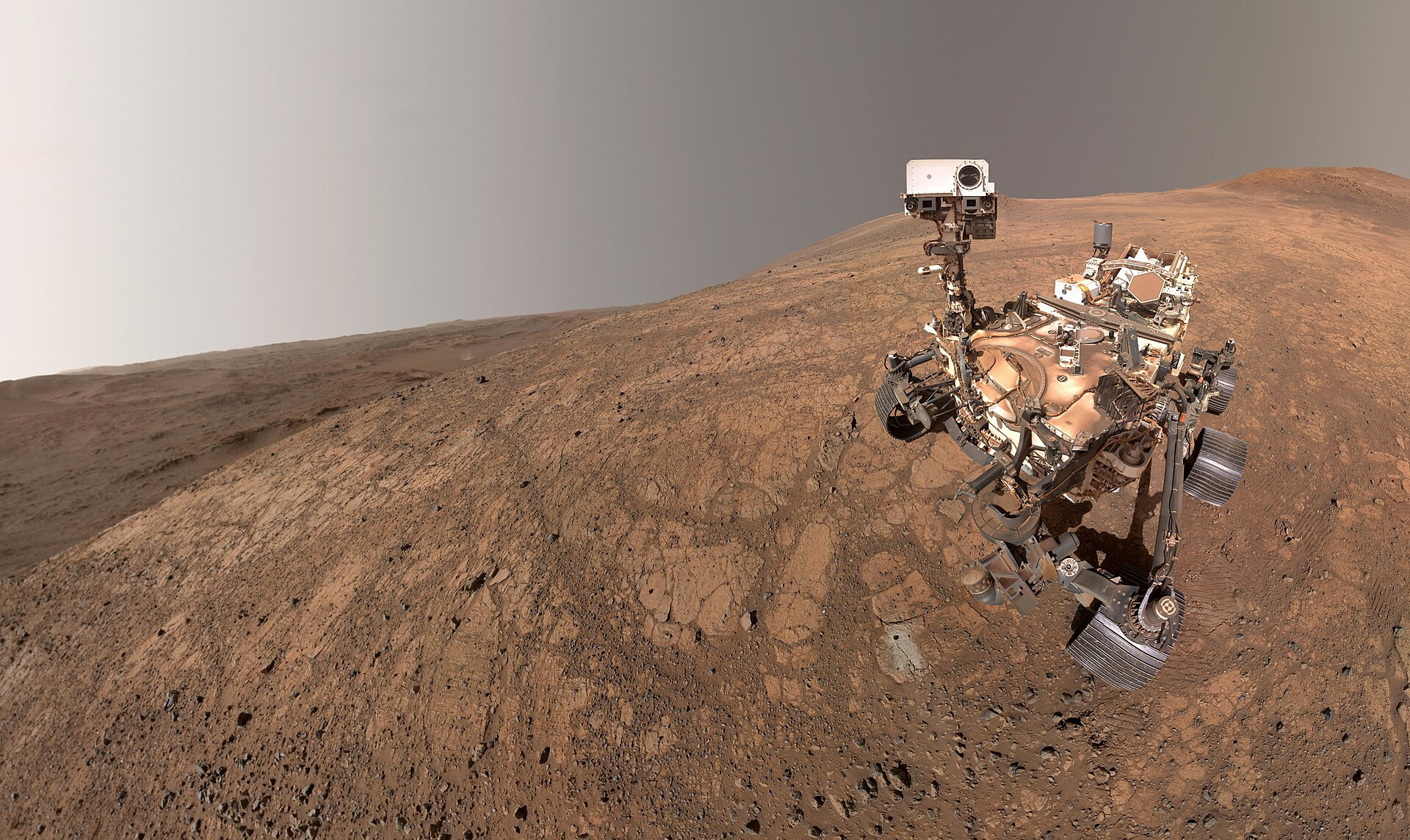
NASA’s Perseverance rover has been roaming Mars since February 2021. The rover took this “selfie” in May 2025. (Photo: NASA/JPL-Caltech, Wikimedia Commons, Public Domain)
On Mars, our planet’s rocky twin, NASA’s Perseverance Rover is seeking signs of past life in Jezero Crater. Now, scientists say they may have uncovered some of the most compelling evidence yet, in the form of complex carbon molecules in Martian mudstones. Planetary scientist Dr. Kevin Hand of the Jet Propulsion Laboratory joins Host Aynsley O’Neill to explain the buzz about these “potential biosignatures.”
Transcript
DOERING: From PRX and the Jennifer and Ted Stanley Studios at the University of Massachusetts Boston, this is Living on Earth. I’m Jenni Doering
O’NEILL: And I’m Aynsley O’Neill.
On our planet’s rocky twin Mars, NASA’s Perseverance Rover is seeking signs of past life in Jezero Crater. Now, scientists say they may have uncovered some of the most compelling evidence yet. In late June, Perseverance detected complex carbon molecules in Martian mudstones using an instrument called the Sherloc spectrometer. The tool works by shining a laser onto ancient rocks to analyze the molecules within. And this time, the molecules within were organic compounds, which were later classified as potential biosignatures. For more, we turn to planetary scientist Dr. Kevin Hand of the Jet Propulsion Laboratory, who is the Principal Investigator of the Sherloc spectrometer on the Perseverance Rover. Kevin, welcome to Living on Earth!
HAND: Thank you so much, Aynsley.
O'NEILL: So, for those of us who don't remember our chemistry classes, what's the significance of organic carbon here?
HAND: So, when it comes to the search for life beyond Earth, we've got a few different kind of mantras. The highest level one is “follow the water.” All life on Earth depends on liquid water, and so when we look beyond Earth for places that might have been habitable or that are currently inhabited, the first thing we're looking for is liquid water. Beyond that, once we've found worlds like Mars where there's evidence of past liquid water, then it's kind of “follow the carbon” because life on Earth is built on carbon, built with carbon, and so when we are roving around on Mars, our spectrometer is looking for those hints of carbon, and in particular carbon-carbon bonds, as an indicator of complex organics and compounds that may be indicative of past life on Mars. Now, just because you find organics or carbon compounds doesn't mean that they have any connection to past life on Mars or past life on any of these worlds we're investigating. We see plenty of complex organics in material returned from asteroids, and we see it in the interstellar media, etc. But what was particularly intriguing about the organics that the Sherloc spectrometer found and detected on Mars is that we found these compounds in an ancient riverbed. So context matters a lot in this case.
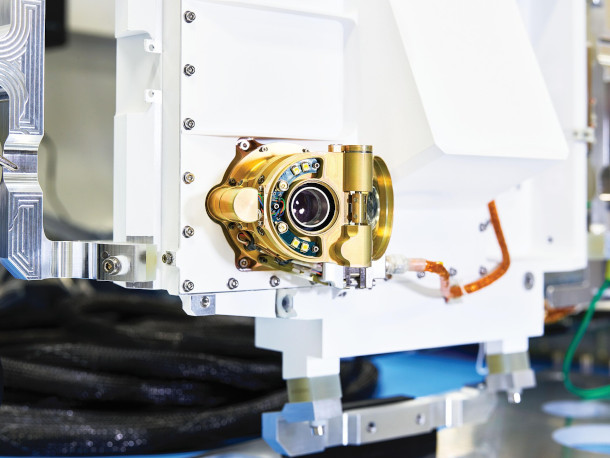
A close-up of the Sherloc spectrometer tool, which is used to detect organic compounds. (Photo: NASA/JPL-Caltech, Wikimedia Commons, Public Domain)
O'NEILL: So tell me about this phrase, potential biosignatures. Why is this the wording that you use here?
HAND: So with such an extraordinary claim, as the search for life often results in, you want to be really cautious with the language. And so, let me give you an example of just a biosignature that everyone would know and love and appreciate. You walk out into, let's say the desert of Utah and you stumble across a dinosaur bone, right? That is, that's a biosignature, and you'd have a really hard time explaining a skeleton structure of a dinosaur non-biologically. But when it comes to microbes and when we talk about the search for life on Mars, we really are talking about the search for evidence of past microbial life, and the signatures that microbes leave are often much more subtle than, say, a dinosaur bone.
O’NEILL: Mhm.
HAND: And so, what did we actually find in Neretva Vallis on Mars? Well, from a mineralogy standpoint, we found these curious ringed structures that we endearingly refer to as poppy seeds and leopard spots. And the key point that you need to understand with these ring structures is that there's a gradient in the mineralogy. In other words, there's energy to be harnessed by exchange of electrons across these various minerals. And what we know about life on Earth is that life, microbial life, loves to utilize that kind of geochemistry. So we found some really compelling mineralogy in the rocks at Bright Angel, which is that outcrop in Neretva Vallis. And then coupled with that, on the Sherloc team, we found with our spectroscopy this evidence of organic carbon and, in particular, macromolecular carbon, large organics, and here you can kind of think of chicken wire, that sort of hexagonal network that visually looks like chicken wire. Well, what we found with Sherloc was that kind of chicken wire structure, but in a jumbled mess. So a lot of carbon connected to other carbon atoms, and that, coupled with the mineralogy, really sets the stage, especially when you put it in an ancient river valley, for us concluding that this could qualify as a potential biosignature.

Jezero Crater, above, was chosen as Perseverance’s landing site because of its history as an ancient riverbed, where organic materials are more likely to be found. (Photo: NASA, Wikimedia Commons, Public Domain)
O'NEILL: Well, I imagine that operating the data-gathering instruments on Perseverance is just tricky. You know, the distance, the time difference that needs to happen when you're sending a set of commands from Earth all the way to Mars. And of course, if something goes wrong, you can't exactly just fix it by opening up a panel and grabbing a wrench. So, what kind of difficulties have you seen as you try and gather this data?
HAND: Yeah, well, there's one very big challenge that we on the the Sherloc team encountered, and so January of 2024, my colleague and deputy Kyle Uckert and I wake up to a message from the downlink, the communication system, that on the Sherloc instrument, our dust cover did not open. What does that mean? Well, Mars is quite a dusty place. There's dust devils and winds and stuff. Some instruments have covers that open and close to make sure that no dust gets in. So we had commanded the dust cover to open, but there was an indication that that command had not worked. Now normally, that's not a huge deal. Small things happen on the rover all the time, but then it did not work again, and we tried again and again and again, it didn't work. So that, in and of itself, Aynsley, was pretty stressful.
O'NEILL: Oh, I bet.
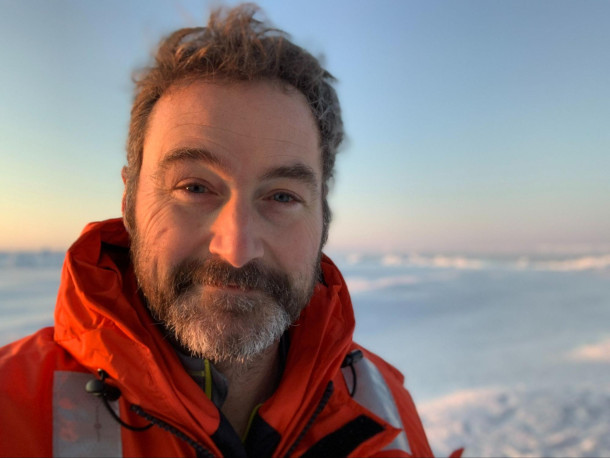
Dr. Kevin P. Hand is the Principal Investigator of the Sherloc spectrometer on the Perseverance Rover. (Photo: Kevin Hand)
HAND: [LAUGHS] But meanwhile, Perseverance rover had been making progress up the delta of Jezero Crater. Part of the whole reason that we landed in Jezero Crater is because we could see these bright deposits right in this ancient riverbed, and the whole team was excited to get down into this valley and look for minerals and organics indicative of past life. So the rover is making progress to this valley. Meanwhile, Kyle and I and our full team are sweating it out each day because if the cover doesn't open by the time we get to these really compelling rocks, we're not going to be able to search for organics. So the weeks go on, the months go on. We gradually figure out how to get the cover a little bit open, a few degrees at a time, but then Mother Nature and Mars helped us out a bit. As we kind of got up on the southern rim of the river valley, the terrain got incredibly rocky, and it slowed down the pace of Perseverance by a lot. So the rover planners and the rest of the science team on the full mission, they were all quite frustrated that progress was slowed. Meanwhile, on my team, on the Sherloc team, we were breathing a huge sigh of relief because that meant we had more time to figure out this anomaly and try and get the dust cover all the way open. And so, by June of 2024, the rover arrived down in the valley, and we had just managed to get our dust cover to be almost fully open, or at least open enough that we could continue to do spectroscopy. And so, if Mars had not been challenging as we tried to rove to the river, we might well have arrived in this valley without the capability to collect some of the key data that was so central to our conclusion that we might actually be looking at potential biosignatures on Mars.
O'NEILL: Well, so how might these findings from Perseverance help us understand our own planet better?
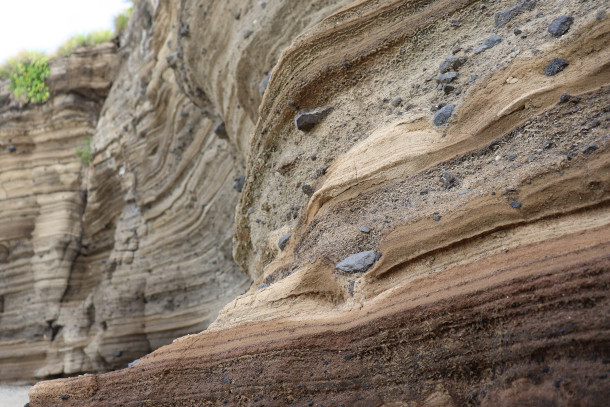
Geochronology is the science of dating rocks and fossils. Looking at rock layers is one method commonly used to find a sample’s relative age. (Photo: Irvin Parco Sto. Tomas, Wikimedia Commons, CC BY-SA 4.0)
HAND: Yeah. Well, first we got to get these samples back so that we can better study the detailed chemistry of these rocks. And so, in my dream of dreams, and the dreams of many of my colleagues, we get these rocks back to Earth. We better understand whether or not the rocks do contain evidence of, of past life on Mars, and coupled with that, we also can do a lot of what's called geochronology. In other words, studying various minerals and elemental ratios to figure out how old the rocks are on Mars. Why is that important? Well, let's say we do get the rocks back, and we arrive at the conclusion that these rocks do contain evidence of past life on Mars, and then imagine that we do the dating of these rocks, and we find that they are 3.6 or 3.8 billion years old. Now we have got an entirely separate planet, Mars, where some of the same conditions on early Mars were what we had here on Earth, and at about the same time we see that life arises on Mars as it did on Earth, and to me, that is so exciting because it means that possibly as soon as a planet becomes habitable, life might arise and the planet becomes inhabited. In other words, when we look out at our solar system and beyond, biology might actually be a universal phenomenon, not just a singularity of some curious conditions that occurred here on planet Earth. So I find that super exciting and, and really kind of captivating when it comes to this ultimate question of, of are we alone?
O'NEILL: Dr. Kevin Hand is the Principal Investigator of the Sherloc spectrometer on the Perseverance rover. Kevin, thank you so much for taking the time with me today.
HAND: Thanks, Aynsley. A pleasure talking with you.
Links
The Guardian | “NASA Rover Detects Potential Signatures of Ancient Microbial Life on Mars”
Living on Earth wants to hear from you!
Living on Earth
62 Calef Highway, Suite 212
Lee, NH 03861
Telephone: 617-287-4121
E-mail: comments@loe.org
Newsletter [Click here]
Donate to Living on Earth!
Living on Earth is an independent media program and relies entirely on contributions from listeners and institutions supporting public service. Please donate now to preserve an independent environmental voice.
NewsletterLiving on Earth offers a weekly delivery of the show's rundown to your mailbox. Sign up for our newsletter today!
 Sailors For The Sea: Be the change you want to sea.
 The Grantham Foundation for the Protection of the Environment: Committed to protecting and improving the health of the global environment.
 Contribute to Living on Earth and receive, as our gift to you, an archival print of one of Mark Seth Lender's extraordinary wildlife photographs. Follow the link to see Mark's current collection of photographs.
 Buy a signed copy of Mark Seth Lender's book Smeagull the Seagull & support Living on Earth
© Copyright World Media Foundation. All Rights Reserved
Home | Contact | RSS | Donate | Newsletter