

Molten, Mushy Planet - Note on Emerging Science
Air Date: Week of July 31, 2026
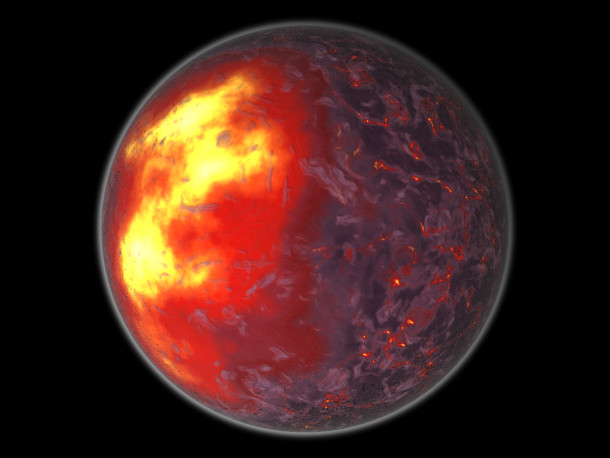
New information about exoplanet L98-59d suggests it has a global magma ocean and possibly a molten core. Above, an artist’s rendering of a liquid, molten planet. (Photo: Merikanto, Wikimedia Commons, CC BY-SA 4.0)
35 light years away from Earth is a planet a bit bigger than ours that’s probably not hospitable to life -- because it’s molten. Scientists have known about L98-59d for years, but new observations from the James Webb Space Telescope helped reveal an atmosphere rich in hydrogen sulfide, which could only be explained if the planet was in a rare molten state. Living on Earth’s El Wilson and Bella Smith teamed up on this note on emerging science.
Transcript
SMITH: Scientists have been studying exoplanets, or planets beyond our solar system, for decades. But a 2026 study published in Nature Astronomy found that one exoplanet is unlike anything we’ve seen before. This planet is called L98-59d, and it’s about 1.6 times the size of Earth and 35 light years away from us. What makes it so special is that, unlike other exoplanets of a similar size and density, it’s neither a rocky planet surrounded by gas, nor a water world. It’s…mushy.
NICHOLLS: It's more like you see those videos of people like poking magma when they go visit Iceland or something like that, it's like a molasses, like a honey type viscosity, you could attempt to walk on it, and given the density of rock, you would not sink, but it would be like walking on molten lava.

Dr. Harrison Nicholls is a postdoctoral researcher at the University of Cambridge’s Institute of Astronomy and co-author of the study. (Photo: Harrison Nicholls)
SMITH: That’s Harrison Nicholls, a postdoctoral research assistant at the University of Cambridge and co-author of the study. He said scientists had known about this planet for years, but new observations from the James Webb Space Telescope revealed that its atmosphere is rich in hydrogen sulfide. In order to sustain such a volatile atmosphere, they concluded the planet must be in a liquid, molten state. Nicholls and his colleagues then used computer simulations to reconstruct the planet’s history. They found that L98-59d likely has a global magma ocean, hundreds of miles deep, and possibly a molten core as well. Planets form through an incredibly energy-intensive process, so young planets are extremely hot and cool over time. But a sulfur-rich atmosphere trapped this planet’s internal heat, preventing it from cooling. So it stayed in this molten, mushy state – even though it’s about 4.5 billion years old. And that hydrogen sulfide atmosphere would likely come with another defining feature: the overwhelming smell of rotten eggs. While this planet is almost certainly uninhabitable, Nicholls is excited about what this new discovery could mean.
NICHOLLS: I think we're going to keep in mind that there's going to be a big diversity of worlds out there, beyond anything we see in the solar system, because planets start molten, and that includes the earth, so by looking at these molten worlds, we can to some extent, look at Earth when it was just born.
SMITH: For Living on Earth, I’m Bella Smith.
Links
The Guardian | “‘A Molten, Mushy State’: Scientists May Have Found a New Type of Liquid Planet”
Read the original study in Nature Astronomy
Living on Earth wants to hear from you!
Living on Earth
62 Calef Highway, Suite 212
Lee, NH 03861
Telephone: 617-287-4121
E-mail: comments@loe.org
Newsletter [Click here]
Donate to Living on Earth!
Living on Earth is an independent media program and relies entirely on contributions from listeners and institutions supporting public service. Please donate now to preserve an independent environmental voice.
NewsletterLiving on Earth offers a weekly delivery of the show's rundown to your mailbox. Sign up for our newsletter today!
 Sailors For The Sea: Be the change you want to sea.
 The Grantham Foundation for the Protection of the Environment: Committed to protecting and improving the health of the global environment.
 Contribute to Living on Earth and receive, as our gift to you, an archival print of one of Mark Seth Lender's extraordinary wildlife photographs. Follow the link to see Mark's current collection of photographs.
 Buy a signed copy of Mark Seth Lender's book Smeagull the Seagull & support Living on Earth
© Copyright World Media Foundation. All Rights Reserved
Home | Contact | RSS | Donate | Newsletter