

This Week's Show
Air Date: November 20, 2026
FULL SHOW
SEGMENTS
Climate Voters in the Midterms
View the page for this story
While climate was not on the ballot directly, many Democrats who made up a historic “blue wave” in the 2026 midterms campaigned on climate adjacent issues like utility affordability and high gas prices. And in a September survey, the Environmental Voter Project found voters in battleground states want politicians to spend more time talking about climate change, not less, offering insight into how climate might play out in the primaries of 2028. EVP founder and executive director Nathaniel Stinnett talks with Host Aynsley O’Neill. (12:18)
Oceans at ‘The Blue COP’
/ Sophia PandelidisView the page for this story
As the annual negotiations of the UN climate treaty or COP31 conclude in Antalya, Türkiye, Living on Earth’s Sophia Pandelidis, who is there with Producer Paloma Beltran, joins Hosts Aynsley O’Neill and Jenni Doering to discuss a focus at this COP on oceans. The world’s oceans absorb 25 to 30% of carbon dioxide emissions and over 90% of excess heat trapped by greenhouse gases. Island states, ocean researchers and advocates are driving a discussion about how to support that capacity as well as adapt to cascading effects of warming and acidifying oceans. (10:41)
Seasonal Butternut Squash Mac and Cheese
/ Bella Smith, Jenni Doering, and Aynsley O'NeillView the page for this story
Mac and cheese, one of the most beloved comfort foods there is, can highlight a seasonal autumn vegetable – butternut squash. And the dish might just be the star of your Thanksgiving feast. Living on Earth’s Bella Smith joins Hosts Aynsley O’Neill and Jenni Doering for a cooking adventure with some sustainable tips to boot. (09:21)

A Native Perspective of the First Thanksgiving
View the page for this story
The story of the “first Thanksgiving” that persists in American culture often stereotypes Native peoples and sanitizes what happened to them as white settlers dispossessed them of their lands. A picture book written and illustrated by Indigenous authors offers a new story of the “first Thanksgiving” that centers the Three Sisters crops. Author Tony Perry joins Host Jenni Doering to discuss the inspiration for Keepunumuk: Weeâchumun’s Thanksgiving Story and share ideas for creating a more inclusive holiday. (13:13)

Listening on Earth: The Many Sounds of Wild Turkeys
View the page for this story
The wild cousins of the centerpiece on many Thanksgiving tables do more than just gobble. Turkeys squawk, chirp, and even softly “purr” to express contentment in a flock. (01:04)
Show Credits and Funders
Show Transcript
261120 Transcript
HOSTS: Jenni Doering, Aynsley O’Neill
GUESTS: Tony Perry, Nathaniel Stinnett
REPORTERS: Bella Smith, Paloma Beltran, Sophia Pandelidis
[THEME]
DOERING: From PRX – this is Living On Earth.
[THEME]
DOERING: I’m Jenni Doering
O’NEILL: And I’m Aynsley O’Neill.
Climate voters and the “blue tsunami” of the 2026 midterms.
STINNETT: Voters in Texas are very concerned about climate and environmental issues, and the fact that Democrats swept every statewide office -- It's a real opportunity for a state that is at the very center of how we make energy and electricity in the United States.
DOERING: Also, reckoning with the painful aftermath of the Pilgrims and white settlement.
PERRY: Use the holiday as a way to think about the Native peoples where families are living, right? So if a family’s having Thanksgiving, it’s an opportunity to ask those questions around, well whose land was this originally? Who are the Native peoples that live or lived in this land?
DOERING: That and more, this week on Living on Earth. Stick around!
[NEWSBREAK MUSIC: Boards Of Canada “Zoetrope” from “In A Beautiful Place Out In The Country” (Warp Records 2000)]
[THEME]
Climate Voters in the Midterms
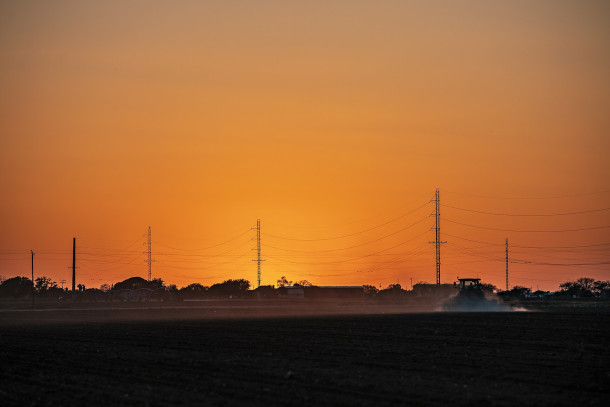
While climate wasn’t explicitly on the ballot this year, Stinnett notes that climate-adjacent issues, such as cost of gas and electricity, were high on the list of voters’ concerns. Above, power lines behind a sprayer in a field in Hondo, Texas. (Photo: USDA, Wikimedia Commons, Public Domain)
DOERING: From PRX and the Jennifer and Ted Stanley Studios at the University of Massachusetts Boston, this is Living on Earth. I’m Jenni Doering.
O’NEILL: And I’m Aynsley O’Neill.
With late word from Alaska, Democrats now have 56 seats in the US Senate. While climate was not on the ballot directly, many campaigned on climate-adjacent issues like utility affordability and high gas prices. In a September survey, the Environmental Voter Project found voters in battleground states want politicians to spend more time talking about climate change, not less. That challenges the wisdom of what’s been called “climate hushing” - keeping climate out of political campaigns - and offers insight into how climate might play out in the primaries of 2028. EVP founder and executive director Nathaniel Stinnett is here. Welcome back to Living on Earth, Nathaniel!
STINNETT: Thank you so much, Aynsley. I'm really excited to be here.
O'NEILL: So, for those who don't remember, tell us a little bit about the organization that you founded, the Environmental Voter Project. What is your goal here?
STINNETT: Our goal is to get millions of people who care deeply about climate and the environment who aren't voting to start voting more often, because at the end of the day, the only way we're going to get good climate policy is if voters force politicians to lead on climate. So we've identified tens of millions of people who care deeply about climate and the environment who don't vote, and they are disproportionately young. They're disproportionately people of color, and they're disproportionately lower income. And I know that goes against many of the stereotypes that people have in their mind. I think a lot of people think of environmentalists as sort of driving around in a Prius wearing a fleece or something like that, but it's not. We're seeing that a Latina teenager living in Arizona is just as likely to care deeply about climate and the environment as some hipster living in Brooklyn is.
O'NEILL: And in this November's midterms, I'm sure there were plenty of voters who wouldn't necessarily rank the environment as their number one issue, but they probably cast their ballot with things like data center development and high gas prices in mind. Tell us more about how these issues manifested in this election.
The Environmental Voter Project helps get environment-minded voters to the polls, especially in battleground states like Texas, where the stakes for energy policy are high. (Photo: @environmentalvoter on Instagram)
STINNETT: Yeah, it's a great point. And first, let me just say you're right. It isn't like the words climate change were on everybody's lips this year. They clearly weren't. However, if you look at exit polling data, it is very clear that voters are extraordinarily concerned about gas and diesel prices. We saw that 87% of voters said that they were either very or somewhat concerned about the cost of gas and diesel, and obviously, if you transition away from fossil fuels, you're not going to have those worries. Similarly, 86% were very or somewhat concerned about the cost of utilities. Well over three quarters of voters said that AI and data centers were a significant concern of theirs when they voted. So yeah, climate change wasn't at the front of everybody's mind, but these climate-aligned or climate-adjacent issues were.
O'NEILL: And now Nathaniel, we'll definitely give you some credit, of course, for getting some of those voters out to the polls, I don't want to take that away from you. But if you had to guess what all came together to get environmental voters so fired up for this particular midterms?
STINNETT: It was a perfect storm. I mean, thank you for giving the Environmental Voter Project some credit, Aynsley, but the truth is, I don't think anything was going to stop this historic wave election. And I think a huge part of it was certainly anti-Donald Trump sentiment. I mean, we saw even in the reddest of red states that people were sick of the president, and when you combine that with him not being on the ballot, so he couldn't drive the people who love him to the polls, but the haters still showed up. Boy, did it make it hard for any Republican who was running for office to keep their head above water. This was just an historic election.
O'NEILL: And I want to talk about one of these major pieces of history in Texas, where Democrats had a very surprising series of victories for a very deep red state. We're talking James Talarico in the Senate, Gina Hinojosa in the governorship. To what extent would you say that environment was on the ballot in Texas, even if not explicitly?
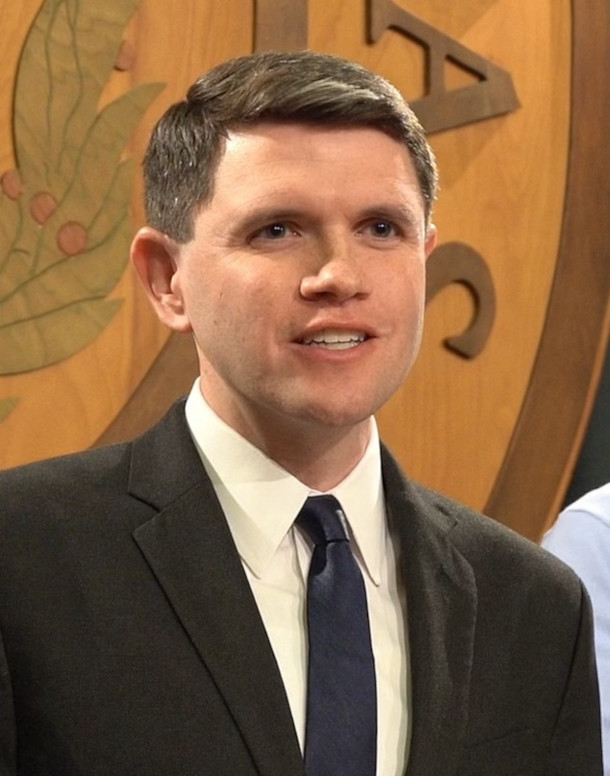
Texas leads the U.S. in combined wind and solar power, and Stinnett says there’s a lot of opportunity to expand renewables in the new Congress. Democrat James Talarico, above, flipped a Senate seat in this year’s midterms. (Photo: Antonioaesparza, Wikimedia Commons, CC BY-SA 4.0)
STINNETT: I think we need to be very careful and honest about claiming that climate and the environment drove people to vote in any state this year. It was not a top voter priority. It was kind of in the middle of the pack. But what we do know is that voters in Texas are very concerned about climate and environmental issues, and the fact that Democrats swept every statewide office and won with such margins, Aynsley, that many races were decided before the sun even rose on election day. I mean, James Talarico is a perfect example of this. He won his U.S. Senate race by so much that he amassed more early votes than his Republican opponent got in total votes. So he won before election day even dawned. And so, this new crop of Democratic politicians, who are typically more likely to lead on climate and environmental issues anyway, are going to look at this data and see how many of their supporters care about climate and the environment, and it's a real opportunity for a state that is at the very center of how we make energy and electricity in the United States.
O'NEILL: And now, from the policy making perspective, what kind of moves do you think that politicians, and specifically the incoming Democratic House and Senate, need to be making to respond to environmental-focused voters?
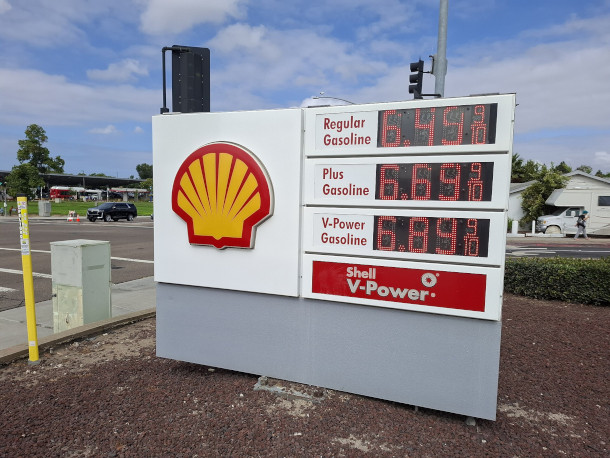
When we discuss affordability and healthcare in politics, we also need to link these issues to the ongoing climate crisis, Stinnett says. Above, a gas price board in Chula Vista, CA, in September 2026. (Photo: Bnuuy, Wikimedia Commons, CCO 1.0)
STINNETT: I think there are two things that incoming Democrats should bear in mind. The first is that across the ideological spectrum, voters are sick and tired of politicians making small adjustments on the dial. I mean, whether you're a liberal or a conservative or an independent, huge majorities of voters think that our entire system is rigged or broken or both, and so that is calling not for incrementalism, but for Democrats to really think about ways to completely change the system, and so that's the first thing I think they should bear in mind. The second thing is, and I know none of your listeners want to hear this, Aynsley, but the presidential election has officially begun, and so what this means is that politicians are going to become increasingly focused on a small sliver of the electorate, and those are the people who are likely to vote in the Democratic presidential primary and the Republican presidential primary. And on the Democratic side, in particular, likely primary voters do list climate and the environment among their top three priorities. And so yeah, the general electorate might not be hungering for climate policymaking right now, but all the voters who are going to decide who the presidential nominee of the Democratic Party are hungering for climate leadership, and it's not going to take very long for Democratic legislators to realize that.
O'NEILL: To what extent do you think there's a need to reframe how we think about climate when it comes to voting, from say a luxury issue to a more universal one?
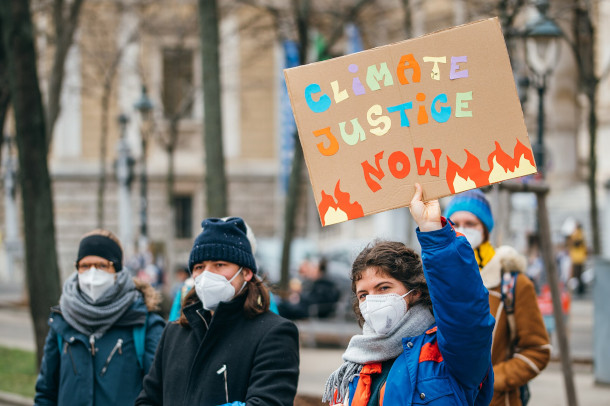
Stinnett believes that talking about climate change is necessary to ensure that people feel validated in their concerns, and continue to advocate for themselves and their communities. Above, activists at the 2021 Global Climate Strike. (Photo: Ivan Radic, Wikimedia Commons, CC BY 2.0)
STINNETT: That's a really great question, Aynsley, and I think we need to start with that basic misconception that the Americans who care deeply about climate and the environment are able to view it as a luxury issue, because that's just not the case when we look at all of our data, and we're not alone. If you look at Pew Research and Yale Project on Climate Change Communications, all of this data shows that the people who care most about climate and the environment are not viewing it as a luxury concern. These are the people who, on a daily basis, are worried about breathing toxic air, or drinking dirty water, or worried about extreme weather. These are people who are experiencing the climate crisis on a regular basis. Now, to get to the second part of your question, how can we change the way we approach this issue to make it more salient in elections? I think there are two ways to handle this. The first is, if anybody is concerned about climate change, we need to make sure they understand that it is not just a personal issue that affects their shopping habits; it's also a political issue. This is a systemic problem, and systemic problems require political solutions. The second thing that I would say is, the climate crisis is going to make people unhealthy, and it's going to make life really expensive. So whenever we talk about healthcare and affordability, we've also got to be talking about climate change.
O'NEILL: Now, Nathaniel, why do you think that it's so important for us to keep talking about climate in this moment?
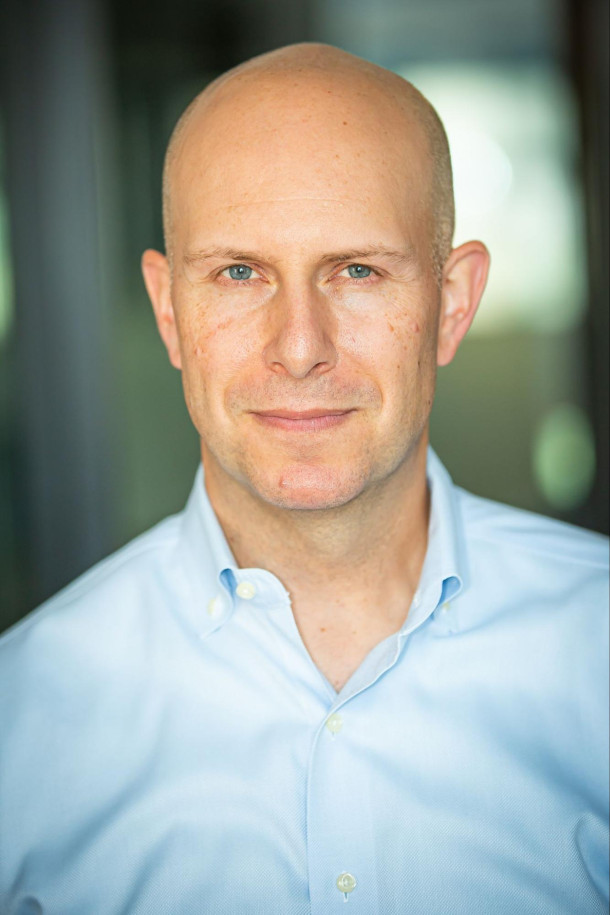
Nathaniel Stinnett is the Founder & Executive Director of the Environmental Voter Project. (Photo: Courtesy of Nathaniel Stinnett)
STINNETT: It's a great question, and I think it's important for two reasons. The first is that Americans are telling us they want politicians to talk about it more, and I'll go back to this climate hushing research that we've done at the Environmental Voter Project. 59% of voters want politicians to talk more about climate rather than less. And if you're a politician, and whenever you're in doubt about what to say, if voters want you to say something, maybe it's a good idea to start talking about it. But the second thing that I'll say is, social scientists do a lot of research about this concept known as pluralistic ignorance. And the basic idea about pluralistic ignorance is that people often underestimate how much other people share their views, and this is absolutely the case when it comes to climate change. There has been a whole lot of research showing that most Americans think that other people, their neighbors, or people across the country care less about climate change than they do, and they're wrong. They are ignorant of what the plurality of Americans think about climate change, and that's harmful, because if you think you're alone in your views, Aynsley, you are much less likely to go out and advocate for them. If you think you're alone in caring about climate and the environment, you're much less likely to be an activist. And so that, more than anything, is why it's important to talk about these issues. Whether you're a voter, whether you're a politician, whether you're in the media, because so many Americans share these concerns, but they're kind of keeping it a secret because they think they're alone, and we need to let them know that they're not alone.
O'NEILL: Nathaniel Stinnett is the founder and executive director of the Environmental Voter Project. Nathaniel, thank you as always for joining us today.
STINNETT: Thank you, Aynsley.
Related links:
- Learn more about the Environmental Voter Project
- The Environmental Voter Project | “Midterm Battleground State Poll: Political Priorities & Opinions on the Clean Energy Transition”
[MUSIC: Get out and Vote]
DOERING: Coming up, another kind of blue wave at this year’s UN climate session, where oceans are part of the discussion. Stay tuned to Living on Earth.
ANNOUNCER: Support for Living on Earth comes from the Waverley Street Foundation, working to cultivate a healing planet with community-led programs for better food, healthy farmlands, and smarter building, energy and businesses.
[CUTAWAY MUSIC: Joe Negri, “Blues For Brody” on Uptown Elegance, MCG Jazz]
Oceans at ‘The Blue COP’
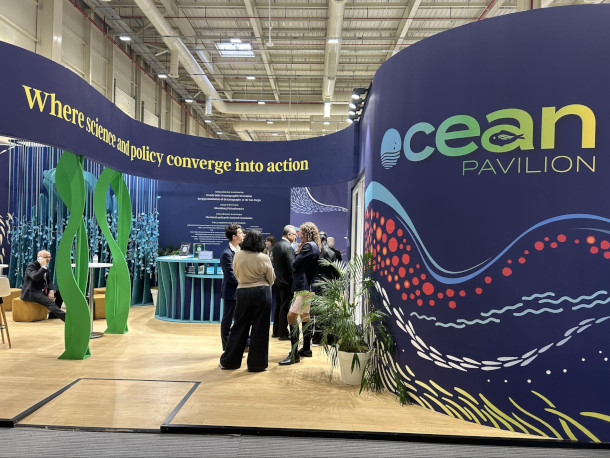
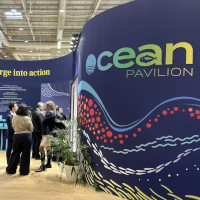
The Oceans Pavilion at COP31 in Antalya, Türkiye. There has been a push from attendees for this year’s COP to be a “blue COP”, or one where the oceans get more attention than they have in the past. (Photo: Courtesy of Sophia Pandelidis)
O’NEILL: It’s Living on Earth, I’m Aynsley O’Neill.
DOERING: And I’m Jenni Doering. COP31, the world’s annual climate treaty negotiations, were expected to conclude on November 20th and as we go to broadcast all but a few details have been settled. And next week we can bring you the final picture.
O’NEILL: But we’ve been hearing a lot about the focus at this year’s COP on the role of the oceans in the climate crisis. Our producer Paloma Beltran and Field Producer Sophia Pandelidis went to this conference in Antalya, Turkiye. How’s it been over there, Sophia?
PANDELIDIS: Hi Aynsley and Jenni, it is a bit overwhelming, but still energizing. As Paloma mentioned last week, there is this push for COP31 to be a quote Blue COP. Oceans are three quarters of our planet, and they actually take up around 25 to 30% of global carbon dioxide emissions. Plus they’ve absorbed over 90% of excess heat trapped by greenhouse gases.
DOERING: Wow, so think about what our climate would look like without the ocean’s help.
O’NEILL: Yeah - so Sophia tell us more, who are some of these players that are advancing that Blue COP agenda?
PANDELIDIS: Well the main drivers are island states, as well as the wider oceans advocacy community. That includes Woods Hole Oceanographic Institution. They had a pavilion dedicated to oceans, where they hosted multiple events. And Paloma got the chance to talk to Kilaparti Ramakrishna, who’s the Senior Advisor to the President on Ocean and Climate Policy at Woods Hole. He’s also an original contributor to the UN Climate Change Treaty, and an advisor to the president of this year’s COP. Rama says the ocean is crucial on the planetary scale and he’s excited about the space oceans took at this year’s COP.
RAMAKRISHNA: Happy because this should be obvious for any scholar thinking about the Earth as a planetary system, and what the linkages that exist between all these things, whether it is biodiversity, whether it is climate, whether it is trade, whether it is food, ocean, atmosphere linkages, and all of that. But that scientific knowledge, that scholarly knowledge, has not reached decision makers, they still think in silos, and the fact that we are breaking down those silos is something quite remarkable.
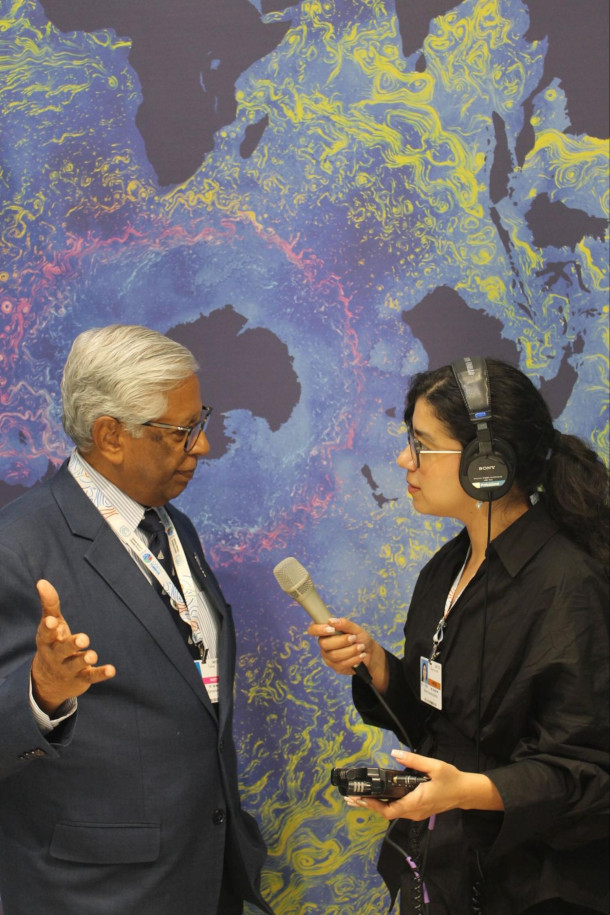
Living on Earth Producer Paloma Beltran (right) speaks to Kilaparti Ramakrishna, Senior Presidential Advisor at Woods Hole Oceanographic Institution. (Photo: Courtesy of Sophia Pandelidis)
DOERING: Alright, so how is COP breaking down those silos?
PANDELIDIS: So this year, 27 countries including the EU block committed to joining what’s called the Blue NDC challenge – basically it’s a coalition that’s helping governments turn ocean-based pledges in their nationally determined contributions or NDCs into climate action. It got its start at last year’s COP in Brazil. And now this year the COP presidency has been integrating oceans into several declarations including the Antalya Oceans and Seas Compact aimed at boosting ocean solutions. And while some say it’s still just words – these types of documents can point the way forward for the global community. Rama said it took decades to even get the oceans into the dialogue over the past few years. And it’s all about building momentum, bit by bit. Here’s a taste of some excitement from Monica Dean, Director of the Ocean Climate Diplomacy Initiative, at the Oceans Pavillion.
DEAN: I hate to tell you this, but I think we're going to need a bigger pavilion. What a testament to this community! Every time I walked by today, the room was overflowing. There were people peeking in the window, and not only that, when we went to go check how many ocean climate events were happening around the COP, there are over 250 ocean side events being planned during COP 31. 250.
PANDELIDIS: Some of those side events, and press conferences gave scientists an opportunity to discuss key ocean research on acidification, mercury and plastic pollution, mapping the sea floor, and ocean solutions.
O’NEILL: And now, Sophia what exactly do ocean solutions mean here? What kinds of efforts are we talking about?
PANDELIDIS: You know it really depends on who you ask. One point of debate is “geoengineering” as a way to remove excess carbon from the ocean. I actually talked to a scientist who prefers not to use that term, since it kind of groups different methods into one bucket when some may have more negative impacts than others.
DOERING: Right – I know there’s been a lot of concern about geoengineering in the atmosphere. But what methods were mentioned in these spaces?
PANDELIDIS: Well, there are chemical methods, like ocean alkalinity enhancement– that basically neutralizes the acid form of dissolved CO2. Now, ocean iron fertilization is a bit different – it gives a nutrient boost to natural phytoplankton so they can absorb more carbon. But studies on these methods’ effects and effectiveness are really limited. So many scientists caution against promoting them too soon. What is widely accepted is increasing marine ecosystem protection across the board, especially for mangroves, seagrass, and kelp forests, which can protect coasts from flooding and act as carbon sinks.
O’NEILL: Okay, so the goal is to keep the healthy ocean intact, where it can then take up this carbon and play its natural role, right?
PANDELIDIS: That’s the idea. And in terms of reducing emissions, there have also been pledges and targets announced for decarbonizing shipping and increasing offshore wind capacity. Those initiatives fit into the larger goal set by the COP Presidency to supply 35% of global energy demand with electricity by 2035–the “35 by 35” pledge. But what we heard over and over is that none of these measures really mean much without finance going directly to communities.
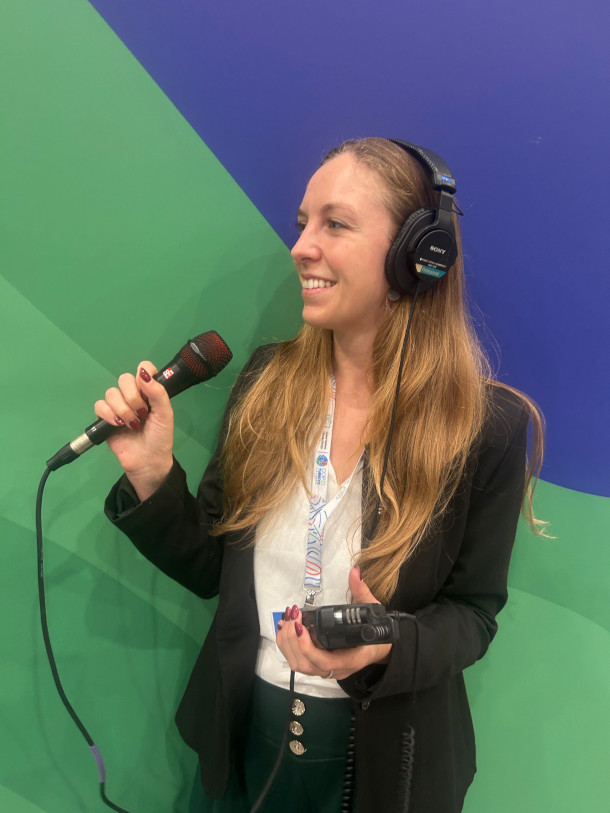
Living on Earth Field Producer Sophia Pandelidis, on assignment at COP31 in Antalya, Türkiye. (Photo: Courtesy of Sophia Pandelidis)
DOERING: Yeah like they say, “show me the money”!
PANDELIDIS: Exactly. Here’s Mark Haver, who’s a youth oceans activist.
HAVER: Ocean finance receives less than 2% of global climate finance, yet it covers 70% of our planet, and more than 3 billion people depend on seafood as a primary source of protein. So, if we cannot translate the political will and the ambition into the finance that not just exists in name, but the finance that actually reaches and supports the local communities implementing the ocean-based climate solutions. Then, what really can we say came out of COP 31?
PANDELIDIS: Among other pledges this year, $30 million have been pledged by the Global Fund for Coral Reefs to scale up protections across 22 developing countries. But that’s a drop in the bucket on the global scale.
DOERING: You know, finance is such a huge topic so what are some examples of financing that can make a difference on the ground?
PANDELIDIS: Yeah, one is called a debt for climate swap. Many developing countries are struggling under enormous debt, so this allows them to receive some debt relief in exchange for promising to spend money on climate mitigation, adaptation, or conservation projects. And another innovative model I heard about was the Nieu Ocean Wide Trust. It allows governments, NGOs, or philanthropists to sponsor a square kilometer of Niue’s marine territory for an annual fee, helping to cover protection costs.
O’NEILL: Well, Niue is a tiny island nation, right? So given the huge costs of adapting to sea level rise, they’re not likely to have much money to spare, so makes a lot of sense.
PANDELIDIS: Right, climate change is really, really expensive. And you know, one of the people we heard on the Ocean Theme day made a point of reminding everyone why we’re paying a price in the first place. Peter Thomson is the UN Secretary General’s Special Envoy for the Ocean.
THOMSON: The basic truth is that burning of fossil fuels causes the warming of the planet, which causes the warming of the ocean, which causes the death of coral, which causes the rising of the sea levels, and we have yet to have the full scientific evidence, but causes the changes in the great oceanic currents, such as the Antarctic one and the Atlantic one, which dictate the climate of this planet. So that is the fundamental truth, and it all goes back to fossil fuels. And every time you put that on the top table, it gets quietly pushed off it. The only time we got it into official language was at COP 28 in Dubai on the insistence of AOSIS. Remember that. So just keep plugging that. Do not let that fundamental truth somehow evaporate into all the dialogue.
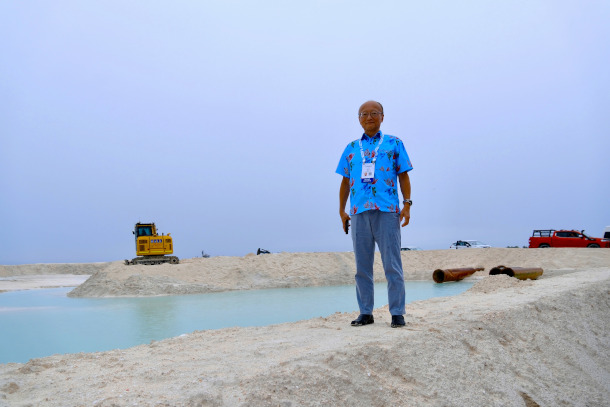
As part of Pre-COP31, Asian Development Bank president Masato Kanda visits Tuvalu, one of the smallest countries in the world. Developing island nations are especially vulnerable to the effects of climate change on the surrounding oceans. (Photo: Robert Hugh Davis, Wikimedia Commons, CC BY 4.0)
O’NEILL: Well Sophia, after all this, what comes next for oceans?
PANDELIDIS: So the High Seas Treaty, or BBNJ, which came into effect last January, will have its first meeting at the beginning of 2027. This agreement is about protecting marine biodiversity in areas outside national jurisdictions - that’s roughly two-thirds of the oceans. Rama of Woods Hole says what we’ve seen at COP31 is setting us up for those talks.
RAMAKRISHNA: The momentum reached here on the ocean front is going to have lot of spin-off benefits. This momentum will be carried to the BBNJ COP in New York next year, and this momentum is going to be carried forward even in the plastics treaty negotiations, because once you reach a point of acknowledging the role of ocean in everything that pertains to the human endeavor, you cannot say any more only thus far and no further.
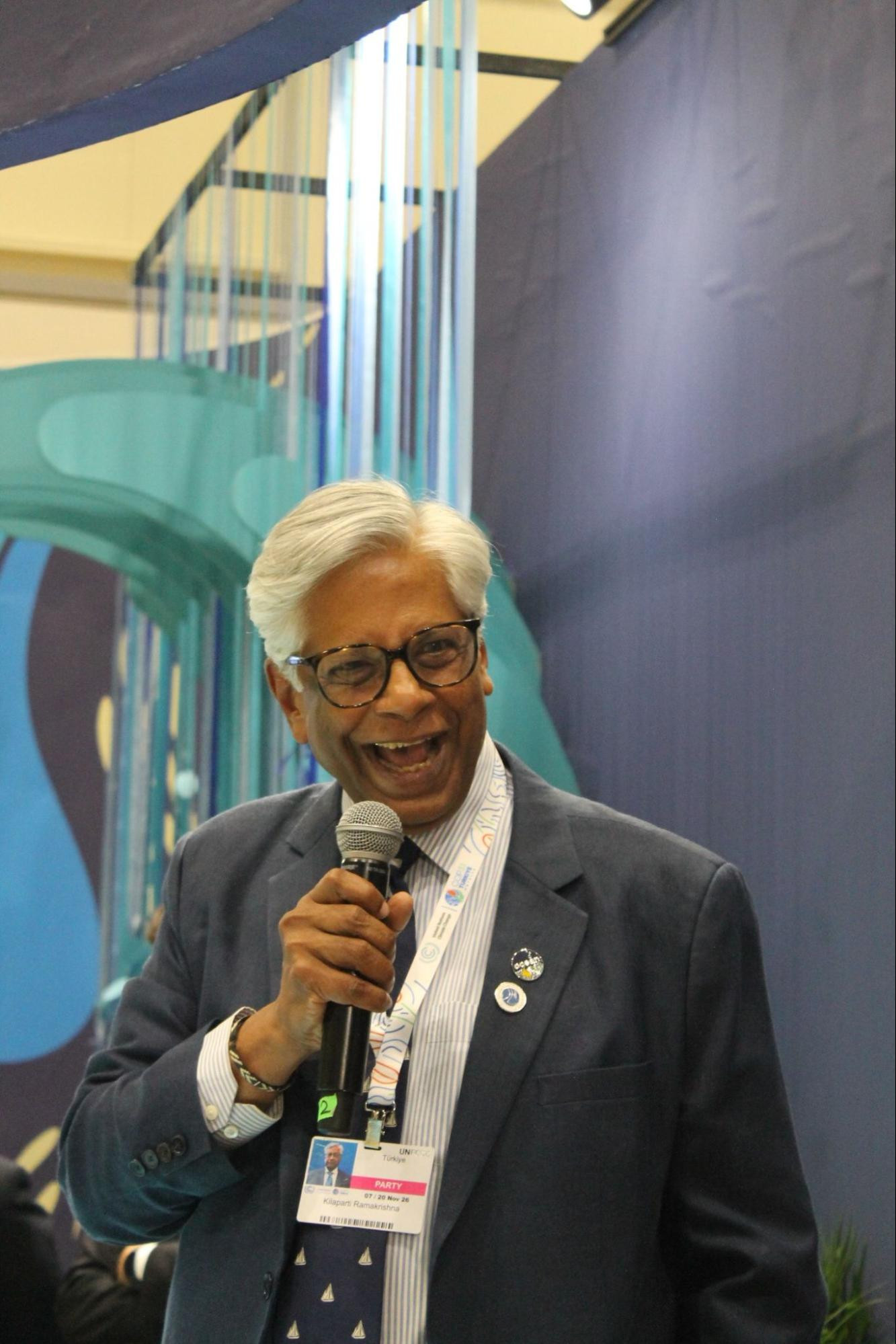
Kilaparti Ramakrishna speaks at the Ocean Pavillion at COP31. (Photo: Sophia Pandelidis)
PANDELIDIS: And Rama has reminded us that for low lying island nations and other countries that depend on coastal economies, the stakes are very high. Some people from those island nations expressed to us disappointment in the COP process– they just don’t have time to wait years and even decades for political posturing and financial promises to come to fruition. At the same time, the many scientists and leaders who were at COP fighting for oceans seem determined to keep the conversation moving forward.
DOERING: So it sounds like this is just the beginning – Well we’ll definitely have to follow up!
O’NEILL: Thanks, Sophia Pandelidis and Paloma Beltran for bringing us this coverage from COP31!
PANDELIDIS: Thanks, Aynsley and Jenni!
Related links:
- Ocean Conservancy | “STATEMENT: In Turkiye, First-Ever COP Declaration Recognizes Ocean for ‘Taking the Heat’”
- More on the Woods Hole Oceanographic Institution
- Learn more about the Blue NDC Challenge
- Mark Haver’s instagram page
- Conservation International | “Bhutan and Niue Ocean Trust Win 2026 Earthshot Prizes”
- Oceanographic Magazine | “100 Countries In: High Seas Treaty Nears Universal Ratification”
- Oceanographic Magazine | “Ocean Receives Record Attention at COP31”
[MUSIC: Pacific Blue]
Seasonal Butternut Squash Mac and Cheese
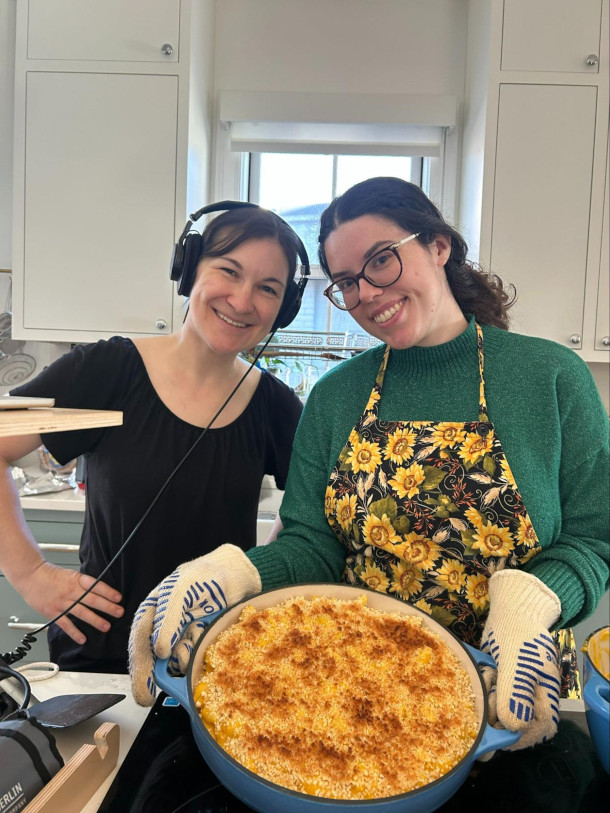
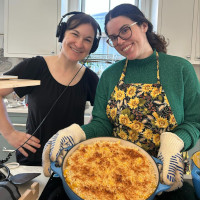
Living on Earth producers Jenni Doering and Aynsley O’Neill (above) joined Assistant Producer Bella Smith to make butternut squash macaroni and cheese for a special Thanksgiving-themed segment. (Photo: Bella Smith)
DOERING: All right, Aynsley and I are here in my kitchen for some holiday cooking.
O'NEILL: And we're joined today by Living on Earth's Bella Smith. Hi, Bella.
SMITH: Hey, how's it going?
O'NEILL: Oh, it's going well, and we're all here to make a recipe together.
DOERING: Yes, Bella, you told us about your friend's butternut squash mac and cheese that is absolutely delicious, and because Thanksgiving is here, we thought we would make it with you.
SMITH: Yeah, my friend made this butternut squash mac and cheese for our Friendsgiving this year, and it was definitely a labor of love, but so so worth it. So I'm excited to share.
O'NEILL: Well, luckily there are three of us, and I think between us we will be able to actually make this happen, and hopefully in time for lunch.
DOERING: That's right. So yeah, just to make it easy, I already roasted the butternut squash in the oven. Pretty straightforward. There's shallots as well that are roasted, and now we have what, a whole bunch of cheese and some shells and other ingredients to throw together.
O'NEILL: I think we just need to get started.
DOERING: All right. So after the roasting happens, we're gonna make the topping. So we need a small bowl, and we're gonna get the panko and olive oil.
O'NEILL: I love topping mac and cheese with panko. You could do other breadcrumbs too. I sometimes will season this, but we're actually gonna do a lot of seasoning of the sauce itself. So if you want to put some in here, if you want to put some in the pasta, whatever you want to do, we're doing lots of herbs and aromatics and all of that. That'll be nice.
DOERING: That's right. Okay, so now we just need to get our pasta water going.
SMITH: This is so much less chaotic than when it was all six of my roommates cooking a Friendsgiving meal for 30 people at once.
O'NEILL: 30 people is really, I'm gonna say brave. I'm gonna say brave is what that is.
SMITH: Brave or foolish?
DOERING: That's a lot of people in your apartment.
SMITH: Yeah.
O'NEILL: Okay, so we're gonna scoop out what, two cups of butternut squash?
DOERING: Correct. Two cups of butternut squash in the blender. It's so orange.
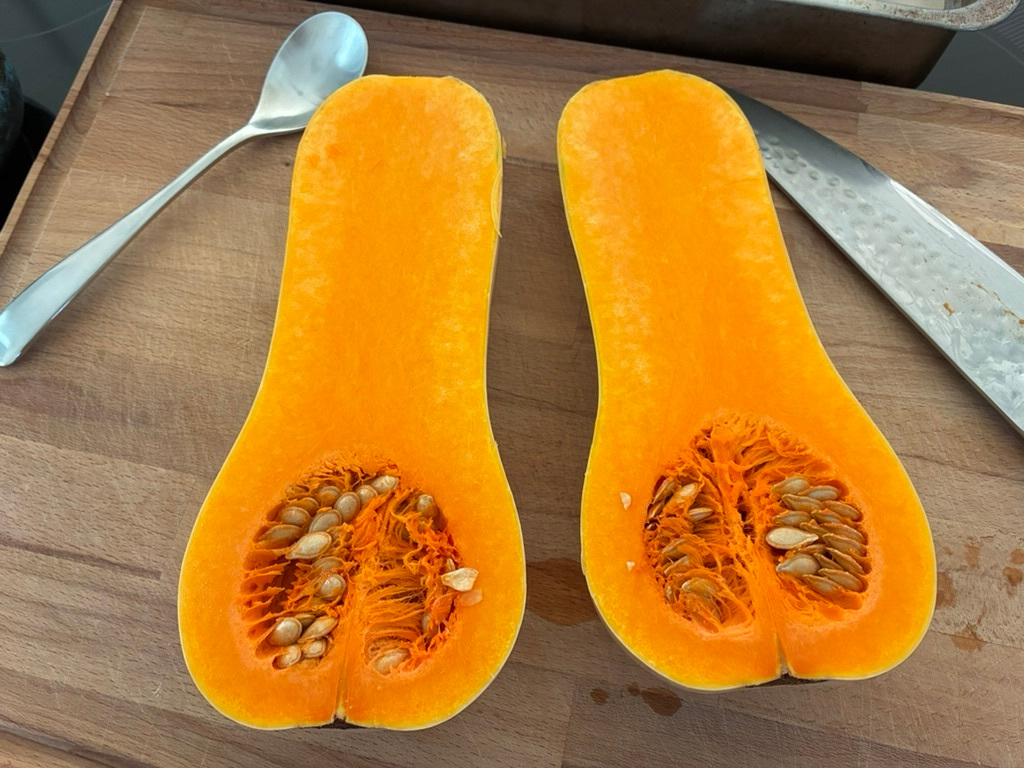
A bright orange butternut squash is the perfect fall addition to creamy mac n’ cheese. (Photo: Jenni Doering)
O'NEILL: Yeah, this is beautiful. This is a beautiful butternut squash. Now I wish at a time like this that I'd have a good suggestion for what you could do with your squash peel, but I'm afraid I don't, so.
DOERING: Actually, I have an idea. So I looked this up when I was making acorn squash soup recently, and you can save the peels. You can put them in stock, vegetable stock. And what I do is I just take those scraps and I stick them in the freezer, instead of you know having to make all of the stock at once. But then if they're in the freezer, they just live in there until I'm ready to make my stock.
O'NEILL: That's perfect.
DOERING: I also think, I think butternut squash is kind of a sustainable vegetable in a way because they don't go bad very easily at all. You can have them sitting around for weeks on your counter and then get around to using them, and you can use pretty much the whole thing. I mean, the seeds you could roast.
O'NEILL: I, so I've actually never had roasted butternut squash seeds, but I always remember growing up. My family would do a jack-o'-lantern for Halloween, and we would always roast those pumpkin seeds. And then afterwards, my mom would take apart the pumpkin and turn it into a pumpkin soup. Now I've never suggested pumpkin mac and cheese to her, but I'm sure that would work as well too.
DOERING: And I think this is the pumpkin soup you've talked about on the broadcast before. Oh yeah, yeah, it sounded really good.
O'NEILL: It's very much a family tradition, and it's one of the things I look forward to every fall, basically.
DOERING: Okay, so we got the olive oil. We need the balsamic vinegar, two teaspoons, onion powder, garlic powder, and we'll get the sage out of the fridge.
O'NEILL: Yeah, and we're, we're following the recipe by rote, but you can definitely be seasoning to your heart's content. I feel like you could add, I don't know, some paprika, some smoked paprika, chipotle, probably cayenne if you want a little kick. All sorts of stuff you could do to dress this up.
DOERING: Okay, so sage is in, and I think nutmeg that's next on this list is going in there too. Yes, it is, and several grains of pepper. We're gonna use fresh nutmeg.
SMITH: We're really pulling out all the stops here.
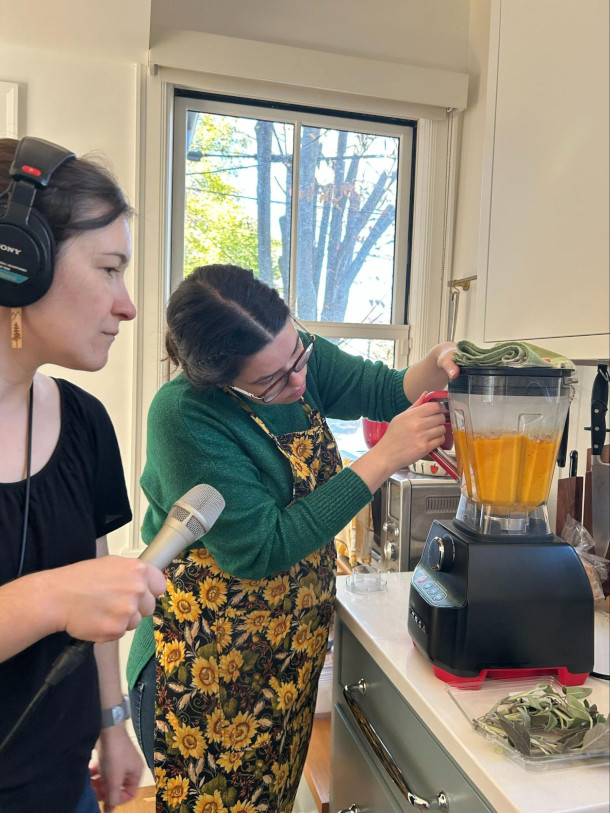
Blending the sauce ingredients ensures the mixture is creamy and smooth before adding the cheese and pasta. (Photo: Bella Smith)
DOERING: Blend until creamy. So this is where, if stuff is hot and you're gonna be blending it like, for soup, you have to be careful about the expansion, and you, you don't want to put the lid on tight. You want to use like a cloth.
DOERING: It does look pretty blended.
O'NEILL: I think so.
DOERING: Okay, great.
SMITH: Yeah, nice.
DOERING: It looks so pretty. So the next step is return our pasta pot to the stove, which we have done, and we're gonna heat the almond milk. And you know, this is of course not a dairy-free recipe. But at least there's almond milk in it.
O'NEILL: There are cheese substitutes, and some which would be better for melting than others. But yeah, this is this is I feel like a recipe that you could really switch a lot of things out without it taking too much of a toll on consistency or flavor or all sorts of things like that. So yeah, for for folks with a nut allergy, I'm sure you could swap this out for cow's milk or any unsweetened, unflavored milk alternatives.
DOERING: Oat milk.
O'NEILL: Oat milk, I'm sure would work out great in this.
DOERING: Yeah. All right. So I guess that's cooking, and we can grate the cheese.
O'NEILL: Yes, we've got some Gruyere here.
DOERING: And this is a good sharp cheddar. It's extra sharp.
O'NEILL: And then it's what one and a half ounces?
DOERING: Only one and a half of the pecorino. I feel like to have something like this on the table, whether or not you have meat on the table. You know, this could be the star of the show for a vegetarian Thanksgiving. Maybe, maybe vegan too if you use vegan cheese. Somebody, somebody should try that out there and tell us.
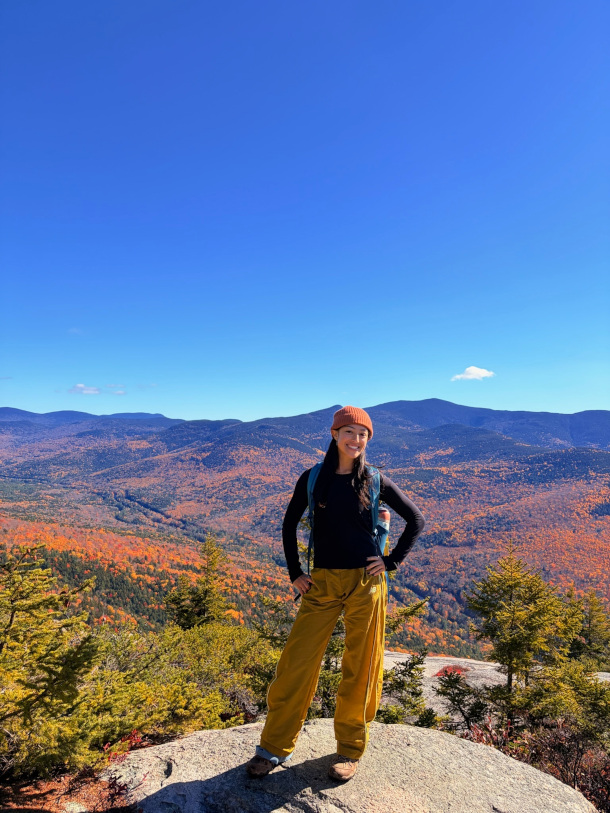
Living on Earth's Assistant Producer Bella Smith brought us this autumnal recipe, which she first had at her Friendsgiving dinner. (Photo: Courtesy of Bella Smith)
SMITH: Yeah, we'd love to know how it how it tastes with vegan cheese.
DOERING: I would love to know.
SMITH: It's definitely the star of the show.
O'NEILL: Oh, what else did you have at your Friendsgiving?
SMITH: We had all the classics. I made mashed potatoes. One of my friends made stuffing. We did have roasted chicken and a really good like brussels, roasted walnut, pomegranate salad was also delicious. And then tons of desserts, lemon bars. It was, it was a feast.
DOERING: Pumpkin pie?
SMITH: No pumpkin pie actually. We were missing that.
O'NEILL: Pumpkin pie the day after for breakfast. That's a classic in my family.
DOERING: All right. So I guess we're just stirring this. This is going to end up looking a bit like, like a Kraft mac and cheese because this this orange butternut squash, except it's so much more real.
SMITH: Very, very different.
DOERING: It looks silky.
O'NEILL: Yeah, yeah, yeah. The cheese really did melt pretty well.
DOERING: Okay.
SMITH: Nice.
DOERING: So now we're just gonna put it in our other pan so we can broil it. So this says three to ten minutes. We just want it to be crisp and brown.
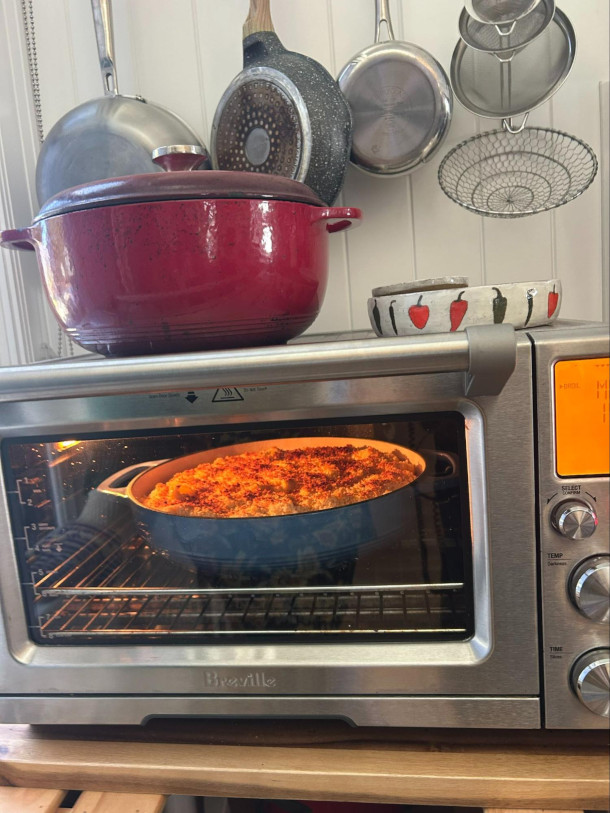
The mac and cheese broiled for a few minutes, just long enough to toast the Panko breadcrumbs. (Photo: Bella Smith)
O'NEILL: You know, baking is definitely going to add the, the extra caramelization and everything on top of that. But I'm sure this would also work out just fine if you just wanted to stir –
DOERING: Oh yeah.
O'NEILL: the pasta in a la your boxed mac and cheeses.
DOERING: Yeah.
O'NEILL: When I make a pumpkin mac and cheese, similar to this. I'll also often add pepitas or pumpkin seeds on top.
DOERING: Ooh, some crunch. Yum! The moment of truth.
O'NEILL: I know, we've now let it rest for say 15 minutes, and it's definitely looking and smelling delicious.
DOERING: I think we definitely worked up an appetite too.
O'NEILL: Yeah, yeah.
DOERING: Wow.
O'NEILL: Yeah.
DOERING: Yes.
O'NEILL: I'm taking a second. It looks a little warm to me still.
DOERING: It's, well.
O'NEILL: It's steaming.
DOERING: I know it was steaming, but I went for it.
SMITH: Yeah. Oh yeah. That's the stuff.
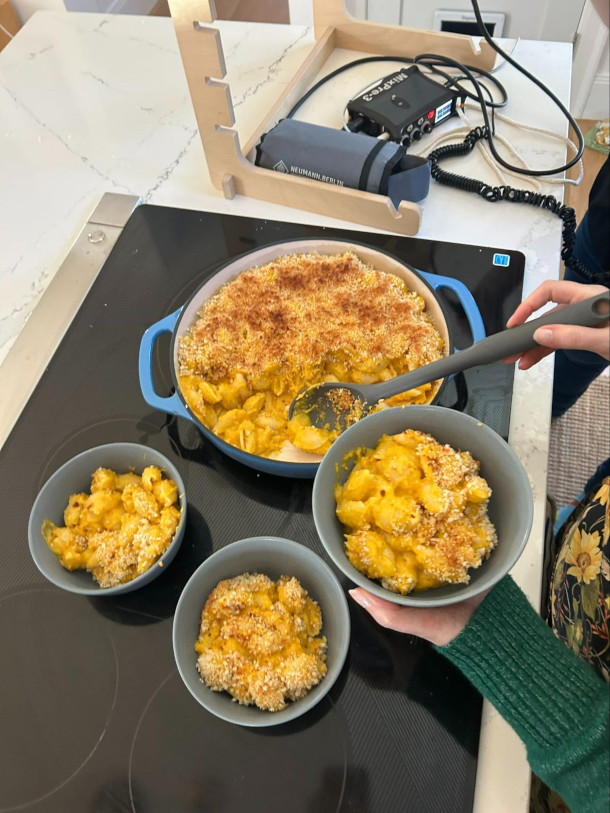
The finished product was nutty, cheesy, and delicious! (Photo: Bella Smith)
DOERING: We did a perfect job on this, actually. I think like, I taste the shallots. I taste the butternut squash, the cheese shells are perfectly cooked.
SMITH: And it's not like too cheesy. Not that a mac and cheese could really be, but the butternut squash makes it like, like nice and nutty.
O'NEILL: Mmm. That is really good. I know I was saying that I make a pumpkin mac and cheese. I may have a new favorite.
DOERING: Well, your roommate had a genius idea in making this.
SMITH: Thank you, Morgan, and also thank you, Love and Lemons.
DOERING: Yes, thank you, Love and Lemons. We'll post the recipe link on our website, loe.org. Well, this was a success. I think we should say from all of us here at Living on Earth, happy Thanksgiving.
O'NEILL: Yeah, happy Thanksgiving, everyone. Enjoy your food. Enjoy good times with good company and have a good time giving thanks.
SMITH: Happy Thanksgiving.
Related links:
- Love & Lemons | “Butternut Squash Mac and Cheese”
- Check out our previous coverage of Living on Earth Thanksgiving feast favorites
[MUSIC: A Hearth In November]
O’NEILL: Just ahead, Decolonizing the Thanksgiving story many of us learned as kids. Keep listening to Living on Earth!
ANNOUNCER: Support for Living on Earth comes from Hansjörg Wyss in honor of Rosamund Stone Zander. Celebrated painter, environmentalist, and author of The Art of Possibility, who inspired others to see the profound interconnectedness of all living things, and to act with courage and creativity on behalf of our planet. Support also comes from Sailors for the Sea and Oceana. Helping boaters race clean, sail green and protect the seas they love. More information at sailorsforthesea.org
[CUTAWAY MUSIC: Vince Guaraldi Trio “Skating – Rematered 2026” on A Charlie Brown Christmas (Remastered 2026) Craft Recordings, A Concord Label Group Release]
A Native Perspective of the First Thanksgiving

Keepunumuk: Weeâchumun’s Thanksgiving Story is a picture book that attempts to teach young children a new, more inclusive, Thanksgiving story. (Photo: © 2022 by Garry Meeches Sr.)
O’NEILL: It’s Living on Earth, I’m Aynsley O’Neill
DOERING: And I’m Jenni Doering.
And as we’re celebrating this Thanksgiving season, it’s story time. So let’s start with you, Aynsley, reading from the start of the children’s book, Keepunumuk: Weeâchumun’s Thanksgiving Story.
O’NEILL: “I love your garden this time of year,” said Maple. “Me, too. What shall we pick for lunch?” N8hkumuhs asked. “How about crab apples?” Maple suggested. “No! Chokecherries!” Quill shouted. “Those are both good medicine,” N8hkumuhs said. “How about some weeâchumun, as well?” “Yes!” Maple replied. “She is such a good big sister to Beans and Squash.” “The Three Sisters! They grow together,” Quill added. “You’re right. They feed people all over Turtle Island,” N8hkumuhs said. “And they have many stories to tell.” “Can you tell us a story?” Quill asked. “How about the time Weeâchumun asked our Wampanoag ancestors to help the Pilgrims?” N8hkumuhs replied. “The first Thanksgiving?” Maple asked. “Some people call it that,” N8hkuhums said. “We call it Keepunumuk, the time of harvest. Here’s what really happened.”
DOERING: And Aynsley, I talked with one of the authors of this book, Keepunumuk: Weeâchumun’s Thanksgiving Story. Weeâchumun, or Corn, is the protagonist in this tale. It’s for young readers so the violence white Europeans brought against Native Americans soon after the time of the Pilgrims isn’t directly in the story. But it does reference the “day of mourning” which is what some Native American people now call Thanksgiving Day. And the story was written and illustrated by Indigenous authors who are descended from the first peoples on this continent. Author Tony Perry joins me now. Welcome to Living on Earth!
PERRY: Thank you. Thank you for the opportunity.
DOERING: You are one of three authors on this book. Can you tell us a little bit about your specific role in creating it?

Tony Perry, one of the coauthors of Keepunumuk, is a citizen of the Chickasaw Nation and currently lives in the U.K. He hopes that the book will create a new default narrative for the Thanksgiving story. (Photo: Courtesy of Chickasaw Press)
PERRY: Absolutely. Actually, I'm going to explain kind of how this book came about because we each ended up having a role. So just to introduce myself, I am a citizen of the Chickasaw Nation. I grew up in Oklahoma, but I live in England now. Our co-authors and our Illustrator come from a very broad range of native traditions, but we are all native creators. Danielle Greendeer is Mashpee Wampanoag so one of the a citizen of the people whose ancestors met the new comers. And Alexis Bunton is Alaska Native, Unangan and Yu'pik. And our illustrator, Gary Meeches Sr., is Anishinaabe. And so the story began, actually through work that Alexis Bunton was doing. She had started an initiative or was participating in initiative called decolonizing Thanksgiving. And a lot of this came from the Thanksgiving meal and the idea of Thanksgiving that we take for granted now, right, the story that I certainly grew up with, was around pilgrims coming across looking for a new life meeting a few friendly Indians who helped them out, they ended up having a feast, and everyone was happy. And that's the story that we have. And so Alexis has done a lot of work trying to unpick some of that story. Pointing out, for example, that it's a myth that came out after the Civil War by a publisher named Sarah Josefa Hale, who had persuaded Abraham Lincoln to have a day of thanks. That's where the idea that so many Americans have of Thanksgiving was really born. And what jumped out to me is that there is so much hard work done by people like Alexis, as well as Danielle and many others, to try to almost reteach this holiday, right, to say, hey look, here's what really happened. What do you think about it? And Keepunumuk takes this at a different approach. Instead of trying to unteach and reteach a story, it's about creating a new story. So if the story that so many Americans know is itself a story, why couldn't we create a new story that creates a new default narrative? And that's what we set out to do. So Alexis and I worked together, trying to think about what this could look like, you know, we talked about it with Danielle and she just said, right? Well, I'd love to work with you. Let's do it. So the three of us started working on the text. Danielle knew Gary Meeches Sr. And so all this came through about a collaboration and a common vision of creating a new narrative, a more inclusive story. But it came through having that common vision and everyone bringing their own perspectives to this again, with native peoples at the heart to make this possible. And as a result, we have Keepunumuk.

Danielle Greendeer is one of the coauthors of Keepunumuk. She is a citizen of the Mashpee Wampanoag Tribe, the tribe which first encountered the pilgrims back in the 1600s. While all the authors and the illustrator are Indigenous people, her particular background was key in making sure the book accurately represented the Wampanoag. (Photo: Matt Cosby)
DOERING: And why is it so important to have Indigenous people themselves telling these kinds of stories?
PERRY: Ultimately, because this story is about Indigenous peoples. It's about the first peoples that were here, and their voices are not have not been really heard. And it's important to note the role of native peoples because again, they were there. They were the ones that were frankly, the center of this story, really, and also what happened afterwards. There is a story of frankly, genocide and of oppression of native peoples, whether it's massacres that happened to the Wampanoag people, King Philip's War that happened about 70 years after where the descendants of the pilgrims return their thanks for having that settlement there by massacring Wampanoag peoples. Then you go further on, you've got the removal of native peoples from their lands as European Americans started to want more space. So my ancestors were among those who were removed from their homeland, as more and more settlers occupied our lands. Going back to the Wampanoag people, the Mashpee Wampanoag tribe were fighting for their very recognition when a president decided to undo a decision that recognize them. And so this went to the highest levels. Thankfully, they have that recognition. These fights to recognize that we were the first peoples on the continent, continue our fight for our identity. And I think it's important to emphasize that we were there. We have survived and are still here and are thriving.
DOERING: So many of us spend time with young children over Thanksgiving. As we talk to young, especially non native kids about Thanksgiving, how can we be honest about the genocide of Indigenous people and colonization in an age-appropriate way?

In the book, the animals and plants come together and agree to send the First Peoples to help the pilgrims. (Photo: © 2022 by Garry Meeches Sr.)
PERRY: That is a very good question and, and it's hard. I would say that, as you say age-appropriate, I think is the key part to this. So in the very beginning of it for the earliest readers, I think it's important to note about the native peoples that were there in this story, and also doing more to think about, well, who are native peoples where do you live now? On what land do you live? Right? Who were the original occupants of that land? So I think that's the starting point of it, and learning more about who those people are, and maybe some of their traditions. So I think that's probably the first entry point to it. For older children, I think that the conversations do become different. They become deeper. That is where you start getting into the conversations around colonialism, decolonialism, about what we can do about it, recognition and also inclusivity and respect that America certainly today is a far more diverse country than it was, say 30 years ago, as I was going through school. I think it's important to recognize that and by recognizing that there are many American stories. We as Native Americans are certainly one and play an important one. But it's right there in the fabric with African Americans, Asian Americans, and others who have come and settled and some of the struggles and triumphs that they have had.
DOERING: So the story is told through the perspective of corn, who is called Weeâchumun. Why did you decide to have corn narrate the story?

Although the book does highlight the First Peoples’ perspective, the main character of the book is Weeâchumun, corn. (Photo: © 2022 by Garry Meeches Sr.)
PERRY: Well, there's a couple of reasons for this. Number one is that corn plays a vital role in the culture of many native peoples that is in the United States going into Mexico, Central and South America. Corn, in fact, was a plant that was created by native peoples. Native peoples had actually created what we know as corn today out of blades of grass, which is a rich story in and of its own right, and plays a central role in the heart of cultures of native peoples, many native peoples today. Beans and squash grow very closely with corn. Native peoples call them the Three Sisters. Native peoples are quite diverse. We're not a monolithic group. So some native peoples will have three sisters, others may have four and some five, but corn, beans, and squash is a pretty universal tradition.
DOERING: And the three sisters are somewhat universal because of the ecology of how those plants grow together. Is that right?

The book features the Three Sisters: beans, corn, and squash which are prominent among many Native American traditions. The three plants are dependent on each other to grow plentifully. (Photo: © 2022 by Garry Meeches Sr.)
PERRY: That's right. That's exactly right. Corn grows first. In native traditions, corn will grow first. It provides structure, and then the beans end up wrapping around the corn. But beans also feeds corn because corn takes nitrates from the soil, and beans actually added in. And then squash, the third sister will grow on the outer sides and keep other plants from taking up space and that sort of thing. So it's their own harmony. So that was important for us. Number two, we also felt that by telling the story through corn, but also other plants and animals, as opposed through just another retelling well, but maybe from a native point of view, we felt like this would spark more thought and more discussion, rather than just a story from quote the other side, which, unfortunately, is how it would be perceived if we just read it as, "Well, here's what happened with Wampanoag people, and through their eyes, and so on." So instead of pitting one against another, we thought, well, let's decenter this a little bit, and provide what is really a more universal story because we all depend on the ecology, on the world around us. And it shapes what options that we have and how we live our lives. So we felt like this would be a more inclusive way of telling the story, helps people think broader than even just Thanksgiving itself to think about how we live in the world today. And as well as being able to give a new perspective to Thanksgiving and hopefully give room for thought.
DOERING: What advice do you have for how we can celebrate Thanksgiving in a way that respects and honors Indigenous peoples?

While the book does steer away from the popular Thanksgiving narrative, it does show First Peoples helping the Pilgrims learn to survive. (Photo: © 2022 by Garry Meeches Sr.)
PERRY: That's a good question. And I think the first part of it is to use the holiday as a way to think about the native peoples where families are living, right. So for families having Thanksgiving, it's an opportunity to ask those questions around well, "Whose land was this originally? Who were the native peoples that live or lived in this land?" And trying to understand a bit more about them, about their cultures and traditions, and what's happened to them today and happening to them today. The book includes backmatter that describes where the Wampanoag people are in the United States, also their storytelling traditions. It offers activities, so trying a Wampanoag tradition of giving thanks through a spirit plate. So basically leaving behind a meal outside you know, and giving thanks to the world. And also a recipe to try Nasamp, which is a traditional Wampanoag dish, as well. So there's a bit of activity and learning as well that tries to set the scene for the book and where it fits in the wider world. I think it's also important to consider the role of native peoples not just on Thanksgiving, but across the year because of the role that they played in the American story, both past and present, and learn more about some of the challenges that they're facing. And also the triumphs. So looking at, you know, native representation and maybe buying books or watching films that involve native characters, that center their stories. So those are different things that you can do.
DOERING: Tony Perry is a citizen of the Chickasaw Nation and one of the authors of Keepunumuk: Weeâchumun's Thanksgiving Story. Thank you so much, Tony.

The Keepunumuk authors have included a recipe for 'nasamp', a traditional Wampanoag dish. (Photo: Courtesy of Danielle Greendeer, Anthony Perry, and Alexis Bunten)
PERRY: Thank you.
O’NEILL: Our studios at the University of Massachusetts Boston are on the traditional, ancestral and unceded Pawtucket and Massachusett First Nations land, with Wampanoag traditional lands just south of here around Cape Cod. And by the way, Nasamp, the traditional Wampanoag dish isn’t hard to make. You boil cornmeal, berries, nuts or seeds in water for a few minutes, then let it simmer until the water is absorbed. Drizzle some maple syrup on top for a sweet finish. And for the complete recipe and more check out the Living on Earth website, loe.org.
Related links:
- Find the book Keepunumuk: Weeâchumun’s Thanksgiving Story (Affiliate link helps donate to LOE and local indie bookstores)
- Learn more about the book and its authors
- Explore ways to decolonize Thanksgiving
- Read about the domestication of corn
- Make your very own Nasamp
[MUSIC: FLUTE MUSIC PERFORMED BY JOE BRUCHAC]
Listening on Earth: The Many Sounds of Wild Turkeys

Wild turkeys make a number of vocalizations other than the famous “gobble gobble”. (Photo: Viktor Talashuk, Unsplash, Unsplash License)
[FLUTTERING AND SQUAWKING SFX, Jay McGowan / Macaulay Library at the Cornell Lab of Ornithology]
DOERING: The wild cousins of the centerpiece on many Thanksgiving tables do more than just gobble. Turkeys squawk –
[FLUTTERING AND SQUAWKING SFX, Jay McGowan / Macaulay Library at the Cornell Lab of Ornithology]
DOERING: Chirp when they’re poults, or chicks –
[CHICKS AND HEN CALLING SFX, Jay McGowan / Macaulay Library at the Cornell Lab of Ornithology]
DOERING: And even softly “purr” to express contentment in a flock.
[TURKEY ‘PURR’ SFX, Geoffrey Keller / Macaulay Library at the Cornell Lab of Ornithology]
DOERING: And of course, there’s the gobble itself.
[TURKEY GOBBLES SFX, Brian Sullivan / Macaulay Library at the Cornell Lab of Ornithology]
DOERING: Toms use it to attract hens and fend off rivals.
[TURKEY GOBBLES SFX, Brian Sullivan / Macaulay Library at the Cornell Lab of Ornithology]
DOERING: The National Wild Turkey Federation lists a dozen types of turkey calls. Hunters hone the skill of “turkey calling” to bring their quarries into range to become Thanksgiving dinner.
[FLUTTERING AND SQUAWKING SFX, Jay McGowan / Macaulay Library at the Cornell Lab of Ornithology]
DOERING: These calls come from the Macaulay Library at the Cornell Lab of Ornithology.
Related links:
- Learn more about wild turkeys here
- Read about the many different calls of wild turkeys
[MUSIC: Hard Times, Bright Hopes]
O’NEILL: Living on Earth is produced by the World Media Foundation. Our crew includes Naomi Arenberg, Paloma Beltran, Claire Brandes, Abby Edgecumbe, Swayam Gagneja, Mark Kausch, Mark Seth Lender, Don Lyman, Ashanti Mclean, Nhung Nguyen, Sophia Pandelidis, Andrew Skerritt, Bella Smith, Jake Rego and El Wilson.
DOERING: Tom Tiger engineered our show. Allison Lirish Dean composed our themes.
You can hear us anytime at loe.org, Apple Podcasts and YouTube Music, and like us please, on our Facebook page, Living on Earth. Find us on Instagram, Threads and BlueSky @livingonearthradio. And we always welcome your feedback at comments@loe.org. Steve Curwood is our Executive Producer - I’m Jenni Doering
O’NEILL: And I’m Aynsley O’Neill. Thanks for listening!
ANNOUNCER: Funding for Living on Earth comes from you, our listeners, and from the University of Massachusetts, Boston, in association with its School for the Environment, developing the next generation of environmental leaders. And from the Grantham Foundation for the protection of the environment, supporting strategic communications and collaboration in solving the world’s most pressing environmental problems.
ANNOUNCER 2: PRX.
Living on Earth wants to hear from you!
Living on Earth
62 Calef Highway, Suite 212
Lee, NH 03861
Telephone: 617-287-4121
E-mail: comments@loe.org
Newsletter [Click here]
Donate to Living on Earth!
Living on Earth is an independent media program and relies entirely on contributions from listeners and institutions supporting public service. Please donate now to preserve an independent environmental voice.
NewsletterLiving on Earth offers a weekly delivery of the show's rundown to your mailbox. Sign up for our newsletter today!
 Sailors For The Sea: Be the change you want to sea.
 The Grantham Foundation for the Protection of the Environment: Committed to protecting and improving the health of the global environment.
 Contribute to Living on Earth and receive, as our gift to you, an archival print of one of Mark Seth Lender's extraordinary wildlife photographs. Follow the link to see Mark's current collection of photographs.
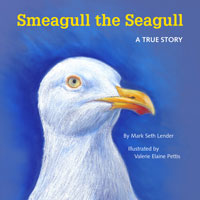 Buy a signed copy of Mark Seth Lender's book Smeagull the Seagull & support Living on Earth
© Copyright World Media Foundation. All Rights Reserved
Home | Contact | RSS | Donate | Newsletter