

Oceans at ‘The Blue COP’
Air Date: Week of November 20, 2026
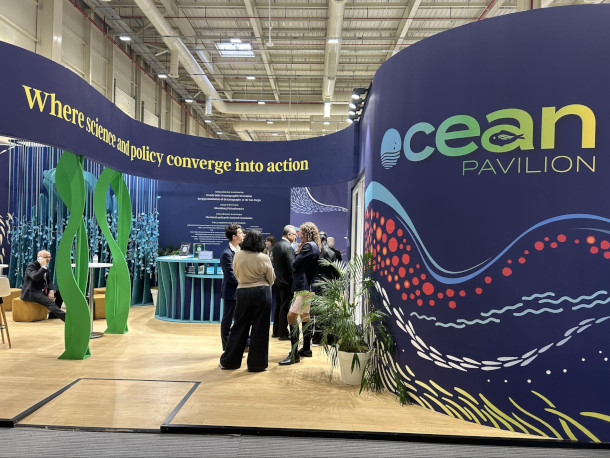
The Oceans Pavilion at COP31 in Antalya, Türkiye. There has been a push from attendees for this year’s COP to be a “blue COP”, or one where the oceans get more attention than they have in the past. (Photo: Courtesy of Sophia Pandelidis)
As the annual negotiations of the UN climate treaty or COP31 conclude in Antalya, Türkiye, Living on Earth’s Sophia Pandelidis, who is there with Producer Paloma Beltran, joins Hosts Aynsley O’Neill and Jenni Doering to discuss a focus at this COP on oceans. The world’s oceans absorb 25 to 30% of carbon dioxide emissions and over 90% of excess heat trapped by greenhouse gases. Island states, ocean researchers and advocates are driving a discussion about how to support that capacity as well as adapt to cascading effects of warming and acidifying oceans.
Transcript
O’NEILL: It’s Living on Earth, I’m Aynsley O’Neill.
DOERING: And I’m Jenni Doering. COP31, the world’s annual climate treaty negotiations, were expected to conclude on November 20th and as we go to broadcast all but a few details have been settled. And next week we can bring you the final picture.
O’NEILL: But we’ve been hearing a lot about the focus at this year’s COP on the role of the oceans in the climate crisis. Our producer Paloma Beltran and Field Producer Sophia Pandelidis went to this conference in Antalya, Turkiye. How’s it been over there, Sophia?
PANDELIDIS: Hi Aynsley and Jenni, it is a bit overwhelming, but still energizing. As Paloma mentioned last week, there is this push for COP31 to be a quote Blue COP. Oceans are three quarters of our planet, and they actually take up around 25 to 30% of global carbon dioxide emissions. Plus they’ve absorbed over 90% of excess heat trapped by greenhouse gases.
DOERING: Wow, so think about what our climate would look like without the ocean’s help.
O’NEILL: Yeah - so Sophia tell us more, who are some of these players that are advancing that Blue COP agenda?
PANDELIDIS: Well the main drivers are island states, as well as the wider oceans advocacy community. That includes Woods Hole Oceanographic Institution. They had a pavilion dedicated to oceans, where they hosted multiple events. And Paloma got the chance to talk to Kilaparti Ramakrishna, who’s the Senior Advisor to the President on Ocean and Climate Policy at Woods Hole. He’s also an original contributor to the UN Climate Change Treaty, and an advisor to the president of this year’s COP. Rama says the ocean is crucial on the planetary scale and he’s excited about the space oceans took at this year’s COP.
RAMAKRISHNA: Happy because this should be obvious for any scholar thinking about the Earth as a planetary system, and what the linkages that exist between all these things, whether it is biodiversity, whether it is climate, whether it is trade, whether it is food, ocean, atmosphere linkages, and all of that. But that scientific knowledge, that scholarly knowledge, has not reached decision makers, they still think in silos, and the fact that we are breaking down those silos is something quite remarkable.
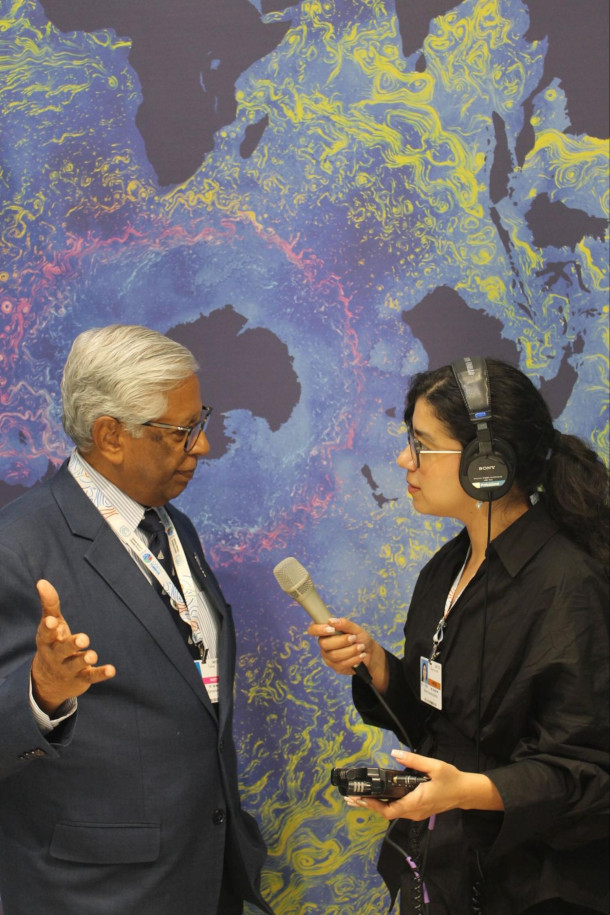
Living on Earth Producer Paloma Beltran (right) speaks to Kilaparti Ramakrishna, Senior Presidential Advisor at Woods Hole Oceanographic Institution. (Photo: Courtesy of Sophia Pandelidis)
DOERING: Alright, so how is COP breaking down those silos?
PANDELIDIS: So this year, 27 countries including the EU block committed to joining what’s called the Blue NDC challenge – basically it’s a coalition that’s helping governments turn ocean-based pledges in their nationally determined contributions or NDCs into climate action. It got its start at last year’s COP in Brazil. And now this year the COP presidency has been integrating oceans into several declarations including the Antalya Oceans and Seas Compact aimed at boosting ocean solutions. And while some say it’s still just words – these types of documents can point the way forward for the global community. Rama said it took decades to even get the oceans into the dialogue over the past few years. And it’s all about building momentum, bit by bit. Here’s a taste of some excitement from Monica Dean, Director of the Ocean Climate Diplomacy Initiative, at the Oceans Pavillion.
DEAN: I hate to tell you this, but I think we're going to need a bigger pavilion. What a testament to this community! Every time I walked by today, the room was overflowing. There were people peeking in the window, and not only that, when we went to go check how many ocean climate events were happening around the COP, there are over 250 ocean side events being planned during COP 31. 250.
PANDELIDIS: Some of those side events, and press conferences gave scientists an opportunity to discuss key ocean research on acidification, mercury and plastic pollution, mapping the sea floor, and ocean solutions.
O’NEILL: And now, Sophia what exactly do ocean solutions mean here? What kinds of efforts are we talking about?
PANDELIDIS: You know it really depends on who you ask. One point of debate is “geoengineering” as a way to remove excess carbon from the ocean. I actually talked to a scientist who prefers not to use that term, since it kind of groups different methods into one bucket when some may have more negative impacts than others.
DOERING: Right – I know there’s been a lot of concern about geoengineering in the atmosphere. But what methods were mentioned in these spaces?
PANDELIDIS: Well, there are chemical methods, like ocean alkalinity enhancement– that basically neutralizes the acid form of dissolved CO2. Now, ocean iron fertilization is a bit different – it gives a nutrient boost to natural phytoplankton so they can absorb more carbon. But studies on these methods’ effects and effectiveness are really limited. So many scientists caution against promoting them too soon. What is widely accepted is increasing marine ecosystem protection across the board, especially for mangroves, seagrass, and kelp forests, which can protect coasts from flooding and act as carbon sinks.
O’NEILL: Okay, so the goal is to keep the healthy ocean intact, where it can then take up this carbon and play its natural role, right?
PANDELIDIS: That’s the idea. And in terms of reducing emissions, there have also been pledges and targets announced for decarbonizing shipping and increasing offshore wind capacity. Those initiatives fit into the larger goal set by the COP Presidency to supply 35% of global energy demand with electricity by 2035–the “35 by 35” pledge. But what we heard over and over is that none of these measures really mean much without finance going directly to communities.
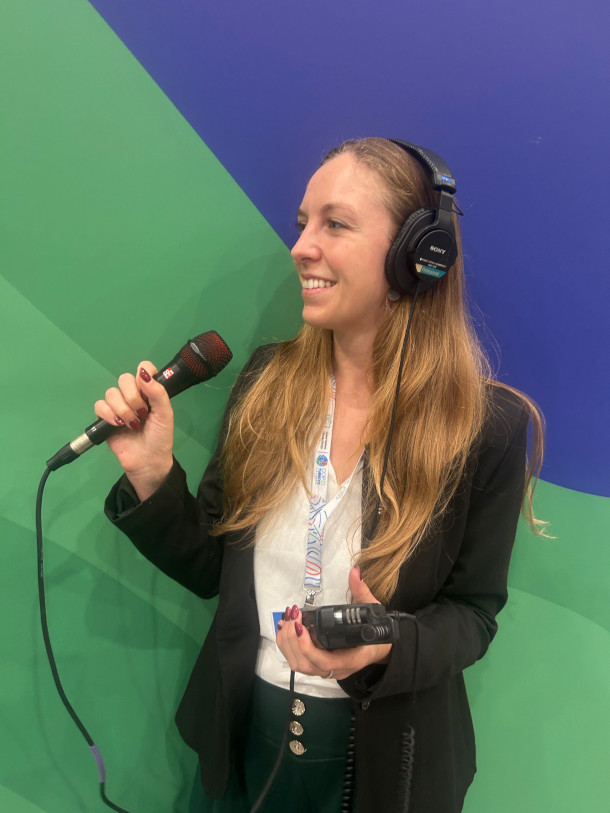
Living on Earth Field Producer Sophia Pandelidis, on assignment at COP31 in Antalya, Türkiye. (Photo: Courtesy of Sophia Pandelidis)
DOERING: Yeah like they say, “show me the money”!
PANDELIDIS: Exactly. Here’s Mark Haver, who’s a youth oceans activist.
HAVER: Ocean finance receives less than 2% of global climate finance, yet it covers 70% of our planet, and more than 3 billion people depend on seafood as a primary source of protein. So, if we cannot translate the political will and the ambition into the finance that not just exists in name, but the finance that actually reaches and supports the local communities implementing the ocean-based climate solutions. Then, what really can we say came out of COP 31?
PANDELIDIS: Among other pledges this year, $30 million have been pledged by the Global Fund for Coral Reefs to scale up protections across 22 developing countries. But that’s a drop in the bucket on the global scale.
DOERING: You know, finance is such a huge topic so what are some examples of financing that can make a difference on the ground?
PANDELIDIS: Yeah, one is called a debt for climate swap. Many developing countries are struggling under enormous debt, so this allows them to receive some debt relief in exchange for promising to spend money on climate mitigation, adaptation, or conservation projects. And another innovative model I heard about was the Nieu Ocean Wide Trust. It allows governments, NGOs, or philanthropists to sponsor a square kilometer of Niue’s marine territory for an annual fee, helping to cover protection costs.
O’NEILL: Well, Niue is a tiny island nation, right? So given the huge costs of adapting to sea level rise, they’re not likely to have much money to spare, so makes a lot of sense.
PANDELIDIS: Right, climate change is really, really expensive. And you know, one of the people we heard on the Ocean Theme day made a point of reminding everyone why we’re paying a price in the first place. Peter Thomson is the UN Secretary General’s Special Envoy for the Ocean.
THOMSON: The basic truth is that burning of fossil fuels causes the warming of the planet, which causes the warming of the ocean, which causes the death of coral, which causes the rising of the sea levels, and we have yet to have the full scientific evidence, but causes the changes in the great oceanic currents, such as the Antarctic one and the Atlantic one, which dictate the climate of this planet. So that is the fundamental truth, and it all goes back to fossil fuels. And every time you put that on the top table, it gets quietly pushed off it. The only time we got it into official language was at COP 28 in Dubai on the insistence of AOSIS. Remember that. So just keep plugging that. Do not let that fundamental truth somehow evaporate into all the dialogue.
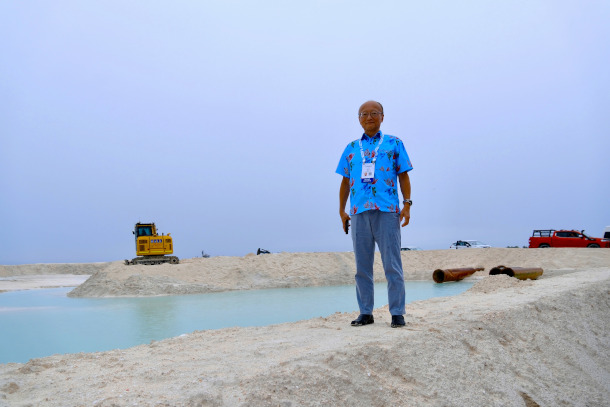
As part of Pre-COP31, Asian Development Bank president Masato Kanda visits Tuvalu, one of the smallest countries in the world. Developing island nations are especially vulnerable to the effects of climate change on the surrounding oceans. (Photo: Robert Hugh Davis, Wikimedia Commons, CC BY 4.0)
O’NEILL: Well Sophia, after all this, what comes next for oceans?
PANDELIDIS: So the High Seas Treaty, or BBNJ, which came into effect last January, will have its first meeting at the beginning of 2027. This agreement is about protecting marine biodiversity in areas outside national jurisdictions - that’s roughly two-thirds of the oceans. Rama of Woods Hole says what we’ve seen at COP31 is setting us up for those talks.
RAMAKRISHNA: The momentum reached here on the ocean front is going to have lot of spin-off benefits. This momentum will be carried to the BBNJ COP in New York next year, and this momentum is going to be carried forward even in the plastics treaty negotiations, because once you reach a point of acknowledging the role of ocean in everything that pertains to the human endeavor, you cannot say any more only thus far and no further.
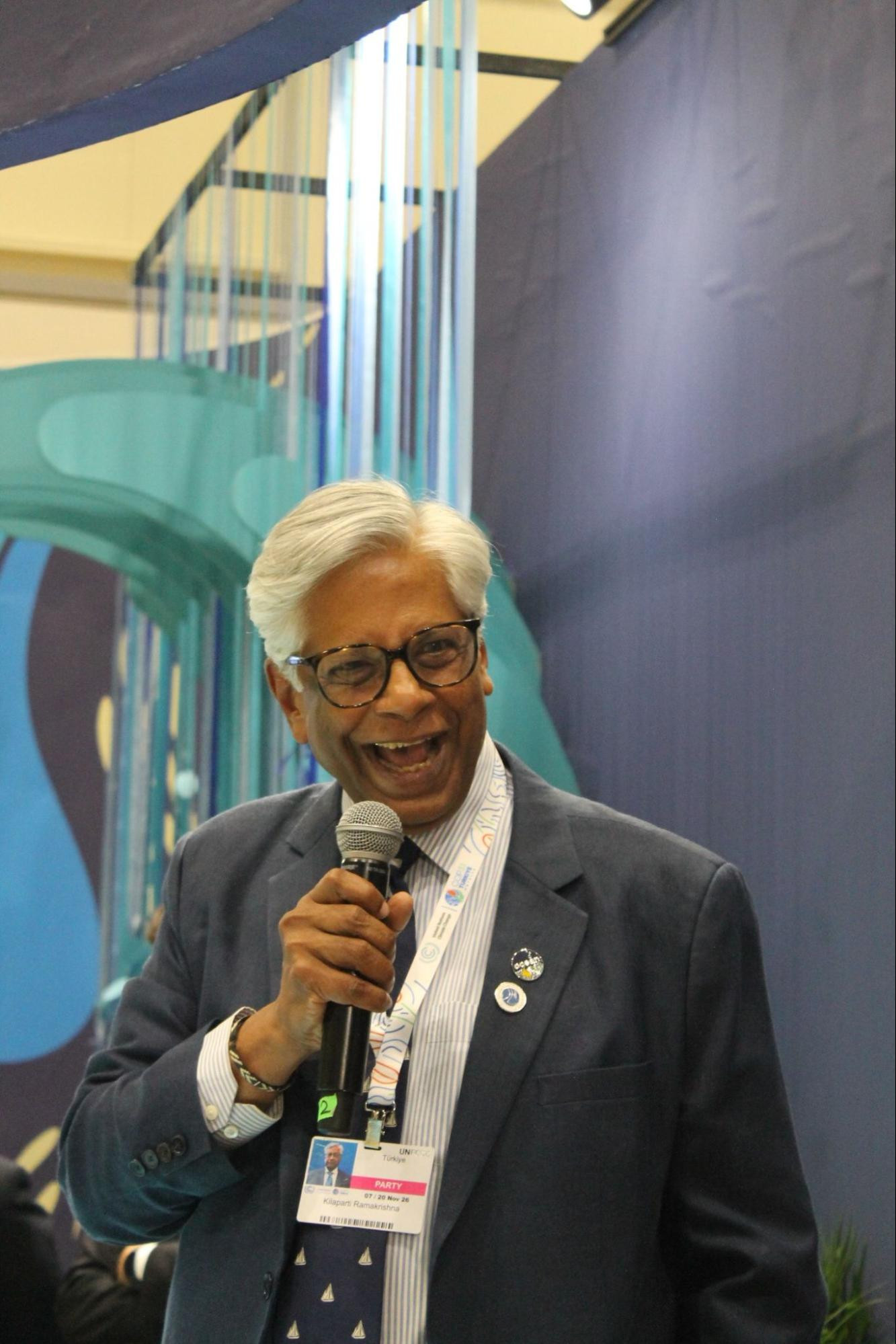
Kilaparti Ramakrishna speaks at the Ocean Pavillion at COP31. (Photo: Sophia Pandelidis)
PANDELIDIS: And Rama has reminded us that for low lying island nations and other countries that depend on coastal economies, the stakes are very high. Some people from those island nations expressed to us disappointment in the COP process– they just don’t have time to wait years and even decades for political posturing and financial promises to come to fruition. At the same time, the many scientists and leaders who were at COP fighting for oceans seem determined to keep the conversation moving forward.
DOERING: So it sounds like this is just the beginning – Well we’ll definitely have to follow up!
O’NEILL: Thanks, Sophia Pandelidis and Paloma Beltran for bringing us this coverage from COP31!
PANDELIDIS: Thanks, Aynsley and Jenni!
Links
More on the Woods Hole Oceanographic Institution
Learn more about the Blue NDC Challenge
Conservation International | “Bhutan and Niue Ocean Trust Win 2026 Earthshot Prizes”
Oceanographic Magazine | “100 Countries In: High Seas Treaty Nears Universal Ratification”
Oceanographic Magazine | “Ocean Receives Record Attention at COP31”
Living on Earth wants to hear from you!
Living on Earth
62 Calef Highway, Suite 212
Lee, NH 03861
Telephone: 617-287-4121
E-mail: comments@loe.org
Newsletter [Click here]
Donate to Living on Earth!
Living on Earth is an independent media program and relies entirely on contributions from listeners and institutions supporting public service. Please donate now to preserve an independent environmental voice.
NewsletterLiving on Earth offers a weekly delivery of the show's rundown to your mailbox. Sign up for our newsletter today!
 Sailors For The Sea: Be the change you want to sea.
 The Grantham Foundation for the Protection of the Environment: Committed to protecting and improving the health of the global environment.
 Contribute to Living on Earth and receive, as our gift to you, an archival print of one of Mark Seth Lender's extraordinary wildlife photographs. Follow the link to see Mark's current collection of photographs.
 Buy a signed copy of Mark Seth Lender's book Smeagull the Seagull & support Living on Earth
© Copyright World Media Foundation. All Rights Reserved
Home | Contact | RSS | Donate | Newsletter