

This Week's Show
Air Date: October 23, 2026
FULL SHOW
SEGMENTS
Fracking and Data Centers
View the page for this story
One of the states where data centers to power AI are growing is Pennsylvania, which also has a large supply of natural gas. In Upper Burrell, a town just east of Pittsburgh, a data center expansion could be fed by fracking rigs already pumping gas out of the ground. The Allegheny Front’s Reid Frazier reports the town is trying to keep pace with these two big industries in its backyard. (07:31)

BirdNote®: A Bird in Hand
/ Michael SteinView the page for this story
Pennsylvania is known for its unusual town names, which include Burnt Cabins, Intercourse, Pillow, Chinchilla, Hazard and Panic. In today’s BirdNote®, Michael Stein shares how one small community came to be called “Bird-in-Hand”, Pennsylvania. (01:58)
A Fossil Fuel Treaty Beyond the UNFCCC
View the page for this story
Thirty years of UN climate sessions and the persistent wide gap between discussion and action to slow the climate crisis have left some countries and NGOs frustrated as they face a dire future. So even as COP31 begins in November in Turkey, an alternate path already began in April in Colombia when roughly 60 countries met for the first Conference on Transitioning Away from Fossil Fuels. Tzeporah Berman, founder and chair of the Fossil Fuel Non-Proliferation Treaty Initiative, joins Host Paloma Beltran to discuss her hopes for the process as she looks ahead to the second conference next year. (17:22)

Science Note: Air Pollution and Human Reproduction
/ Ashanti McLeanView the page for this story
Fine particulate air pollution, or PM2.5, has been linked to many health consequences such as cancer, respiratory diseases, and cardiovascular damage. Now researchers are finding connections between exposure to this air pollution and longer menstrual cycles. Ashanti McLean reports in this note on emerging science how period tracker app data helped make the link. (02:43)
Hurricane Helene's Impact Brought to Life
View the page for this story
In 2024, Hurricane Helene ripped through the mountain communities of western North Carolina, leaving them stranded and unable to communicate with the outside world for days. A new graphic novel, Islands in the Sky: A People’s History of Hurricane Helene, pairs up survivors with artists to help them tell their stories of resourcefulness and resilience in their own words. Creator and editor Andrew Aydin, who also survived Helene, talks with Host Jenni Doering about the power of hearing directly from survivors. (17:53)
Show Credits and Funders
Show Transcript
261023 Transcript
HOSTS: Paloma Beltran, Jenni Doering
GUESTS: Andrew Aydin, Tzeporah Berman
REPORTERS: Reid Frazier, Ashanti McLean, Michael Stein
[THEME]
DOERING: From PRX – this is Living On Earth.
[THEME]
DOERING: I’m Jenni Doering
BELTRAN: And I’m Paloma Beltran.
As the UN prepares for climate talks, a new coalition pushes for more ambition.
BERMAN: This will be, I think, my 16th COP that I'm going to in Turkey in a couple of weeks, and it's been the same conversation, the refusal to address fossil fuels for many, many years, and this year we changed that, and, I think that that will have huge ramifications. I think it'll save lives.
DOERING: Also, stories of resilience after Hurricane Helene in North Carolina.
AYDIN: What saved us was our ability to cut our way out, to use the skills that come from living in a region where the right to exist comes from a constant negotiation with nature. That's what saved us, and not very many other regions, particularly urban regions are prepared for this level of disaster.
DOERING: That and more, this week on Living on Earth. Stick around!
[NEWSBREAK MUSIC: Boards Of Canada “Zoetrope” from “In A Beautiful Place Out In The Country” (Warp Records 2000)]
[THEME]
Fracking and Data Centers
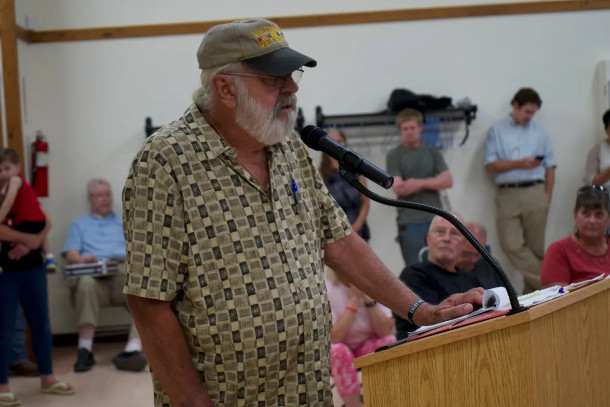
Guy Fuller lives near two fracking sites and is worried about a nearby data center that will run on the natural gas generated in Upper Burrell Township. (Photo: Reid Frazier/The Allegheny Front)
DOERING: From PRX and the Jennifer and Ted Stanley Studios at the University of Massachusetts Boston, this is Living on Earth. I’m Jenni Doering.
BELTRAN: And I’m Paloma Beltran.
Voting is already well underway in this year’s US midterm elections, and all eyes are on numerous close House and Senate races that could end the Republican trifecta. But further down the ballot are candidates for local government who have the power to influence local decisions about issues important to voters. One of those hot-button issues this year is data centers, which are built to power soaring artificial intelligence use. And in Pennsylvania, data center development is growing in part because of the state’s large supply of natural gas. In Upper Burrell, a town just east of Pittsburgh, a data center expansion could be fed by fracking rigs already pumping gas out of the ground. The Allegheny Front’s Reid Frazier reports the town is trying to keep pace with these two big industries in its backyard.
FRAZIER: At a recent meeting in the Upper Burrell Township Municipal Hall, people packed a room to hear about a new local law in the works.
WALKER III: Who’s in favor of the data center, let’s see. Who’s in favor?
FRAZIER: That’s Ross Walker, III, the chair of the board of supervisors, asking for a show of hands. Only a few shoot up.
WALKER III: How many are opposed?
FRAZIER: Now, almost everyone in the room raises their hand. Most in the crowd of around 50 came to hear about the township’s proposed data center ordinance. The ordinance applies to a project by Tech Fusions, a Florida-based data center developer. The company is already operating a small data center here, but it wants to make it much bigger, feeding it with on-site natural gas-powered electricity generation. The plan has brought a lot of public interest, mostly negative.
SPEAKER: We don’t want these data centers! [APPLAUSE]
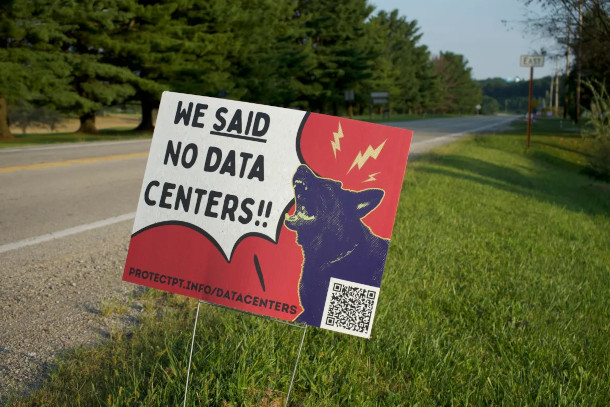
Signs like this line State Route 780 in Upper Burrell Township, near the entrance to the TECfusions data center. (Photo: Reid Frazier/The Allegheny Front)
FRAZIER: In May, the township supervisors passed a six-month temporary moratorium on data centers while they worked on the ordinance, which would govern everything from lighting to water use. Upper Burrell resident Guy Fuller is skeptical the law would go far enough. He’s already living with gas drilling. Every day, massive sand trucks drive up and down the town’s roads, and there’s noise and lights at well pads.
FULLER: Okay, I’m right in the middle of two wells. Now I’m going to have to put up with a data center on top of it, a power station.
FRAZIER: In an exchange with Fuller, town supervisor Ken Slahtovsky says he’s worked hard to research the data center industry.
SLAHTOVSKY: I wake up in the middle of the night, turn my phone on, and read data centers.
FULLER: I do the same thing.
SLAHTOVSKY: Because that’s all that’s on my phone these days.
FRAZIER: Data centers power the computers behind artificial intelligence. The companies developing them tout their economic benefits, mostly from the construction of the data centers, but they don’t need many workers once built. The Tech Fusions facility is at a former Alcoa Research and Development Center, where 1,600 people used to work, including resident Dave Ostrowski’s father. He’s skeptical the project will improve the community.
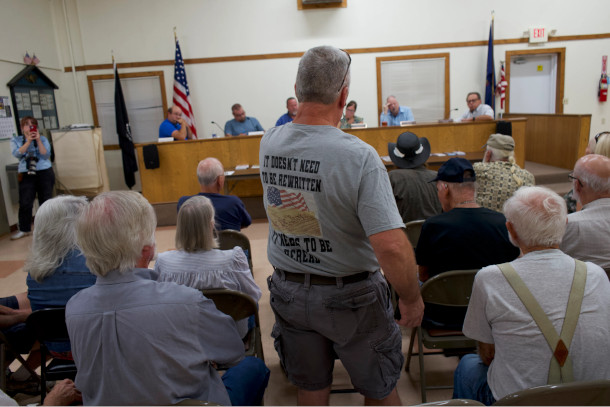
John Mataldi speaks at a Sept. 2 township supervisor meeting in Upper Burrell Township, September, 2026. (Photo: Reid Frazier/The Allegheny Front)
OSTROWSKI: I mean, my dad worked for Alcoa for many years. Alcoa brought a lot of good things to this community, okay. And bottom line is, I don’t get that vibe from these guys. These guys are here to take advantage of the situation, make money, sell that off, and leave us with the bag. [APPLAUSE]
FRAZIER: After the meeting, Slahtovsky, the township supervisor, said the proposed ordinance deals with a variety of community concerns.
SLAHTOVSKY: Noise, pollution, lighting, all the concerns, water consumption.
FRAZIER: The ordinance includes minimum setbacks from residential areas and sets water use and lighting guidelines. But there’s only so much a township like Upper Burrell can do to regulate the industry, Slahtovsky said.
SLAHTOVSKY: From what our solicitors said, we cannot ban it. And my personal viewpoint is, I don’t want to drag the township in a legal battle where we can’t afford to battle it.
FRAZIER: Local governments can’t ban a specific type of industry in Pennsylvania, but the state government can. While New York and Texas have temporary bans on data center development, there’s no such law in Pennsylvania, even though there is a proposal for one. Slahtovsky said from his vantage point, fracking companies operating in the township have been better at communicating than the data center’s developers.
SLAHTOVSKY: They were showing up at meetings. They were answering questions. I have not got much out of Tech Fusion.
FRAZIER: Tech Fusions did not respond to requests for comment. Gilian Graber is with the environmental group Protect PT, which is suing the municipality over its decision to allow the data center under its current zoning code. She says the local government should be aggressive in regulating data centers, because residents already have to put up with the dust and noise from fracking.
GRABER: When we spoke to residents of Upper Burrell, they were, they were really mad at the fact that the, the local government has not even addressed the impacts of fracking, and now they’re welcoming in another type of developer.
FRAZIER: One of those residents is John Mataldi. He lives near two gas wells and a pipeline, and across the street from the data center.
MATALDI: My neighbor is encroaching on my rights, is the way I look at it, and I’m sure a lot of other people do.
FRAZIER: The proposed ordinance caps noise at 75 decibels, around the level of a city street or a running lawnmower.
MATALDI: That is a very loud noise with no barriers in place. I live 1,000 yards from the building, no barriers. There’s one row of trees.
FRAZIER: Hannah Wiseman, a law professor at Penn State University, says there are similarities between the data center boom and the arrival of fracking in Pennsylvania about 20 years ago. As with data centers, many worried about environmental impacts from fracking, but many also supported fracking for economic reasons, like gas royalties for landowners.
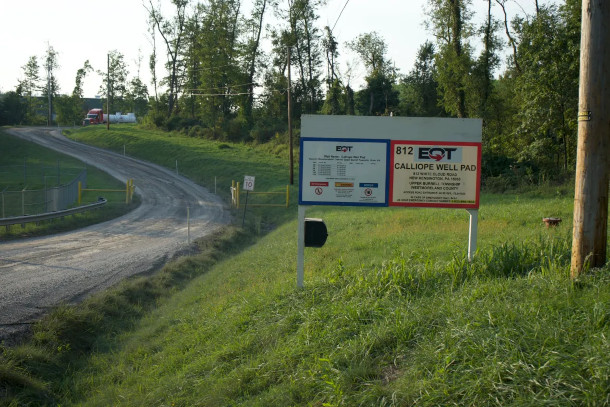
The entrance to a natural gas drilling site in Upper Burrell Township, September, 2026. (Photo: Reid Frazier/The Allegheny Front)
WISEMAN: When it comes to a data center, you you’ve got a, you know a few landowners who will benefit from selling their property, and the data center companies are offering unbelievable quantities of money to these landowners. But it’s, it’s fewer landowners who will benefit.
FRAZIER: Communities rely on tax money, but it’s unclear how much benefit data centers will bring to them, Wiseman says. That makes it a hard sell for local communities.
WISEMAN: They’re shouldering the burden of a national economic boom. Often they’re not getting compensated for that burden.
FRAZIER: One way to ensure communities get a good deal is through a community benefits agreement, a bargain developer strike with local governments in exchange for permission to build. Communities can get cash or commitments to use clean energy, or limit data center water use, Wiseman says.
WISEMAN: They can get extensive benefits. I mean, the sky’s the limit because data center data center companies want to build so badly and so quickly. I think communities don’t fully realize their negotiating power.
FRAZIER: The Upper Burrell supervisors say they’ll negotiate a benefits agreement after they have their data center ordinance in hand. A deadline for the ordinance is November 2. For Living on Earth, I’m Reed Frazier.
BELTRAN: Reid’s story comes to us from The Allegheny Front.
Related link:
This story on the Allegheny Front website
[BIRDNOTE THEME]
BirdNote®: A Bird in Hand

The American Tree Sparrow, a common species in the Northern United States. (Photo: Tom Murray, Flickr, CC BY-NC 2.0)
DOERING: Pennsylvania is famous for its unusual town names, which include Burnt Cabins, Intercourse, Pillow, Chinchilla, Hazard, and Panic. And there’s a story for how each got its name. In today’s BirdNote, Michael Stein shares how one small community came to be called “Bird-in-Hand”, Pennsylvania.
BirdNote®
A Bird in the Hand
Written by Bob Sundstrom
[ambient of Eastern bird songs in the background throughout]
STEIN: You’ve probably heard the old saying: “A bird in the hand is worth two in the bush.” Well, it’s a very old saying, and it’s gone through some changes over the years.
The phrase first pops up in a seventh-century Aramaic proverb, “Better is a sparrow held tight in the hand than a thousand birds flying about in the air.”

A Northern Cardinal, famous for the red coloration in males. (Photo: Robert Engbird, Flickr, CC BY 2.0)
An English book from the 15th century had this version: “It is more certain a bird in your fist than to have three in the sky above.” One hundred years later, there was another old English saying: “Better one byrde in hande than ten in the wood.” In each era, the pragmatic wisdom is clear: Hold on to the sure thing rather than taking a gamble on something better.
The old saying eventually made it to Pennsylvania, where there’s a town named “Bird-in-Hand.” Legend has it that when two road surveyors in the early 1700s were trying to decide whether to stay the night where they were working, or head back to Lancaster, one cited the bird-in-hand proverb. They decided to stay, and the place was named “Bird-in-Hand.”
I’m Michael Stein.

The American Goldfinch collects thistle seed, which can be both eaten and used for nest building. (Photo: Rob Kleine, Flickr, CC BY-NC 2.0)
###
Producer: John Kessler
Executive Producer: Sallie Bodie
Editor: Ashley Ahearn
Associate Producer: Ellen Blackstone
Assistant Producer: Mark Bramhill
Bird sounds provided by The Macaulay Library of Natural Sounds at the Cornell Lab of Ornithology, Ithaca, New York. 110222 recorded by ML W Hershberger WV May
BirdNote’s theme was composed and played by Nancy Rumbel and John Kessler.
© 2019 BirdNote December 2019
ID# language-09-2019-12-16 language-09 Narrator: Michael Stein
https://www.birdnote.org/podcasts/birdnote-daily/bird-hand
DOERING: For pictures and more, migrate on over to the Living on Earth website, loe dot org.
Related links:
- Find this BirdNote® and more BirdNote® Daily episodes
- Learn more about Bird-in-Hand in Pennsylvania
- Visit All About Birds, a Bird Identification and Education Platform by Cornell Lab of Ornithology
[MUSIC: Hard Times, Soft Hands]
BELTRAN: Coming up, Hopes for a treaty on transitioning away from fossil fuels. Keep listening to Living on Earth!
ANNOUNCER: Support for Living on Earth comes from the Waverley Street Foundation, working to cultivate a healing planet with community-led programs for better food, healthy farmlands, and smarter building, energy, and businesses.
[CUTAWAY MUSIC: Luca Sestac, “Blame Game” on Lighter Notes, Luca Sestac]
A Fossil Fuel Treaty Beyond the UNFCCC
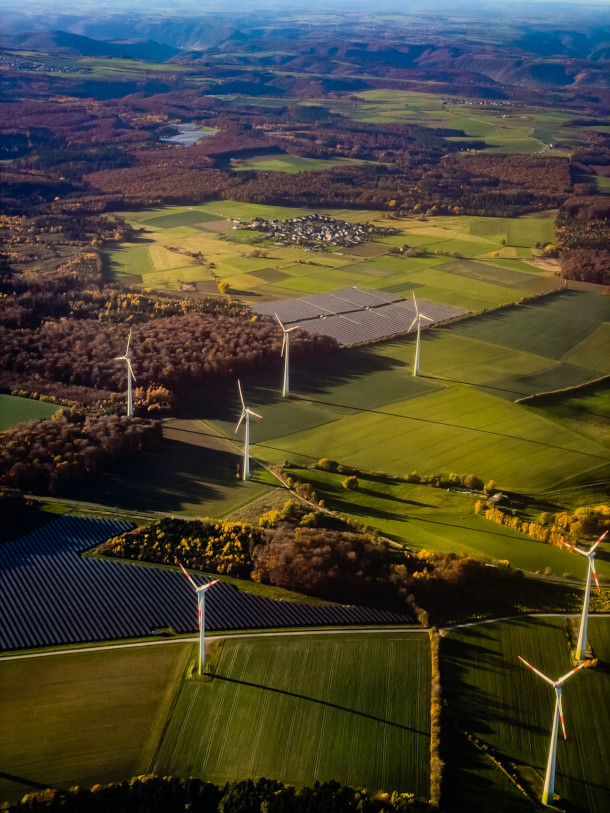
Solar panels and wind turbines in Rhein-Hunsrück-Kreis, Germany. In September 2026, after attending the Santa Marta conference earlier that year, Germany published a roadmap for phasing out fossil fuels nationwide. (Photo: Bernd Dittrich, Unsplash, Unsplash license)
DOERING: It’s Living on Earth, I’m Jenni Doering
BELTRAN: And I’m Paloma Beltran.
As the United Nations gears up for the COP31 climate session in mid-November, nearly three decades after the Kyoto Protocol, we are also considering a newer set of international climate negotiations that hopes to close the wide gap between discussion and action. This April in Santa Marta, Colombia was the first Conference on Transitioning Away from Fossil Fuels. It’s known to proponents as the “coalition of the willing”. Hosted by Colombia and the Netherlands, this event brought together 57 countries and the European Union, as well as civil society organizations, scientists, indigenous leaders, and more. Born out of the frustration with the fossil-fuel-friendly nations and the oil and gas lobbyists at the COP process, this Fossil Fuel Treaty effort is kickstarting an alternative approach to international cooperation on climate. And the second conference is coming up in just a few months. Tzeporah Berman is the founder and chair of the Fossil Fuel Non-Proliferation Treaty Initiative, and she joins us now from Vancouver, Canada. Tzeporah, welcome to Living on Earth!
BERMAN: Thanks. Hi.
BELTRAN: Six months after the first conference on this, what is the energy like from the countries who are interested in moving forward with transitioning away from fossil fuels?
(Video: Courtesy of the Fossil Fuel Treaty Initiative)
BERMAN: You know, in some ways, we're starting to see kind of groupings of countries within the process. So there were 57 countries that came. I really think at the next international conference, which will be co-hosted by Ireland and Tuvalu in 2027, there's going to be even more, because I've been talking to a lot of countries who are like, "Wow, it happened really quick. You know, it was announced at Belém, and then it happened in April, and we didn't come, but we want to." And so, I actually think the broad coalition of countries that are committed to do fossil fuel phase out will grow, and that's exciting. So a lot of conversations where people are like, "What happened there? Can I come to the next one?" And so there's a lot of that, but then there's also specific conversations that began in Santa Marta that are now deepening. Conversations on specific solutions. There is a group of countries which I kind of think of as like the high-ambition coalition of countries on fossil fuel phase out that are at the table starting to design a fossil fuel treaty. So there's 25 or so countries that are at the table working on this, and these are countries who are really committed to new global governance on fossil fuel phase out, legal strategies so that they can be binding, not just voluntary, and cooperative mechanisms. And what I mean by that is, look, there's a lot of countries out there who are digging for more oil, fracking for more gas, because they feel like they have to, like they're being pushed into it because of crushing debt, because of financial architecture and tax agreements and trade agreements that have existed historically that really prop up the fossil fuel industry and push fossil fuel production. So these are countries that want to cooperate on some of those big picture solutions like debt, and so those countries are hard at work looking at different legal mechanisms and mechanisms of international cooperation. There's a group of countries that are working specifically on fossil fuel subsidies, and encouraging countries to get rid of subsidizing the oil and gas industry. And there's a number of countries that are now doing national roadmaps, which are great, and that's kind of increasing ambition within the UNFCCC and COP spaces as well. So, I think these conferences and this conversation, you know, there's not one answer to phasing out the most powerful industry on earth. It's going to take multiple initiatives, and I think these conferences have really sparked a lot of new bilateral and plurilateral convenings and cooperations.
BELTRAN: So, many of our listeners are familiar with the UNFCCC, the United Nations Framework Convention on Climate Change. How does a potential fossil fuel treaty exist in relation to the United Nations and the Paris Agreement?
BERMAN: It's a great question because a lot of people don't realize that any issue that we have that we work on within the UN has multiple agreements, multiple treaties associated with it. So, it's not uncommon to have different agreements and different treaties on different aspects of a big problem: landmines, nuclear weapons, chemical weapons. And so what we are proposing is that the fossil fuel treaty would be a companion to the Paris Agreement. It would be some international agreements on helping phase out the production of fossil fuels, in a way that is equitable and fair. And what I think what a lot of people don't realize is that we don't have that. For 30 years our countries have been negotiating on emissions reductions, so how much each country gets to pollute, but not on reducing the supply and production of fossil fuels. So an economist would say it's like trying to cut with one half of the scissors, only the demand, but not the supply. So every year we negotiate new emissions reduction targets, and then every year we grow new projects and new development, and then we fail to meet our targets. But, it's not rocket science, what we build today will be what we use tomorrow. So the fossil fuel treaty will be an agreement between countries who are willing to come into the coalition to stop expansion of new projects and to manage a wind down in a way that's safe and fair.
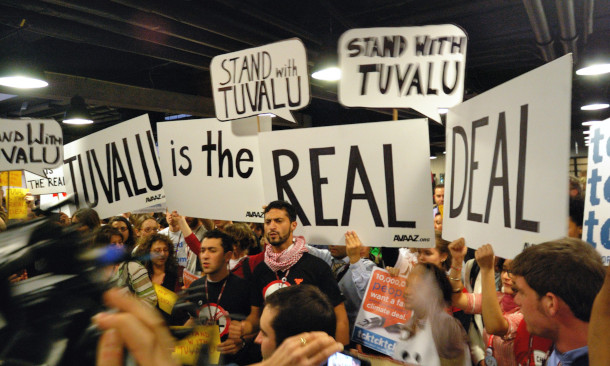
Above, a demonstration in support of Tuvalu at COP15. Tuvalu is one of the nations on the front lines of sea level rise, and will be co-hosting the next Fossil Fuel Treaty conference in 2027, alongside Ireland. (Photo: Lauri Myllyvirta, Wikimedia Commons, CC BY 2.0)
BELTRAN: And this fossil fuel treaty, this treaty we're talking about, was not initiated by the United Nations. It was actually spearheaded by you with a formal campaign launching in 2020. How is it different from UN processes and conventions?
BERMAN: Well, it is likely that the fossil fuel treaty will become a UN process. It's not right now, and that historically is what we've seen with a lot of tricky and intransigent issues. So landmines, chemical weapons, nuclear. These are treaties that were created initially outside the UN process, especially landmines. Great analogy, because we got the idea of the Santa Marta conference from landmines, because landmines were an issue that was really not moving forward in the UN space because there's a bunch of vested interests who were like adamant not to have the conversation, that they wanted to expand landmines, and Ottawa created the Ottawa Convention, which was the precursor to the landmine agreement, and it was again a coalition of the willing. Fine, you don't want to talk about it, don't come, because you're holding back the conversation anyways. Let's just have the countries who want to do this come, and that process outside the UN space is what created the landmine ban treaty, which was eventually brought back inside the UN. So, working along that framework and that model, we're working with a group of countries that want to create a fossil fuel treaty, and they're starting to design it. Now, once they design the treaty and negotiate the terms, and more countries join, it is likely that that will be brought back inside the UN.
BELTRAN: And how would it benefit from becoming part of the UN process?
BERMAN: Infrastructure and buy-in. Like, right now, I have to say these conferences and a lot of the diplomatic work, without having structure and infrastructure, and the support of the UN, it's a little spit and duct tape. It's not easy to bring a conference together of 5,000 to 10,000 people and without private money invested and without the infrastructure to invite all the countries to do the security for all the ministers, etc. So there's infrastructure, there's history, there's expertise within the UN in diplomacy, and no one treaty or agreement between countries is going to exist in isolation. So when it becomes an issue of foreign policy debate, there's a little bit of tit for tat. There's a little bit of trade in foreign diplomacy. And so, these issues need a cycle, they need a structure, and they need to exist within the ecosystem of the other international agreements.
BELTRAN: And most of the nations who are early participants in these negotiations are not major fossil fuel producers. What does a path forward look like for getting more buy-in on this?
BERMAN: So there are some who are major fossil fuel producers. For example, Colombia is the fifth largest coal exporter in the world, and they have joined the table of the fossil fuel treaty. It's not a formal negotiating table yet; it's a discussion table. Certainly, some of the countries have communicated to us that they're hoping to develop a formal negotiating mandate later in 2027. That's their goal, and I think they will do that. So there's two things that happen. Once the formal negotiating mandate exists and the negotiations begin, there's usually, if you look throughout history, that's a moment when a lot more countries join. Because if you're not at the table, you're not designing the rules. And so we already have about 25 countries at the table. There's an expectation that once that formal negotiating table is created, we'll probably have 35 to 40. Which, a lot of treaties were built on 20 to 40 countries being the ones to participate. Then once the treaty is designed and countries start to see, oh wait a minute, there's benefits for being a part of that group. It's not just all stick, there's lots of carrots embedded in the frameworks that are being discussed at the treaty table, and so there will be countries that will join because once they see the actual text, they're like, oh, this works for us. Then the third issue is about social norms. What we've learned from studying the other treaties is that there are some countries that will never join, but actually that's okay, because if you look at the other big issues - nuclear, landmines, etc. - there are countries that never joined, but they changed their practices, because the treaty itself and the development of the treaty shifted the social norm around that issue. It became elephants for ivory, you know, to be saying you're stockpiling landmines or you're stockpiling nuclear weapons, even if you hadn't signed the treaty. Because, before the campaign and the development of the Nuclear Non-Proliferation Treaty, stockpiling nuclear weapons was considered something that kept us safe.
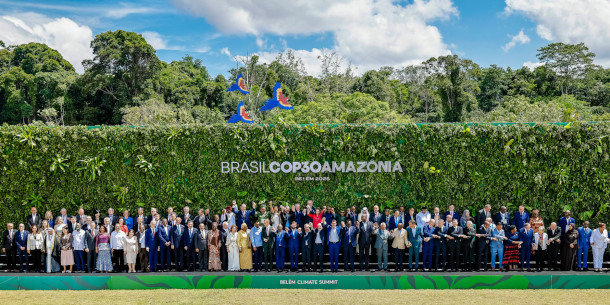
The COP process has been going on for over 30 years, but some say that influence from the fossil fuel industry and pro-fossil-fuel countries have stalled meaningful climate action during that process. Tzeporah Berman believes that the Fossil Fuel Non-Proliferation Treaty may one day become a United Nations process, as many other treaties have been formed outside that system and later been brought in. (Photo: Ricardo Stuckert / PR, Wikimedia Commons, CC BY-SA 4.0)
And it was throughout that campaign and the development of the treaty that the information came out, that actually, experts around the world were saying we already have enough nuclear weapons to blow up the world six times over, and this is actually what's threatening us, is more nuclear capacity, and so that social norm shifted. It shifted from being something that keeps you safe to something that's threatening you. And I think that's what we're seeing happen on fossil fuels, and I think that's in large part because of the last five years of the fossil fuel treaty campaign and the support for it that is growing so quickly around the world. I mean, there are 4000 organizations now, in 120 countries that have endorsed the idea of a fossil fuel treaty and are working on it, and so that starts to shift what becomes acceptable. And when that shift happens within foreign policy, because there's an actual treaty that some countries are a part of, that will change the practices, I believe, of many of the other countries. It won't be so easy for Australia to announce a new coal mine while also saying it's a climate leader.
BELTRAN: And Tzeporah, you were just at the pre-COP meeting in Fiji, one of the many small island nations at the front lines of climate change. What was discussed in terms of the dangers that these countries face?
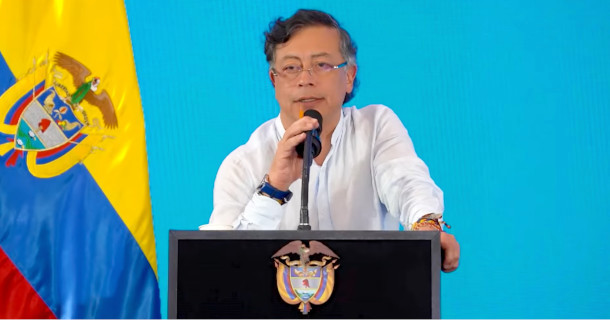
Pictured above is Colombian President Gustavo Petro, delivering a speech at the First International Conference for the Transition Beyond Fossil Fuels event on April 28, 2026. Colombia and the Netherlands co-hosted the conference. (Photo: Screenshot Youtube Presidencia de la Republica Colombia)
BERMAN: It's really inspiring to be working in the South Pacific, to be somewhere like Fiji, having these conversations, and it's also heart-wrenching, right? These are countries, many of whom are already moving their population. They are having to move grave sites. They are struggling with rising sea levels, and salination of water, and the dramatic increase in extreme weather and storms. You know, the hurricane season used to be a month. It's now three months. They can expect multiple hurricanes every year, and that is their lived reality now. And, the spirit of the people in the South Pacific around these issues is truly inspiring. Like, they're not despairing, you know. They, they have this mantra, “1.5 to survive,” and “we're not drowning, we're fighting,” and it's no wonder that these are the people at the forefront of many solutions. We wouldn't have the 1.5 degree target and commitment under the Paris Agreement if it wasn't for island nations from the South Pacific, we wouldn't have even the frameworks on loss and damage financing. We wouldn't have the commitment by the International Court of Justice to recognize climate change and fossil fuel expansion as being illegal under the international courts. The ICJ decision is a direct result of leadership from the South Pacific. And, they were the first countries to join the fossil fuel treaty because they are the most vulnerable nations on Earth. And while we all feel it now, we can all see the wildfire smoke and the fires and the extreme weather that we're living now, the heat domes and the lethal heat, they've known it for decades.
BELTRAN: What do you see as the biggest barriers for this treaty moving forward?
Wondering how a Fossil Fuel Treaty would work and what the legal mechanisms could be to compliment the Paris Agreement and support cooperation between countries to phase out fossil fuels? New briefs just published!
— Tzeporah Berman (@tzeporah.bsky.social) August 4, 2026 at 11:32 AM
[image or embed]
BERMAN: I think one of the biggest barriers to moving forward on fossil fuel phase out is the fear mongering by the oil and gas industry around scarcity and around price, and around affordability. They're very powerful. This is an industry that has made 2.8 billion dollars a day in pure profit, every day, for the last 50 years. They have unlimited resources to run communications campaigns on social media and to fearmonger around, for example, your gas, your price of gas is going to go up if they stop drilling. That's actually not true. Price is not related to new drilling, but they argued that in California through an ad campaign, and they won. And Gavin Newsom reversed his decision to stop expanding drilling because the oil industry had people so scared that they wouldn't support the right policies. Or we find commercials and ads all over the world that the oil industry is funding, telling people that, you know, if people start working on fossil fuel phase out, that the economy will collapse. The term I keep seeing in all the ads is “your hospitals will be closed and your roads won't be paved.” That is not true. Renewables are cheaper than fossil fuels. Countries have the capacity to support export revenues from multiple industries besides fossil fuels. In fact, fossil fuels are one of the priciest things for our countries to do because we subsidize the oil and gas industry because they're so powerful, and then we're left with the bills of the cleanup, and the health concerns. Between five and seven million people died last year on the planet just from air pollution due to fossil fuels alone, and one person is dying every minute now due to lethal heat, primarily due to fossil fuels, so if we start to phase out fossil fuels, our lives actually become cleaner, safer, and more affordable.
BELTRAN: Tzeporah, we're talking midway between the first two meetings of this conference. How optimistic do you feel about this process?
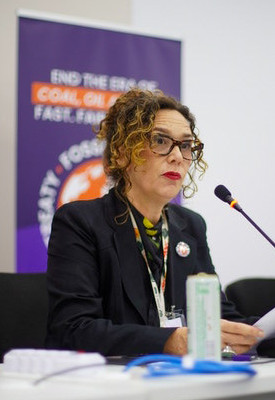
Tzeporah Berman is the founder and chair of the Fossil Fuel Non-Proliferation Treaty Initiative. (Photo: Courtesy of the Fossil Fuel Treaty Initiative)
BERMAN: It's honestly the only thing right now, one of the only things that's giving me hope, that makes me feel optimistic. These conferences are creating new conversations that are decades overdue. This will be, I think, my 16th COP that I'm going to in Turkey in a couple of weeks, and it's been extremely frustrating. It's been the same conversation, the refusal to address fossil fuels, the, I think, a distorted conversation for many, many years. And this year, we changed that, and it's changing. And I think that that will have huge ramifications. I think it'll save lives. I think we're actually living in one of the most exciting times in human history. We are reinventing industrial society. We're watching it happen around the world, and it is happening. The question for us now is how quickly will it happen, and how many lives can we save? And I think that requires all hands on deck. I don't think hope is something we just get to have. Look at the changes in technology. Look at how cheap renewables are. Yay! There's hope. No, I think hope is something we create. We create it by waking up in the morning and deciding what's our piece of the puzzle. What can we do? And everyone can do something. This is a movement that includes individuals, businesses, faith leaders, health leaders, everyone around the world. And make it your own, because we need all hands on deck.
BELTRAN: Tzeporah Berman is the founder and chair of the Fossil Fuel Non-Proliferation Treaty Initiative.
Related links:
- The Fossil Fuel Treaty website
- The 2nd International Conference on the Just Transition Away from Fossil Fuels website
- The Guardian | “How Frustration at Cop Stalemates Inspires First Global Talks on Phasing Out Fossil Fuels”
[MUSIC: Onward]
Science Note: Air Pollution and Human Reproduction
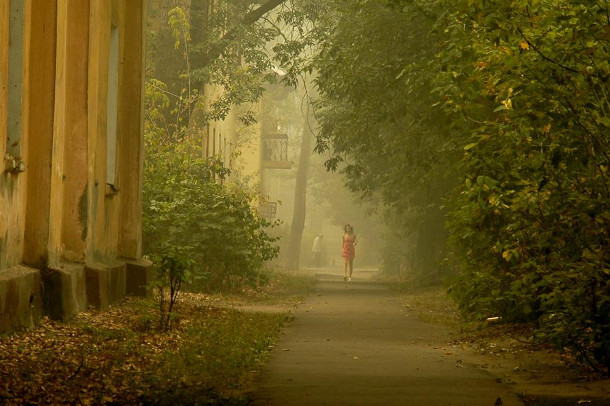
Research suggests a link between ultrafine particle air pollutant exposure and longer menstrual cycles. (Photo: Dmitry Makeev, Wikimedia Commons, Public Domain CC BY-SA 4.0)
DOERING: The health consequences of burning fossil fuels go beyond what you might expect, as Ashanti McLean reports in this week’s note on emerging science.
[SCIENCE NOTE THEME]
MCCLEAN: In our post-industrial revolution world, where fossil fuels continue to power our cities, air pollution follows closely behind. Health consequences such as cancer, respiratory diseases, and cardiovascular damage are well documented when people are exposed to high levels of the fine particulates known as PM2.5. This air pollution is emitted by coal and gas fired power plants, gas powered vehicles, and wildfires.
But research has begun to uncover another potential consequence—one that may affect human reproduction. In a study published in The Lancet Planetary Health, a research team from the MIT Sense-able City Lab and the University of Colorado Denver, collaborated with a menstrual period tracker app called Clue. They examined the cycles of 92,000 users with female anatomy across the US, Mexico, and Brazil, and discovered a significant link between fine particulate air pollution and unusually long menstrual cycles, or those lasting longer than 38 days. Coauthor of the study, Dr. Priyanka deSouza stated that “for every 10 micrograms per meter cubed increase in long-term PM2.5, the odds of a long cycle were about 3.6% higher.” Like any other bodily function, reproductive health is an important aspect of overall wellbeing. While more research is needed, as one of the first to use a menstrual tracking app to obtain cycle data, this study provides compelling evidence that air pollution from smoke stacks and tail pipes may be linked to more health consequences than we thought. That’s this week’s note on emerging science. I’m Ashanti McLean.
Related links:
- Read more about this human reproductive health study at the Clue app website
- Find this article at The Lancet Planetary Health
[SCIENCE NOTE THEME]
BELTRAN: Just ahead, how radio became a lifeline in the aftermath of Hurricane Helene. Stay tuned to this broadcast -- of Living on Earth!
ANNOUNCER: Support for Living on Earth comes from Hansjörg Wyss in honor of Rosamund Stone Zander. Celebrated painter, environmentalist, and author of The Art of Possibility, who inspired others to see the profound interconnectedness of all living things, and to act with courage and creativity on behalf of our planet. Support also comes from Sailors for the Sea and Oceana. Helping boaters race clean, sail green, and protect the seas they love. More information at sailorsforthesea.org
[CUTAWAY MUSIC: Luca Sestac, “Minute Waltz” on Lighter Notes, Luca Sestac]
Hurricane Helene's Impact Brought to Life
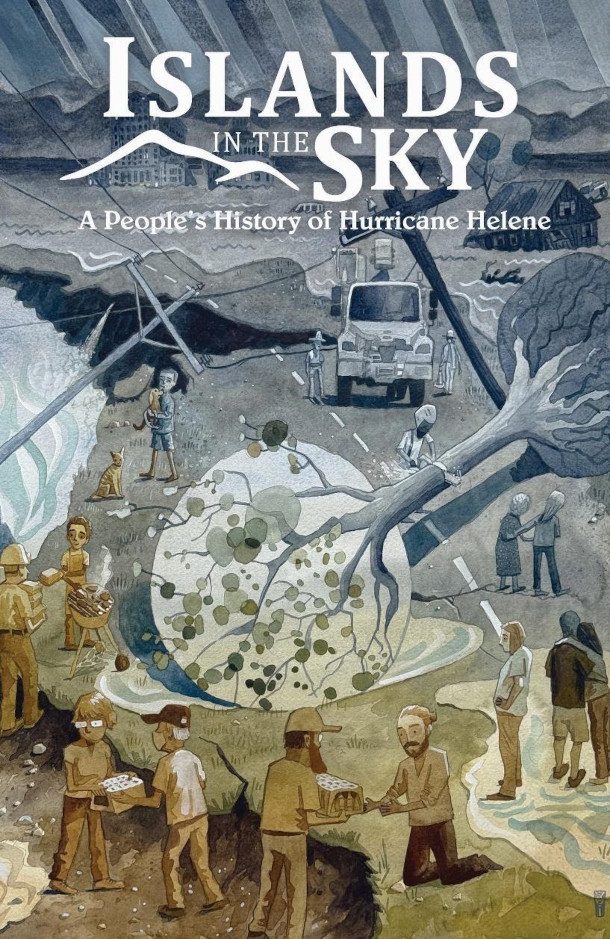
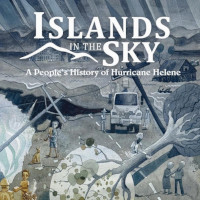
Islands in the Sky: A People’s History of Hurricane Helene pairs hurricane survivors with comic creators to tell eleven unique accounts of the storm. (Cover art: Jarrett Rutland/Appalachia Comics Project)
BELTRAN: It’s Living on Earth, I’m Paloma Beltran
DOERING: And I’m Jenni Doering.
In 2024, Hurricane Helene ripped through America’s Appalachian region and devastated the mountain communities of western North Carolina. In part fueled by climate change, the storm brought feet of rain that swelled creeks and rivers and swept houses, roads, and powerlines away, leaving residents stranded and unable to contact the outside world. As the waters receded, Helene survivor Andrew Aydin (Eyeden) realized he could put his skills and experience to work to help those who lived through the disaster share their stories. Andrew had served as Digital Director and Policy Advisor to Georgia Congressman and civil rights activist John Lewis from 2007 until his death in 2020. The two co-wrote the award-winning graphic novel trilogy, March, about the civil rights movement as Lewis had lived it. And in the aftermath of Hurricane Helene, Andrew again turned to comics. Islands in the Sky: A People’s History of Hurricane Helene is a collection of eleven comics, each written by a survivor paired with an artist. Andrew Aydin is also the founder of the Appalachia Comics Project, which aims to amplify the voices and stories of local people. And he joins me now, Andrew welcome to Living on Earth!
AYDIN: Thank you so much for having me. It's good to be with you, Jenni.
DOERING: Andrew, you were there in North Carolina during Hurricane Helene in 2024. What was that experience like for you?
AYDIN: It was really hard. Um, I live in a town called Edneyville, and it was one of the hardest hit areas during the whole storm. And you live through this dark night, where you just hear these terrifying sounds: the wind, the trees snapping, the impact of debris hitting your home because it was being shot through the air with such velocity. These limbs and branches and rocks and things like that, and the rain just pounding. And then you wake up, and what I saw was a creek in front of my house that usually is four or five feet wide, that was four or five hundred feet wide, that had completely covered the road, multiple bridges in front of my home, and then came to find that one of my neighbor's home had been flooded, and he drowned. And, and then you deal with okay, how do we survive the next day? Because communications is completely gone. You've just got no cell phone, no power, no internet, no way to reach anybody, and no way to even traverse the road in front of your house. And what we did is we pulled together first as neighbors. One of my other neighbors, we, we got on walkie talkies to stay in touch. You couldn't go as far as into town, so it's first hyper local. Then everybody cuts through the trees, and you're driving under these holes, basically cut in downed trees that just fit a car, driving over down power lines. People are walking around like it's the Walking Dead, and that was just in the first, you know, few days, and then it just got worse as people started to run out of water and food. And then by the time you did get back onto the internet, all you saw was misinformation and these sort of content people coming in to, to film your misery and making something that wasn't true, not capturing the real story. But at the same time, I mean, despite all of that, I think the thing that I, I think back on the most is how my neighbors and I, everybody set down the identities that they had, that the internet gave them, you know, and, and they, they just talked to each other, they helped each other. What do you need? In a small community, in these small towns, there is a resilience and a care and a love for one another that is vastly misunderstood, and that the social media environment we live in today is polluting our minds and taking that away from us.
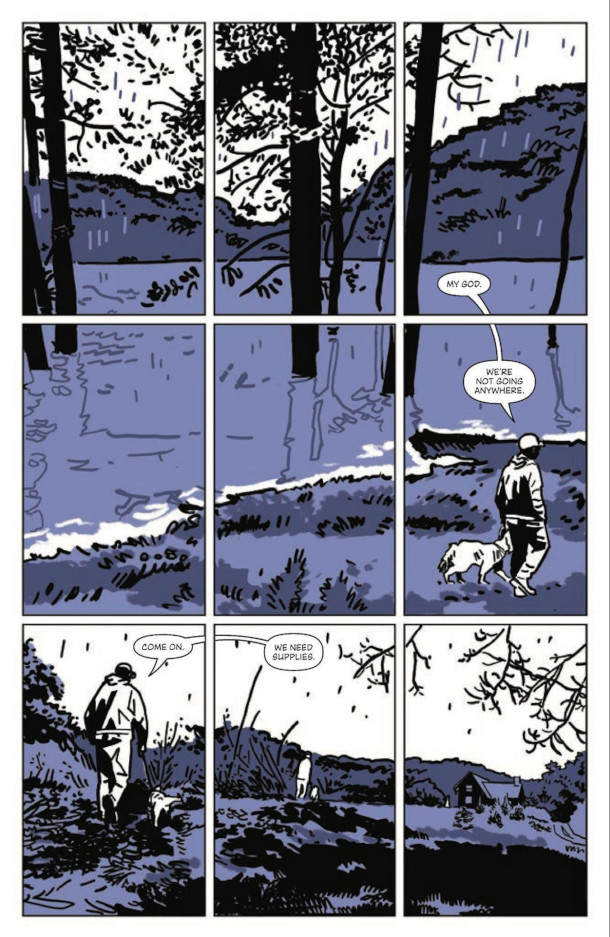
“What I saw was a creek in front of my house that usually is four or five feet wide, that was four or five hundred feet wide,” Andrew says in his interview with Living on Earth. Page 8 of Andrew Aydin’s story, “Islands in the Sky,” with art by Valentine de Landro and lettering by Josh Reed. (Credit: Islands in the Sky, Andrew Aydin/Valentine Landro/Josh Reed)
DOERING: It sounds really hard, especially to, as you said, lose a neighbor, flooded, drowned in his home.
AYDIN: Yeah.
DOERING: So, how did your experience living through this nightmare inspire the Appalachia Comics project and this book, Islands in the Sky?
AYDIN: All of the misinformation and disinformation and manipulation that went into and still goes on today, in talking about, and telling the story of what happened during Hurricane Helene, it made me very angry. I mean, furious. Because I saw it with my own eyes, because I lived it. And I read a graduate thesis by a woman named Elon Justice, who's from Kentucky, and she wrote it for the MIT Media Lab. It was called "Hillbilly Talkback," and she wrote a long, detailed history of all the ways in which Appalachia has been controlled through controlling the narrative, the ways in which Appalachia is depicted in popular culture, in the media, in the news, and this long history of it being done by outsiders. And her proposal, her solution from her thesis was that people living in Appalachia need to have the opportunity to tell their own story, and she proposed something, what she called the co-creation model, right? And this is something that I'd experienced a lot working for John Lewis, particularly in the Southern Black communities, where Black folks would get the opportunity to tell their story, but they wouldn't get the support to make it succeed, and then they would be written off because they didn't get that support. I mean, it's hard to learn how to do comics or any other medium without support, without mentorship. And I thought about that, and I was like, okay, one, I know a lot about this co-creation model after years and years of working alongside John Lewis, and also these are my people. I came to my mother's home to live after Congressman Lewis died, here at Edneyville. My grandfather was the mailman for this valley. My grandmother lived about a mile down the road from where my mother lived, and after I lost all of them, this was the only place that I thought I could go to heal. And many of these people saved me, and this was something I felt I could do to help them, and help all of us.
DOERING: Yeah, so in this book, Islands in the Sky, you paired up survivors with comic artists to help tell their stories. Why did you choose that format, and how did it allow you to tell a really broad range of stories?
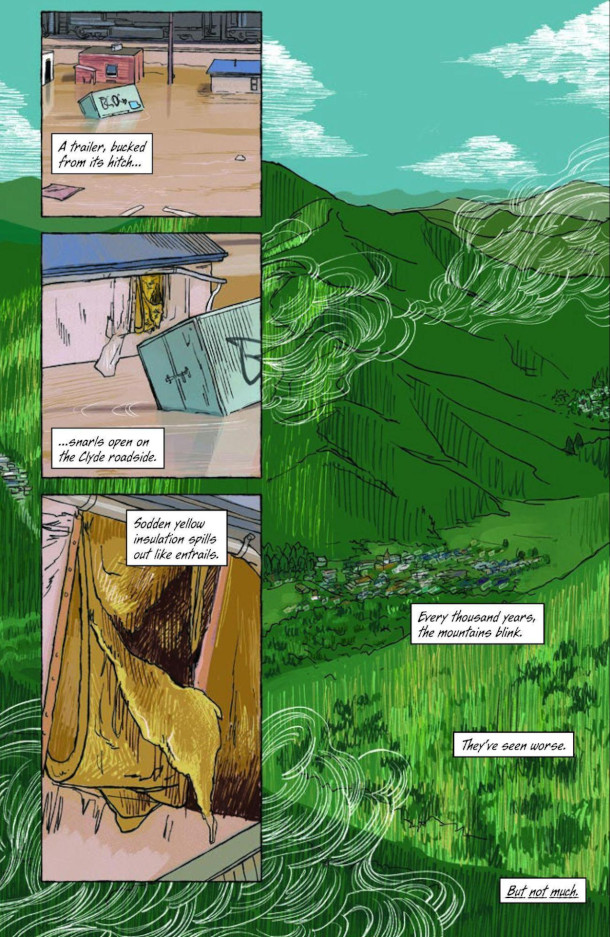
“Every thousand years, the mountains blink. They’ve seen worse. But not much.” Page 9 in reporter Cory Vaillancourt’s story, “The News Still Came,” with art by June Kim and lettering by Josh Reed. (Credit: Islands in the Sky, Cory Vaillancourt/June Kim/Josh Reed)
AYDIN: Appalachia is a region of storytellers, and yet it is this almost criminal occurrence that we have not given Appalachia the ability to use that. And I think that's why comics work, right? I mean, this is the people's medium. People love comics here, and so I wanted to create an opportunity for people to tell their story in the most beautiful way possible, but give them the support that they needed to not feel overwhelmed by the process, to not feel like they were alone, to let their emotions focus on what was going to be the end result, and not on the sort of nitty gritty immediately of learning the particulars of the medium. And I was just so fortunate that so many of my colleagues signed up to help, and it was so much fun to introduce many of these first time writers to comic creators that they had read before, that they admired, that they got so excited, they just got to, to work with, and then you see how beautiful the stories that they made came out to be.
DOERING: Could you share one of the stories in this collection that especially moved you? I know it's hard to pick a favorite.
AYDIN: Yeah, I mean it is hard. I think there's several that I was really, really proud of. First, I mean, Cory Vaillancourt, who had been a reporter for many many, years in the region and had never written a comic book, but he wrote this almost poetic and ghostly story about being a reporter during the storm, and he wrote it with Steve Orlando, who's a fantastic writer that I've been friends with for a long, long time. And Corey started in Haywood County, which is where he lived at the time, near a place called Canton, and Corey found flooding that he was familiar with. I mean, Canton has flooded many times in recent memory, except it was on a scale that surpassed anything that they'd experienced so far. And as he tried to make his way to other towns and other places because he couldn't get a cell phone, he couldn't get a signal, he had to be there in person. He had to get his pen and pad and write it down and take photographs and document it himself. He came across destruction. He came across washed out and burned out homes and cars and bridges that just no longer existed, and yet he knew his responsibility, his obligation, was to not be sad in that moment. It was to preserve, to document, to tell the story, to share, so that people knew what happened. And he became a key element of just information sharing.
DOERING: In an awful way, I guess, you feel like you're there, you're seeing it, and I have to say, the art in Cory Vaillancourt's story is really captivating. You know, showing scenes of destruction, but somehow beautifully rendered? You know, one of the pages: "Every thousand years, the mountains blink. They've seen worse, but not much."
AYDIN: Cory's story is a perfect example of the overlooked talent and ability that exists here, that has never had the platform it deserves, and because we were able to take this disaster and turn it into an opportunity for the people who endured it and survived it and helped everyone else endure and survive. We can take a tragedy and maybe not fix it, but we can make it better and make it less painful. And I think there's just this terrible history of extraction from Appalachia, and what we're trying to do is reverse that so that we're exporting the important stories and then bringing the money into the region so that we can create this independence and self sufficiency through this thing that is so important to everyone here culturally, which is storytelling.
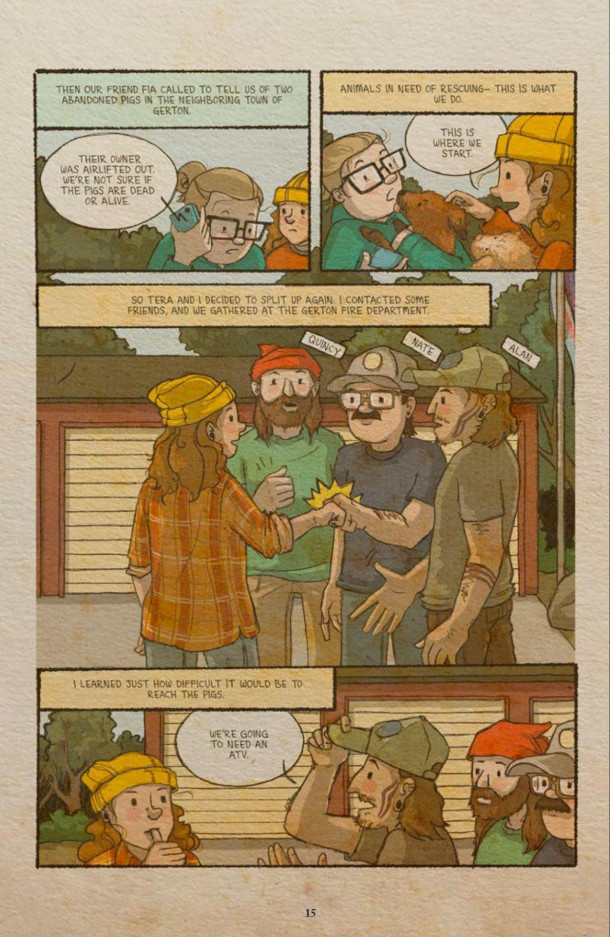
Some of the comics depicted neighbors coming together to help one another — and even some stranded animals. Page 3 of “A Community of Misfits,” written by Tera and Amy McIntosh and Gene Luen Yang, illustrated by Thien Pham and Briana Loewinsohn. (Credit: Islands in the Sky, Tera and Amy McIntosh/Gene Luen Yang/Thien Pham/Briana Loewinsohn)
DOERING: I guess the flip side of realizing just how resilient you are as a community, as Appalachian people, is that you were really failed and left to fend for yourselves, and, and maybe, I don't know if warnings should have come that didn't come. How did I guess a lack of urgency from, you know, people in charge affect the way that this crisis developed?
AYDIN: I think everybody's looking at one person to blame, and there isn't just one person or one organization or one group, right? From the outset of the storm, the National Weather Service office out of Spartanburg put out this SOS message the day before the storm hit, being like, "Strap in. This is going to be the worst thing you've ever seen." And yet, county officials in certain parts of the region refused to send out evacuation warnings because they were afraid that it would be received negatively because of the upcoming election, and so, many people were caught in places they wouldn't have otherwise been because they were counting on the county to give them the heads up to tell them, don't go out, to tell them to evacuate, and they didn't because it was a political decision. And then at the same time, because we'd never had a disaster where a region that is effectively the size of Connecticut, was completely cut off from the outside world, word could not get to Raleigh or Washington about how bad it was. It was this deafening silence in the first day and the first weekend after the storm. This is why the book is so important because it was this devastation that nobody else has ever experienced before. When you have these disasters like the fires in LA and everything, you've got everybody videotaping it and sending it out, and people are watching it so closely. This is a true example of what happens if a disaster falls in the woods, but nobody can hear it, right? And those lessons of resilience, communication resilience, are so, so important because it is in those first days after the storm that determines whether people live or die. And I have long said that if this storm had been 90 miles east or 90 miles west at this scale, and hit Charlotte or hit Charleston or hit Atlanta, there would have been thousands and thousands and thousands of people dead, because what saved us was our ability to cut our way out, to use the skills that come from living in a region where the right to exist comes from a constant negotiation with nature. That's what saved us. And not very many other regions, particularly urban regions, are prepared for this level of disaster. And I think, as a country, as a nation, we have to take a long, hard look at the lessons of what happened during Hurricane Helene to prepare ourselves for the next one, and we're preparing. We're preparing here, but I don't think the rest of the country is.
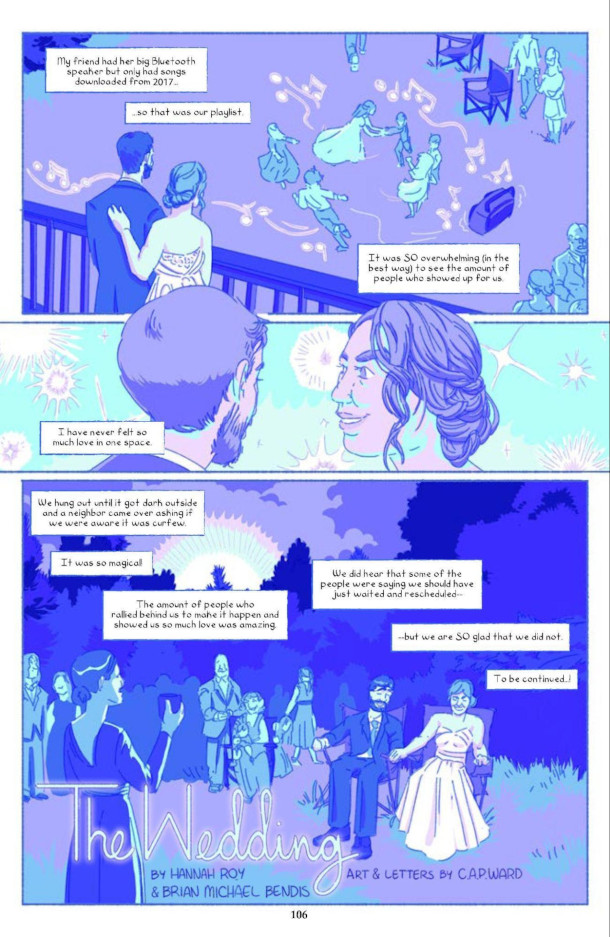
Other comics showed moments of joy amidst the destruction. Page 8 of “The Wedding,” written by Hannah Roy and Brian Michael Bendis, with art and letters by C.A.P. Ward. (Credit: Islands in the Sky, Hannah Roy/Brian Michael Bendis/C.A.P. Ward)
DOERING: In your story, in other stories, in Islands in the Sky, you're riding out the storm without information, without you know, cell networks, they were down, internet was down, power was out. You dig out your radio, and some of your neighbors also mentioned Blue Ridge Public Radio being the only information source that they had during this time when it felt like you were cut off from the world.
AYDIN: There were two main stations that people could get, and even that in the first day or two, they lost their towers. There was AM 570 and Blue Ridge Public Radio, and these people, like camped out and lived in the stations for weeks, relaying information. Once people could call in, they had them calling in. And there's another phenomenon that happens out here that is sort of a relic of days gone by, which is that some of these churches have low power radio transmitters. And I'm pretty far away from Asheville. I'm about 45 minutes away. I managed, the first signal I managed to get was one of those churches, and I know many of the local governmental authorities have been working on communication resiliency plans, but I don't think our machines can fight nature, and I think that's what we have to be prepared for as climate change gets worse, as these storms get worse and more prevalent, as resources get more scarce. We have to be prepared as local communities for how we take care of one another when we aren't able to reach the outside world.
DOERING: So, how is climate change likely to affect North Carolina and Appalachia in the years to come? And, you know to what extent are people in the region talking about the climate emergency differently after Hurricane Helene?
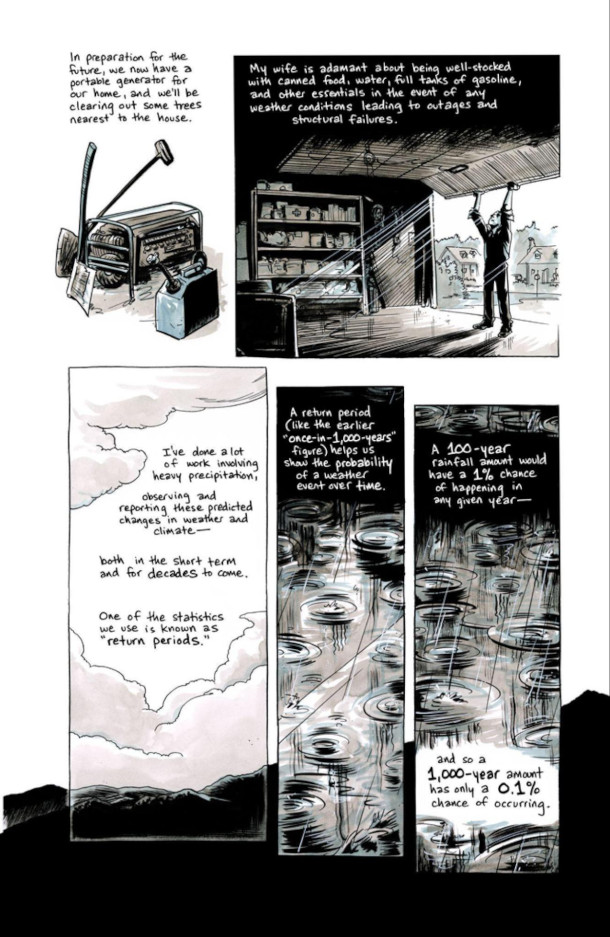
Page 7 of David Easterling's story, “A Measure of Stormy Weather,” with art and lettering by Nate Powell. David Easterling is a climate scientist and was a lead author on the 2007 Nobel Peace Prize-winning Intergovernmental Panel on Climate Change (IPCC) Fourth Assessment . (Credit: Islands in the Sky, David Easterling/Nate Powell)
AYDIN: People in the region have sort of largely abandoned any of those attitudes about climate change isn't real, which is interesting to watch. I think particularly in Appalachia, we have to be prepared for flooding, and we have to be prepared for wildfires, because they work in conjunction. The flooding and the rain knocks down the trees, and then you have all this debris that piles up. That debris then dries out and becomes kindling, and the forest fires become worse. I mean, the year after Hurricane Helene, we had several devastating wildfires within a few miles of my home, and so this flooding and then these fires, we're going to encounter them more and more. We're going to get more rain. Everybody talks about Hurricane Helene as a one in a thousand year storm, but we had a storm similar to this in 1916 that reached many of these same levels, right? So even that, we're underestimating the rareness of this storm by ten times over the last century. And if that's the case, and it's continuing to grow in danger through the rising global temperature, and now with El Niño, it could be just a matter of years before we face this again, or a matter of years before somewhere else, as I said, 90 miles east or 90 miles west, faces the same disaster.
DOERING: Yeah. How do you maintain a sense of optimism about Appalachia's future?
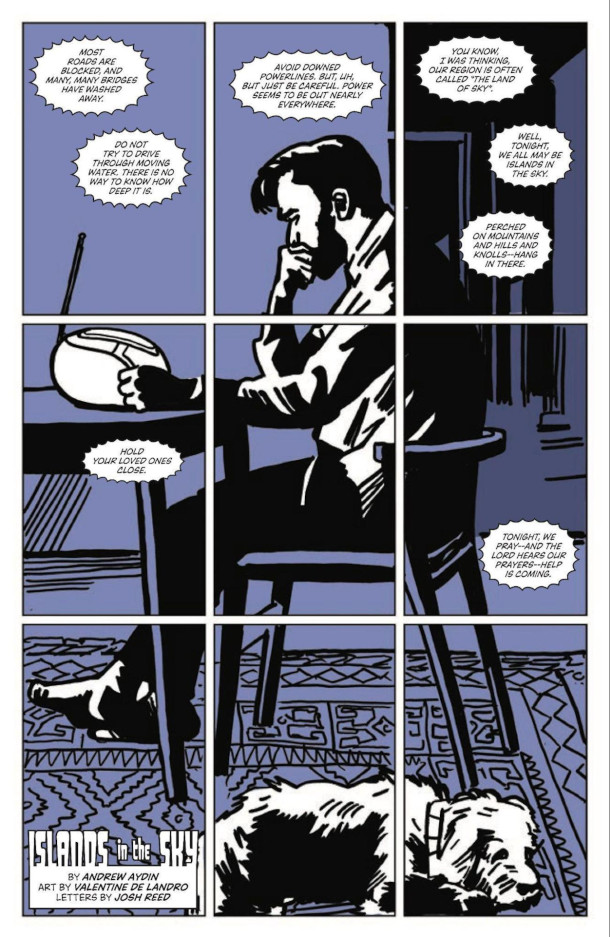
Without internet or cell service, many survivors had to rely on radios for communication. Page 10 of Andrew Aydin’s story, “Islands in the Sky,” with art by Valentine de Landro and lettering by Josh Reed. (Credit: Islands in the Sky, Andrew Aydin/Valentine Landro/Josh Reed)
AYDIN: Somebody said to me the other day, "How did you know Appalachia was gonna be cool?" And I, I was kind of taken back at first, but really, my first thought was like, I always knew Appalachia was cool. It's just, we're making you see it. We're telling Appalachia's story, and all of a sudden now you're realizing what we already knew. I think you have people like Dolly Parton, who did so much for the region, and I think it's not a coincidence that she spent so much of her time and energy making sure that kids in Appalachia and around the country have books in their homes. I think the, the great leap that maybe we're making is that for the first time in a long time we're helping make books by people from Appalachia, by, about people from Appalachia, giving them a voice so that we carry on that work. And, you know, Congressman Lewis used to always say something to me and to others that has always just guided me, and he would say, you know, "Don't get down. Do not become lost in a sea of despair. Be hopeful. Be optimistic. Our struggle is not the struggle of a day, a week, a month, or a year. Our struggle is the struggle of a lifetime, of many lifetimes." I'm not going to become angry. I'm not going to become bitter. Or if I do become angry, I'm going to use it as fuel to do something to help. And I think that's what we all have to do. We don't have a choice. We cannot give up. We've only got one planet. We've only got one country. We have to constantly work to make it better, because nobody else is gonna save us. We have to save ourselves.
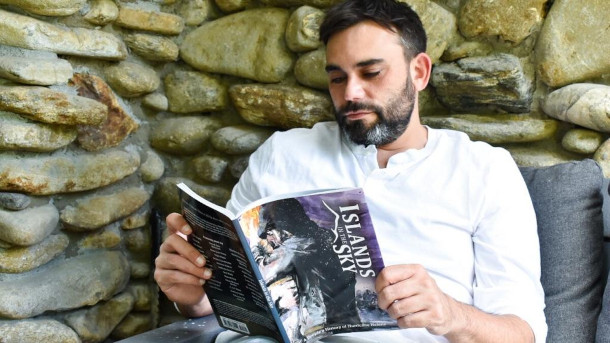
Andrew Aydin is the founder of the Appalachian Comics Project. He was also Digital Director and Policy Advisor to the late Georgia Congressman and civil rights activist John Lewis. (Photo: Courtesy of Andrew Aydin)
DOERING: Andrew Aydin is the creator and project founder of the graphic novel collection Islands in the Sky: A People's History of Hurricane Helene. Thank you so much, Andrew.
AYDIN: Thank you so much for having me.
Related links:
- Learn more about the Appalachian Comics Project and Islands in the Sky
- Purchase March and support Living on Earth and independent booksellers
- WCNC Television | “Western North Carolina Still Healing Two Years After Hurricane Helene"
[MUSIC: Hard Times, Bright Hopes]
BELTRAN: Living on Earth is produced by the World Media Foundation.
Our crew includes Naomi Arenberg, Claire Brandes, Abby Edgecumbe, Swayam Gagneja, Mark Kausch, Mark Seth Lender, Don Lyman, Ashanti Mclean, Nhung Nguyen, Aynsley O’Neill, Sophia Pandelidis, Andrew Skerritt, Bella Smith, Jake Rego and El Wilson.
DOERING: Tom Tiger engineered our show. Allison Lirish Dean composed our themes. You can hear us anytime at loe.org, Apple Podcasts and YouTube Music, and like us please, on our Facebook page, Living on Earth. Find us on Instagram, Threads and BlueSky @livingonearthradio. And we always welcome your feedback at comments@loe.org. Steve Curwood is our Executive Producer. I’m Jenni Doering
BELTRAN: And I’m Paloma Beltran. Thanks for listening!
ANNOUNCER: Funding for Living on Earth comes from you, our listeners, and from the University of Massachusetts, Boston, in association with its School for the Environment, developing the next generation of environmental leaders. And from the Grantham Foundation for the protection of the environment, supporting strategic communications and collaboration in solving the world’s most pressing environmental problems.
ANNOUNCER 2: PRX.
Living on Earth wants to hear from you!
Living on Earth
62 Calef Highway, Suite 212
Lee, NH 03861
Telephone: 617-287-4121
E-mail: comments@loe.org
Newsletter [Click here]
Donate to Living on Earth!
Living on Earth is an independent media program and relies entirely on contributions from listeners and institutions supporting public service. Please donate now to preserve an independent environmental voice.
NewsletterLiving on Earth offers a weekly delivery of the show's rundown to your mailbox. Sign up for our newsletter today!
 Sailors For The Sea: Be the change you want to sea.
 The Grantham Foundation for the Protection of the Environment: Committed to protecting and improving the health of the global environment.
 Contribute to Living on Earth and receive, as our gift to you, an archival print of one of Mark Seth Lender's extraordinary wildlife photographs. Follow the link to see Mark's current collection of photographs.
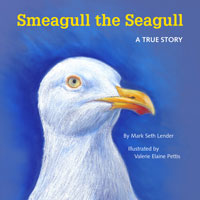 Buy a signed copy of Mark Seth Lender's book Smeagull the Seagull & support Living on Earth
© Copyright World Media Foundation. All Rights Reserved
Home | Contact | RSS | Donate | Newsletter