
Hurricane Helene's Impact Brought to Life
Air Date: Week of October 23, 2026
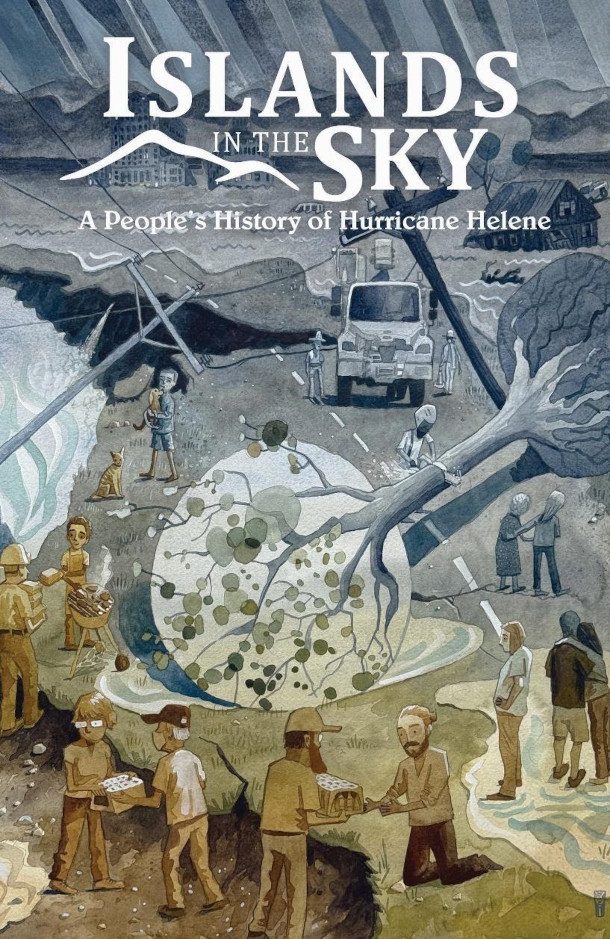
Islands in the Sky: A People’s History of Hurricane Helene pairs hurricane survivors with comic creators to tell eleven unique accounts of the storm. (Cover art: Jarrett Rutland/Appalachia Comics Project)
In 2024, Hurricane Helene ripped through the mountain communities of western North Carolina, leaving them stranded and unable to communicate with the outside world for days. A new graphic novel, Islands in the Sky: A People’s History of Hurricane Helene, pairs up survivors with artists to help them tell their stories of resourcefulness and resilience in their own words. Creator and editor Andrew Aydin, who also survived Helene, talks with Host Jenni Doering about the power of hearing directly from survivors.
Transcript
BELTRAN: It’s Living on Earth, I’m Paloma Beltran
DOERING: And I’m Jenni Doering.
In 2024, Hurricane Helene ripped through America’s Appalachian region and devastated the mountain communities of western North Carolina. In part fueled by climate change, the storm brought feet of rain that swelled creeks and rivers and swept houses, roads, and powerlines away, leaving residents stranded and unable to contact the outside world. As the waters receded, Helene survivor Andrew Aydin (Eyeden) realized he could put his skills and experience to work to help those who lived through the disaster share their stories. Andrew had served as Digital Director and Policy Advisor to Georgia Congressman and civil rights activist John Lewis from 2007 until his death in 2020. The two co-wrote the award-winning graphic novel trilogy, March, about the civil rights movement as Lewis had lived it. And in the aftermath of Hurricane Helene, Andrew again turned to comics. Islands in the Sky: A People’s History of Hurricane Helene is a collection of eleven comics, each written by a survivor paired with an artist. Andrew Aydin is also the founder of the Appalachia Comics Project, which aims to amplify the voices and stories of local people. And he joins me now, Andrew welcome to Living on Earth!
AYDIN: Thank you so much for having me. It's good to be with you, Jenni.
DOERING: Andrew, you were there in North Carolina during Hurricane Helene in 2024. What was that experience like for you?
AYDIN: It was really hard. Um, I live in a town called Edneyville, and it was one of the hardest hit areas during the whole storm. And you live through this dark night, where you just hear these terrifying sounds: the wind, the trees snapping, the impact of debris hitting your home because it was being shot through the air with such velocity. These limbs and branches and rocks and things like that, and the rain just pounding. And then you wake up, and what I saw was a creek in front of my house that usually is four or five feet wide, that was four or five hundred feet wide, that had completely covered the road, multiple bridges in front of my home, and then came to find that one of my neighbor's home had been flooded, and he drowned. And, and then you deal with okay, how do we survive the next day? Because communications is completely gone. You've just got no cell phone, no power, no internet, no way to reach anybody, and no way to even traverse the road in front of your house. And what we did is we pulled together first as neighbors. One of my other neighbors, we, we got on walkie talkies to stay in touch. You couldn't go as far as into town, so it's first hyper local. Then everybody cuts through the trees, and you're driving under these holes, basically cut in downed trees that just fit a car, driving over down power lines. People are walking around like it's the Walking Dead, and that was just in the first, you know, few days, and then it just got worse as people started to run out of water and food. And then by the time you did get back onto the internet, all you saw was misinformation and these sort of content people coming in to, to film your misery and making something that wasn't true, not capturing the real story. But at the same time, I mean, despite all of that, I think the thing that I, I think back on the most is how my neighbors and I, everybody set down the identities that they had, that the internet gave them, you know, and, and they, they just talked to each other, they helped each other. What do you need? In a small community, in these small towns, there is a resilience and a care and a love for one another that is vastly misunderstood, and that the social media environment we live in today is polluting our minds and taking that away from us.
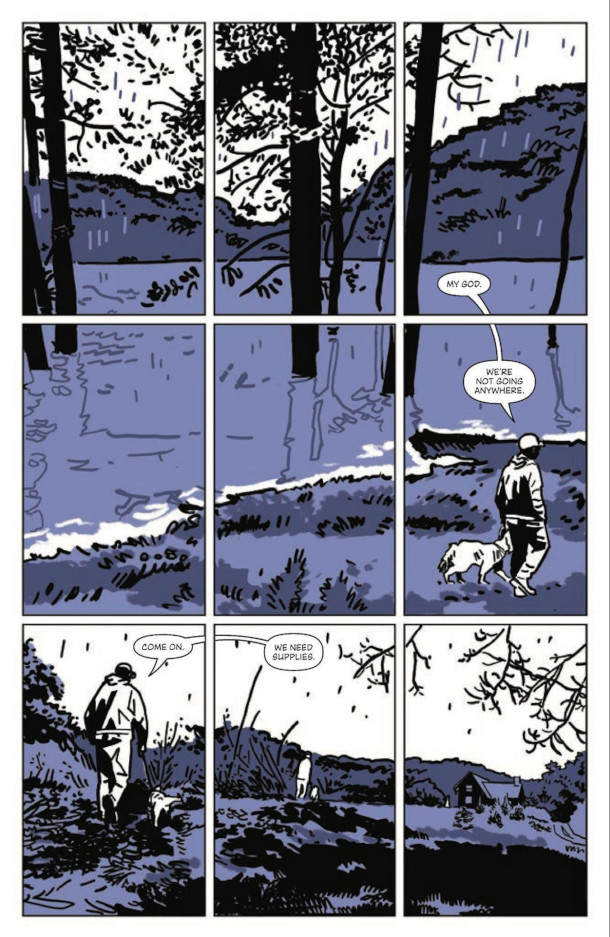
“What I saw was a creek in front of my house that usually is four or five feet wide, that was four or five hundred feet wide,” Andrew says in his interview with Living on Earth. Page 8 of Andrew Aydin’s story, “Islands in the Sky,” with art by Valentine de Landro and lettering by Josh Reed. (Credit: Islands in the Sky, Andrew Aydin/Valentine Landro/Josh Reed)
DOERING: It sounds really hard, especially to, as you said, lose a neighbor, flooded, drowned in his home.
AYDIN: Yeah.
DOERING: So, how did your experience living through this nightmare inspire the Appalachia Comics project and this book, Islands in the Sky?
AYDIN: All of the misinformation and disinformation and manipulation that went into and still goes on today, in talking about, and telling the story of what happened during Hurricane Helene, it made me very angry. I mean, furious. Because I saw it with my own eyes, because I lived it. And I read a graduate thesis by a woman named Elon Justice, who's from Kentucky, and she wrote it for the MIT Media Lab. It was called "Hillbilly Talkback," and she wrote a long, detailed history of all the ways in which Appalachia has been controlled through controlling the narrative, the ways in which Appalachia is depicted in popular culture, in the media, in the news, and this long history of it being done by outsiders. And her proposal, her solution from her thesis was that people living in Appalachia need to have the opportunity to tell their own story, and she proposed something, what she called the co-creation model, right? And this is something that I'd experienced a lot working for John Lewis, particularly in the Southern Black communities, where Black folks would get the opportunity to tell their story, but they wouldn't get the support to make it succeed, and then they would be written off because they didn't get that support. I mean, it's hard to learn how to do comics or any other medium without support, without mentorship. And I thought about that, and I was like, okay, one, I know a lot about this co-creation model after years and years of working alongside John Lewis, and also these are my people. I came to my mother's home to live after Congressman Lewis died, here at Edneyville. My grandfather was the mailman for this valley. My grandmother lived about a mile down the road from where my mother lived, and after I lost all of them, this was the only place that I thought I could go to heal. And many of these people saved me, and this was something I felt I could do to help them, and help all of us.
DOERING: Yeah, so in this book, Islands in the Sky, you paired up survivors with comic artists to help tell their stories. Why did you choose that format, and how did it allow you to tell a really broad range of stories?
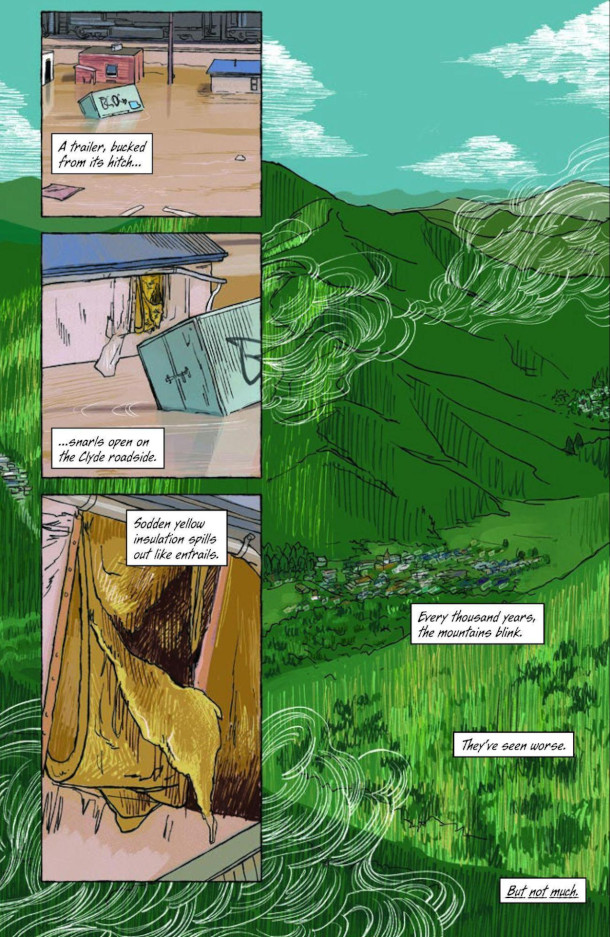
“Every thousand years, the mountains blink. They’ve seen worse. But not much.” Page 9 in reporter Cory Vaillancourt’s story, “The News Still Came,” with art by June Kim and lettering by Josh Reed. (Credit: Islands in the Sky, Cory Vaillancourt/June Kim/Josh Reed)
AYDIN: Appalachia is a region of storytellers, and yet it is this almost criminal occurrence that we have not given Appalachia the ability to use that. And I think that's why comics work, right? I mean, this is the people's medium. People love comics here, and so I wanted to create an opportunity for people to tell their story in the most beautiful way possible, but give them the support that they needed to not feel overwhelmed by the process, to not feel like they were alone, to let their emotions focus on what was going to be the end result, and not on the sort of nitty gritty immediately of learning the particulars of the medium. And I was just so fortunate that so many of my colleagues signed up to help, and it was so much fun to introduce many of these first time writers to comic creators that they had read before, that they admired, that they got so excited, they just got to, to work with, and then you see how beautiful the stories that they made came out to be.
DOERING: Could you share one of the stories in this collection that especially moved you? I know it's hard to pick a favorite.
AYDIN: Yeah, I mean it is hard. I think there's several that I was really, really proud of. First, I mean, Cory Vaillancourt, who had been a reporter for many many, years in the region and had never written a comic book, but he wrote this almost poetic and ghostly story about being a reporter during the storm, and he wrote it with Steve Orlando, who's a fantastic writer that I've been friends with for a long, long time. And Corey started in Haywood County, which is where he lived at the time, near a place called Canton, and Corey found flooding that he was familiar with. I mean, Canton has flooded many times in recent memory, except it was on a scale that surpassed anything that they'd experienced so far. And as he tried to make his way to other towns and other places because he couldn't get a cell phone, he couldn't get a signal, he had to be there in person. He had to get his pen and pad and write it down and take photographs and document it himself. He came across destruction. He came across washed out and burned out homes and cars and bridges that just no longer existed, and yet he knew his responsibility, his obligation, was to not be sad in that moment. It was to preserve, to document, to tell the story, to share, so that people knew what happened. And he became a key element of just information sharing.
DOERING: In an awful way, I guess, you feel like you're there, you're seeing it, and I have to say, the art in Cory Vaillancourt's story is really captivating. You know, showing scenes of destruction, but somehow beautifully rendered? You know, one of the pages: "Every thousand years, the mountains blink. They've seen worse, but not much."
AYDIN: Cory's story is a perfect example of the overlooked talent and ability that exists here, that has never had the platform it deserves, and because we were able to take this disaster and turn it into an opportunity for the people who endured it and survived it and helped everyone else endure and survive. We can take a tragedy and maybe not fix it, but we can make it better and make it less painful. And I think there's just this terrible history of extraction from Appalachia, and what we're trying to do is reverse that so that we're exporting the important stories and then bringing the money into the region so that we can create this independence and self sufficiency through this thing that is so important to everyone here culturally, which is storytelling.
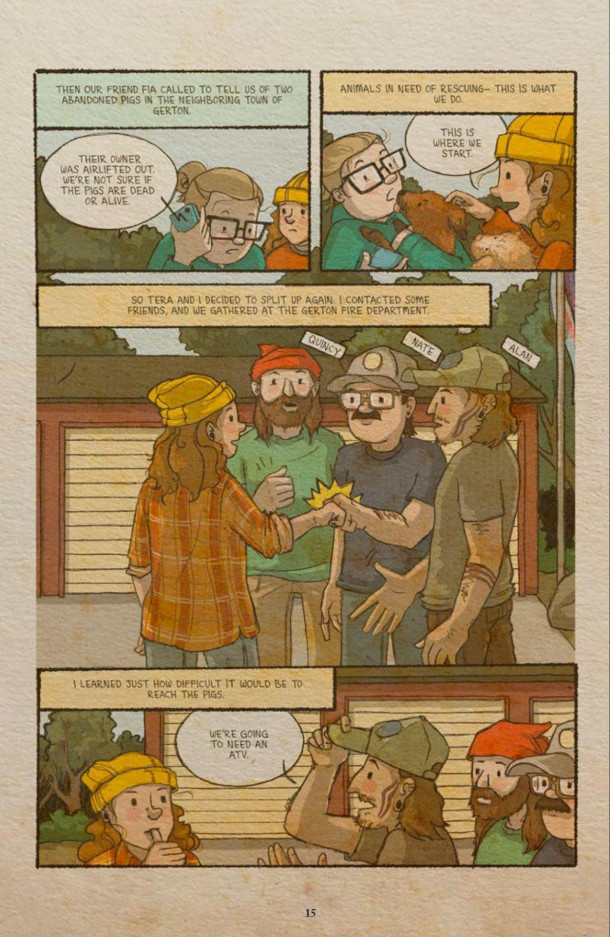
Some of the comics depicted neighbors coming together to help one another — and even some stranded animals. Page 3 of “A Community of Misfits,” written by Tera and Amy McIntosh and Gene Luen Yang, illustrated by Thien Pham and Briana Loewinsohn. (Credit: Islands in the Sky, Tera and Amy McIntosh/Gene Luen Yang/Thien Pham/Briana Loewinsohn)
DOERING: I guess the flip side of realizing just how resilient you are as a community, as Appalachian people, is that you were really failed and left to fend for yourselves, and, and maybe, I don't know if warnings should have come that didn't come. How did I guess a lack of urgency from, you know, people in charge affect the way that this crisis developed?
AYDIN: I think everybody's looking at one person to blame, and there isn't just one person or one organization or one group, right? From the outset of the storm, the National Weather Service office out of Spartanburg put out this SOS message the day before the storm hit, being like, "Strap in. This is going to be the worst thing you've ever seen." And yet, county officials in certain parts of the region refused to send out evacuation warnings because they were afraid that it would be received negatively because of the upcoming election, and so, many people were caught in places they wouldn't have otherwise been because they were counting on the county to give them the heads up to tell them, don't go out, to tell them to evacuate, and they didn't because it was a political decision. And then at the same time, because we'd never had a disaster where a region that is effectively the size of Connecticut, was completely cut off from the outside world, word could not get to Raleigh or Washington about how bad it was. It was this deafening silence in the first day and the first weekend after the storm. This is why the book is so important because it was this devastation that nobody else has ever experienced before. When you have these disasters like the fires in LA and everything, you've got everybody videotaping it and sending it out, and people are watching it so closely. This is a true example of what happens if a disaster falls in the woods, but nobody can hear it, right? And those lessons of resilience, communication resilience, are so, so important because it is in those first days after the storm that determines whether people live or die. And I have long said that if this storm had been 90 miles east or 90 miles west at this scale, and hit Charlotte or hit Charleston or hit Atlanta, there would have been thousands and thousands and thousands of people dead, because what saved us was our ability to cut our way out, to use the skills that come from living in a region where the right to exist comes from a constant negotiation with nature. That's what saved us. And not very many other regions, particularly urban regions, are prepared for this level of disaster. And I think, as a country, as a nation, we have to take a long, hard look at the lessons of what happened during Hurricane Helene to prepare ourselves for the next one, and we're preparing. We're preparing here, but I don't think the rest of the country is.
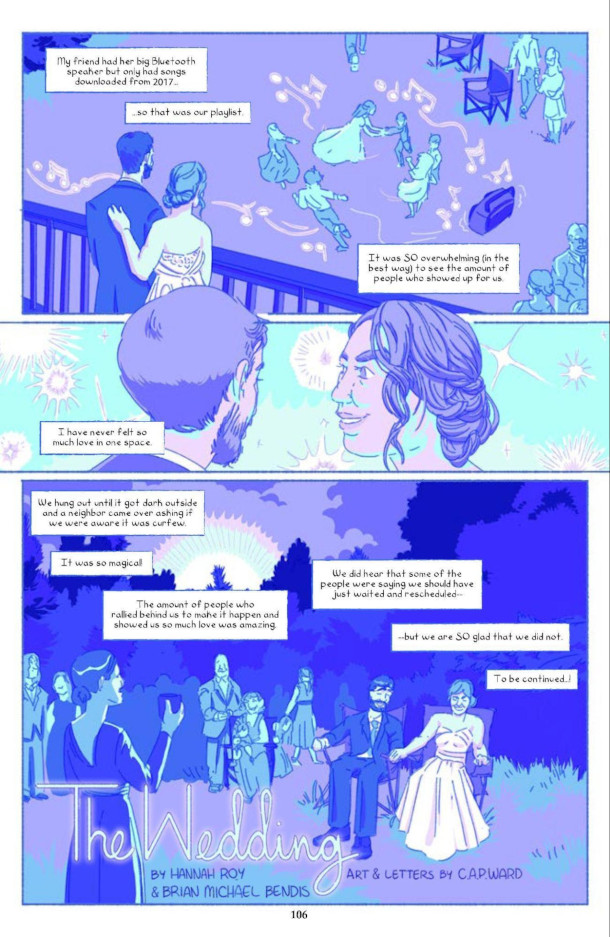
Other comics showed moments of joy amidst the destruction. Page 8 of “The Wedding,” written by Hannah Roy and Brian Michael Bendis, with art and letters by C.A.P. Ward. (Credit: Islands in the Sky, Hannah Roy/Brian Michael Bendis/C.A.P. Ward)
DOERING: In your story, in other stories, in Islands in the Sky, you're riding out the storm without information, without you know, cell networks, they were down, internet was down, power was out. You dig out your radio, and some of your neighbors also mentioned Blue Ridge Public Radio being the only information source that they had during this time when it felt like you were cut off from the world.
AYDIN: There were two main stations that people could get, and even that in the first day or two, they lost their towers. There was AM 570 and Blue Ridge Public Radio, and these people, like camped out and lived in the stations for weeks, relaying information. Once people could call in, they had them calling in. And there's another phenomenon that happens out here that is sort of a relic of days gone by, which is that some of these churches have low power radio transmitters. And I'm pretty far away from Asheville. I'm about 45 minutes away. I managed, the first signal I managed to get was one of those churches, and I know many of the local governmental authorities have been working on communication resiliency plans, but I don't think our machines can fight nature, and I think that's what we have to be prepared for as climate change gets worse, as these storms get worse and more prevalent, as resources get more scarce. We have to be prepared as local communities for how we take care of one another when we aren't able to reach the outside world.
DOERING: So, how is climate change likely to affect North Carolina and Appalachia in the years to come? And, you know to what extent are people in the region talking about the climate emergency differently after Hurricane Helene?
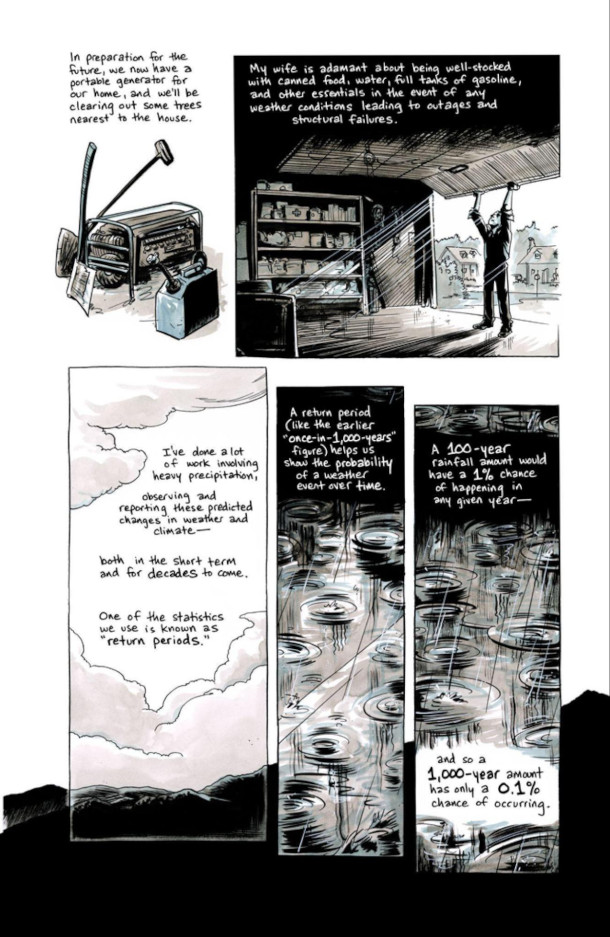
Page 7 of David Easterling's story, “A Measure of Stormy Weather,” with art and lettering by Nate Powell. David Easterling is a climate scientist and was a lead author on the 2007 Nobel Peace Prize-winning Intergovernmental Panel on Climate Change (IPCC) Fourth Assessment . (Credit: Islands in the Sky, David Easterling/Nate Powell)
AYDIN: People in the region have sort of largely abandoned any of those attitudes about climate change isn't real, which is interesting to watch. I think particularly in Appalachia, we have to be prepared for flooding, and we have to be prepared for wildfires, because they work in conjunction. The flooding and the rain knocks down the trees, and then you have all this debris that piles up. That debris then dries out and becomes kindling, and the forest fires become worse. I mean, the year after Hurricane Helene, we had several devastating wildfires within a few miles of my home, and so this flooding and then these fires, we're going to encounter them more and more. We're going to get more rain. Everybody talks about Hurricane Helene as a one in a thousand year storm, but we had a storm similar to this in 1916 that reached many of these same levels, right? So even that, we're underestimating the rareness of this storm by ten times over the last century. And if that's the case, and it's continuing to grow in danger through the rising global temperature, and now with El Niño, it could be just a matter of years before we face this again, or a matter of years before somewhere else, as I said, 90 miles east or 90 miles west, faces the same disaster.
DOERING: Yeah. How do you maintain a sense of optimism about Appalachia's future?
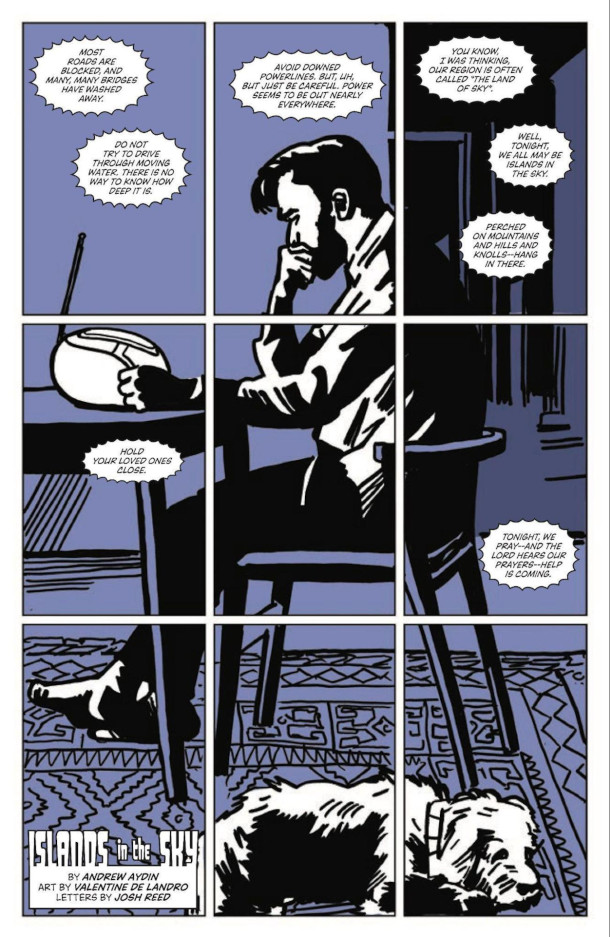
Without internet or cell service, many survivors had to rely on radios for communication. Page 10 of Andrew Aydin’s story, “Islands in the Sky,” with art by Valentine de Landro and lettering by Josh Reed. (Credit: Islands in the Sky, Andrew Aydin/Valentine Landro/Josh Reed)
AYDIN: Somebody said to me the other day, "How did you know Appalachia was gonna be cool?" And I, I was kind of taken back at first, but really, my first thought was like, I always knew Appalachia was cool. It's just, we're making you see it. We're telling Appalachia's story, and all of a sudden now you're realizing what we already knew. I think you have people like Dolly Parton, who did so much for the region, and I think it's not a coincidence that she spent so much of her time and energy making sure that kids in Appalachia and around the country have books in their homes. I think the, the great leap that maybe we're making is that for the first time in a long time we're helping make books by people from Appalachia, by, about people from Appalachia, giving them a voice so that we carry on that work. And, you know, Congressman Lewis used to always say something to me and to others that has always just guided me, and he would say, you know, "Don't get down. Do not become lost in a sea of despair. Be hopeful. Be optimistic. Our struggle is not the struggle of a day, a week, a month, or a year. Our struggle is the struggle of a lifetime, of many lifetimes." I'm not going to become angry. I'm not going to become bitter. Or if I do become angry, I'm going to use it as fuel to do something to help. And I think that's what we all have to do. We don't have a choice. We cannot give up. We've only got one planet. We've only got one country. We have to constantly work to make it better, because nobody else is gonna save us. We have to save ourselves.
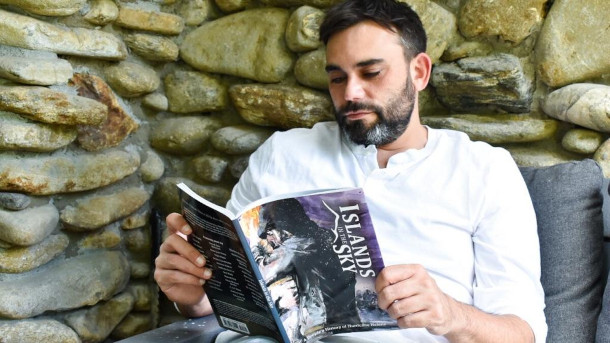
Andrew Aydin is the founder of the Appalachian Comics Project. He was also Digital Director and Policy Advisor to the late Georgia Congressman and civil rights activist John Lewis. (Photo: Courtesy of Andrew Aydin)
DOERING: Andrew Aydin is the creator and project founder of the graphic novel collection Islands in the Sky: A People's History of Hurricane Helene. Thank you so much, Andrew.
AYDIN: Thank you so much for having me.
Links
Learn more about the Appalachian Comics Project and Islands in the Sky
Purchase March and support Living on Earth and independent booksellers
WCNC Television | “Western North Carolina Still Healing Two Years After Hurricane Helene"
Living on Earth wants to hear from you!
Living on Earth
62 Calef Highway, Suite 212
Lee, NH 03861
Telephone: 617-287-4121
E-mail: comments@loe.org
Newsletter [Click here]
Donate to Living on Earth!
Living on Earth is an independent media program and relies entirely on contributions from listeners and institutions supporting public service. Please donate now to preserve an independent environmental voice.
NewsletterLiving on Earth offers a weekly delivery of the show's rundown to your mailbox. Sign up for our newsletter today!
 Sailors For The Sea: Be the change you want to sea.
 The Grantham Foundation for the Protection of the Environment: Committed to protecting and improving the health of the global environment.
 Contribute to Living on Earth and receive, as our gift to you, an archival print of one of Mark Seth Lender's extraordinary wildlife photographs. Follow the link to see Mark's current collection of photographs.
 Buy a signed copy of Mark Seth Lender's book Smeagull the Seagull & support Living on Earth
© Copyright World Media Foundation. All Rights Reserved
Home | Contact | RSS | Donate | Newsletter