

A Fossil Fuel Treaty Beyond the UNFCCC
Air Date: Week of October 23, 2026
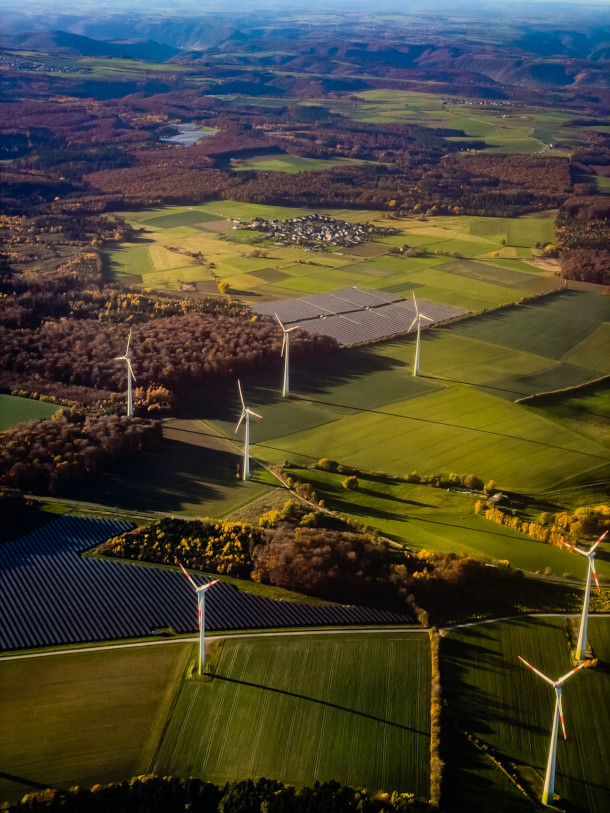
Solar panels and wind turbines in Rhein-Hunsrück-Kreis, Germany. In September 2026, after attending the Santa Marta conference earlier that year, Germany published a roadmap for phasing out fossil fuels nationwide. (Photo: Bernd Dittrich, Unsplash, Unsplash license)
Thirty years of UN climate sessions and the persistent wide gap between discussion and action to slow the climate crisis have left some countries and NGOs frustrated as they face a dire future. So even as COP31 begins in November in Turkey, an alternate path already began in April in Colombia when roughly 60 countries met for the first Conference on Transitioning Away from Fossil Fuels. Tzeporah Berman, founder and chair of the Fossil Fuel Non-Proliferation Treaty Initiative, joins Host Paloma Beltran to discuss her hopes for the process as she looks ahead to the second conference next year.
Transcript
DOERING: It’s Living on Earth, I’m Jenni Doering
BELTRAN: And I’m Paloma Beltran.
As the United Nations gears up for the COP31 climate session in mid-November, nearly three decades after the Kyoto Protocol, we are also considering a newer set of international climate negotiations that hopes to close the wide gap between discussion and action. This April in Santa Marta, Colombia was the first Conference on Transitioning Away from Fossil Fuels. It’s known to proponents as the “coalition of the willing”. Hosted by Colombia and the Netherlands, this event brought together 57 countries and the European Union, as well as civil society organizations, scientists, indigenous leaders, and more. Born out of the frustration with the fossil-fuel-friendly nations and the oil and gas lobbyists at the COP process, this Fossil Fuel Treaty effort is kickstarting an alternative approach to international cooperation on climate. And the second conference is coming up in just a few months. Tzeporah Berman is the founder and chair of the Fossil Fuel Non-Proliferation Treaty Initiative, and she joins us now from Vancouver, Canada. Tzeporah, welcome to Living on Earth!
BERMAN: Thanks. Hi.
BELTRAN: Six months after the first conference on this, what is the energy like from the countries who are interested in moving forward with transitioning away from fossil fuels?
(Video: Courtesy of the Fossil Fuel Treaty Initiative)
BERMAN: You know, in some ways, we're starting to see kind of groupings of countries within the process. So there were 57 countries that came. I really think at the next international conference, which will be co-hosted by Ireland and Tuvalu in 2027, there's going to be even more, because I've been talking to a lot of countries who are like, "Wow, it happened really quick. You know, it was announced at Belém, and then it happened in April, and we didn't come, but we want to." And so, I actually think the broad coalition of countries that are committed to do fossil fuel phase out will grow, and that's exciting. So a lot of conversations where people are like, "What happened there? Can I come to the next one?" And so there's a lot of that, but then there's also specific conversations that began in Santa Marta that are now deepening. Conversations on specific solutions. There is a group of countries which I kind of think of as like the high-ambition coalition of countries on fossil fuel phase out that are at the table starting to design a fossil fuel treaty. So there's 25 or so countries that are at the table working on this, and these are countries who are really committed to new global governance on fossil fuel phase out, legal strategies so that they can be binding, not just voluntary, and cooperative mechanisms. And what I mean by that is, look, there's a lot of countries out there who are digging for more oil, fracking for more gas, because they feel like they have to, like they're being pushed into it because of crushing debt, because of financial architecture and tax agreements and trade agreements that have existed historically that really prop up the fossil fuel industry and push fossil fuel production. So these are countries that want to cooperate on some of those big picture solutions like debt, and so those countries are hard at work looking at different legal mechanisms and mechanisms of international cooperation. There's a group of countries that are working specifically on fossil fuel subsidies, and encouraging countries to get rid of subsidizing the oil and gas industry. And there's a number of countries that are now doing national roadmaps, which are great, and that's kind of increasing ambition within the UNFCCC and COP spaces as well. So, I think these conferences and this conversation, you know, there's not one answer to phasing out the most powerful industry on earth. It's going to take multiple initiatives, and I think these conferences have really sparked a lot of new bilateral and plurilateral convenings and cooperations.
BELTRAN: So, many of our listeners are familiar with the UNFCCC, the United Nations Framework Convention on Climate Change. How does a potential fossil fuel treaty exist in relation to the United Nations and the Paris Agreement?
BERMAN: It's a great question because a lot of people don't realize that any issue that we have that we work on within the UN has multiple agreements, multiple treaties associated with it. So, it's not uncommon to have different agreements and different treaties on different aspects of a big problem: landmines, nuclear weapons, chemical weapons. And so what we are proposing is that the fossil fuel treaty would be a companion to the Paris Agreement. It would be some international agreements on helping phase out the production of fossil fuels, in a way that is equitable and fair. And what I think what a lot of people don't realize is that we don't have that. For 30 years our countries have been negotiating on emissions reductions, so how much each country gets to pollute, but not on reducing the supply and production of fossil fuels. So an economist would say it's like trying to cut with one half of the scissors, only the demand, but not the supply. So every year we negotiate new emissions reduction targets, and then every year we grow new projects and new development, and then we fail to meet our targets. But, it's not rocket science, what we build today will be what we use tomorrow. So the fossil fuel treaty will be an agreement between countries who are willing to come into the coalition to stop expansion of new projects and to manage a wind down in a way that's safe and fair.
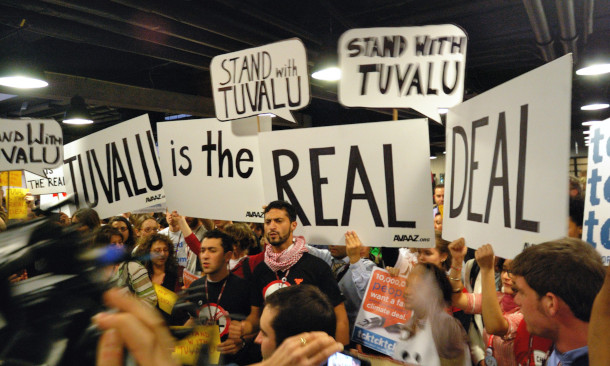
Above, a demonstration in support of Tuvalu at COP15. Tuvalu is one of the nations on the front lines of sea level rise, and will be co-hosting the next Fossil Fuel Treaty conference in 2027, alongside Ireland. (Photo: Lauri Myllyvirta, Wikimedia Commons, CC BY 2.0)
BELTRAN: And this fossil fuel treaty, this treaty we're talking about, was not initiated by the United Nations. It was actually spearheaded by you with a formal campaign launching in 2020. How is it different from UN processes and conventions?
BERMAN: Well, it is likely that the fossil fuel treaty will become a UN process. It's not right now, and that historically is what we've seen with a lot of tricky and intransigent issues. So landmines, chemical weapons, nuclear. These are treaties that were created initially outside the UN process, especially landmines. Great analogy, because we got the idea of the Santa Marta conference from landmines, because landmines were an issue that was really not moving forward in the UN space because there's a bunch of vested interests who were like adamant not to have the conversation, that they wanted to expand landmines, and Ottawa created the Ottawa Convention, which was the precursor to the landmine agreement, and it was again a coalition of the willing. Fine, you don't want to talk about it, don't come, because you're holding back the conversation anyways. Let's just have the countries who want to do this come, and that process outside the UN space is what created the landmine ban treaty, which was eventually brought back inside the UN. So, working along that framework and that model, we're working with a group of countries that want to create a fossil fuel treaty, and they're starting to design it. Now, once they design the treaty and negotiate the terms, and more countries join, it is likely that that will be brought back inside the UN.
BELTRAN: And how would it benefit from becoming part of the UN process?
BERMAN: Infrastructure and buy-in. Like, right now, I have to say these conferences and a lot of the diplomatic work, without having structure and infrastructure, and the support of the UN, it's a little spit and duct tape. It's not easy to bring a conference together of 5,000 to 10,000 people and without private money invested and without the infrastructure to invite all the countries to do the security for all the ministers, etc. So there's infrastructure, there's history, there's expertise within the UN in diplomacy, and no one treaty or agreement between countries is going to exist in isolation. So when it becomes an issue of foreign policy debate, there's a little bit of tit for tat. There's a little bit of trade in foreign diplomacy. And so, these issues need a cycle, they need a structure, and they need to exist within the ecosystem of the other international agreements.
BELTRAN: And most of the nations who are early participants in these negotiations are not major fossil fuel producers. What does a path forward look like for getting more buy-in on this?
BERMAN: So there are some who are major fossil fuel producers. For example, Colombia is the fifth largest coal exporter in the world, and they have joined the table of the fossil fuel treaty. It's not a formal negotiating table yet; it's a discussion table. Certainly, some of the countries have communicated to us that they're hoping to develop a formal negotiating mandate later in 2027. That's their goal, and I think they will do that. So there's two things that happen. Once the formal negotiating mandate exists and the negotiations begin, there's usually, if you look throughout history, that's a moment when a lot more countries join. Because if you're not at the table, you're not designing the rules. And so we already have about 25 countries at the table. There's an expectation that once that formal negotiating table is created, we'll probably have 35 to 40. Which, a lot of treaties were built on 20 to 40 countries being the ones to participate. Then once the treaty is designed and countries start to see, oh wait a minute, there's benefits for being a part of that group. It's not just all stick, there's lots of carrots embedded in the frameworks that are being discussed at the treaty table, and so there will be countries that will join because once they see the actual text, they're like, oh, this works for us. Then the third issue is about social norms. What we've learned from studying the other treaties is that there are some countries that will never join, but actually that's okay, because if you look at the other big issues - nuclear, landmines, etc. - there are countries that never joined, but they changed their practices, because the treaty itself and the development of the treaty shifted the social norm around that issue. It became elephants for ivory, you know, to be saying you're stockpiling landmines or you're stockpiling nuclear weapons, even if you hadn't signed the treaty. Because, before the campaign and the development of the Nuclear Non-Proliferation Treaty, stockpiling nuclear weapons was considered something that kept us safe.
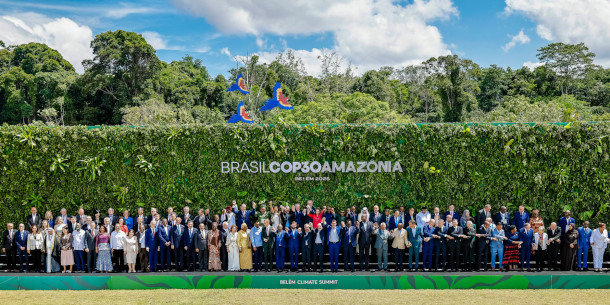
The COP process has been going on for over 30 years, but some say that influence from the fossil fuel industry and pro-fossil-fuel countries have stalled meaningful climate action during that process. Tzeporah Berman believes that the Fossil Fuel Non-Proliferation Treaty may one day become a United Nations process, as many other treaties have been formed outside that system and later been brought in. (Photo: Ricardo Stuckert / PR, Wikimedia Commons, CC BY-SA 4.0)
And it was throughout that campaign and the development of the treaty that the information came out, that actually, experts around the world were saying we already have enough nuclear weapons to blow up the world six times over, and this is actually what's threatening us, is more nuclear capacity, and so that social norm shifted. It shifted from being something that keeps you safe to something that's threatening you. And I think that's what we're seeing happen on fossil fuels, and I think that's in large part because of the last five years of the fossil fuel treaty campaign and the support for it that is growing so quickly around the world. I mean, there are 4000 organizations now, in 120 countries that have endorsed the idea of a fossil fuel treaty and are working on it, and so that starts to shift what becomes acceptable. And when that shift happens within foreign policy, because there's an actual treaty that some countries are a part of, that will change the practices, I believe, of many of the other countries. It won't be so easy for Australia to announce a new coal mine while also saying it's a climate leader.
BELTRAN: And Tzeporah, you were just at the pre-COP meeting in Fiji, one of the many small island nations at the front lines of climate change. What was discussed in terms of the dangers that these countries face?
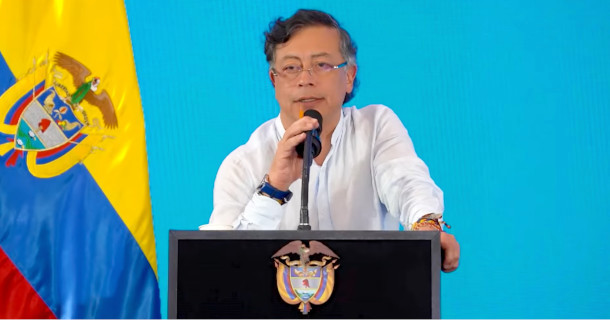
Pictured above is Colombian President Gustavo Petro, delivering a speech at the First International Conference for the Transition Beyond Fossil Fuels event on April 28, 2026. Colombia and the Netherlands co-hosted the conference. (Photo: Screenshot Youtube Presidencia de la Republica Colombia)
BERMAN: It's really inspiring to be working in the South Pacific, to be somewhere like Fiji, having these conversations, and it's also heart-wrenching, right? These are countries, many of whom are already moving their population. They are having to move grave sites. They are struggling with rising sea levels, and salination of water, and the dramatic increase in extreme weather and storms. You know, the hurricane season used to be a month. It's now three months. They can expect multiple hurricanes every year, and that is their lived reality now. And, the spirit of the people in the South Pacific around these issues is truly inspiring. Like, they're not despairing, you know. They, they have this mantra, “1.5 to survive,” and “we're not drowning, we're fighting,” and it's no wonder that these are the people at the forefront of many solutions. We wouldn't have the 1.5 degree target and commitment under the Paris Agreement if it wasn't for island nations from the South Pacific, we wouldn't have even the frameworks on loss and damage financing. We wouldn't have the commitment by the International Court of Justice to recognize climate change and fossil fuel expansion as being illegal under the international courts. The ICJ decision is a direct result of leadership from the South Pacific. And, they were the first countries to join the fossil fuel treaty because they are the most vulnerable nations on Earth. And while we all feel it now, we can all see the wildfire smoke and the fires and the extreme weather that we're living now, the heat domes and the lethal heat, they've known it for decades.
BELTRAN: What do you see as the biggest barriers for this treaty moving forward?
Wondering how a Fossil Fuel Treaty would work and what the legal mechanisms could be to compliment the Paris Agreement and support cooperation between countries to phase out fossil fuels? New briefs just published!
— Tzeporah Berman (@tzeporah.bsky.social) August 4, 2026 at 11:32 AM
[image or embed]
BERMAN: I think one of the biggest barriers to moving forward on fossil fuel phase out is the fear mongering by the oil and gas industry around scarcity and around price, and around affordability. They're very powerful. This is an industry that has made 2.8 billion dollars a day in pure profit, every day, for the last 50 years. They have unlimited resources to run communications campaigns on social media and to fearmonger around, for example, your gas, your price of gas is going to go up if they stop drilling. That's actually not true. Price is not related to new drilling, but they argued that in California through an ad campaign, and they won. And Gavin Newsom reversed his decision to stop expanding drilling because the oil industry had people so scared that they wouldn't support the right policies. Or we find commercials and ads all over the world that the oil industry is funding, telling people that, you know, if people start working on fossil fuel phase out, that the economy will collapse. The term I keep seeing in all the ads is “your hospitals will be closed and your roads won't be paved.” That is not true. Renewables are cheaper than fossil fuels. Countries have the capacity to support export revenues from multiple industries besides fossil fuels. In fact, fossil fuels are one of the priciest things for our countries to do because we subsidize the oil and gas industry because they're so powerful, and then we're left with the bills of the cleanup, and the health concerns. Between five and seven million people died last year on the planet just from air pollution due to fossil fuels alone, and one person is dying every minute now due to lethal heat, primarily due to fossil fuels, so if we start to phase out fossil fuels, our lives actually become cleaner, safer, and more affordable.
BELTRAN: Tzeporah, we're talking midway between the first two meetings of this conference. How optimistic do you feel about this process?
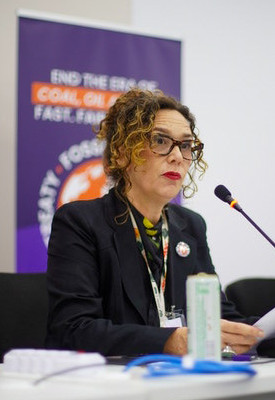
Tzeporah Berman is the founder and chair of the Fossil Fuel Non-Proliferation Treaty Initiative. (Photo: Courtesy of the Fossil Fuel Treaty Initiative)
BERMAN: It's honestly the only thing right now, one of the only things that's giving me hope, that makes me feel optimistic. These conferences are creating new conversations that are decades overdue. This will be, I think, my 16th COP that I'm going to in Turkey in a couple of weeks, and it's been extremely frustrating. It's been the same conversation, the refusal to address fossil fuels, the, I think, a distorted conversation for many, many years. And this year, we changed that, and it's changing. And I think that that will have huge ramifications. I think it'll save lives. I think we're actually living in one of the most exciting times in human history. We are reinventing industrial society. We're watching it happen around the world, and it is happening. The question for us now is how quickly will it happen, and how many lives can we save? And I think that requires all hands on deck. I don't think hope is something we just get to have. Look at the changes in technology. Look at how cheap renewables are. Yay! There's hope. No, I think hope is something we create. We create it by waking up in the morning and deciding what's our piece of the puzzle. What can we do? And everyone can do something. This is a movement that includes individuals, businesses, faith leaders, health leaders, everyone around the world. And make it your own, because we need all hands on deck.
BELTRAN: Tzeporah Berman is the founder and chair of the Fossil Fuel Non-Proliferation Treaty Initiative.
Links
The Fossil Fuel Treaty website
The 2nd International Conference on the Just Transition Away from Fossil Fuels website
Living on Earth wants to hear from you!
Living on Earth
62 Calef Highway, Suite 212
Lee, NH 03861
Telephone: 617-287-4121
E-mail: comments@loe.org
Newsletter [Click here]
Donate to Living on Earth!
Living on Earth is an independent media program and relies entirely on contributions from listeners and institutions supporting public service. Please donate now to preserve an independent environmental voice.
NewsletterLiving on Earth offers a weekly delivery of the show's rundown to your mailbox. Sign up for our newsletter today!
 Sailors For The Sea: Be the change you want to sea.
 The Grantham Foundation for the Protection of the Environment: Committed to protecting and improving the health of the global environment.
 Contribute to Living on Earth and receive, as our gift to you, an archival print of one of Mark Seth Lender's extraordinary wildlife photographs. Follow the link to see Mark's current collection of photographs.
 Buy a signed copy of Mark Seth Lender's book Smeagull the Seagull & support Living on Earth
© Copyright World Media Foundation. All Rights Reserved
Home | Contact | RSS | Donate | Newsletter