

Fracking and Data Centers
Air Date: Week of October 23, 2026
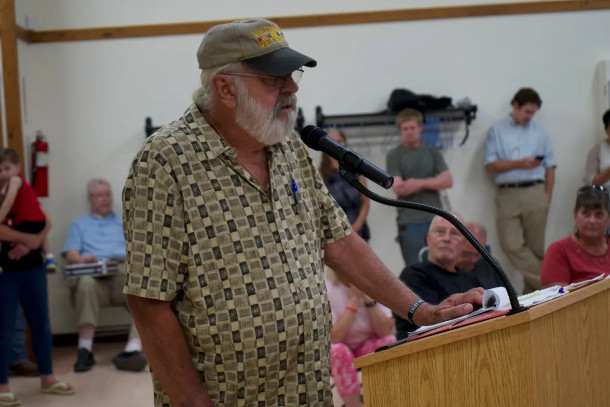
Guy Fuller lives near two fracking sites and is worried about a nearby data center that will run on the natural gas generated in Upper Burrell Township. (Photo: Reid Frazier/The Allegheny Front)
One of the states where data centers to power AI are growing is Pennsylvania, which also has a large supply of natural gas. In Upper Burrell, a town just east of Pittsburgh, a data center expansion could be fed by fracking rigs already pumping gas out of the ground. The Allegheny Front’s Reid Frazier reports the town is trying to keep pace with these two big industries in its backyard.
Transcript
DOERING: From PRX and the Jennifer and Ted Stanley Studios at the University of Massachusetts Boston, this is Living on Earth. I’m Jenni Doering.
BELTRAN: And I’m Paloma Beltran.
Voting is already well underway in this year’s US midterm elections, and all eyes are on numerous close House and Senate races that could end the Republican trifecta. But further down the ballot are candidates for local government who have the power to influence local decisions about issues important to voters. One of those hot-button issues this year is data centers, which are built to power soaring artificial intelligence use. And in Pennsylvania, data center development is growing in part because of the state’s large supply of natural gas. In Upper Burrell, a town just east of Pittsburgh, a data center expansion could be fed by fracking rigs already pumping gas out of the ground. The Allegheny Front’s Reid Frazier reports the town is trying to keep pace with these two big industries in its backyard.
FRAZIER: At a recent meeting in the Upper Burrell Township Municipal Hall, people packed a room to hear about a new local law in the works.
WALKER III: Who’s in favor of the data center, let’s see. Who’s in favor?
FRAZIER: That’s Ross Walker, III, the chair of the board of supervisors, asking for a show of hands. Only a few shoot up.
WALKER III: How many are opposed?
FRAZIER: Now, almost everyone in the room raises their hand. Most in the crowd of around 50 came to hear about the township’s proposed data center ordinance. The ordinance applies to a project by Tech Fusions, a Florida-based data center developer. The company is already operating a small data center here, but it wants to make it much bigger, feeding it with on-site natural gas-powered electricity generation. The plan has brought a lot of public interest, mostly negative.
SPEAKER: We don’t want these data centers! [APPLAUSE]
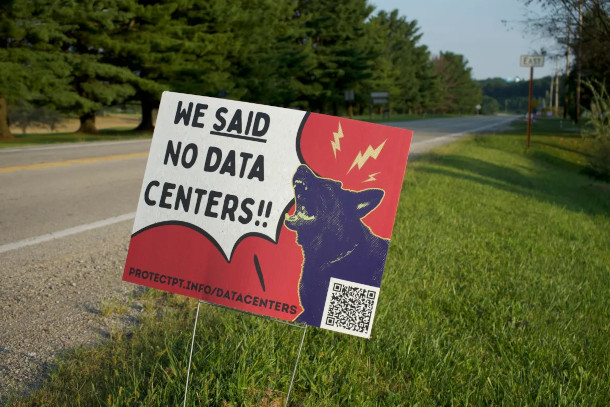
Signs like this line State Route 780 in Upper Burrell Township, near the entrance to the TECfusions data center. (Photo: Reid Frazier/The Allegheny Front)
FRAZIER: In May, the township supervisors passed a six-month temporary moratorium on data centers while they worked on the ordinance, which would govern everything from lighting to water use. Upper Burrell resident Guy Fuller is skeptical the law would go far enough. He’s already living with gas drilling. Every day, massive sand trucks drive up and down the town’s roads, and there’s noise and lights at well pads.
FULLER: Okay, I’m right in the middle of two wells. Now I’m going to have to put up with a data center on top of it, a power station.
FRAZIER: In an exchange with Fuller, town supervisor Ken Slahtovsky says he’s worked hard to research the data center industry.
SLAHTOVSKY: I wake up in the middle of the night, turn my phone on, and read data centers.
FULLER: I do the same thing.
SLAHTOVSKY: Because that’s all that’s on my phone these days.
FRAZIER: Data centers power the computers behind artificial intelligence. The companies developing them tout their economic benefits, mostly from the construction of the data centers, but they don’t need many workers once built. The Tech Fusions facility is at a former Alcoa Research and Development Center, where 1,600 people used to work, including resident Dave Ostrowski’s father. He’s skeptical the project will improve the community.
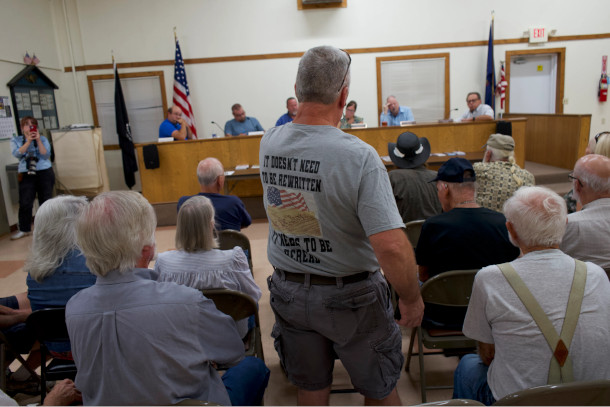
John Mataldi speaks at a Sept. 2 township supervisor meeting in Upper Burrell Township, September, 2026. (Photo: Reid Frazier/The Allegheny Front)
OSTROWSKI: I mean, my dad worked for Alcoa for many years. Alcoa brought a lot of good things to this community, okay. And bottom line is, I don’t get that vibe from these guys. These guys are here to take advantage of the situation, make money, sell that off, and leave us with the bag. [APPLAUSE]
FRAZIER: After the meeting, Slahtovsky, the township supervisor, said the proposed ordinance deals with a variety of community concerns.
SLAHTOVSKY: Noise, pollution, lighting, all the concerns, water consumption.
FRAZIER: The ordinance includes minimum setbacks from residential areas and sets water use and lighting guidelines. But there’s only so much a township like Upper Burrell can do to regulate the industry, Slahtovsky said.
SLAHTOVSKY: From what our solicitors said, we cannot ban it. And my personal viewpoint is, I don’t want to drag the township in a legal battle where we can’t afford to battle it.
FRAZIER: Local governments can’t ban a specific type of industry in Pennsylvania, but the state government can. While New York and Texas have temporary bans on data center development, there’s no such law in Pennsylvania, even though there is a proposal for one. Slahtovsky said from his vantage point, fracking companies operating in the township have been better at communicating than the data center’s developers.
SLAHTOVSKY: They were showing up at meetings. They were answering questions. I have not got much out of Tech Fusion.
FRAZIER: Tech Fusions did not respond to requests for comment. Gilian Graber is with the environmental group Protect PT, which is suing the municipality over its decision to allow the data center under its current zoning code. She says the local government should be aggressive in regulating data centers, because residents already have to put up with the dust and noise from fracking.
GRABER: When we spoke to residents of Upper Burrell, they were, they were really mad at the fact that the, the local government has not even addressed the impacts of fracking, and now they’re welcoming in another type of developer.
FRAZIER: One of those residents is John Mataldi. He lives near two gas wells and a pipeline, and across the street from the data center.
MATALDI: My neighbor is encroaching on my rights, is the way I look at it, and I’m sure a lot of other people do.
FRAZIER: The proposed ordinance caps noise at 75 decibels, around the level of a city street or a running lawnmower.
MATALDI: That is a very loud noise with no barriers in place. I live 1,000 yards from the building, no barriers. There’s one row of trees.
FRAZIER: Hannah Wiseman, a law professor at Penn State University, says there are similarities between the data center boom and the arrival of fracking in Pennsylvania about 20 years ago. As with data centers, many worried about environmental impacts from fracking, but many also supported fracking for economic reasons, like gas royalties for landowners.
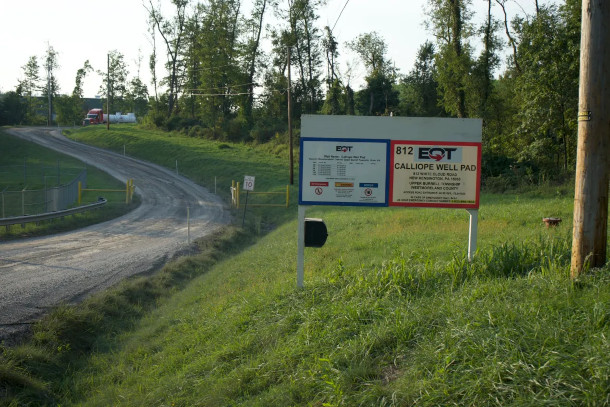
The entrance to a natural gas drilling site in Upper Burrell Township, September, 2026. (Photo: Reid Frazier/The Allegheny Front)
WISEMAN: When it comes to a data center, you you’ve got a, you know a few landowners who will benefit from selling their property, and the data center companies are offering unbelievable quantities of money to these landowners. But it’s, it’s fewer landowners who will benefit.
FRAZIER: Communities rely on tax money, but it’s unclear how much benefit data centers will bring to them, Wiseman says. That makes it a hard sell for local communities.
WISEMAN: They’re shouldering the burden of a national economic boom. Often they’re not getting compensated for that burden.
FRAZIER: One way to ensure communities get a good deal is through a community benefits agreement, a bargain developer strike with local governments in exchange for permission to build. Communities can get cash or commitments to use clean energy, or limit data center water use, Wiseman says.
WISEMAN: They can get extensive benefits. I mean, the sky’s the limit because data center data center companies want to build so badly and so quickly. I think communities don’t fully realize their negotiating power.
FRAZIER: The Upper Burrell supervisors say they’ll negotiate a benefits agreement after they have their data center ordinance in hand. A deadline for the ordinance is November 2. For Living on Earth, I’m Reed Frazier.
BELTRAN: Reid’s story comes to us from The Allegheny Front.
Links
Living on Earth wants to hear from you!
Living on Earth
62 Calef Highway, Suite 212
Lee, NH 03861
Telephone: 617-287-4121
E-mail: comments@loe.org
Newsletter [Click here]
Donate to Living on Earth!
Living on Earth is an independent media program and relies entirely on contributions from listeners and institutions supporting public service. Please donate now to preserve an independent environmental voice.
NewsletterLiving on Earth offers a weekly delivery of the show's rundown to your mailbox. Sign up for our newsletter today!
 Sailors For The Sea: Be the change you want to sea.
 The Grantham Foundation for the Protection of the Environment: Committed to protecting and improving the health of the global environment.
 Contribute to Living on Earth and receive, as our gift to you, an archival print of one of Mark Seth Lender's extraordinary wildlife photographs. Follow the link to see Mark's current collection of photographs.
 Buy a signed copy of Mark Seth Lender's book Smeagull the Seagull & support Living on Earth
© Copyright World Media Foundation. All Rights Reserved
Home | Contact | RSS | Donate | Newsletter