

July 17, 2026
Air Date: July 17, 2026
FULL SHOW
SEGMENTS
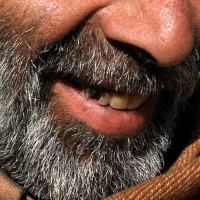
Extreme Heat and Tooth Decay
View the page for this story
The extreme heat that’s becoming far more common in a warming world is now being linked to dental problems. As the body prioritizes sweat for cooling over saliva production, the resulting dry mouth can have devastating impacts on your teeth. That’s according to Dr. Zain Azhar, a dentist in Pakistan who is documenting a tooth decay trend among his patients who work outdoors in the heat for prolonged periods, and he spoke with Host Aynsley O’Neill. (08:27)
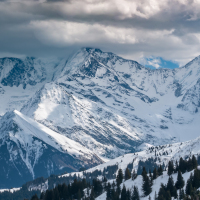
Melting Glaciers Trigger Earthquakes
View the page for this story
A 2025 paper published in the journal Earth and Planetary Science Letters documented a link between melting ice in the Alps caused by a heat wave, and an uptick in small earthquakes. In this note on emerging science written by El Wilson, Living on Earth’s Bella Smith explains this unexpected aspect of the warming planet. (02:49)
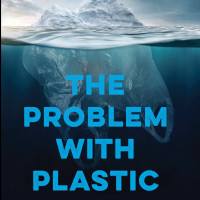
The Problem with Plastic
View the page for this story
Cheap and convenient plastic products are everywhere you turn, and the microplastics they break down to are now in our water, soil, air, and deep inside our bodies. Joining Living on Earth’s Paloma Beltran to discuss her 2025 book The Problem with Plastic: How We Can Save Ourselves and Our Planet Before It’s Too Late is Judith Enck, a former EPA Regional Administrator and the founder and President of the advocacy group Beyond Plastics. (15:23)
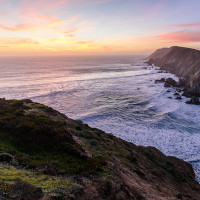
National Parks Magic
View the page for this story
It’s peak summer travel season, and for many people traveling in the US that means a visit to a national park or monument. After all, "America's crown jewels” are ideal places to disconnect and reconnect with nature and our shared history. Will Shafroth, recently retired CEO of the National Park Foundation, takes a virtual road trip of sorts with Host Jenni Doering to share the magic of the national parks. (15:43)
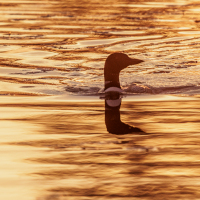
Loon in Fog
/ Mark Seth LenderView the page for this story
The iconic loon with its haunting, far-reaching call can be found in many lakes and wetlands throughout North America, including at the Seney National Wildlife Refuge in Michigan. That’s where Living on Earth Explorer in Residence, Mark Seth Lender spotted a pair one foggy morning. (02:35)
Show Credits and Funders
Show Transcript
260717 Transcript
HOSTS: Jenni Doering, Aynsley O’Neill
GUESTS: Dr. Zain Azhar, Judith Enck, Will Shafroth
REPORTERS: Mark Seth Lender, Bella Smith
[THEME]
DOERING: From PRX – this is Living on Earth.
[THEME]
DOERING: I’m Jenni Doering.
O’NEILL: And I’m Aynsley O’Neill.
The push to reduce plastic use for the sake of our health.
ENCK: If we can make progress and actually reduce the production of some plastic, it will help our climate, it will help environmental justice communities where plastics are produced, and bring us a safer environment for our kids and grandchildren.
DOERING: Also, a virtual road trip to the national parks.
SHAFROTH: Traditionally, people think of these places that are geologically interesting, or have natural beauty associated with them, or amazing recreational opportunities. But the other part of the wonder of these places is that you can learn so much about our nation’s history and the people, places, and events that really shaped who we are as a country.
DOERING: That and more, this week on Living on Earth. Stick around!
[NEWSBREAK MUSIC: Boards Of Canada “Zoetrope” from “In A Beautiful Place Out In The Country” (Warp Records 2000)]
[THEME]
Extreme Heat and Tooth Decay
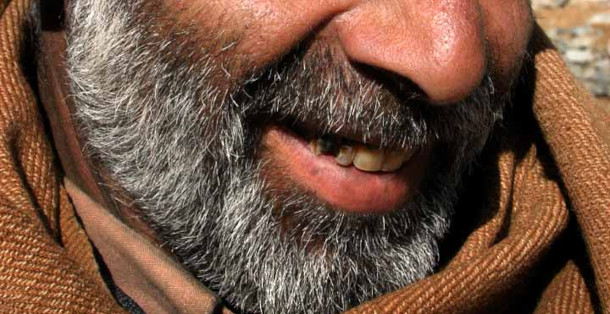
New Pakistani research reveals a negative link between extreme heat and the deterioration of teeth, tied to reduced rates of saliva production. (Photo: Steve Evans, Wikimedia Commons, CC BY-SA 2.0)
DOERING: From PRX and the Jennifer and Ted Stanley Studios at the University of Massachusetts Boston, this is Living on Earth. I’m Jenni Doering.
O’NEILL: And I’m Aynsley O’Neill.
The extreme heat that’s becoming far more common in a warming world is now being linked to some health impacts you might not expect. Namely, on your teeth. Extreme heat can lead to extreme dehydration, and that can take the form of not only exhaustion and brain fog, but it can even start to turn part of your body against you, prioritizing sweat for cooling over saliva production as your body goes into survival mode. And when your mouth gets too dry, that can have devastating impacts on your teeth, according to new research being done in Pakistan.
AZHAR: Without adequate saliva, and I mean genuinely adequate saliva, not just the minimal amount needed to swallow, teeth begin to demineralize within weeks. A process that becomes increasingly difficult to reverse.
O’NEILL: That’s Dr. Zain Azhar, a dentist, healthcare writer, and journalist in Okara, Pakistan who calls saliva a “physiological fortress” because of how it protects our teeth. He’s been looking into the effect that extreme heat has on the oral health of local farmworkers, who are regularly working outdoors in 110 degree Fahrenheit heat, often without access to shade or clean drinking water. And of course, as our planet warms, hot days are getting both hotter and more frequent. Earlier this year, several cities in Pakistan saw temperatures over 122 degrees Fahrenheit. Dr. Azhar wrote about his research on heat and tooth decay for Earth Island Journal, so I called him up, and started off asking him about his patient Rashid, a 32 year-old farmworker who had lost eight teeth in only two years. Rashid was losing teeth not from dental neglect but from a perpetually dry mouth.
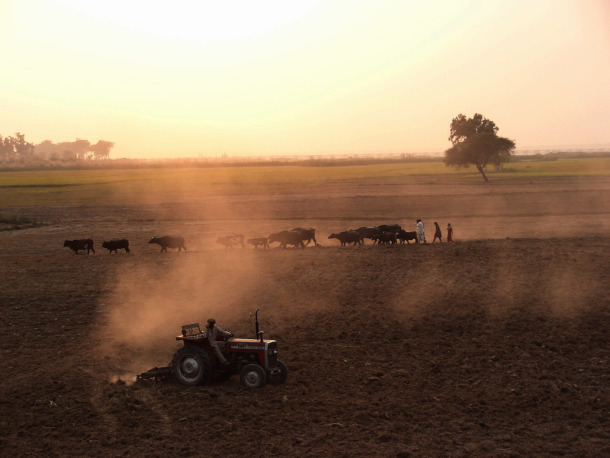
More heat-intense days are making the conditions for Pakistani outdoor workers unbearable with temperatures reaching peaks of 122 degrees Fahrenheit. Shown above is a farmworker in the Bajwat sector of Sialkot District in Punjab, Pakistan. (Photo: Bilal Farhat Ullah, Wikimedia Commons, CC BY-SA 4.0)
AZHAR: His was not the gradual erosion from poor hygiene or untreated cavities that you would expect in communities with limited access to healthcare. This was aggressive systemic dissolution, as if teeth were being chemically attacked from the inside out, dissolved by forces entirely beyond individual control or comprehension. So, like most outdoor laborers during peak season, Rashid used to drink 15 to 20 liters of water daily to survive the relentless heat. So, he chews on sugar cane during breaks, which provides quick calories, and nothing about his general health seemed unusual at first. But when I asked about saliva, that often overlooked component of oral health that most people never think about, there was a long pause. He said, "My mouth is always dry. Even when I drink water until I feel sick, my mouth stays dry.” So that's when something clicked into place that would fundamentally reshape my understanding of what I had been observing in my practice.
O’NEILL: And Dr. Azhar told me, the extreme heat was not the only environmental factor in the population losing teeth. As the planet heats up, evaporation means that drinking water in this part of Pakistan is seeing more concentrated salt levels. So when workers try to hydrate themselves, the brackish water ends up contributing to this dental decay.
AZHAR: So Pakistan's agricultural zones are experiencing a dramatic drop in groundwater due to reduced rainfall and high rates of evaporation from freshwater bodies. This, in turn, is concentrating dissolved salts in the groundwater, turning it more brackish during dry months, so regular consumption of brackish water, which we mean water with elevated salt content, it creates an osmotic effect inside the mouth, pulling moisture out of oral tissues and worsening the dry mouth conditions caused by heat stress. So when workers drink from these compromised sources during extreme heat, they are consuming water that may already be either slightly acidic or mineral poor. So combined with heat-induced salivary changes, this creates a knock-on effect.
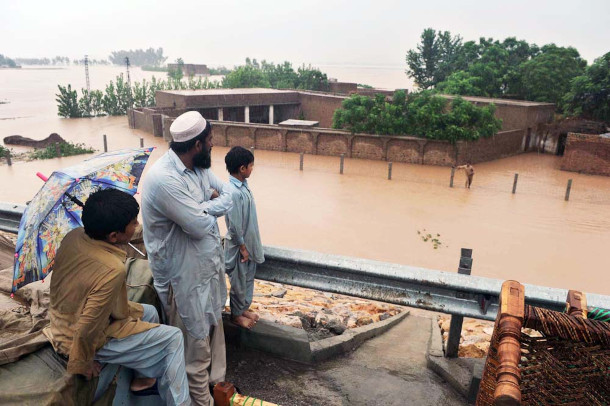
Shown above are Pakistani citizens during a flood in 2010. Many Pakistani water sources can become contaminated with nitrates and phosphates during monsoon season. These increase the acidity of the groundwater. At the same time, evaporation rates due to high temperatures leave behind brackish water, which has a higher salt content than freshwater. Ultimately drinking this water ends up pulling more moisture from mouths, leaving them dry. (Photo: IRIN Photos, Flickr, CC BY-NC-ND 2.0)
O’NEILL: Noticing a pattern, Dr. Azhar started to survey patients, all outdoor workers dealing with the extreme heat and the brackish water combined, throughout the Pakistani state of Punjab. He conducted some pH testing and discovered that in 42 of his 73 climate-exposed patients, their mouth pH was below a 5.5, an extremely acidic environment compared to a healthy mouth which is closer to a neutral pH of 7. To quote Dr. Azhar’s article, “at 5.2 pH, enamel doesn’t just demineralize slowly; it actively dissolves, like chalk in vinegar.” And for these patients, losing teeth affects their ability to eat and speak, and that affects their careers, social lives, and even marriage prospects.
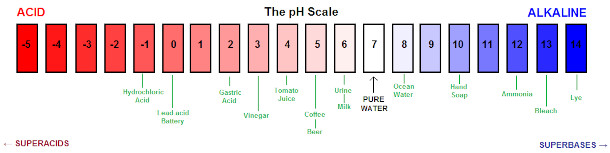
The average mouth should have a pH level closer to the neutral zone of 7. Dr. Azhar’s patients were ranging in more acidic territories of 5.2-5.5. (Photo: Piercetheorganist, Wikimedia Commons, public domain)
AZHAR: There is a stigma associated with having bad or no teeth. Nasreen, another patient from Lahore, households hiring for in-home roles have turned her away, telling her she appeared unclean. So she said, “In my community, a woman without teeth is considered unmarriageable. It's not stated explicitly, but everyone knows it. My younger sisters,” according to her, “my younger sister's marriage prospects are affected too because people talk. They wonder if there is something genetically wrong with our family."
O’NEILL: Dr. Azhar told me about grassroots movements to try to help guard against these issues. Temporary solutions include shifting work hours to avoid the hottest parts of the day, or providing outdoor workers with clean water and electrolyte drinks. And as a country, Pakistan declared climate change a national security priority back in 2022, and climate solutions are gaining traction there, including a big jump in solar energy. Of course, as Dr. Azhar points out, Pakistan may be a case study here, but it’s not the only place where this is happening.
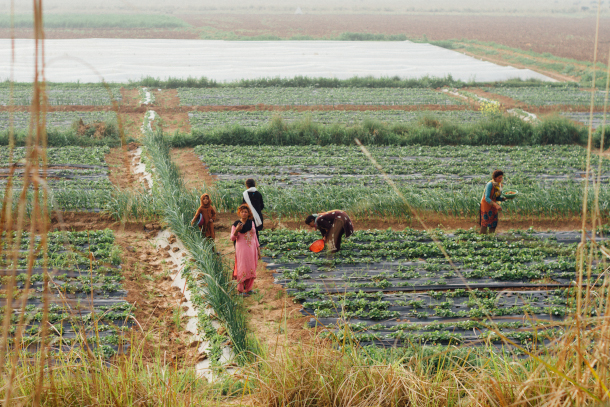
To counteract the intense daytime temperatures, some local Pakistani grassroots movements began encouraging outdoor laborers to shift working hours to cooler hours of the day. (Photo: Adam Cohn, Flickr, CC BY-NC-ND 2.0)
AZHAR: Global warming is a global problem. Climate change is a global problem. So, if climate change is affecting Pakistani people, then the human beings living around the world are the same; they will affect in the same way. Like recently, you can see the heat wave which has hit Europe. This is the result of climate change. People are dying there. So, basically, oral health is ignored because due to dental issues, people do not die instantly. They die instantly due to heat stroke. They die instantly due to cardiac failure. They die instantly due to cardiac arrest. But they do not die instantly due to dental issue. But you can see that the dental issue is causing them their lives. The climate change is affecting the oral health of these patients, which is directly affecting their economy and everything. So I would like to repeat the words of my dear patient Rashid, which is the main highlight of the story. He said to me when I asked him that what he wanted people to know about what's happening to him and others like him. So he told me that “tell them that climate change is not abstract. It's here right now in my mouth, in my family's survival, in my ability to work and eat and live with dignity. It's not just teeth. It's my entire future, and I am not alone. Every farmer I know is experiencing this. We are all getting older before our time. We are all becoming invisible.” Can you imagine? These are the words by an uneducated Pakistani person. So you can assess the damage that has been done by climate change to us.

Dr. Zain Azhar Gill is a dentist, healthcare writer, and journalist in Okara, Pakistan. (Photo: Courtesy of Zain Azhar Gill)
O’NEILL: That’s Dr. Zain Azhar, a dentist, healthcare writer, and journalist in Okara, Pakistan. His article When the Heat Steals Your Smile was published in Earth Island Journal.
Related link:
Earth Island Journal | “When the Heat Steals Your Smile”
[MUSIC: Varanasi Evening]
Melting Glaciers Trigger Earthquakes
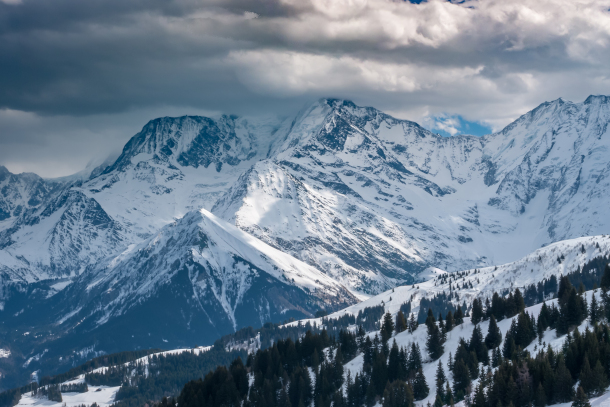
Scientists discovered that a 2015 heat wave sparked a wave of small earthquakes under Mont Blanc, the tallest mountain in Western Europe. (Photo: Matti Blume, Wikimedia Commons, CC BY-SA 4.0)
DOERING: Climate change is so profoundly affecting our world that perhaps we shouldn’t be surprised by another unexpected consequence, described in this note on emerging science written by El Wilson and voiced by Bella Smith.
[SCIENCE NOTE THEME]
SMITH: When we think of natural disasters caused by the climate crisis, many of us picture hurricanes and forest fires. But now, scientists are discovering that the earth beneath our feet is shifting too. In a paper released in September 2025, in the journal Earth and Planetary Science Letters, seismologists describe how increased snow melt on our warming planet appears to be leading to earthquakes. Their investigation began at Mont Blanc, the highest mountain in Western Europe, which has an unusual feature: a deep tunnel connecting Italy and France. Scientists examined the interior tunnel and identified fault lines where different sections of rock can slip past each other, just a little bit, resulting in earthquakes. After studying decades of seismic records, they saw a notable jump in earthquake frequency beginning in 2015, when a massive heat wave melted large portions of snow and ice in the Alps. To help us understand how this could work we called up Colin Meyer, an associate professor of engineering at Dartmouth who studies the fluid dynamics of snow and ice and wasn’t involved in the research itself.
MEYER: The general idea of the paper is that some water from the glaciers, as they are melting, is making its way into this fracture zone, and it's changing the friction on the fractures, causing them to be a little bit more seismically active.

Colin Meyer is an associate professor of engineering at Dartmouth who specializes in snow and ice mechanics. (Photo: Greg LeClaire Wagner)
SMITH: In other words, the pressurized water makes those cracks in the rock a little bit more slippery. Now, if you’re picturing giant avalanches, take a deep breath. Most of the earthquakes measured by the seismologists were a one or two on the Richter Scale, which you would barely notice. And while there is the potential for these small earthquakes to lead to larger ones, other hazards from melting glaciers, like floods from ice dams bursting, are likely going to be more of a concern for people living near these glaciers than the increased seismic activity. Still, Meyer believes the research is valuable.
MEYER: What I like about this paper, it's connecting things about the climate crisis, about glaciers melting, to things that are innately concerning. You know, we in most of our lifetimes have not seen 50 centimeters of sea level rise before, whereas we have heard and watched movies about earthquakes. It's connecting the story about how climate is causing mountain glaciers to melt, and how that's affecting systems that are beyond the typical systems we think about.
SMITH: For Living on Earth and with Producer El Wilson, I’m Bella Smith.
Related links:
- Science | “Global Warming Is Triggering Earthquakes in the Alps”
- Learn more about Colin Meyer
[SCIENCE NOTE THEME]
O’NEILL: Just ahead, the problem with plastic, and what we can do about it. Stay tuned to Living on Earth!
ANNOUNCER: Support for Living on Earth comes from the Waverley Street Foundation, working to cultivate a healing planet with community-led programs for better food, healthy farmlands, and smarter building, energy and businesses.
[CUTAWAY MUSIC: McCoy Tyner, “Blue Monk” on Nights of Ballads & Blues, GRP Records Inc.]
The Problem with Plastic
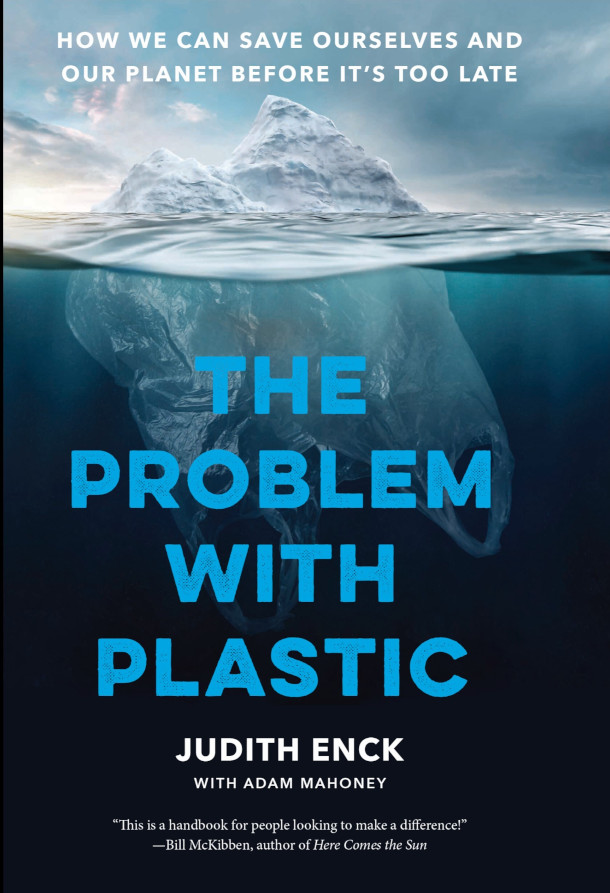
Judith Enck’s latest book, The Problem with Plastic: How We Can Save Ourselves and Our Planet Before It’s Too Late. (Photo: Beyond Plastics)
DOERING: It’s Living on Earth, I’m Jenni Doering
O’NEILL: And I’m Aynsley O’Neill.
After World War II plastics grew from a cheap wartime alternative to a staple in the American home. From Tupperware to disposable water bottles and children’s toys, plastic waste began to pile up, and the companies making these products saw huge profits. Groups concerned about the proliferation of plastics have been encouraged by single-use plastic bans, and producer responsibility programs. But there’s still a long way to go, and the negotiations for a United Nations plastics treaty have hit roadblocks.
And plastics linger in our ecosystems and our bodies long after they’re produced.
Tiny pieces of plastic have been found in every corner of the world, trapped in Antarctic ice and floating in coral reefs. Judith Enck is a former EPA Regional Administrator and the founder and President of the advocacy group Beyond Plastics. Her latest book is The Problem with Plastic: How We Can Save Ourselves and Our Planet Before It’s Too Late, and she spoke with Living on Earth’s Paloma Beltran.
BELTRAN: Judith, you know it can sometimes feel as though there are endless environmental challenges today. You know, air pollution, extreme heat, et cetera. In your view, why is plastic an issue worth championing?
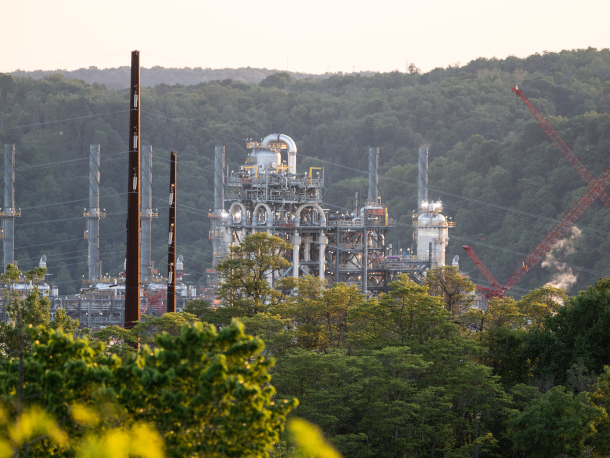
Plastics are emerging as a “plan B” for fossil fuel companies to continue production despite increased growth in electric transportation and renewable energy. Above, a Shell-owned ethylene cracker plant in Pennsylvania. (Photo: Mark Dixon, Wikimedia Commons, CC BY 2.0)
ENCK: Well, it touches so many environmental and public health issues all at once. So, if we can make progress and actually reduce the production of some plastic, it will help our climate. It will improve the ocean, not having so much plastic waste in the ocean. It will help environmental justice communities where plastics are produced. It will improve our own health because of the large amounts of microplastics being found in different parts of the human body. It will save taxpayer dollars, and in general, bring us a cleaner and safer environment for our kids and grandchildren. So, you know, this touches so many different issues that I've worked on throughout my long career in environmental protection. It's not just one thing. And each of these things, you know, health, climate change, environmental justice. Each of those things deserve a book all by themselves. The plastics impact of these things, but we try to fold it all together in one readable, conversational sort of book, and just to kind of whet people's appetite on if they want to go a little deeper on whatever interests them the most.
BELTRAN: Definitely, it's a great guide for anyone who wants to learn more about plastics, plastic pollution, and what they can do about it. And in your book, you note that plastic production accounts for one sixth of global carbon dioxide emissions. Where in the plastic life cycle do these emissions come from?
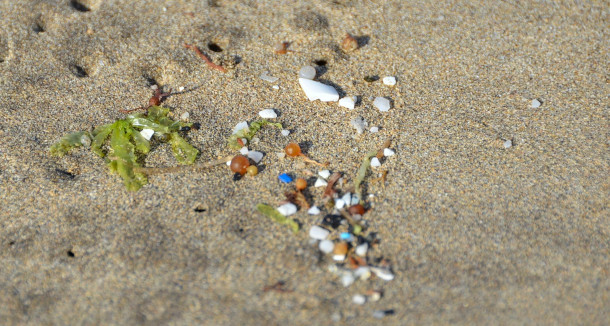
Microplastics, or pieces of plastic less than five millimeters long, are especially harmful to humans and animals when ingested. Enck says traces of microplastics have been found in human lungs, kidneys, and even breast milk. (Photo: Emina Mamaca, Wikimedia Commons, CC BY 4.0)
ENCK: Well, every step of the plastic life cycle: production, use, and disposal. So production, we've got these giant ethane cracker facilities where plastics are produced, emitting greenhouse gasses into the environment. And because only five to six percent of plastics actually get recycled, that means most of it is going to incinerators where you get a lot of air pollution when plastic is burned, or landfills, or it is released in the marine environment, and there's even some greenhouse gas emissions from plastics in the ocean, and so this is a serious climate change issue that I don't think has been fully appreciated by policymakers.
BELTRAN: Now, of course, plastics are made from petrochemicals. How are oil and gas companies profiting from our dependence on plastics?
ENCK: Well, the largest plastic manufacturer in the United States today is Exxon Mobil. So, what happened, I believe, a number of years ago, is fossil fuel companies like Chevron and Shell and Exxon Mobil saw that their market was changing. Historically, they sold fossil fuel to power cars and trucks, and what's going on in that sector? We're finally seeing electric vehicles, electric school busses, etc. The other big market for fossil fuels is electricity generation, and while it's slow going, we are finally seeing progress with solar and wind and geothermal and innovation on energy efficiency. You know, the refrigerator you buy today is significantly more efficient than a refrigerator you bought 10 years ago. So the big guys and gals at fossil fuel companies decided, without checking with any of us, that plastic was going to be their growth area. So we are seeing plastics emerge as plan B for the fossil fuel industry, and companies are making a lot of money manufacturing plastic, and we're paying for it with our health and damage to our ecology.
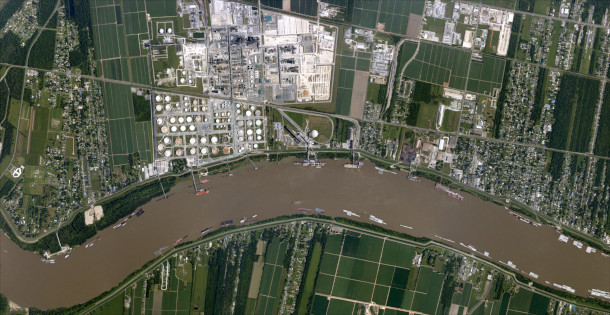
Satellite imagery of Cancer Alley in Louisiana shows the high concentration of plastic and petrochemical manufacturing facilities along the Mississippi River. (Photo: NOAA, Wikimedia Commons, Public Domain)
BELTRAN: Yeah, plastic doesn't just affect the environment, it also impacts human health. And recently, there's been a lot of discussion about microplastics. What exactly are microplastics, and how do they affect our human body?
ENCK: Microplastics are tiny pieces of plastic that are five millimeters or less, so kind of the size of a grain of sand, and we breathe in microplastics. We also swallow microplastics. Those are the two major ways that microplastics get into our bodies. So you might be opening a container of yogurt or hummus, and it has like a little plastic layer on the top. Some of that plastic will be in the form of a microplastic that gets sprinkled into your yogurt or your hummus, or you may be turning the bottle cap of a plastic soda bottle. The abrasion of turning the bottle cap can result in small amounts of microplastic getting into your soda or your water. So some of the microplastics that get into our bodies, we excrete some of it, but not all of it. And just in the last few years, we're seeing more and more peer-reviewed scientific papers documenting the presence of microplastics in our blood, which means it's circulating throughout our body. Microplastics have been found in human lungs, kidneys, liver, the human placenta, both the fetal side and the maternal side. So our babies are being born pre-polluted. Microplastics have been found in breast milk, in human testicles, and for years the plastics industry was saying, "Oh, there's no evidence that it causes harm to us." They can no longer honestly say that because of two studies that came out last year, one by the New England Journal of Medicine, one of the most well-respected medical journals in the world, identified microplastics in the arteries in our necks, and it attaches to plaque. And if you have microplastic attaching to plaque, unfortunately, you have an increased risk of stroke, heart attack, or premature death. And then a big study that we were waiting on for a long time was published last year, that looked at, do microplastics cross the blood-brain barrier, and unfortunately the conclusion was yes, and when that happens, we have an increased risk of Alzheimer's disease and neurological diseases. So this is quite a serious health issue for all of us. But I do want to bring us back to where plastics are produced, because it's an even more serious issue if you live in Texas, Louisiana, or Appalachia, where you have a concentration of plastic production facilities. There is an area, I think Paloma, you and I have spoken about this before. There is an area in Louisiana known as Cancer Alley.
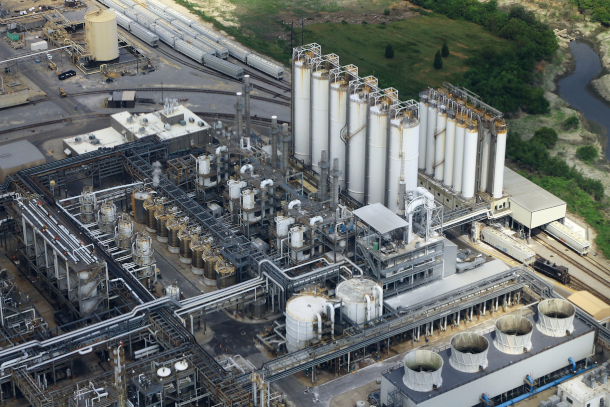
Enck highlights many women who take a stand against plastics in her book. Sharon Lavigne, for example, is fighting to stop the construction of a Formosa Plastics plant (like the one above in East Baton Rouge Parish, Louisiana) near her home. (Photo: Formula None, Wikimedia Commons, CC BY-SA 2.0)
BELTRAN: Yeah.
ENCK: 85 miles along the Mississippi River between Baton Rouge and New Orleans, where you have a large concentration of plastic and petrochemical manufacturing facilities. Johns Hopkins recently did a study and identified the cancer risk in Cancer Alley, Louisiana, is seven times the national average.
BELTRAN: Incredible, yeah.
ENCK: So people are paying for all of this plastic with their health.
BELTRAN: Definitely. And for people who have not had the chance to visit Cancer Alley or did not know about it, when you step out from your vehicle and out into the Cancer Alley world, you smell the chemicals in the air, and you look at the fumes coming out from these petrochemical facilities, and it's evident that the communities in Louisiana in this Cancer Alley region are constantly exposed to toxic chemicals.
ENCK: Yeah, 24/7 and people have lived there for decades. And I've had people say to me, "Well, why don't people just move?" Well, well, it's not easy to move. You don't always have the resources to move. You don't want to leave your job. You don't want to leave your families. And I think the question is, why don't these plastic production facilities move? They are environmental and health menaces, and we don't have strong enforcement of environmental laws ever from the state agencies in Louisiana or Texas, and now during the Trump administration, my former agency, the EPA, is MIA on enforcing environmental laws. And so these residents that are living near these facilities are breathing in carcinogenic chemicals. Their drinking water is compromised, and it's really quite unconscionable that in 2026 we've got seven times the cancer rate because of petrochemical production, just totally, totally unethical.
BELTRAN: Judith, what factors make a community more vulnerable to the harms of plastic pollution?
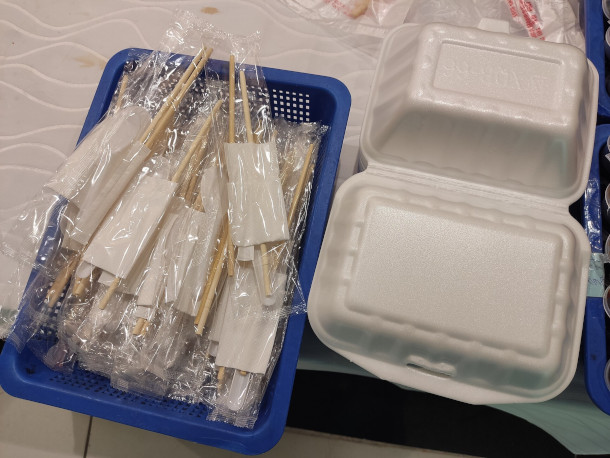
Another anti-plastics champion is Debbie Lee Cohen, a mother who worked to ban styrofoam trays from New York City public schools. (Photo: Gurgaon Anmuyto, Wikimedia Commons, CC BY-SA 4.0)
ENCK: I think you're going to see plastic production facilities that are historically very polluting in either low-income neighborhoods or communities of color, or both, because so much pollution is produced, it would not be acceptable in more affluent communities. You know, you don't see Scarsdale in Westchester County or Beverly Hills in California, having to deal with the pollution from any kind of facility. So your health outcome is very much determined by your zip code, and I think a lot of the big companies look for marginalized communities. They purposely look at where are their existing polluting facilities, so you have a clustering effect, and then people are being damaged by the cumulative impacts of all of this pollution. And I think companies look for communities that they perceive do not have political power, but that's where I think they're making a mistake. In our book, The Problem with Plastic, we profile a number of women who are on the front lines, protecting their families and their communities from plastic pollution. Women like Sharon Lavigne, the founder of Rise Saint James in Saint James Parish, Louisiana, where she's already defeated a major plastic production proposal from Formosa Plastics, one of the largest plastic makers in the world, and now there's another Formosa Plastics proposal like two miles from her house. Sharon's a retired special ed teacher. She has six children, has lived in Louisiana her whole life, and she is taking on this multinational company, and she's winning. The book also profiles Diane Wilson, a fourth-generation shrimper in Texas, who by coincidence is also taking on Formosa Plastics and Dow Chemical because of little tiny pre-production pellets known as nurdles being released in the bay where she gains her livelihood. And then we also profile an amazing woman, Debbie Lee Cohen, a mom from New York City, who doesn't live in Cancer Alley in Louisiana, she doesn't live on the Gulf Coast in Texas, but her two little girls were going to New York City public school, and she was appalled to see that their hot lunches were being served on polystyrene food trays. The food was being put directly on the polystyrene trays. And so she mobilized with other parents and convinced the largest school district in the country, the New York City public school system, to stop using polystyrene trays in school cafeterias. And then tragically, recently Debbie Lee Cohen died from cancer. But her legacy is she got plastic trays out of her kids' schools, benefiting millions of school kids. But she also founded this feisty little nonprofit called Cafeteria Culture, where they work with schoolchildren in low-income school districts in New York City to get plastics out of their schools.
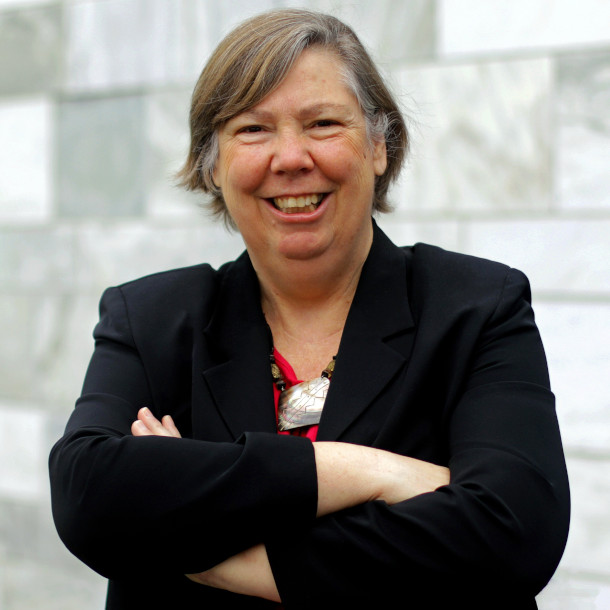
Judith Enck is the founder and President of Beyond Plastics, a nonprofit dedicated to ending plastic pollution. (Photo: Beyond Plastics)
BELTRAN: What a great legacy she left behind.
ENCK: She really did. She is missed. She and her colleagues at Cafeteria Culture produced a film that is so uplifting. It's called "Microplastic Madness." You can get it on the Cafeteria Culture website. Whenever I'm feeling a little blue about the lack of progress on this issue, which sometimes can be hourly, I just go on the Cafeteria Culture website and watch the trailer for "Microplastic Madness." It's really inspiring.
O’NEILL: That’s Judith Enck, former EPA Regional Administrator and the founder and President of Beyond Plastics. Her latest book is The Problem with Plastic: How We Can Save Ourselves and Our Planet Before It’s Too Late, and she spoke with Living on Earth’s Paloma Beltran.
Related links:
- Learn more about Judith Enck and Beyond Plastics
- Purchase The Problem with Plastic: How We Can Save Ourselves and Our Planet Before It’s Too Late and support Living on Earth and independent booksellers
- Watch the Cafeteria Culture documentary Microplastic Madness
- Learn more about The Problem with Plastic.
[MUSIC: St. Charles Shuffle]
DOERING: Thanks to everyone who tuned in to our recent Living on Earth Book Club event! We spoke with Amy Bowers Cordalis about her book The Water Remembers: My Indigenous Family’s Fight to Save a River and a Way of Life. In case you missed it, we’ve got good news. It’s up on the Living on Earth website for you to stream now. And here’s a taste.
CORDALIS: The creation story essentially says, like, you know this place was made for not only us as humans but for all the lonely spirits. So some of them were rocks, some of them became animals, some of them chose to become a river, or a mountain, water, land. Like, they took different forms and there was a balance created between all those spirits. And also, you know, we were told, and the humans were a part of that, not separate, right, not separate, a part of. And the creator told us, as long as you live in balance with the natural world, so all those different spirits, we would never want for anything. And for a long time, we lived that way.
DOERING: Catch up now on the full interview with Amy Bowers Cordalis about The Water Remembers. Just go to the Living on Earth website, loe dot org slash events.
[MUSIC: High Desert Pulse]
O’NEILL: Coming up after the break, National parks from coast to coast. Keep listening to Living on Earth!
ANNOUNCER: Support for Living on Earth comes from the estate of Rosamund Stone Zander - celebrated painter, environmentalist, and author of The Art of Possibility – who inspired others to see the profound interconnectedness of all living things, and to act with courage and creativity on behalf of our planet. Support also comes from Sailors for the Sea and Oceana. Helping boaters race clean, sail green and protect the seas they love. More information at sailorsforthesea.org.
[CUTAWAY MUSIC: Oscar Peterson, “Love For Sale” in Oscar Peterson Plays The Cole Porter Songbook, The Verve Music Group]
National Parks Magic
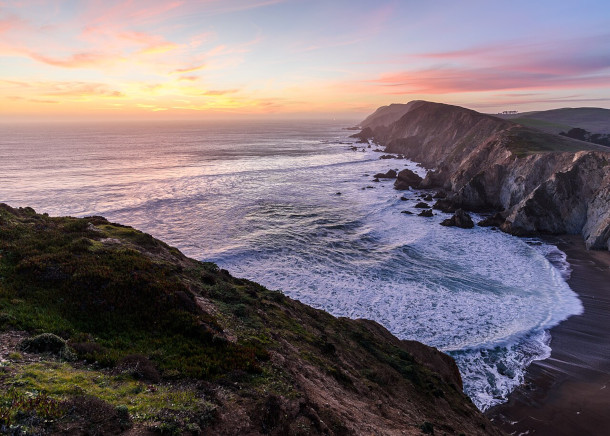
The Pacific Ocean hugs the rugged Point Reyes headlands, shown here from Chimney Rock Trail, Point Reyes National Seashore, California. (Photo: King of Hearts, Wikimedia Commons, CC BY-SA 4.0)
O’NEILL: It’s Living on Earth, I’m Aynsley O’Neill
DOERING: And I’m Jenni Doering.
It’s peak summer travel season, and for many people traveling in the US that means a visit to a national park or monument. After all, "America's crown jewels” are ideal places to disconnect and reconnect with nature. To help us get inspired about the magic of national parks and take a virtual road trip of sorts, on the line now is Will Shafroth, recently retired CEO of the National Park Foundation. Welcome to Living on Earth Will!
SHAFROTH: Thanks, Jenni. Nice to be here.
DOERING: So you have an extensive career dedicated to protecting national parks and land across the U.S. and I understand that one of the places that really formed your love for nature is Point Reyes National Seashore in California, just up the coast from San Francisco. What makes Point Reyes so special?
SHAFROTH: Well, Jenni, it was an interesting time of life for me when I started discovering and exploring Point Reyes. I just graduated from high school and trying to figure out who I was as a young man, and my girlfriend and I would meet there every weekend in 1981 and early 82, and spend literally Friday, Saturday, Sunday night there. Sometimes more, but every weekend we're out exploring, hiking, biking, canoeing, kayaking, fishing, gathering clams, and hunting for wild berries and mushrooms, and doing all sorts of fun activities. And in the course of that time there, I really had a better understanding of who I was and what kind of impact I wanted to have in my life. There's a clarity that came with that, and sort of an evolution of my own being.
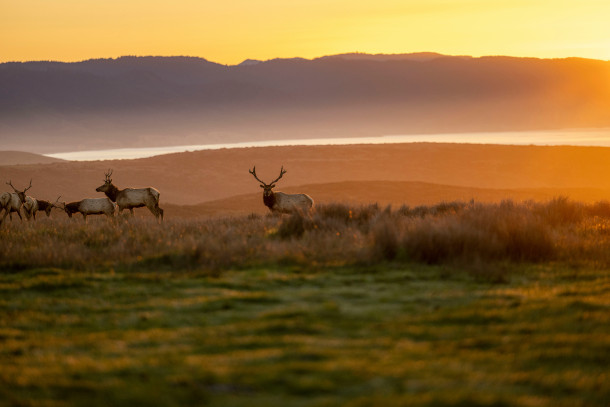
Tule elk, silhouetted against a vibrant orange sunset in Point Reyes landscape, are native to the state of California. (Photo: Leo_Visions on Unsplash)
DOERING: Hmm...and give us a sense of this place. It's a really rugged coast, right?
SHAFROTH: Yeah, it's a long bit of coast from Tomales Point and within Tomales Bay all the way down, where it meets up with portions of Golden Gate National Recreation Area closer to San Francisco. But there's also just a lot of the hills there — the redwood forest and the Douglas fir forest and the Jepson pine forest and just unbelievably wild country. And in a place, as you said, it's an hour and 15 minutes from San Francisco, and so you have access to that. And it's one of these places where, in a couple of minutes from parking your car and getting out and walking, you can be alone in quiet, connected to nature. There's a lot of wildlife in the area, hundreds of bird species. You're right on the coast, this intersection of coastal and kind of mountain range, and it's just a really special place where you know the awe and wonder of nature is present, and if you're open to it, it can have a profound effect on you.
DOERING: Yeah, you said wildlife. What kinds of wildlife encounters have you had in California?
SHAFROTH: One of the things I used to do in Point Reyes is I would, I was following the tides very closely. So I would like to fish something called a poke pole, which is a 10 foot long bamboo pole with a small bit of line at the end of it, and you'd have to basically climb down a cliff at 6:30 in the morning at the super low tides, which often happened in December. And my friend and I would arrive, and we'd walk across this field, usually in the dark, and we encountered the tule elk, which is an historic species of of elk that lives along the coast. And we could smell them. We could hear them. They were not a threat to us or we to them. But just walking among them, as the light was coming up, was one of the most powerful wildlife experiences I've ever had.
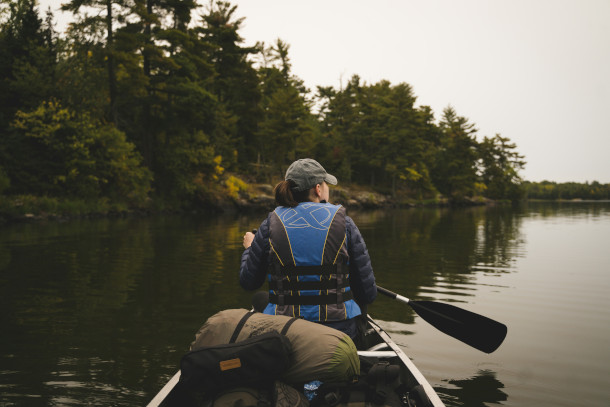
Voyageurs National Park in northern Minnesota is famous for its interconnected network of pristine lakes and rivers. It’s considered by many to be a great destination for camping and kayaking. (Photo by Tim Umphreys on Unsplash)
DOERING: Wow, they're big creatures, those elk.
SHAFROTH: They are. They're very big. But you know, in a way, they're docile. I'm sure they too can get yourself in trouble with them if you aren't paying attention, but really, really amazing creatures. And you know, also right off the coast, the whales are migrating. So you see the gray whales frequently spouting and moving their way up or down coast.
DOERING: So we're on this road trip, imaginary road trip, and and we're heading across the U.S. west to east. And I think the next stop on this cross-country road trip with you is the Midwest. So we've got this national park in Minnesota, Voyageurs National Park. What should we know before we visit Voyageurs?
SHAFROTH: A lot of people in the country have heard of something called the Boundary Waters Canoe Area Wilderness, which is U.S. Forest Service managed land, and it's right along the Minnesota Canadian border, and it abuts Quetico State Provincial Park. It's called Provincial Park, and and it's it's on the other side of the border. So they really connected. Voyageurs National Park is just to the west of that. It's the same land and water scape. It's right along the border, which just happens to be an area that was set aside at a different time, and and is managed by the National Park Service instead. So, I learned about it in about 2011. My friend and I had been going to Voyageurs and and Quetico prior to that on a regular basis, and then we took a, since I was working for the Secretary of the Interior and I felt the Park Service is kind of part of my portfolio, I better go visit this place, and you know it's a little more work to get into places like these, Jenni. You have to like get yourself across a big lake. You have to hike three and a half miles with all your gear. You have to then paddle for 12 miles to your campsite. This is not something you just kind of pull up and set up, pitch your tent. It takes a lot of work, and then therefore you're in there for a week, and it takes a lot of preparation, the food and the clothing and the camping and sleeping gear and all that kind of stuff. So once you're in there, though, it is kind of unbelievable. You're by yourself. There's one campsite per lake, and each of the lakes is like two or three miles long and half a mile across. And so you're really out there by yourself. You can hike into other lakes and fish or explore, or whatever, but it's a pretty remarkably remote place. And again, the quiet, the sounds of coyotes, seeing moose in the area, and seeing evidence of wolves, pretty powerful.
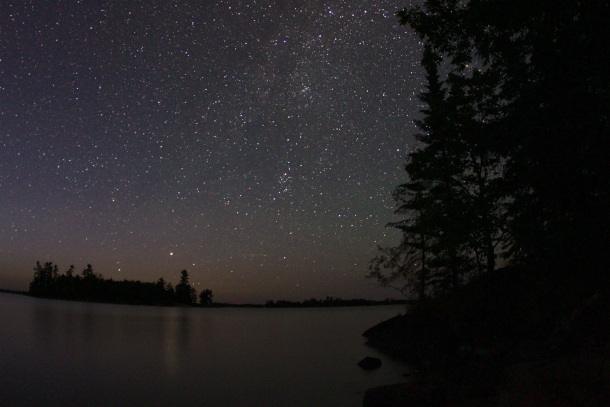
Stars blanket the night sky over Voyageurs National Park, Minnesota. (Photo: daveynin on Flickr, CC BY-NC 2.0)
DOERING: Wow! And those dark skies, I imagine, not so much light pollution out there.
SHAFROTH: Exactly, like the stars are unbelievable, and most of the time, it's not raining, and so we are able to kind of have our tent flies off and be able to lie in our tents at night and look up and see the stars, and it's pretty magical experience. The only hesitation is certain times of the year the mosquitoes can do pretty bad. It is the official state bird of Minnesota, supposedly, so you know.
DOERING: So you'll get eaten alive, but you'll have an amazing time while you're doing it.
SHAFROTH: Just go a little later in the season, and the bugs are pretty much gone by then, or they're just around for half an hour and cover up during that time. But it's a remarkable place, and you know, there aren't many places like that in our country that are that wild.
DOERING: You mentioned coyotes, even wolves. Any other wildlife memories from Voyageurs?
SHAFROTH: Yeah, maybe the most powerful one is the call of the loon. And in these lakes, there's usually a nesting pair of loons raising a chick or two at a time. And so every day, early in the morning, between four and six, they'll start calling, and in the evenings often, and it's a very hauntingly beautiful call that they have, and so that's a very important part of the memory. And they get pretty close; they're not too shy, and they're quite strikingly beautiful birds too.
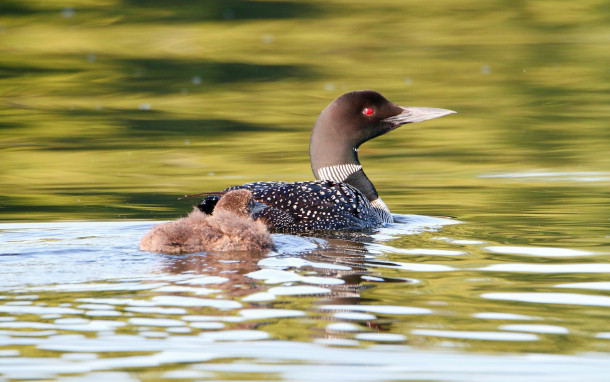
Here, an adult loon leads its chick through calm water near Walker, Minnesota. Loons are known for their haunting calls, which drift across Minnesota's lakes. (Photo by Paul Crook on Unsplash)
DOERING: Alright, so it sounds like we could spend a lot of time in Voyageurs just enjoying the wild there, but if we do want to keep heading east on this road trip and go pretty much as far east as you can go in the U.S. and not too far from the Living on Earth studios here in Boston, we have Acadia National Park up in Maine. I have been there. It is such a special place. What does it feel like for you to be there, and what do you think visitors can experience?
SHAFROTH: Well, one of the things I love about the national parks is that they're also different. You heard about my love of Point Reyes, but going to Acadia is extremely different than that. And yet, it's coastal, but the main coast is it's more east-west there than it is north-south, and so you're getting a different kind of exposure. The light's different. The currents are different. You know, it's it's outside the Gulf Stream, so the water's a lot colder than it might be in other places like in Cape Cod, just to the south of there, and it's just such a spectacularly beautiful place. I think the Park Service has done a really nice job of integrating recreation like biking and hiking into a pretty wild landscape, and so you can get on the carriage roads, which are historic in their own right, and so they tell a story of a different time in America as well, and integrate people's visitation with that kind of thing. There's also good hiking, Cadillac Mountain, and Cadillac Mountain is both for hikers as well as drivers, and there's a throng of people every day to see the sunset and the throng of people every day to see the sunrise, that is one of the more amazing visual experiences you can have, and it's also you see how that kind of visual is something that we human beings share, the magic of it, just the light coming up, and there's something deeply connective about that that people appreciate. So there's that, and then but you know that's sort of on the the main part around Bar Harbor. But there's a whole another place called Schoodic Peninsula where the Park Service also has significant science center there, a different campground, and it brings a much more wild experience. Hiking there is very few people. The coastline is a little more rugged and underpopulated, so they offer a lot of different things. It's pretty cool.
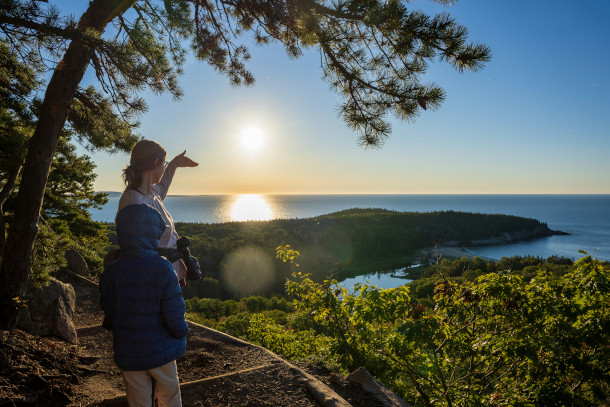
A family pauses along The Beehive Trail to catch a view of the Atlantic and a rising sun from in Acadia National Park. (Photo by Mike Burke on Unsplash)
DOERING: Yeah, I've actually camped at Schoodic Peninsula, and it was one of the best campgrounds I've ever camped at. It was just really nice facilities and beautiful skies at night. Just really quiet, really nice.
SHAFROTH: Well, the other thing about Schoodic is that campground. I've been there too, that was a campground that the National Park Foundation was actually deeply involved with creating, and it was through the donation of a family that made that happen. That they decided they wanted to make a meaningful contribution to that park and provided state-of-the-art camping facilities for people, both who wanted a wilder experience, hiking, you know, walk-in campsites, but also places where people can hook up their RVs, and you know, have a shower and a bathroom close at hand.
DOERING: So, as the recently retired CEO of the National Park Foundation, Will, why do you think people should visit national parks and take advantage of this resource?
SHAFROTH: Well, I can share that from a personal perspective as well as more broadly. I think from a personal perspective, it's just that it's one of the places that I have found to be most enjoyable and most inspirational in my life. I've also we took our kids to national parks throughout their lives, and it was maybe the best family time that we had. We're all sharing in something that is kind of bigger than all of us, and in terms of the awe and wonder of nature and the magnificence of what we're seeing, and just like sitting at the beach at the just on the edge of Redwood National Park and seeing these 2,500-year-old trees behind us and this incredible ocean in front of us, and just having our kids understand their part in a broader world. Pretty powerful stuff, and you look for those things as parents to try to contribute to your children in that way, and have them take that into their own lives going forward. The part that we really haven't talked much about, Jenni, is really the other aspect of the national parks. Traditionally, people think of these places that are geologically interesting or have natural beauty associated with them, or amazing recreational opportunities, hiking and climbing, and whatever. But more than half of the national park sites are actually about our history and culture. It's about telling America's story, and so the other part of the wonder of these places is that you can learn so much about our nation's history and the people, places, and events that really shaped who we are as a country.
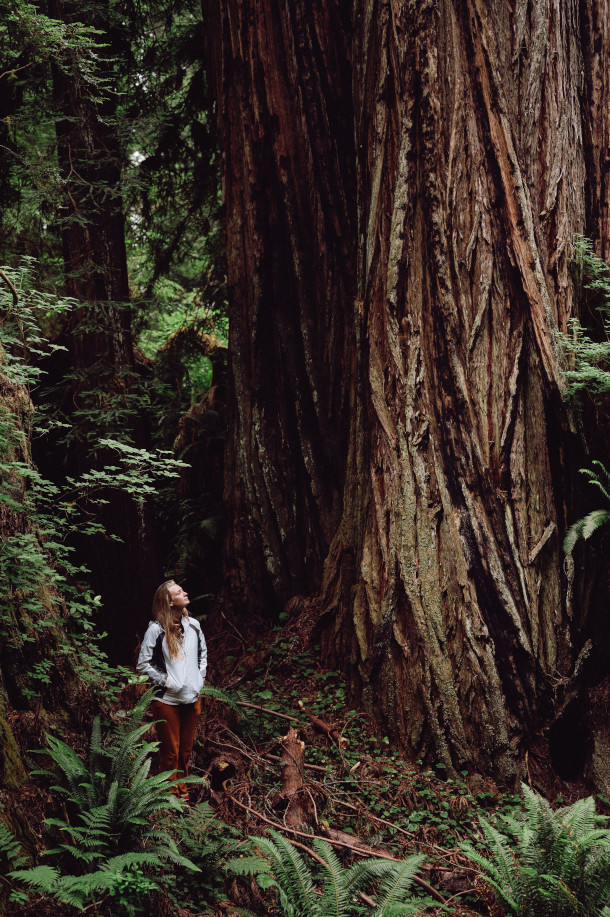
A woman stands next to giant redwoods in Orick, California. Many of these ancient trees can be found in the old-growth forest of Redwood National and State Parks, where they have stood for more than two millennia. (Photo by Alfo Medeiros on Pexels)
DOERING: So, when it comes to the history of this country and those stories, do you have a favorite park or two that you want to highlight?
SHAFROTH: Yeah, I do. Thanks for asking. Back in about 2011 I was lucky to take a trip with then Secretary of Interior Ken Salazar, and he and I were visiting Arkansas, and we were asking the governor of Arkansas at the time what kind of work could the Department of Interior do with its broad reach across parks and wildlife and public lands to support the vision that the governor and his people had for that state. And in the course of those conversations, we decided that we were going to go visit Little Rock Central High School, which was a park in Little Rock, Arkansas, and a national historic site, and we got to the visitor center and were greeted by a young woman who gave us an orientation and then said, "Well, my mom is here to take you on a tour," and her mother was Minnijean Brown. Minnijian was one of the Little Rock Nine who, in September of 1957, was taken by National Guard to basically forcefully integrate Little Rock Central High School, which had been mandated through Brown versus Board of Education in 1954. But it was the first real test case where the federal government was decided we're going to, the state officials and local officials were refusing to admit black students, and so it was an opportunity. So we, Secretary Salazar and I, took the walk with Minnijean Brown that she took in 1957. She described what it was like on that sidewalk and what the people were saying to her and how it felt as a 10th grader trying to just go to school. And it was, it was amazing. Just like you know, to see life through her eyes, it's just so something that we don't do very often or necessarily very well. So that was a very powerful experience for me, and really cemented, I've hadn't been back there since, but it's one of those memories that'll never leave me.

Minnijean Brown, standing at the far left of the front row, meets with New York City Mayor Robert Wagner (center) as he welcomes the Little Rock Nine teenagers in 1958, a year after they integrated Central High School, Little Rock, Arkansas. Pictured from left to right, front row, included Minnijean Brown, Elizabeth Eckford, Carlotta Walls, Mayor Robert Wagner, Thelma Mothershed, Gloria Ray; in the back row, are Terrence Roberts, Ernest Green, Melba Pattilo, Jefferson Thomas. (Photo: Walter Albertin, Wikimedia Commons, public domain)
DOERING: That's so powerful, and you know, I have to imagine, it just feels like these days we're spending so much time on our phones and screens, and in the digital space, and yet we're also seeing soaring visitors to the National Park System. What do you think the National Park System is sort of fulfilling within us this like hunger to get outside and experience these kinds of places for ourselves?
SHAFROTH: Well, it's interesting. All this talk about our 250th anniversary as a country, and a lot of what we're talking about is the notion of the pursuit of happiness: life, liberty, and the pursuit of happiness. And you think about our federal government. Who else is providing an ability to pursue happiness other than the National Park Service? I mean, it's kind of a profound thing. And why are 330 million people basically one visit per every citizen on average go to the national parks? People love these places. They experience them, and they're part of our DNA as a country. And people are all the time are kinda like I want to go put that on my bucket list and you know I want to go to this place because there is a, not only a long memory that we have of all the positive experiences we've had these places, but we read about them all the time and we see you know everything's being shared on Instagram these days and so people like wow I want to go with do what that person did and that's an amazing trail in Yosemite. Or I didn't know about that park. I mean, some of the lesser-known places in the park system are also equally interesting, and and yet maybe a little harder to get to. Maybe not as many visitors, but deeply profound if you're willing to make the effort to get there.
DOERING: Will Shafroth is the recently retired CEO of the National Park Foundation. Thank you so much, Will.
SHAFROTH: Thank you, Jenni, for having me.
DOERING: And you can find more stories from our ongoing “Exploring the Parks” series in the Living on Earth archives at loe dot org. We’ve covered North Cascades in Washington State, Sequoia and Kings Canyon in California, Petrified Forest in Arizona, and Great Smoky Mountains in North Carolina and Tennessee. And all the way up on the Alaska Peninsula, Aniakchak National Monument and Preserve, one of the least visited but most spectacular landscapes of all.
Related links:
- Visit the National Park Service website to learn more
- The Point Reyes National Seashore website
- The Voyageurs National Park website
- The Acadia National Park website
- The Redwood National Park website
- Be sure to visit Little Rock Central High School National Historic Site
- Learn about the National Park Foundation and its work
[MUSIC: High Desert Sky]
Loon in Fog
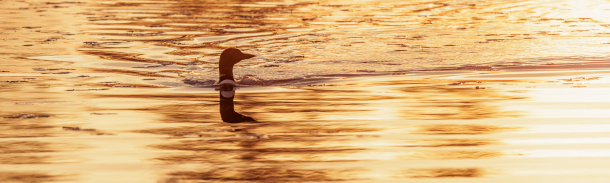
Loons make their home in the waters of Seney National Wildlife Refuge. (Photo: © Mark Seth Lender)
O’NEILL: Minnesota, which is home to Voyageurs National Park, has the most loons in the Lower 48. But you can find these birds in many lakes and wetlands throughout North America, including at the Seney National Wildlife Refuge in Michigan. That’s where Living on Earth Explorer in Residence, Mark Seth Lender spotted a pair one foggy morning.
Loon in Fog
Seney National Wildlife Refuge
© 2025 Mark Seth Lender
All Rights Reserved
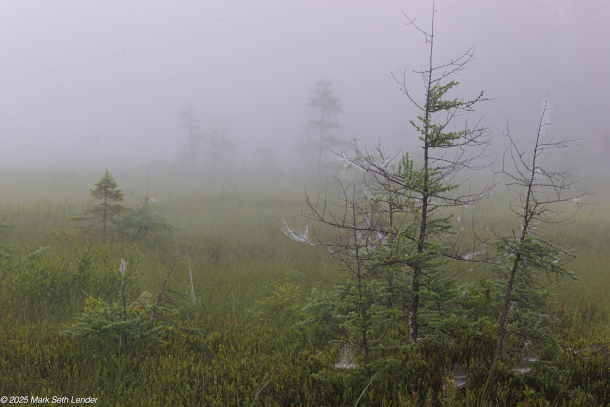
Strings of droplets trace the architecture of spiders in the morning fog. (Photo: © Mark Seth Lender)
LENDER: The hour cannot be tolled by the light. Fog has made its own time of day. A luminous magic gray. Within gray. And yet reveals. Loon. Asleep. Turning and turning in the eddy of the spillway as the ponds pour, each into the other. One above. One below. And the spider webs along the edges are aglow, the droplets gemlike on the strands. Like ripples stilled in place.
The quality of an ice storm on this the Longest Day.
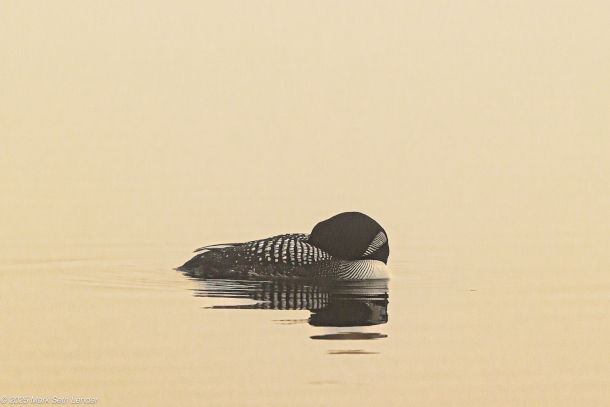
A sleeping loon rests and drifts on the water. (Photo: © Mark Seth Lender)
Loon wakes. To make a certainty of the safety promised here. And safe, tucks between the wings.
Not far, another Loon. Looking this way and that way. Seeking, and seeking. Not long and sunrise breaks. The colors of smoke, orange and gold and the water scored black by shadows. How the fog trembles in the arcade of light cast in a narrow column by the sun. Paddling through her path is straight. Will each of them find the other?
This is the thing discovered only in the wake made by Time.
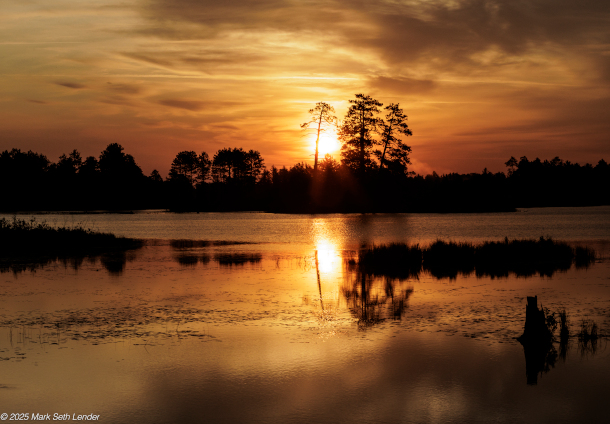
Sunrise arrives in orange and gold, a slow unfolding of light. (Photo: © Mark Seth Lender)
O’NEILL: That’s Living on Earth Explorer in Residence, Mark Seth Lender and you can find his beautiful pictures of loons on our website, LOE dot org.
[LOON CALL: Canadian Loons in family.wav by laurent -- https://freesound.org/s/163300/ -- License: Attribution NonCommercial 4.0]
O’NEILL: And this of course is the haunting call of the loon.
[LOON CALL: Canadian Loons in family.wav by laurent -- https://freesound.org/s/163300/ -- License: Attribution NonCommercial 4.0]
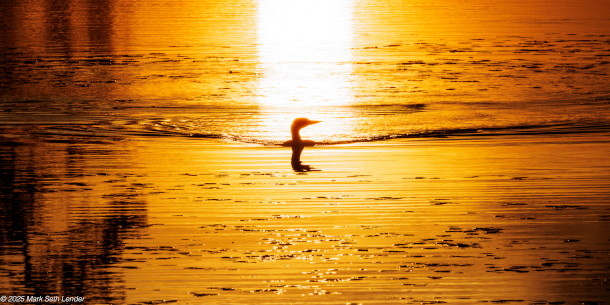
A loon paddles, carving ripples across a quiet pond at sunrise. (Photo: © Mark Seth Lender)
O’NEILL: Mated pairs of loons often make this far-reaching wail to communicate across long distances. Loons are also known for their territorial or warning “tremolo” call if you get too close to their chicks. Another name for it is the “crazy laugh.”
[LOON CALL: Canadian Loons in family.wav by laurent -- https://freesound.org/s/163300/ -- License: Attribution NonCommercial 4.0]
Related links:
- Visit Mark Seth Lender’s website here
- Learn more about the Seney National Wildlife Refuge
DOERING: Next time on Living on Earth, The author of Smog and Sunshine: the Surprising Story of How Los Angeles Cleaned Up Its Air.
CARLSON: Sunshine is one of our great assets, but it also turns out to be one of the big culprits in our problems with air pollution, and I should be clear that our problems with air pollution are not done. It's just that our air is vastly cleaner than it used to be. But here's what happens when hydrocarbons and other chemicals are emitted from things like cars and trucks and the smokestacks of factories. They interact with sunshine, and when they interact with sunshine, that actually creates ozone, and ozone pollution is the most persistent problem that Southern California has faced. And it was one of the big problems, though by no means the only big problem that was causing the terrible air quality that we experienced, really starting in the 1940 s and all the way into the 2000s.
DOERING: How California helped lead the country on addressing air pollution, next time on Living on Earth.
[MUSIC: Pacific Coast Highway]
O’NEILL: Living on Earth is produced by the World Media Foundation. Our crew includes Naomi Arenberg, Paloma Beltran, Mia DiLorenzo, Abby Edgecumbe, Swayam Gagneja, Mark Kausch, Mark Seth Lender, Don Lyman, Ashanti Mclean, Nhung Nguyen, Sophia Pandelidis, Jake Rego, Andrew Skerritt, Bella Smith, and El Wilson.
DOERING: Tom Tiger engineered our show. Allison Lirish Dean composed our themes.
Special thanks this week to the Seney National Wildlife Refuge. You can hear us anytime at L-O-E dot org, Apple Podcasts and YouTube Music, and like us please, on our Facebook page, Living on Earth. Find us on Instagram, Threads and BlueSky at Living on Earth radio. And we always welcome your feedback at comments at loe.org.
Steve Curwood is our Executive Producer. I’m Jenni Doering.
O’NEILL: And I’m Aynsley O’Neill. Thanks for listening!
ANNOUNCER: Funding for Living on Earth comes from you, our listeners, and from the University of Massachusetts, Boston, in association with its School for the Environment, developing the next generation of environmental leaders. And from the Grantham Foundation for the protection of the environment, supporting strategic communications and collaboration in solving the world’s most pressing environmental problems.
ANNOUNCER 2: PRX.
Living on Earth wants to hear from you!
Living on Earth
62 Calef Highway, Suite 212
Lee, NH 03861
Telephone: 617-287-4121
E-mail: comments@loe.org
Newsletter [Click here]
Donate to Living on Earth!
Living on Earth is an independent media program and relies entirely on contributions from listeners and institutions supporting public service. Please donate now to preserve an independent environmental voice.
NewsletterLiving on Earth offers a weekly delivery of the show's rundown to your mailbox. Sign up for our newsletter today!
 Sailors For The Sea: Be the change you want to sea.
 The Grantham Foundation for the Protection of the Environment: Committed to protecting and improving the health of the global environment.
 Contribute to Living on Earth and receive, as our gift to you, an archival print of one of Mark Seth Lender's extraordinary wildlife photographs. Follow the link to see Mark's current collection of photographs.
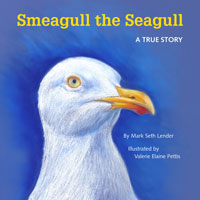 Buy a signed copy of Mark Seth Lender's book Smeagull the Seagull & support Living on Earth
© Copyright World Media Foundation. All Rights Reserved
Home | Contact | RSS | Donate | Newsletter