

National Parks Magic
Air Date: Week of July 17, 2026
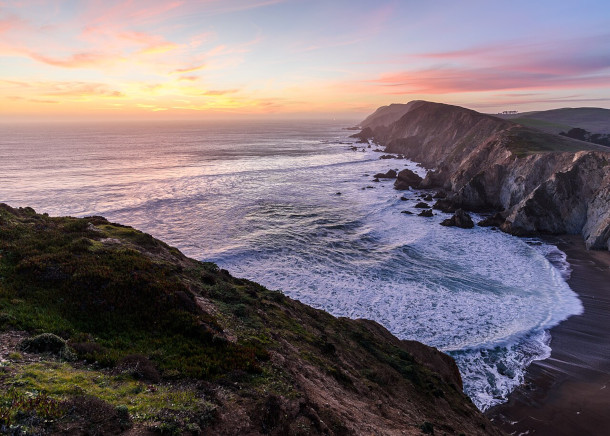
The Pacific Ocean hugs the rugged Point Reyes headlands, shown here from Chimney Rock Trail, Point Reyes National Seashore, California. (Photo: King of Hearts, Wikimedia Commons, CC BY-SA 4.0)
It’s peak summer travel season, and for many people traveling in the US that means a visit to a national park or monument. After all, "America's crown jewels” are ideal places to disconnect and reconnect with nature and our shared history. Will Shafroth, recently retired CEO of the National Park Foundation, takes a virtual road trip of sorts with Host Jenni Doering to share the magic of the national parks.
Transcript
O’NEILL: It’s Living on Earth, I’m Aynsley O’Neill
DOERING: And I’m Jenni Doering.
It’s peak summer travel season, and for many people traveling in the US that means a visit to a national park or monument. After all, "America's crown jewels” are ideal places to disconnect and reconnect with nature. To help us get inspired about the magic of national parks and take a virtual road trip of sorts, on the line now is Will Shafroth, recently retired CEO of the National Park Foundation. Welcome to Living on Earth Will!
SHAFROTH: Thanks, Jenni. Nice to be here.
DOERING: So you have an extensive career dedicated to protecting national parks and land across the U.S. and I understand that one of the places that really formed your love for nature is Point Reyes National Seashore in California, just up the coast from San Francisco. What makes Point Reyes so special?
SHAFROTH: Well, Jenni, it was an interesting time of life for me when I started discovering and exploring Point Reyes. I just graduated from high school and trying to figure out who I was as a young man, and my girlfriend and I would meet there every weekend in 1981 and early 82, and spend literally Friday, Saturday, Sunday night there. Sometimes more, but every weekend we're out exploring, hiking, biking, canoeing, kayaking, fishing, gathering clams, and hunting for wild berries and mushrooms, and doing all sorts of fun activities. And in the course of that time there, I really had a better understanding of who I was and what kind of impact I wanted to have in my life. There's a clarity that came with that, and sort of an evolution of my own being.
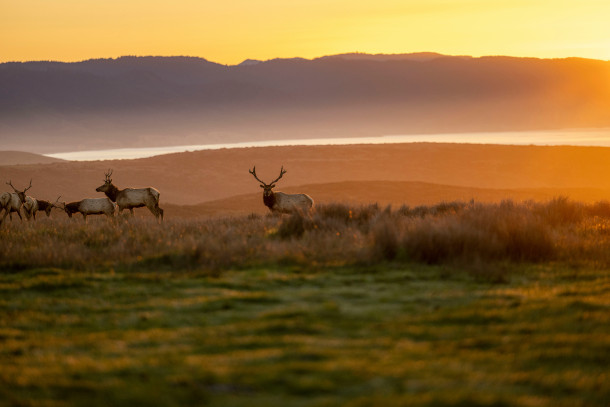
Tule elk, silhouetted against a vibrant orange sunset in Point Reyes landscape, are native to the state of California. (Photo: Leo_Visions on Unsplash)
DOERING: Hmm...and give us a sense of this place. It's a really rugged coast, right?
SHAFROTH: Yeah, it's a long bit of coast from Tomales Point and within Tomales Bay all the way down, where it meets up with portions of Golden Gate National Recreation Area closer to San Francisco. But there's also just a lot of the hills there — the redwood forest and the Douglas fir forest and the Jepson pine forest and just unbelievably wild country. And in a place, as you said, it's an hour and 15 minutes from San Francisco, and so you have access to that. And it's one of these places where, in a couple of minutes from parking your car and getting out and walking, you can be alone in quiet, connected to nature. There's a lot of wildlife in the area, hundreds of bird species. You're right on the coast, this intersection of coastal and kind of mountain range, and it's just a really special place where you know the awe and wonder of nature is present, and if you're open to it, it can have a profound effect on you.
DOERING: Yeah, you said wildlife. What kinds of wildlife encounters have you had in California?
SHAFROTH: One of the things I used to do in Point Reyes is I would, I was following the tides very closely. So I would like to fish something called a poke pole, which is a 10 foot long bamboo pole with a small bit of line at the end of it, and you'd have to basically climb down a cliff at 6:30 in the morning at the super low tides, which often happened in December. And my friend and I would arrive, and we'd walk across this field, usually in the dark, and we encountered the tule elk, which is an historic species of of elk that lives along the coast. And we could smell them. We could hear them. They were not a threat to us or we to them. But just walking among them, as the light was coming up, was one of the most powerful wildlife experiences I've ever had.
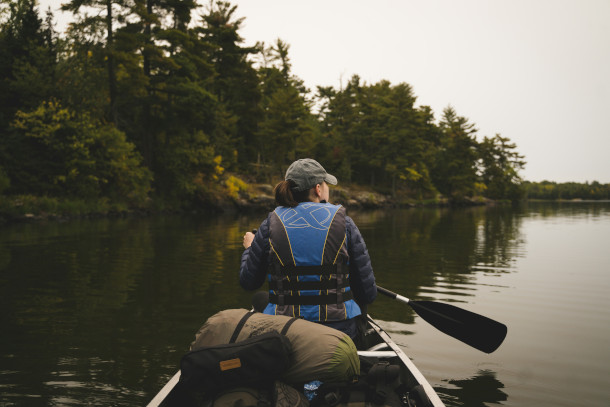
Voyageurs National Park in northern Minnesota is famous for its interconnected network of pristine lakes and rivers. It’s considered by many to be a great destination for camping and kayaking. (Photo by Tim Umphreys on Unsplash)
DOERING: Wow, they're big creatures, those elk.
SHAFROTH: They are. They're very big. But you know, in a way, they're docile. I'm sure they too can get yourself in trouble with them if you aren't paying attention, but really, really amazing creatures. And you know, also right off the coast, the whales are migrating. So you see the gray whales frequently spouting and moving their way up or down coast.
DOERING: So we're on this road trip, imaginary road trip, and and we're heading across the U.S. west to east. And I think the next stop on this cross-country road trip with you is the Midwest. So we've got this national park in Minnesota, Voyageurs National Park. What should we know before we visit Voyageurs?
SHAFROTH: A lot of people in the country have heard of something called the Boundary Waters Canoe Area Wilderness, which is U.S. Forest Service managed land, and it's right along the Minnesota Canadian border, and it abuts Quetico State Provincial Park. It's called Provincial Park, and and it's it's on the other side of the border. So they really connected. Voyageurs National Park is just to the west of that. It's the same land and water scape. It's right along the border, which just happens to be an area that was set aside at a different time, and and is managed by the National Park Service instead. So, I learned about it in about 2011. My friend and I had been going to Voyageurs and and Quetico prior to that on a regular basis, and then we took a, since I was working for the Secretary of the Interior and I felt the Park Service is kind of part of my portfolio, I better go visit this place, and you know it's a little more work to get into places like these, Jenni. You have to like get yourself across a big lake. You have to hike three and a half miles with all your gear. You have to then paddle for 12 miles to your campsite. This is not something you just kind of pull up and set up, pitch your tent. It takes a lot of work, and then therefore you're in there for a week, and it takes a lot of preparation, the food and the clothing and the camping and sleeping gear and all that kind of stuff. So once you're in there, though, it is kind of unbelievable. You're by yourself. There's one campsite per lake, and each of the lakes is like two or three miles long and half a mile across. And so you're really out there by yourself. You can hike into other lakes and fish or explore, or whatever, but it's a pretty remarkably remote place. And again, the quiet, the sounds of coyotes, seeing moose in the area, and seeing evidence of wolves, pretty powerful.
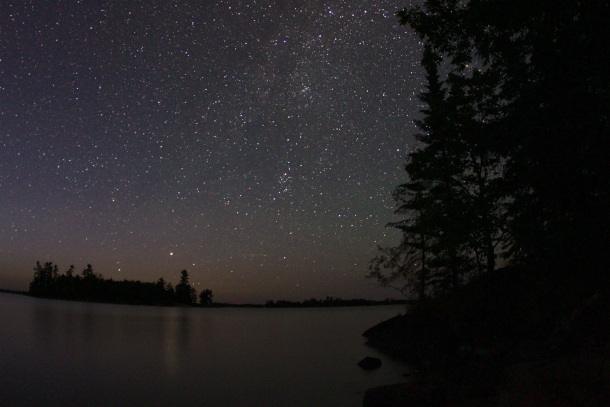
Stars blanket the night sky over Voyageurs National Park, Minnesota. (Photo: daveynin on Flickr, CC BY-NC 2.0)
DOERING: Wow! And those dark skies, I imagine, not so much light pollution out there.
SHAFROTH: Exactly, like the stars are unbelievable, and most of the time, it's not raining, and so we are able to kind of have our tent flies off and be able to lie in our tents at night and look up and see the stars, and it's pretty magical experience. The only hesitation is certain times of the year the mosquitoes can do pretty bad. It is the official state bird of Minnesota, supposedly, so you know.
DOERING: So you'll get eaten alive, but you'll have an amazing time while you're doing it.
SHAFROTH: Just go a little later in the season, and the bugs are pretty much gone by then, or they're just around for half an hour and cover up during that time. But it's a remarkable place, and you know, there aren't many places like that in our country that are that wild.
DOERING: You mentioned coyotes, even wolves. Any other wildlife memories from Voyageurs?
SHAFROTH: Yeah, maybe the most powerful one is the call of the loon. And in these lakes, there's usually a nesting pair of loons raising a chick or two at a time. And so every day, early in the morning, between four and six, they'll start calling, and in the evenings often, and it's a very hauntingly beautiful call that they have, and so that's a very important part of the memory. And they get pretty close; they're not too shy, and they're quite strikingly beautiful birds too.
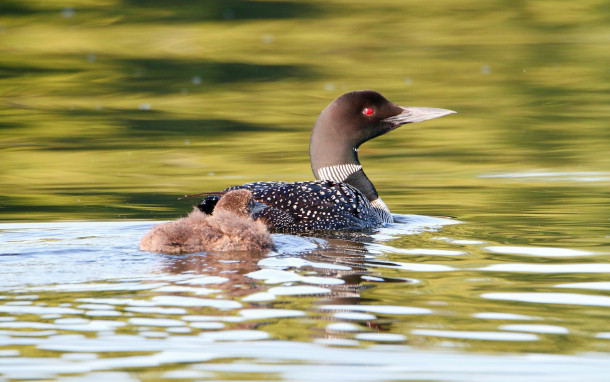
Here, an adult loon leads its chick through calm water near Walker, Minnesota. Loons are known for their haunting calls, which drift across Minnesota's lakes. (Photo by Paul Crook on Unsplash)
DOERING: Alright, so it sounds like we could spend a lot of time in Voyageurs just enjoying the wild there, but if we do want to keep heading east on this road trip and go pretty much as far east as you can go in the U.S. and not too far from the Living on Earth studios here in Boston, we have Acadia National Park up in Maine. I have been there. It is such a special place. What does it feel like for you to be there, and what do you think visitors can experience?
SHAFROTH: Well, one of the things I love about the national parks is that they're also different. You heard about my love of Point Reyes, but going to Acadia is extremely different than that. And yet, it's coastal, but the main coast is it's more east-west there than it is north-south, and so you're getting a different kind of exposure. The light's different. The currents are different. You know, it's it's outside the Gulf Stream, so the water's a lot colder than it might be in other places like in Cape Cod, just to the south of there, and it's just such a spectacularly beautiful place. I think the Park Service has done a really nice job of integrating recreation like biking and hiking into a pretty wild landscape, and so you can get on the carriage roads, which are historic in their own right, and so they tell a story of a different time in America as well, and integrate people's visitation with that kind of thing. There's also good hiking, Cadillac Mountain, and Cadillac Mountain is both for hikers as well as drivers, and there's a throng of people every day to see the sunset and the throng of people every day to see the sunrise, that is one of the more amazing visual experiences you can have, and it's also you see how that kind of visual is something that we human beings share, the magic of it, just the light coming up, and there's something deeply connective about that that people appreciate. So there's that, and then but you know that's sort of on the the main part around Bar Harbor. But there's a whole another place called Schoodic Peninsula where the Park Service also has significant science center there, a different campground, and it brings a much more wild experience. Hiking there is very few people. The coastline is a little more rugged and underpopulated, so they offer a lot of different things. It's pretty cool.
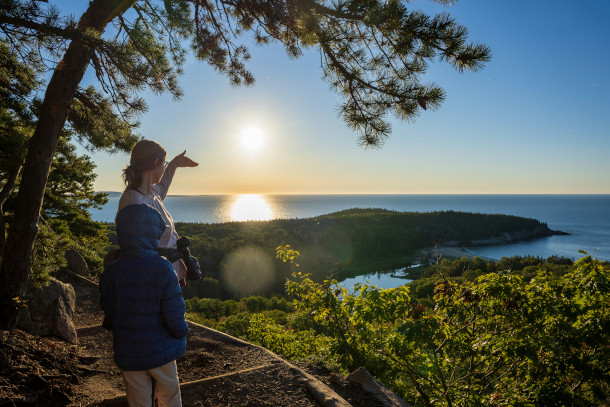
A family pauses along The Beehive Trail to catch a view of the Atlantic and a rising sun from in Acadia National Park. (Photo by Mike Burke on Unsplash)
DOERING: Yeah, I've actually camped at Schoodic Peninsula, and it was one of the best campgrounds I've ever camped at. It was just really nice facilities and beautiful skies at night. Just really quiet, really nice.
SHAFROTH: Well, the other thing about Schoodic is that campground. I've been there too, that was a campground that the National Park Foundation was actually deeply involved with creating, and it was through the donation of a family that made that happen. That they decided they wanted to make a meaningful contribution to that park and provided state-of-the-art camping facilities for people, both who wanted a wilder experience, hiking, you know, walk-in campsites, but also places where people can hook up their RVs, and you know, have a shower and a bathroom close at hand.
DOERING: So, as the recently retired CEO of the National Park Foundation, Will, why do you think people should visit national parks and take advantage of this resource?
SHAFROTH: Well, I can share that from a personal perspective as well as more broadly. I think from a personal perspective, it's just that it's one of the places that I have found to be most enjoyable and most inspirational in my life. I've also we took our kids to national parks throughout their lives, and it was maybe the best family time that we had. We're all sharing in something that is kind of bigger than all of us, and in terms of the awe and wonder of nature and the magnificence of what we're seeing, and just like sitting at the beach at the just on the edge of Redwood National Park and seeing these 2,500-year-old trees behind us and this incredible ocean in front of us, and just having our kids understand their part in a broader world. Pretty powerful stuff, and you look for those things as parents to try to contribute to your children in that way, and have them take that into their own lives going forward. The part that we really haven't talked much about, Jenni, is really the other aspect of the national parks. Traditionally, people think of these places that are geologically interesting or have natural beauty associated with them, or amazing recreational opportunities, hiking and climbing, and whatever. But more than half of the national park sites are actually about our history and culture. It's about telling America's story, and so the other part of the wonder of these places is that you can learn so much about our nation's history and the people, places, and events that really shaped who we are as a country.
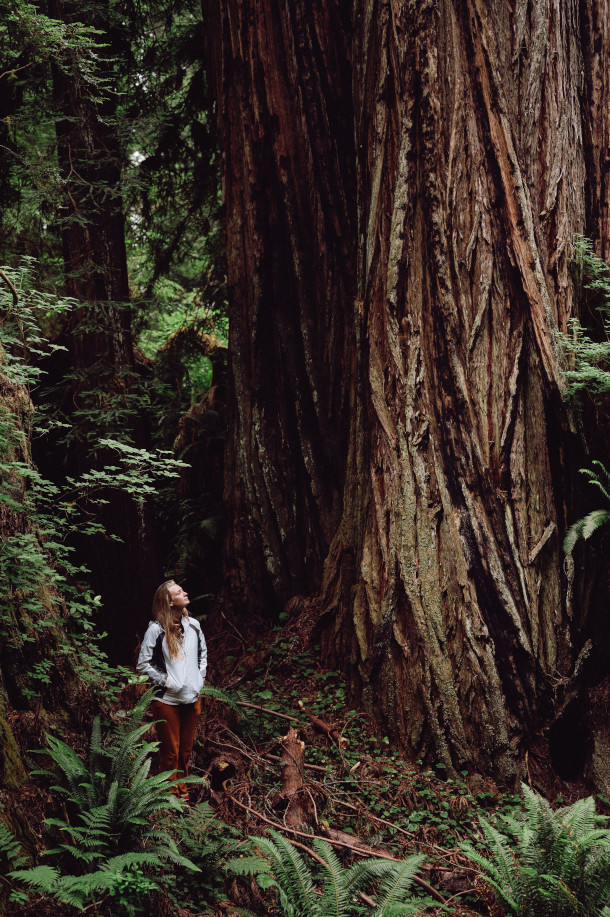
A woman stands next to giant redwoods in Orick, California. Many of these ancient trees can be found in the old-growth forest of Redwood National and State Parks, where they have stood for more than two millennia. (Photo by Alfo Medeiros on Pexels)
DOERING: So, when it comes to the history of this country and those stories, do you have a favorite park or two that you want to highlight?
SHAFROTH: Yeah, I do. Thanks for asking. Back in about 2011 I was lucky to take a trip with then Secretary of Interior Ken Salazar, and he and I were visiting Arkansas, and we were asking the governor of Arkansas at the time what kind of work could the Department of Interior do with its broad reach across parks and wildlife and public lands to support the vision that the governor and his people had for that state. And in the course of those conversations, we decided that we were going to go visit Little Rock Central High School, which was a park in Little Rock, Arkansas, and a national historic site, and we got to the visitor center and were greeted by a young woman who gave us an orientation and then said, "Well, my mom is here to take you on a tour," and her mother was Minnijean Brown. Minnijian was one of the Little Rock Nine who, in September of 1957, was taken by National Guard to basically forcefully integrate Little Rock Central High School, which had been mandated through Brown versus Board of Education in 1954. But it was the first real test case where the federal government was decided we're going to, the state officials and local officials were refusing to admit black students, and so it was an opportunity. So we, Secretary Salazar and I, took the walk with Minnijean Brown that she took in 1957. She described what it was like on that sidewalk and what the people were saying to her and how it felt as a 10th grader trying to just go to school. And it was, it was amazing. Just like you know, to see life through her eyes, it's just so something that we don't do very often or necessarily very well. So that was a very powerful experience for me, and really cemented, I've hadn't been back there since, but it's one of those memories that'll never leave me.

Minnijean Brown, standing at the far left of the front row, meets with New York City Mayor Robert Wagner (center) as he welcomes the Little Rock Nine teenagers in 1958, a year after they integrated Central High School, Little Rock, Arkansas. Pictured from left to right, front row, included Minnijean Brown, Elizabeth Eckford, Carlotta Walls, Mayor Robert Wagner, Thelma Mothershed, Gloria Ray; in the back row, are Terrence Roberts, Ernest Green, Melba Pattilo, Jefferson Thomas. (Photo: Walter Albertin, Wikimedia Commons, public domain)
DOERING: That's so powerful, and you know, I have to imagine, it just feels like these days we're spending so much time on our phones and screens, and in the digital space, and yet we're also seeing soaring visitors to the National Park System. What do you think the National Park System is sort of fulfilling within us this like hunger to get outside and experience these kinds of places for ourselves?
SHAFROTH: Well, it's interesting. All this talk about our 250th anniversary as a country, and a lot of what we're talking about is the notion of the pursuit of happiness: life, liberty, and the pursuit of happiness. And you think about our federal government. Who else is providing an ability to pursue happiness other than the National Park Service? I mean, it's kind of a profound thing. And why are 330 million people basically one visit per every citizen on average go to the national parks? People love these places. They experience them, and they're part of our DNA as a country. And people are all the time are kinda like I want to go put that on my bucket list and you know I want to go to this place because there is a, not only a long memory that we have of all the positive experiences we've had these places, but we read about them all the time and we see you know everything's being shared on Instagram these days and so people like wow I want to go with do what that person did and that's an amazing trail in Yosemite. Or I didn't know about that park. I mean, some of the lesser-known places in the park system are also equally interesting, and and yet maybe a little harder to get to. Maybe not as many visitors, but deeply profound if you're willing to make the effort to get there.
DOERING: Will Shafroth is the recently retired CEO of the National Park Foundation. Thank you so much, Will.
SHAFROTH: Thank you, Jenni, for having me.
DOERING: And you can find more stories from our ongoing “Exploring the Parks” series in the Living on Earth archives at loe dot org. We’ve covered North Cascades in Washington State, Sequoia and Kings Canyon in California, Petrified Forest in Arizona, and Great Smoky Mountains in North Carolina and Tennessee. And all the way up on the Alaska Peninsula, Aniakchak National Monument and Preserve, one of the least visited but most spectacular landscapes of all.
Links
Visit the National Park Service website to learn more
The Point Reyes National Seashore website
The Voyageurs National Park website
The Acadia National Park website
The Redwood National Park website
Be sure to visit Little Rock Central High School National Historic Site
Living on Earth wants to hear from you!
Living on Earth
62 Calef Highway, Suite 212
Lee, NH 03861
Telephone: 617-287-4121
E-mail: comments@loe.org
Newsletter [Click here]
Donate to Living on Earth!
Living on Earth is an independent media program and relies entirely on contributions from listeners and institutions supporting public service. Please donate now to preserve an independent environmental voice.
NewsletterLiving on Earth offers a weekly delivery of the show's rundown to your mailbox. Sign up for our newsletter today!
 Sailors For The Sea: Be the change you want to sea.
 The Grantham Foundation for the Protection of the Environment: Committed to protecting and improving the health of the global environment.
 Contribute to Living on Earth and receive, as our gift to you, an archival print of one of Mark Seth Lender's extraordinary wildlife photographs. Follow the link to see Mark's current collection of photographs.
 Buy a signed copy of Mark Seth Lender's book Smeagull the Seagull & support Living on Earth
© Copyright World Media Foundation. All Rights Reserved
Home | Contact | RSS | Donate | Newsletter