
The Problem with Plastic
Air Date: Week of July 17, 2026
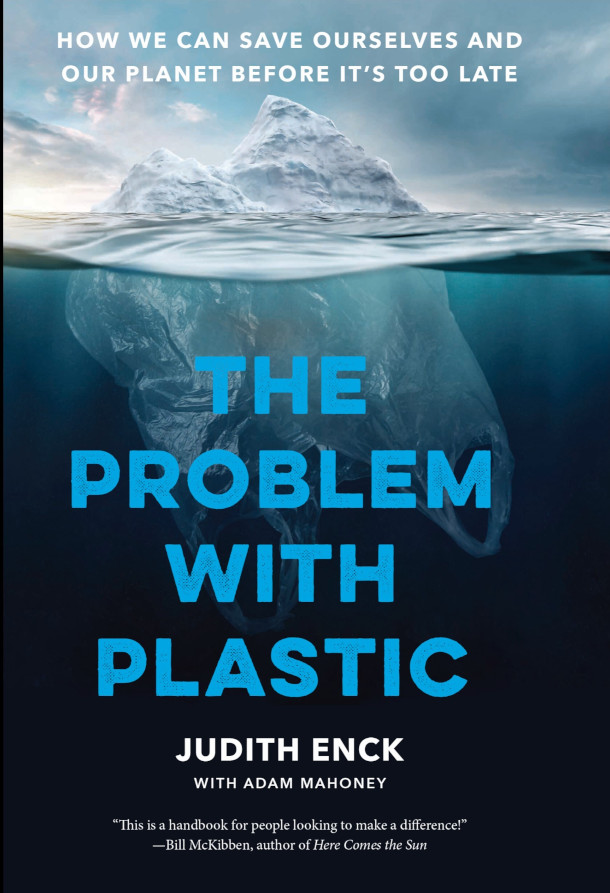
Judith Enck’s latest book, The Problem with Plastic: How We Can Save Ourselves and Our Planet Before It’s Too Late. (Photo: Beyond Plastics)
Cheap and convenient plastic products are everywhere you turn, and the microplastics they break down to are now in our water, soil, air, and deep inside our bodies. Joining Living on Earth’s Paloma Beltran to discuss her 2025 book The Problem with Plastic: How We Can Save Ourselves and Our Planet Before It’s Too Late is Judith Enck, a former EPA Regional Administrator and the founder and President of the advocacy group Beyond Plastics.
Transcript
DOERING: It’s Living on Earth, I’m Jenni Doering
O’NEILL: And I’m Aynsley O’Neill.
After World War II plastics grew from a cheap wartime alternative to a staple in the American home. From Tupperware to disposable water bottles and children’s toys, plastic waste began to pile up, and the companies making these products saw huge profits. Groups concerned about the proliferation of plastics have been encouraged by single-use plastic bans, and producer responsibility programs. But there’s still a long way to go, and the negotiations for a United Nations plastics treaty have hit roadblocks.
And plastics linger in our ecosystems and our bodies long after they’re produced.
Tiny pieces of plastic have been found in every corner of the world, trapped in Antarctic ice and floating in coral reefs. Judith Enck is a former EPA Regional Administrator and the founder and President of the advocacy group Beyond Plastics. Her latest book is The Problem with Plastic: How We Can Save Ourselves and Our Planet Before It’s Too Late, and she spoke with Living on Earth’s Paloma Beltran.
BELTRAN: Judith, you know it can sometimes feel as though there are endless environmental challenges today. You know, air pollution, extreme heat, et cetera. In your view, why is plastic an issue worth championing?
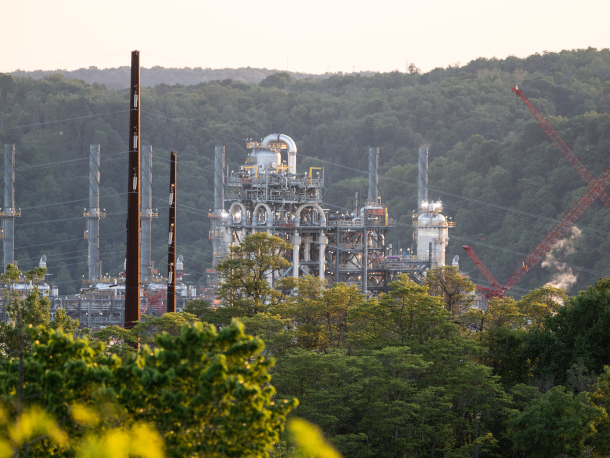
Plastics are emerging as a “plan B” for fossil fuel companies to continue production despite increased growth in electric transportation and renewable energy. Above, a Shell-owned ethylene cracker plant in Pennsylvania. (Photo: Mark Dixon, Wikimedia Commons, CC BY 2.0)
ENCK: Well, it touches so many environmental and public health issues all at once. So, if we can make progress and actually reduce the production of some plastic, it will help our climate. It will improve the ocean, not having so much plastic waste in the ocean. It will help environmental justice communities where plastics are produced. It will improve our own health because of the large amounts of microplastics being found in different parts of the human body. It will save taxpayer dollars, and in general, bring us a cleaner and safer environment for our kids and grandchildren. So, you know, this touches so many different issues that I've worked on throughout my long career in environmental protection. It's not just one thing. And each of these things, you know, health, climate change, environmental justice. Each of those things deserve a book all by themselves. The plastics impact of these things, but we try to fold it all together in one readable, conversational sort of book, and just to kind of whet people's appetite on if they want to go a little deeper on whatever interests them the most.
BELTRAN: Definitely, it's a great guide for anyone who wants to learn more about plastics, plastic pollution, and what they can do about it. And in your book, you note that plastic production accounts for one sixth of global carbon dioxide emissions. Where in the plastic life cycle do these emissions come from?
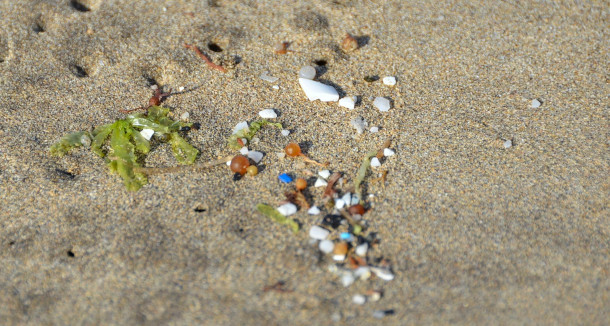
Microplastics, or pieces of plastic less than five millimeters long, are especially harmful to humans and animals when ingested. Enck says traces of microplastics have been found in human lungs, kidneys, and even breast milk. (Photo: Emina Mamaca, Wikimedia Commons, CC BY 4.0)
ENCK: Well, every step of the plastic life cycle: production, use, and disposal. So production, we've got these giant ethane cracker facilities where plastics are produced, emitting greenhouse gasses into the environment. And because only five to six percent of plastics actually get recycled, that means most of it is going to incinerators where you get a lot of air pollution when plastic is burned, or landfills, or it is released in the marine environment, and there's even some greenhouse gas emissions from plastics in the ocean, and so this is a serious climate change issue that I don't think has been fully appreciated by policymakers.
BELTRAN: Now, of course, plastics are made from petrochemicals. How are oil and gas companies profiting from our dependence on plastics?
ENCK: Well, the largest plastic manufacturer in the United States today is Exxon Mobil. So, what happened, I believe, a number of years ago, is fossil fuel companies like Chevron and Shell and Exxon Mobil saw that their market was changing. Historically, they sold fossil fuel to power cars and trucks, and what's going on in that sector? We're finally seeing electric vehicles, electric school busses, etc. The other big market for fossil fuels is electricity generation, and while it's slow going, we are finally seeing progress with solar and wind and geothermal and innovation on energy efficiency. You know, the refrigerator you buy today is significantly more efficient than a refrigerator you bought 10 years ago. So the big guys and gals at fossil fuel companies decided, without checking with any of us, that plastic was going to be their growth area. So we are seeing plastics emerge as plan B for the fossil fuel industry, and companies are making a lot of money manufacturing plastic, and we're paying for it with our health and damage to our ecology.
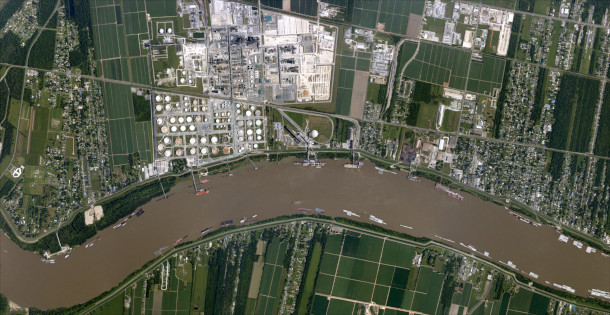
Satellite imagery of Cancer Alley in Louisiana shows the high concentration of plastic and petrochemical manufacturing facilities along the Mississippi River. (Photo: NOAA, Wikimedia Commons, Public Domain)
BELTRAN: Yeah, plastic doesn't just affect the environment, it also impacts human health. And recently, there's been a lot of discussion about microplastics. What exactly are microplastics, and how do they affect our human body?
ENCK: Microplastics are tiny pieces of plastic that are five millimeters or less, so kind of the size of a grain of sand, and we breathe in microplastics. We also swallow microplastics. Those are the two major ways that microplastics get into our bodies. So you might be opening a container of yogurt or hummus, and it has like a little plastic layer on the top. Some of that plastic will be in the form of a microplastic that gets sprinkled into your yogurt or your hummus, or you may be turning the bottle cap of a plastic soda bottle. The abrasion of turning the bottle cap can result in small amounts of microplastic getting into your soda or your water. So some of the microplastics that get into our bodies, we excrete some of it, but not all of it. And just in the last few years, we're seeing more and more peer-reviewed scientific papers documenting the presence of microplastics in our blood, which means it's circulating throughout our body. Microplastics have been found in human lungs, kidneys, liver, the human placenta, both the fetal side and the maternal side. So our babies are being born pre-polluted. Microplastics have been found in breast milk, in human testicles, and for years the plastics industry was saying, "Oh, there's no evidence that it causes harm to us." They can no longer honestly say that because of two studies that came out last year, one by the New England Journal of Medicine, one of the most well-respected medical journals in the world, identified microplastics in the arteries in our necks, and it attaches to plaque. And if you have microplastic attaching to plaque, unfortunately, you have an increased risk of stroke, heart attack, or premature death. And then a big study that we were waiting on for a long time was published last year, that looked at, do microplastics cross the blood-brain barrier, and unfortunately the conclusion was yes, and when that happens, we have an increased risk of Alzheimer's disease and neurological diseases. So this is quite a serious health issue for all of us. But I do want to bring us back to where plastics are produced, because it's an even more serious issue if you live in Texas, Louisiana, or Appalachia, where you have a concentration of plastic production facilities. There is an area, I think Paloma, you and I have spoken about this before. There is an area in Louisiana known as Cancer Alley.
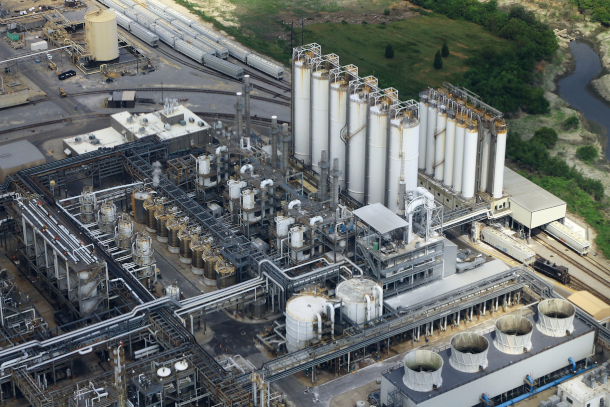
Enck highlights many women who take a stand against plastics in her book. Sharon Lavigne, for example, is fighting to stop the construction of a Formosa Plastics plant (like the one above in East Baton Rouge Parish, Louisiana) near her home. (Photo: Formula None, Wikimedia Commons, CC BY-SA 2.0)
BELTRAN: Yeah.
ENCK: 85 miles along the Mississippi River between Baton Rouge and New Orleans, where you have a large concentration of plastic and petrochemical manufacturing facilities. Johns Hopkins recently did a study and identified the cancer risk in Cancer Alley, Louisiana, is seven times the national average.
BELTRAN: Incredible, yeah.
ENCK: So people are paying for all of this plastic with their health.
BELTRAN: Definitely. And for people who have not had the chance to visit Cancer Alley or did not know about it, when you step out from your vehicle and out into the Cancer Alley world, you smell the chemicals in the air, and you look at the fumes coming out from these petrochemical facilities, and it's evident that the communities in Louisiana in this Cancer Alley region are constantly exposed to toxic chemicals.
ENCK: Yeah, 24/7 and people have lived there for decades. And I've had people say to me, "Well, why don't people just move?" Well, well, it's not easy to move. You don't always have the resources to move. You don't want to leave your job. You don't want to leave your families. And I think the question is, why don't these plastic production facilities move? They are environmental and health menaces, and we don't have strong enforcement of environmental laws ever from the state agencies in Louisiana or Texas, and now during the Trump administration, my former agency, the EPA, is MIA on enforcing environmental laws. And so these residents that are living near these facilities are breathing in carcinogenic chemicals. Their drinking water is compromised, and it's really quite unconscionable that in 2026 we've got seven times the cancer rate because of petrochemical production, just totally, totally unethical.
BELTRAN: Judith, what factors make a community more vulnerable to the harms of plastic pollution?
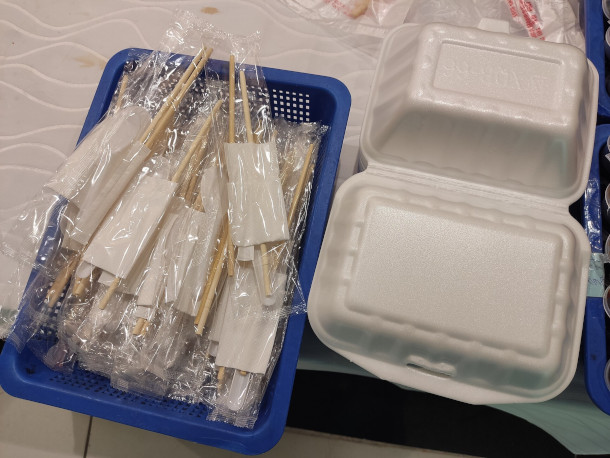
Another anti-plastics champion is Debbie Lee Cohen, a mother who worked to ban styrofoam trays from New York City public schools. (Photo: Gurgaon Anmuyto, Wikimedia Commons, CC BY-SA 4.0)
ENCK: I think you're going to see plastic production facilities that are historically very polluting in either low-income neighborhoods or communities of color, or both, because so much pollution is produced, it would not be acceptable in more affluent communities. You know, you don't see Scarsdale in Westchester County or Beverly Hills in California, having to deal with the pollution from any kind of facility. So your health outcome is very much determined by your zip code, and I think a lot of the big companies look for marginalized communities. They purposely look at where are their existing polluting facilities, so you have a clustering effect, and then people are being damaged by the cumulative impacts of all of this pollution. And I think companies look for communities that they perceive do not have political power, but that's where I think they're making a mistake. In our book, The Problem with Plastic, we profile a number of women who are on the front lines, protecting their families and their communities from plastic pollution. Women like Sharon Lavigne, the founder of Rise Saint James in Saint James Parish, Louisiana, where she's already defeated a major plastic production proposal from Formosa Plastics, one of the largest plastic makers in the world, and now there's another Formosa Plastics proposal like two miles from her house. Sharon's a retired special ed teacher. She has six children, has lived in Louisiana her whole life, and she is taking on this multinational company, and she's winning. The book also profiles Diane Wilson, a fourth-generation shrimper in Texas, who by coincidence is also taking on Formosa Plastics and Dow Chemical because of little tiny pre-production pellets known as nurdles being released in the bay where she gains her livelihood. And then we also profile an amazing woman, Debbie Lee Cohen, a mom from New York City, who doesn't live in Cancer Alley in Louisiana, she doesn't live on the Gulf Coast in Texas, but her two little girls were going to New York City public school, and she was appalled to see that their hot lunches were being served on polystyrene food trays. The food was being put directly on the polystyrene trays. And so she mobilized with other parents and convinced the largest school district in the country, the New York City public school system, to stop using polystyrene trays in school cafeterias. And then tragically, recently Debbie Lee Cohen died from cancer. But her legacy is she got plastic trays out of her kids' schools, benefiting millions of school kids. But she also founded this feisty little nonprofit called Cafeteria Culture, where they work with schoolchildren in low-income school districts in New York City to get plastics out of their schools.
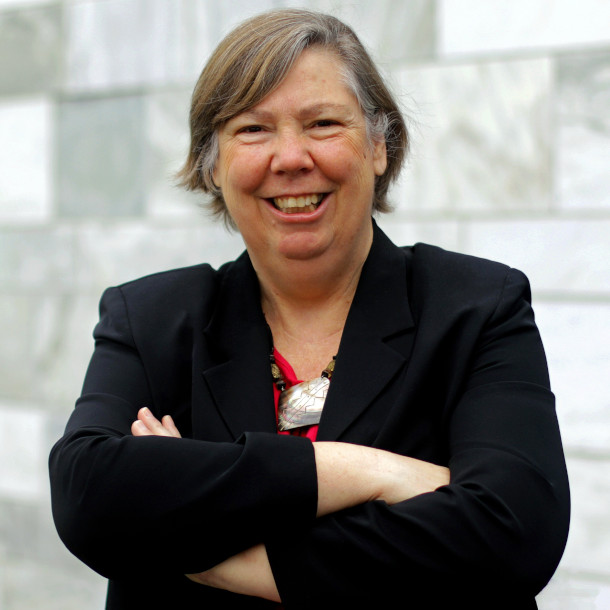
Judith Enck is the founder and President of Beyond Plastics, a nonprofit dedicated to ending plastic pollution. (Photo: Beyond Plastics)
BELTRAN: What a great legacy she left behind.
ENCK: She really did. She is missed. She and her colleagues at Cafeteria Culture produced a film that is so uplifting. It's called "Microplastic Madness." You can get it on the Cafeteria Culture website. Whenever I'm feeling a little blue about the lack of progress on this issue, which sometimes can be hourly, I just go on the Cafeteria Culture website and watch the trailer for "Microplastic Madness." It's really inspiring.
O’NEILL: That’s Judith Enck, former EPA Regional Administrator and the founder and President of Beyond Plastics. Her latest book is The Problem with Plastic: How We Can Save Ourselves and Our Planet Before It’s Too Late, and she spoke with Living on Earth’s Paloma Beltran.
Links
Learn more about Judith Enck and Beyond Plastics
Watch the Cafeteria Culture documentary Microplastic Madness
Living on Earth wants to hear from you!
Living on Earth
62 Calef Highway, Suite 212
Lee, NH 03861
Telephone: 617-287-4121
E-mail: comments@loe.org
Newsletter [Click here]
Donate to Living on Earth!
Living on Earth is an independent media program and relies entirely on contributions from listeners and institutions supporting public service. Please donate now to preserve an independent environmental voice.
NewsletterLiving on Earth offers a weekly delivery of the show's rundown to your mailbox. Sign up for our newsletter today!
 Sailors For The Sea: Be the change you want to sea.
 The Grantham Foundation for the Protection of the Environment: Committed to protecting and improving the health of the global environment.
 Contribute to Living on Earth and receive, as our gift to you, an archival print of one of Mark Seth Lender's extraordinary wildlife photographs. Follow the link to see Mark's current collection of photographs.
 Buy a signed copy of Mark Seth Lender's book Smeagull the Seagull & support Living on Earth
© Copyright World Media Foundation. All Rights Reserved
Home | Contact | RSS | Donate | Newsletter