
July 10, 2026
Air Date: July 10, 2026
FULL SHOW
SEGMENTS
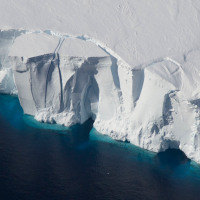
Antarctic Ice Missing
View the page for this story
Midsummer in the Northern hemisphere marks the dead of winter in Antarctica, usually a time when temperatures plunge and the surrounding ocean ices over, nearly doubling the continent’s size. But this June, scientists found Antarctica’s west coast was missing a chunk of sea ice the size of France. Ted Scambos, a Senior Research Scientist at the University of Colorado Boulder, speaks with Host Aynsley O’Neill about how unusually warm ocean water is affecting sea ice as well as massive Antarctic glaciers. (10:40)
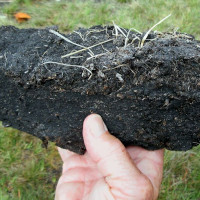
Arctic Peatlands Expanding
View the page for this story
Recent findings that peatlands are expanding northward as the Arctic warms might sound like good news, since peat has powerful carbon storage capabilities. But it takes millennia for peat to sequester large amounts of carbon, while we are burning fossil fuels far more quickly than the Earth can absorb. One of the authors of the 2026 study on Arctic peatland expansion is Angela Gallego-Sala, a professor and biogeochemist at the University of Exeter in the UK, who talked with Living on Earth’s Jenni Doering about what changes in peatland distribution could mean for the climate. (11:21)
A Bend in the Creek
/ Don LymanView the page for this story
The long days of summer and freedom from school bring some kids the chance to explore the outdoors, sometimes with wildlife encounters. Living on Earth’s Don Lyman shares one of those memories from his boyhood and how it took on a new dimension later in life. (06:07)
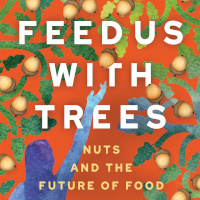
Nuts to Feed the World
View the page for this story
Much of the world’s staple crops of corn, wheat, rice and soy are grown in huge monocultures that disrupt ecosystems and require massive amounts of fertilizer, pesticides, fossil fuels and water. In her book Feed Us with Trees: Nuts and the Future of Food, Elspeth Hay offers a more sustainable vision of food production. She joins Host Paloma Beltran to share how nut trees can offer alternative sources of starch, protein and healthy fats that integrate well into local ecosystems and can help feed a growing population. (17:55)
Show Credits and Funders
Show Transcript
260710 Transcript
HOSTS: Paloma Beltran, Aynsley O’Neill
GUESTS: Elspeth Hay, Angela Gallego Sala, Ted Scambos
REPORTERS: Don Lyman
[THEME]
O’NEILL: From PRX – this is Living on Earth.
[THEME]
O’NEILL: I’m Aynsley O’Neill.
BELTRAN: And I’m Paloma Beltran.
Rediscovering the power of nut trees to help sustainably feed the world.
HAY: Ever since the end of the last ice age in the Northern hemisphere, these trees have been staple foods in North America, in Europe, in Asia, Northern Africa, the Mediterranean, the Middle East, this incredible range of cultures.
O’NEILL: Also, peatlands appear to be expanding as the Arctic rapidly warms.
GALLEGO-SALA: Peatlands are fascinating ecosystems. They happen all over the world, from the poles to the tropics, and basically, they are very wet ecosystems that, because of being wet, they store a lot of carbon on the soil.
O’NEILL: Those stories and more, this week on Living on Earth. Stick around!
[NEWSBREAK MUSIC: Boards Of Canada “Zoetrope” from “In A Beautiful Place Out In The Country” (Warp Records 2000)]
[THEME]
Antarctic Ice Missing
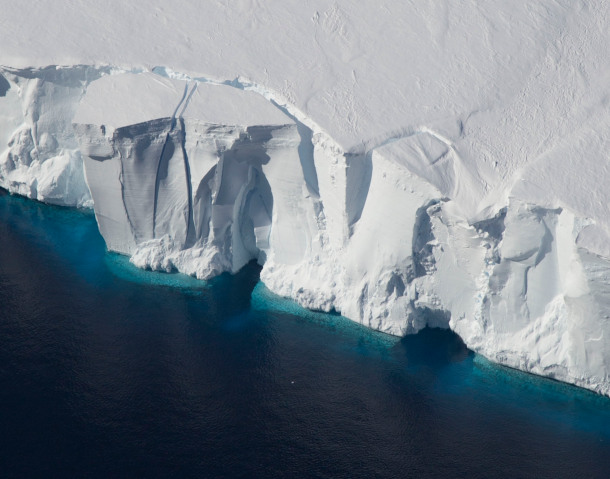
Antarctica’s west coast is missing an area of sea ice the size of France, experts report. Shown above is iceberg calving off the Getz Ice Shelf in West Antarctica. (Photo: NASA ICE, Wikimedia Commons, Public Domain)
BELTRAN: From PRX and the Jennifer and Ted Stanley Studios at the University of Massachusetts Boston, this is Living on Earth. I’m Paloma Beltran.
O’NEILL: And I’m Aynsley O’Neill.
Midsummer in the Northern hemisphere marks the dead of winter in Antarctica, usually a time when temperatures plunge and the surrounding ocean ices over, nearly doubling the continent’s size. But this June, scientists found Antarctica’s west coast was missing a chunk of sea ice the size of France.
For more on this, we reached out to Ted Scambos, a Senior Research Scientist at the Cooperative Institute for Research in Environmental Sciences at the University of Colorado Boulder. But he joined us from a visit to family in Hawai’i, where he must be defrosting after all his Antarctic research. To start, I asked him how unusual it is to see this lack of ice in midwinter.
SCAMBOS: Ordinarily, this area near the peninsula, that's the part that points up towards South America on the map, that area to the west side of the peninsula has extremely low sea ice for mid-winter. There's no ice forming along this very long coast on the western side, and that's extremely unusual, unusual in the last 50 years or so of keeping records on Antarctica, and probably for a lot longer than that. What's been going on is that there's a very strong wind pattern that's pushing warm air from the South Pacific into this part of Antarctica, and the ice simply isn't forming. Now the other part of this, and it's a little hard to know which comes first, they're probably both happening together. The surface of the ocean is also unusually warm, and that also has to do with how the winds are pushing the ocean water around Antarctica. So, ordinarily that area in Antarctica would be frozen over completely, and everything would be adapting to the fact that there's a big ice layer over the ocean. The climate would be a lot cooler on the coast, because the air has to come from the ocean, then cross a frozen ocean for hundreds of miles, usually, and then hit the continent. Now you're seeing this warm, moist air come straight off the ocean and hit the continent and dump a lot of snow. In particular, the area south of South Africa has seen enough extra accumulation to mostly offset how much ice is being lost in some other parts of Antarctica, and we still think that there's a slowly evolving catastrophe on the ice sheet in other parts of Antarctica, but for now the total mass is close to balanced for the last few years.
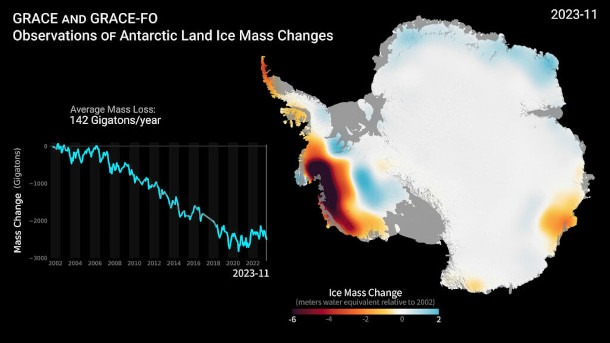
The west coast of Antarctica has been steadily losing ice mass for decades. This year, a portion of sea ice approximately the size of France was missing, in part due to warm air coming in from the South Pacific, Scambos says. (Photo: NASA, Wikimedia Commons, Public Domain)
O'NEILL: Well, when you think about how massive Antarctica is, it does make sense where you can hear that some parts were seeing more snow this season and some parts were seeing much less ice than you would otherwise.
SCAMBOS: Yes, that's true. It is a continent-sized area, and in fact, I often describe it as being sort of like Australia with Indonesia and New Guinea, all of it buried under ice, and different sides of it experience different circulation patterns and ocean currents. There's one major current that surrounds Antarctica that goes from west to east, it's pushed along by the wind. In fact, the name of it is the West Wind Drift, and that has a big influence on the local climate, wherever it comes up close to the coast or backs away from the coast. In fact, there's also a vertical component, but deep in the ocean, different things are happening, and in fact, that's actually the main threat for ice loss in Antarctica, is that the deeper ocean is more frequently moving towards the coastline of Antarctica. There's a current that reaches the underside of the ice at depth, and for those deeper, larger glaciers that flow out towards the ocean, they're seeing a lot more melting because of this warm ocean current that's reaching them. That is the big problem for the long term in Antarctica.
O'NEILL: It's so easy for us to imagine the warmth of the sun beating down on us that it's maybe not as obvious to people that the warm ocean underneath means that the ice is seeing this from sort of all sides, getting this warming.
SCAMBOS: You're right, and in fact the part that is facing the Pacific in particular seems to be getting a lot of this deeper warm water that's reaching the thickest glaciers, melting them and causing them to speed up, so that they flow outward and lose ice. They deflate faster than that ice is replaced by snowfall in that area. As I said, you take Antarctica as a whole, the last few years it's been in balance, and there's a lot of discussion about how persistent that's likely to be going forward. But in the long term, we know from ice core records in the past ice ages and warm periods that in general, a warmer planet means a smaller Antarctica and a higher sea level, and that's what we can anticipate in the long-term going forward.
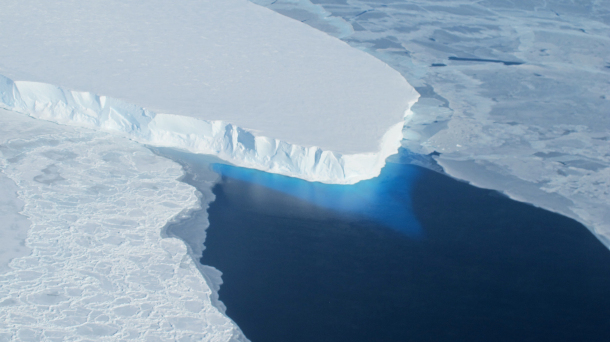
Scambos says the Thwaites glacier, above, is the “biggest wildcard in sea level rise” due to its unpredictable nature and vast mass. (Photo: NASA, Wikimedia Commons, Public Domain)
O'NEILL: Now, Ted, a lot of your work focuses on the Thwaites Glacier, which is the widest glacier on earth, as I understand it. It's in West Antarctica, and it's sometimes referred to as the Doomsday Glacier. How is the Thwaites Glacier faring here in 2026?
SCAMBOS: Well, unfortunately, it's right at the center of this problem I've been talking about, with the warm ocean water reaching the coast of Antarctica. The glaciers adjacent to Thwaites are also experiencing the same thing, and their losses are not insignificant, but the way the landscape is underneath the ice sheet makes Thwaites the critical glacier for losing a huge area of ice in Antarctica. Now I like to say that it's a slow-moving catastrophe, it's not a doomsday, it's more of a doomed century or two. Still, the amount of sea level rise that will occur from the loss of ice in this area, and we think it's already underway, and we're pretty much the models are showing that we're committed to losing the ice. It's just a question of whether we're fast enough to stretch out that loss to several thousand years versus dumb enough to keep warming the planet and seeing it collapse very quickly, a century or two. Thwaites is really the biggest player, the biggest wild card in sea level rise in the future. Warming oceans, which makes the water expand, that's a big part of what will happen, and Greenland melting, especially surface melting water running off at the top of the ice sheet into the ocean, another big player, but both of those are fairly easy to predict and forecast. They'll scale with the warming planet pretty predictably. Thwaites is less predictable, a lot less predictable in terms of when and how this ice is really going to come off the continent.
O'NEILL: When do you feel like the rest of the world will start to feel the consequences of this rapid ice loss, whether it be the sea ice or the glacier ice, when is the rest of the world going to feel it?
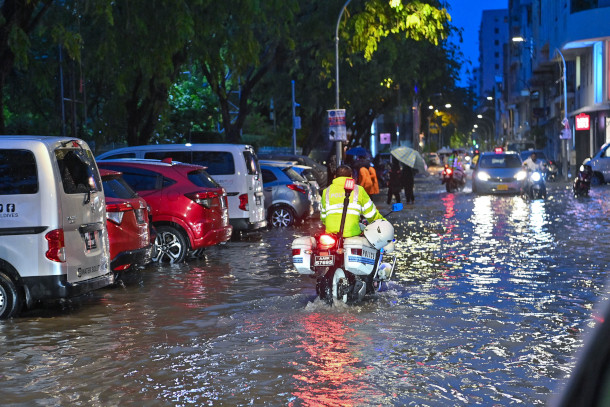
Low-lying island nations are the most vulnerable to sea level rise. Nearly 80% of land in the Maldives sits less than a meter above sea level, putting citizens at risk during extreme floods like the 2023 event above. (Photo: The President's Office, Maldives, Wikimedia Commons, CC BY 4.0)
SCAMBOS: Unfortunately, human beings need a catastrophe, and there's this steady drumbeat of events that have actually more or less convinced the American public that climate warming and climate change are real. I think the heat wave in Europe, heat waves in the United States, hurricanes, those things, they have a cumulative effect on opinion, and I think we're there in the US, just tipping over into, yeah, this is really happening, and we might need to think about this sooner rather than later.
O'NEILL: Well, when we talk about the dimension of this that is about sea level rise, you'll always see passionate talkers from low-lying island nations who are, you know, is quite literally their doorstep, their front yard is at risk.
SCAMBOS: Nicely put. Yes, the ocean is at their doorstep, and there's an interesting reason why those islands are actually the ones that are jumping up and down the most. You see, sea level rise on earth is not uniform. It won't just be like a bathtub slowly filling up evenly around all of the coastlines. Almost unfairly, the areas that are losing ice the most will actually see sea level drop near those coasts. It's a little bit complicated, but because you're losing literally trillions of tons of ice, that continent is not pulling the ocean against the coast as much as it used to. The gravity from that ice sheet is lower than it used to be, because that mass went into the ocean. The net effect is that the band of the tropics around the middle of the earth, near the equator, on either side, up to about 30 or 40 degrees latitude, both sides, will see more than its share of sea level rise, and those islands in the Indian Ocean and in the Pacific Ocean, they're going to see about 30% more sea level rise than the rest of the world does. It's unfortunate, and that's why that's such a critical problem. And yes, they've got nowhere to retreat to. I mean, I don't want to be flippant, but there's Baton Rouge for New Orleans, but there's no higher ground for the Maldives.
O'NEILL: Ted, what's something that you want people to keep in mind when they hear a story like this?
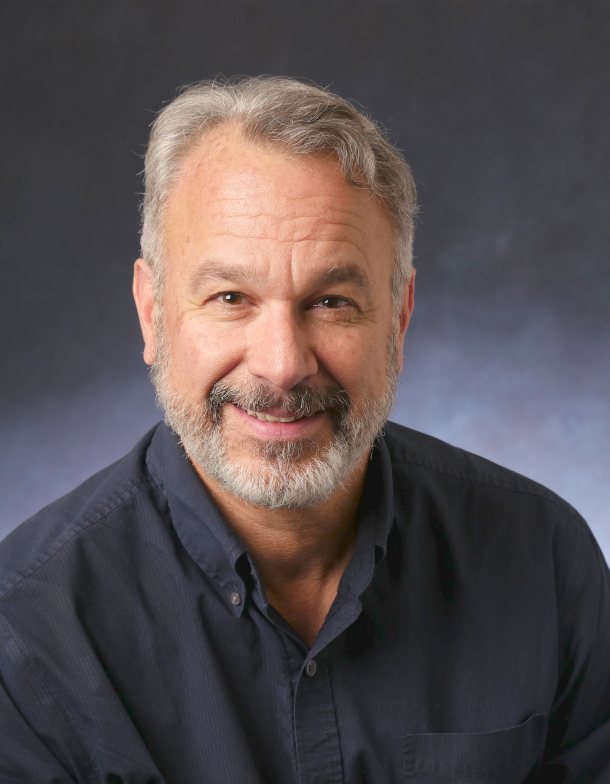
Ted Scambos is a Senior Research Scientist at the Cooperative Institute for Research in Environmental Sciences at the University of Colorado Boulder. (Photo: Courtesy of Ted Scambos)
SCAMBOS: I realize that it's a Debbie Downer talk to keep going down this road of hammering home how at risk the future appears to be, but the fact of the matter is, we have the technology that we need in order to radically slow the pace of sea level rise and the pace of warming on Earth. We're committed to some warming for quite a while, but in terms of solving the issue of greenhouse gas emissions, we're really there, and between solar and wind, and I don't want to eliminate new forms of nuclear power, that may well be a part of it. We can do this without continuing to put heat trapping gasses into the atmosphere. The solution is right there in front of us.
O’NEILL: That’s Ted Scambos, a Senior Research Scientist at the Cooperative
Institute for Research in Environmental Sciences at the University of Colorado Boulder. By the way, in addition to the carbon-free energy that Ted mentioned, Earth’s trees are also powerful tools in the fight against climate change.
BELTRAN: And you can hear more about carbon-sequestering forests in some of our recent episodes on the Living on Earth website, that’s loe.org. And let's not forget about the carbon storage potential in soils, especially peatlands. That’s coming up after the break on Living on Earth. Stay tuned!
Related links:
- The Guardian | “Antarctica’s West Coast Missing an Area of Sea Ice the Size of France as Temperatures Peak 20C Above Average”
- Learn more about Ted Scambos
[MUSIC: Closing Credits]
ANNOUNCER: Support for Living on Earth comes from the Waverley Street Foundation, working to cultivate a healing planet with community-led programs for better food, healthy farmlands, and smarter building, energy and businesses.
[CUTAWAY MUSIC: Tim Donnelly Band, “Cantaloupe Island” on Sunny, Chill Tone Records]
BELTRAN: It’s Living on Earth, I’m Paloma Beltran.
O’NEILL: And I’m Aynsley O’Neill.
We want to remind you about our next Living on Earth Book Club event on July 14 at 8 pm Eastern! We’ll talk on Zoom with Amy Bowers Cordalis, Yurok activist and attorney, about her book The Water Remembers: My Indigenous Family’s Fight to Save A River and a Way of Life. Amy will discuss the struggle to protect the Klamath River in Northern California, a crucial habitat for salmon and the lifeblood of the Yurok tribe. Join us for this free, live webinar with Amy Bowers Cordalis on Tuesday, July 14 at 8 PM Eastern. Register at loe.org/events! That’s loe.org/events. See you there!
[MUSIC: Linear Motion]
Arctic Peatlands Expanding
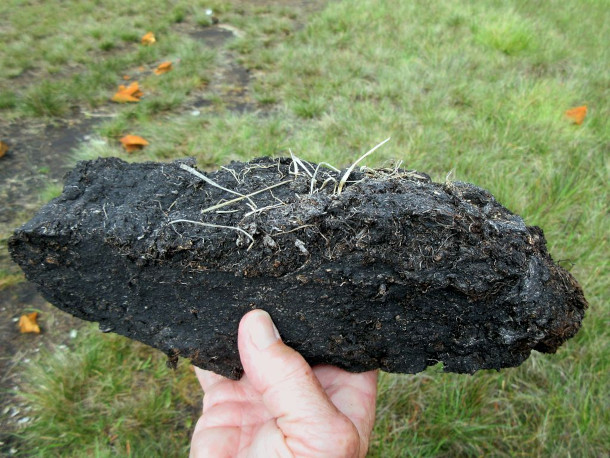
Peat comes in a wide range of appearances, but all types are formed from dead organic plant matter. (Photo: David Stanley, Wikimedia Commons, CC BY-SA 2.0)
BELTRAN: Millions of years before humans worried about climate change, the planet had already devised its own way of removing carbon from the atmosphere. In oxygen-deprived wetlands all over the world, dead plant material accumulates instead of fully decomposing, gradually forming peat that locks away its carbon. Over millions of years, peat eventually fossilizes to become coal. It’s how the planet has sequestered carbon to cool down since the much hotter times when dinosaurs roamed under palm trees near the North and South poles. So recent findings that peatlands are expanding northward as the Arctic warms might sound like good news. But it’s not that simple, and one problem is time, since it takes millennia for peat to sequester large amounts of carbon, while we are burning fossil fuels far more quickly than the Earth can absorb. One of the researchers studying the changes in peatlands is Angela Gallego-Sala, a professor and biogeochemist at the University of Exeter in the UK who coauthored a 2026 study on Arctic peatland expansion. She’s also a lead author for the IPCC, the Intergovernmental Panel on Climate Change, and spoke with Living on Earth’s Jenni Doering.
DOERING: So, Scotch Whiskey fans might perk up at hearing the word peat, but when it comes to the peatlands that you study, what exactly are they, and why are they significant?
GALLEGO-SALA: So, peatlands are fascinating ecosystems. They happen all over the world, from the poles to the tropics, and basically they are very wet ecosystems that, because of being wet, they store a lot of carbon on the soil, so they are basically defined by all of that carbon that accumulates as undecomposed organic matter that means plant matter on the soil.
DOERING: And these places, peatlands, they are places, as you say, where plants don't really decompose, or they decompose very slowly, so they build up a lot of carbon over time, carbon from the photosynthesis that the plants have been doing. What is the scale of the carbon that these peatlands contain?
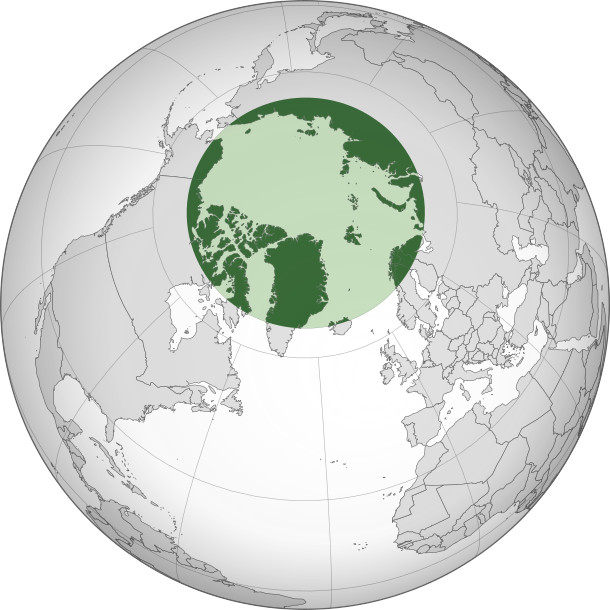
As temperatures rise, peatlands are expanding into regions that were previously too cold for them to grow in. This phenomenon is known as arctic greening. (Photo: Isochrone, Wikimedia Commons, CC BY-SA 3.0)
GALLEGO-SALA: So they basically all together they contain more carbon than there is in the atmosphere, or more carbon than all of the forests of the world combined. So that is a lot of carbon.
DOERING: That is a lot. And Angela, your study found that peatlands are expanding across the Arctic. This is part of a phenomenon known as Arctic greening. What's causing this?
GALLEGO-SALA: So, as the climate is warming, all of the biomes are expecting to be shifting polewards, so in the case of the Northern Hemisphere, northwards or higher up the mountain, if they're in a mountain setting, and peatlands are similarly, or they could be similarly shifting northwards. So we had a project that explored this possibility, and we found that indeed some of the peatlands in the Arctic are expanding, and this is because basically in their very high latitudes, plants have a very short window in the year where they can grow. As the climate is warming, that window is expanding, and so you get more input into the system, more carbon into the system, and if those systems are wet, then they can maybe the decomposition processes are slowed down enough to accumulate this peat.
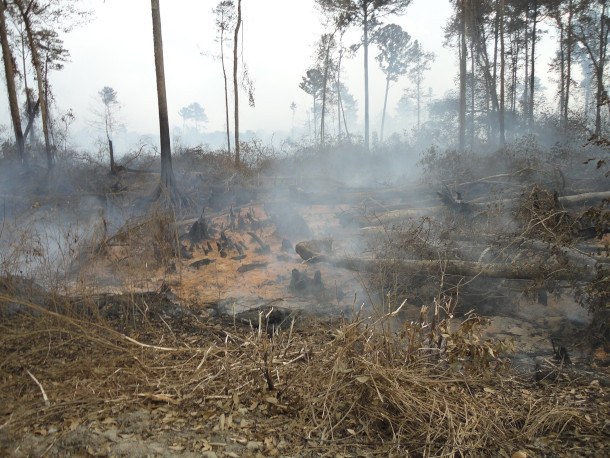
Although peatlands are great carbon sinks and absorb plenty of carbon, under hot dry seasons, they can paradoxically be a carbon emitter, with peat releasing carbon back into the atmosphere as it burns. Above, remnants of the Lateral West Fire in Great Dismal Swamp National Wildlife Refuge in Suffolk, Virginia. (Photo: U.S. Fish and Wildlife Services Northeast Region, Wikimedia Commons, CC BY-SA 2.0)
DOERING: I think anybody who's a gardener in many northern latitudes would understand, you know, I can't grow here in Boston vegetables for quite as long as someone in San Diego. So these places are getting warmer, the Arctic is getting warmer as the climate changes, and it's warming very quickly, as I understand. And then, what's the role of moisture, rainfall?
GALLEGO-SALA: Yeah, so this is the tricky part, that for other ecosystems we expect the biome just to shift northwards, but for peatlands the biome relies on really the soil being wet all year round, and the precipitation predictions are less certain, so we know less well how that will change, but even with that uncertainty, that most of the predictions say that the Arctic will become wetter, so it is likely that these peatlands will move northwards, but as you say, moisture will be key. So, if the areas are waterlogged, they will become peatlands, and if not, they will become something else, probably boreal forest, or whatever. The boreal forests are also moving northwards, for example.
DOERING: So, of course, peatlands are an important carbon sink. They are these places where the plants build up, where that carbon builds up. But I understand that this expansion of peatlands that you're documenting in the Arctic, that actually could become a source of carbon that could contribute to more warming over time. Why is that? Can you explain that sort of paradox for me?
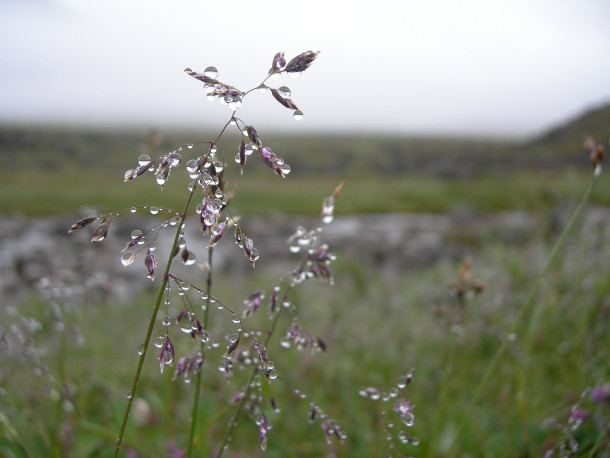
Precipitation and moisture are major components in the formation of peat, so a wetter Arctic calls for more opportunities for peat expansion. Here, grass grows near Pangniqtuuq, Nunavut, Canada. (Photo: Qaqqaqtunaaq, Wikimedia Commons, CC BY-SA 2.0)
GALLEGO-SALA: Yeah, so there is kind of like two hypotheses. So one is that because a lot of the Arctic is now under permafrost, so that means frozen, and that will thaw that all that thawing will release the carbon that is now in the soil, and that will, that carbon will be released into the atmosphere, and therefore you know it will contribute to warming, but our observations and our hypothesis is kind of saying, okay, that will may be the case for some parts of the Arctic, but for some parts of the Arctic, if they are wet enough, then that will not be the case, and they will be actually taking up carbon from the atmosphere, and both might be true, because you know the Arctic is complex, and these landscapes are complex, and there will be dry parts of the landscape and wet parts of the landscape, and also I would also say that there are other considerations that we of course, need to be aware of with climate change, that is not just the warming, but the extremes, and so we could have things like fire, for example, that could be an element that could tip the ecosystems into becoming sources, for example. So yes, we are documenting an expansion, but that doesn't mean that great, we can warm the earth, and you know nothing will happen. Actually, warming the earth can have, let's say, unwanted consequences beyond the greening of the Arctic, I would say.
DOERING: Right I mean, it sounds like you need a lot of moisture for these peatlands to form, but then let's say we get, you know, several really hot, really dry years, those peatlands dry out, maybe there's even fire that happens, and we've seen a lot of increasing fires in northern regions and boreal forest regions, especially, and then that contributes to a whole lot of carbon going into the atmosphere.
GALLEGO-SALA: Exactly, and that's the kind of real possibility for a lot of these peatlands, you know, not just the Arctic ones, but as you say, the boreal ones, they are suffering from more frequent fires, and this is something that is in some ways well unprecedented, in the sense that these wetter ecosystems don't normally catch fire if they are in a good climate, you know, in a favorable climate.
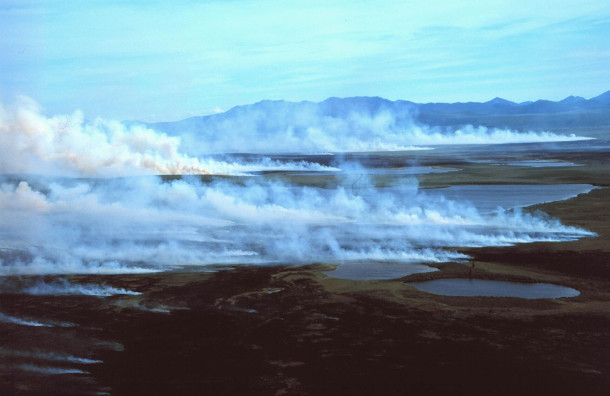
The hidden nature of zombie fires makes it more difficult to track and contain the damage they are causing to peat. Above, a smoky tundra landscape in front of the Baird Mountains in Alaska. (Photo: Western Arctic National Parklands, Wikimedia Commons, CC BY-SA 2.0)
DOERING: Angela, we've reported previously on the show about zombie fires, and I believe we were talking about, you know, when permafrost thaws and dries out enough, and then maybe the forest above it catches fire, and the soil itself, that carbon in the soil, that actually can catch fire, then be smoldering even throughout the whole winter. To what extent is that part of the concern here with peatlands, if they dry out, they could become these zombie fires?
GALLEGO-SALA: Yeah, so this is very real for peatlands all over the world, also in the tropics. So in the boreal area, but also in the tropics, when they are drained for agriculture, we also get these zombie fires, basically smoldering away, and you know, there is no visible flames, and therefore much harder to contain, much harder to stop. So, yeah, it's a real concern for peatlands, I would say all over the world, because you know they are very good at taking carbon away from the atmosphere, but actually this is a very slow process, so it happens over millennia, and these fires are releasing the carbon very fast, so all of the good work that the peatlands have done over all of that time is suddenly lost in a matter of months, or whatever, you know. So, really, this is definitely a concern for peatlands all over the world, I would say.
DOERING: There's a lot of different complicated things happening here. Some expansion of peatlands, as you've documented. How are you and other scientists responding to these findings, and what are your next steps?
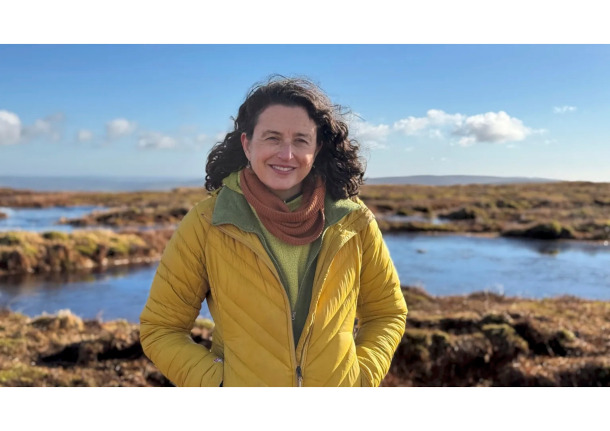
Angela Gallego-Sala is a professor and biogeochemist at the University of Exeter, as well as a lead author for the IPCC, the Intergovernmental Panel on Climate Change’s Seventh Assessment Report. She is in Working Group I, which examines the physical science underpinning past, present, and future climate change. (Photo: Courtesy of Angela Gallego-Sala)
GALLEGO-SALA: So, I think, as a scientist working in the natural environment, and trying to document changes due to climate change, I think there is a profound sadness, really. I mean, I love peatlands, and I love that they're expanding in the Arctic, but I'm still sad, you know, the fact that they are expanding is because we have a rapidly changing environment. We haven't mentioned them, but there is a lot of people that live in the Arctic, and their ways of life relies on having frozen ground and frozen seas, and you know their way of life is going to be profoundly affected by these changes. So I think it's not just me, but any of my colleagues that works in the natural environment, witnessing all of these changes, and kind of monitoring these changes. I think there is a part of us that is really sad, but on the other hand, I also, I'm a born optimist, and I think nature is extremely resilient, and that we still have time to do something about it, and to reverse these changes, and in a way, that's why my chapter in the IPCC is talking about, is talking about what are the consequences of not doing something about climate change, and can we reverse if we go too far in terms of temperature? Can we reverse that, and if so, how costly that is, and what is possible, and what is not. But I think sadness is probably a part of my job. I also very much enjoy my job, I have to say, and I enjoy very much working on these systems, but yes, I think we live in this kind of contradictory joy for studying the ecosystems that we love and sadness to be witness to what is happening really.
BELTRAN: Angela Gallego-Sala is a professor and biogeochemist at the University of Exeter and a lead author for the Intergovernmental Panel on Climate Change. She spoke with Living on Earth’s Jenni Doering.
Related links:
- Find the study here
- More on Angela Gallego-Sala
[MUSIC: Flicker in the Gray]
A Bend in the Creek
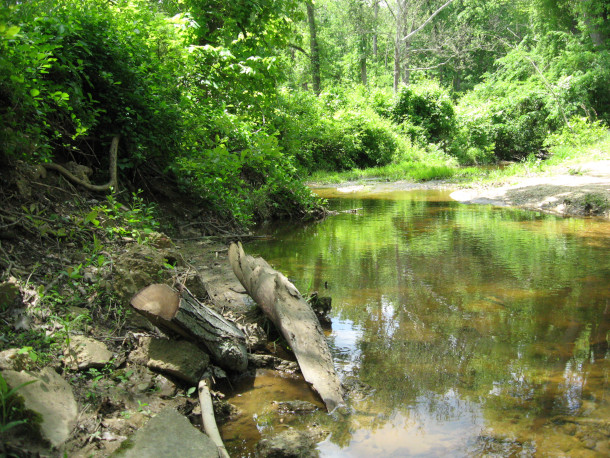
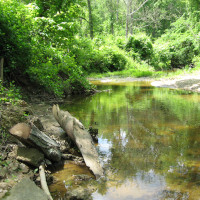
Little Creek borders Marine Corps Base Quantico in Virginia, where Don Lyman lived when his father was a Marine. (Photo: Don Lyman)
O’NEILL: The long days of summer and freedom from school bring some kids the chance to explore the outdoors, sometimes with wildlife encounters. Living on Earth’s Don Lyman shares one of those memories from his boyhood and how it took on a new dimension later in life.
LYMAN: The winding course of Little Creek formed the boundary between Marine Corps Base Quantico and the town of Triangle, Virginia. On one side of the creek was the base golf course, bisected by the main road leading into Quantico. On the other side, beyond the tangle of green briars and blackberry brambles that lined the creek bank, was a small Southern town. Carefully manicured fairways, tidy red brick government buildings, and a gate guarded by armed Marine Corps sentries in their neatly pressed uniforms, contrasted sharply with the older homes, overgrown lawns, and even the occasional shack in Triangle.
The water in the creek was clear, but littered with discarded bottles, bits of paper and plastic, and slabs of broken concrete. Yet, for young boys with a love of nature, it seemed like paradise. Little Creek provided a place for my friends and I to explore, a mysterious world where we could find all manner of curious creatures.
Our dads were Marines, and we lived on the base. My friends Tom and Junior were brothers, 12 and 13 respectively. Steve was 12, and at 14, I was the oldest of our intrepid little group of budding biologists.
We shared an interest in nature and wildlife, especially herpetology ─ the study of reptiles and amphibians ─ and we loved to go exploring. Carefully traversing steep banks of eroded soil to the stream below, we'd spend hot, humid summer days splashing through the cool, shallow waters that flowed gently over sand and gravel. Shade from big oaks, tulip trees, and sweetgum that towered over the creek protected us from the hot sun. We flipped over rocks and pieces of concrete along the edges of the creek to see what treasures might be concealed beneath ─ striped queen snakes, feisty little water snakes, frogs, salamanders, crayfish. It seemed there was always some new discovery that awaited us.
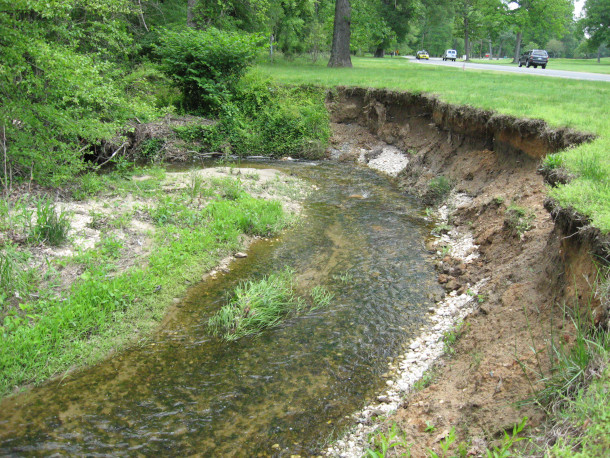
Lyman and his friends loved exploring the wildlife of the area, and once saw a snapping turtle at a bend in the creek. (Photo: Don Lyman)
One summer day we came upon a large snapping turtle that had crawled up onto a sandy bank at a bend in the creek. Its shell was nearly a foot-and-a-half-long, and the turtle probably weighed about 30 pounds. With a hooked beak, sharp jaws, and a powerful bite, snappers can be dangerous, so we kept a safe distance while we observed the ponderous reptile slowly making its way toward the water. Plodding along with its legs fully extended, and its long saw-toothed tail dragging behind it, the snapper looked prehistoric.
Suddenly from behind us someone shouted, "Catch that turtle! Don't let it get away!"
Startled, we turned to see an old man with white hair and a scraggly white beard hobbling toward us on a cane. A little black dog followed close behind him, barking furiously. The man lived in a small shack in Triangle a couple hundred feet from the creek.
By this time the turtle had reached the edge of the water.
"Grab him! I can eat him for dinner!", the old man shouted.
We were torn between disobeying an adult and not wanting the old man to kill the turtle, not to mention the danger of trying to capture such a large snapper.
"Just grab him by the tail and drag him up onto the bank!" he commanded.
Junior and I tentatively waded into the water, exchanging knowing glances, and made a half-hearted effort to catch the snapper, dancing around and grabbing at its tail as the turtle slipped into a deep pool and disappeared under a tangle of partially submerged tree roots. I felt relieved that the turtle was safely out of reach.
"I could have ‘et’ him for my supper," the old man grumbled.
"We tried to catch it but it got away," I nervously replied, feeling badly that I wasn't telling the truth.
"You should have grabbed it," the old man said as he walked away.
"I felt bad for him," I told Junior. "Maybe he didn't have anything to eat."
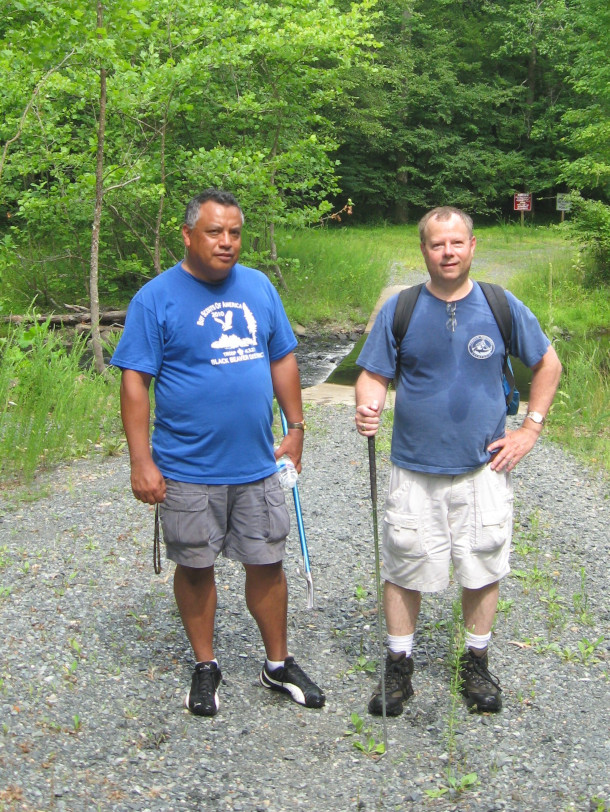
Don Lyman, right, with his childhood friend Junior Poolaw, left, at nearby Chopawamsic Creek during their 2010 reunion trip to Marine Corps Base Quantico. (Photo: Don Lyman)
"Me too," Junior replied. "But I didn't want him to kill the turtle."
"Me neither," I said. "Me neither."
In the summer of 2010, I headed south from New England for a reunion with Junior at Quantico. We’d both become teachers among other careers – Junior at the high school level and myself as an adjunct college professor—and we still shared a fervent love of herpetology.
We spent several wonderful days exploring our old boyhood haunts, including Little Creek, searching for reptiles and amphibians like we did when we were kids, this time accompanied by Junior’s oldest son, Dane, who had recently graduated from college.
Over 40 summers had passed since our youthful adventures at Quantico. The old man and the shack he lived in were gone, and the young boys who once explored the creek had long since grown into men.
Walking along Little Creek brought back memories of the snapping turtle incident. Reflecting on our experience, I realized that perhaps our encounter with the old man went much deeper than the inner turmoil between obeying or not obeying an adult, and even beyond not wanting to kill another living creature.
On another level the encounter represented a clash of cultures between our middle-class world on the Marine base and the poverty on the other side of the creek. It brought forth the stark reality that while some people enjoy nature for its recreational, scientific, and aesthetic value, others may depend on it for their very survival.
It was a hard lesson and a tough choice for young boys to make, but even looking back through the experienced lens of adulthood, I still don't think I could have brought myself to help kill that turtle. To my friends and me, Little Creek was a refuge, not only for us, but also for the creatures that lived there.
O’NEILL: That’s Living on Earth’s Don Lyman.
Related link:
More from Don Lyman
[MUSIC: Pulse of the Hearth]
BELTRAN: Coming up after the break, with fiber, protein, and healthy fats, nuts can be a great part of a human diet. But it turns out, eating more nuts can be good for the planet too. Keep listening to Living on Earth!
ANNOUNCER: Support for Living on Earth comes from the estate of Rosamund Stone Zander - celebrated painter, environmentalist, and author of The Art of Possibility – who inspired others to see the profound interconnectedness of all living things, and to act with courage and creativity on behalf of our planet. Support also comes from Sailors for the Sea and Oceana. Helping boaters race clean, sail green and protect the seas they love. More information @sailorsforthesea.org.
[CUTAWAY MUSIC: Tim Donnelly Band, “Sunny” on Sunny, Chill Tone Records]
Nuts to Feed the World
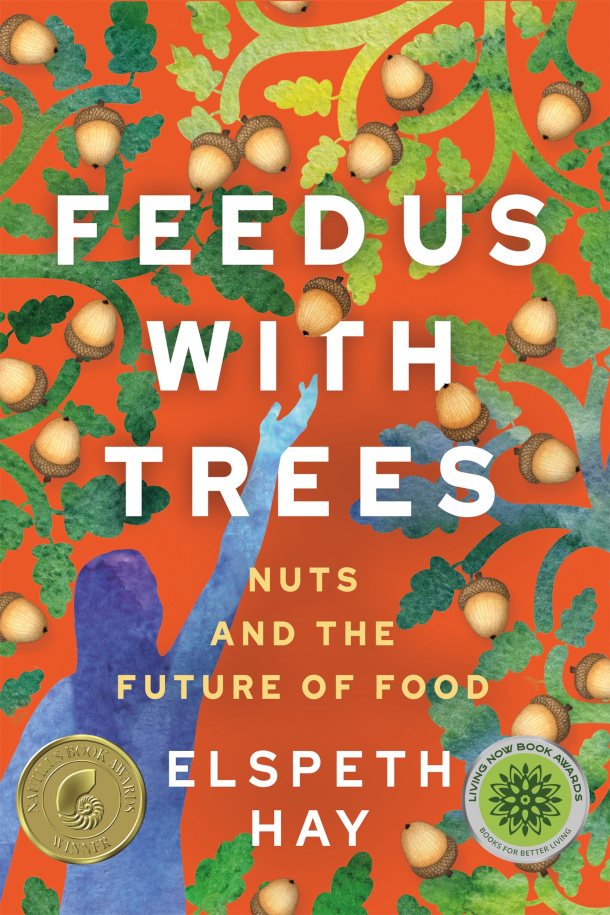
Feed Us With Trees: Nuts and the Future of Food by Elspeth Hay. (Cover design by Diane McIntosh)
O’NEILL: It’s Living on Earth, I’m Aynsley O’Neill.
BELTRAN: And I’m Paloma Beltran.
Much of the world’s staple crops of corn, wheat, rice and soy are grown in massive monocultures. Backed by subsidies from the US federal government for nearly a century, this form of food production continues to be incentivized, despite negative environmental impacts like habitat destruction and the massive amounts of fertilizer, pesticides, fossil fuels and water it often involves. Much of that grain is fed to livestock with a huge carbon footprint and our food system accounts for as much as a quarter to a third of global greenhouse gas emissions. But there may be a more sustainable way to feed our growing population, if we’re willing to learn from an ancient, largely forgotten food system. Elspeth Hay is the host of “The Local Food Report” on WCAI and the author of Feed Us With Trees: Nuts and the Future of Food, and she joins me now. Elspeth, welcome to Living on Earth!
HAY: Thank you so much for having me. It's exciting to be here.
BELTRAN: So, tell me a bit about how you grew up. You know, what stories about humans and their relationship to the land were dominant in your culture?
HAY: So, I grew up in Maine with two parents who were bird watchers, and we spent a lot of time traveling around the state of Maine, looking at birds in different habitats, and I learned about the ways that bird species were really well adapted to the places where they lived. I remember learning about crossbills and how they had these mandibles perfectly adapted to extracting conifer seeds from the trees where they lived, sap suckers drilling neat little rows of holes into maples and birches, and then we would come home from these sort of field trips to different ecosystems and get our food from the grocery store, and as I started to get older and make my way through school, I realized that the way that we were getting our food was really different, and was actually destroying these same ecosystems that all of these wild species depended on, and I definitely couldn't have articulated it as a kid, but I always had this sense of wrongness, and of feeling like, what, what is wrong with our species? Why don't we fit into our habitat in the same way that these other species do? It didn't make sense.
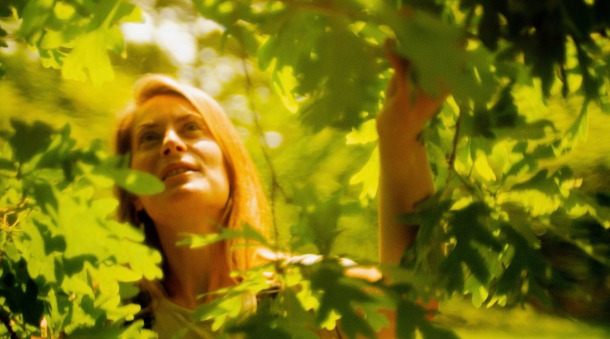
Our guest, Elspeth Hay, checking for acorns on a white oak, Quercus alba, at home on Cape Cod. Elspeth says she never considered acorns as a food source until hearing a TED talk by Marcy Mayer. (Photo: J. Elon Goodman)
BELTRAN: And Elspeth, you're the host and creator of "The Local Food Report," which airs on the Cape and Islands NPR station. So clearly you think a lot about food and where it comes from. What got you thinking, hey, maybe there's a better way of doing this?
HAY: Yeah, I get to talk to farmers and fishermen and policymakers all the time, and it's pretty rare that I hear something truly kind of revolutionary that catches me in a new way. But about six years ago now, a friend sent me a link to a TEDx talk by a woman in Greece named Marcy Mayer, and she said that acorns, which I had always seen as a nuisance in my yard, are edible and are human food, and not just edible, but actually one of our oldest human foods, and a super food, and that got my attention. I live in Cape Cod, on the Cape Cod National Seashore, and I am in a forest that is completely surrounding me, of oak trees, and so I had always seen these acorns falling in the yard and around the house as kind of a nuisance, maybe food for squirrel and deer, definitely not a human food source, I had never heard of people eating acorns. And I was shocked that all around me all this time had been this food source, while I had been seeing these trees and this protected land as basically an impediment to food production, because I had always understood food as coming from farmed fields, so that was a big moment of discovery for me and I immediately started trying to learn more, not just about acorns, but also about some other nut trees, once I started to realize how many different options there were for growing food on nut trees.
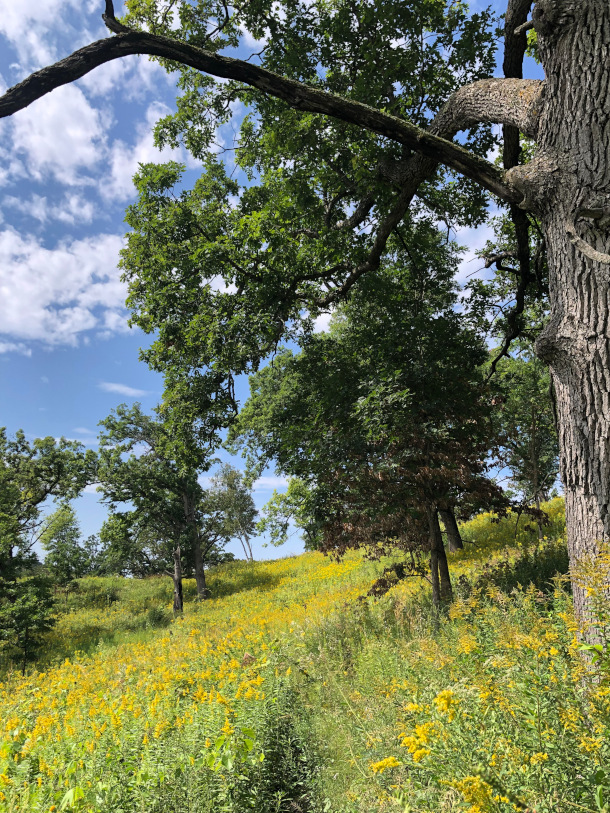
A restored oak savanna in Black Earth, Wisconsin with a canopy of open grown oaks, black walnuts, and hickories that tower over an understory filled with ripe hazelnuts. Under Midwest Indigenous management, oak savannas once covered much of what we think of today as American farm country and were tended with fire as a key management tool. (Photo: Elspeth Hay)
BELTRAN: So, what has the role of nut trees been historically for indigenous people here and beyond?
HAY: So all over the northern hemisphere, in an incredibly diverse range of cultures, nut trees, including oaks, chestnuts, walnuts, pecans, hazelnuts, a huge range of nut trees, have been staple crops, so that means they're growing everyday foods, like today we would consider wheat or corn or soy or rice a staple crop, and the history of these nut trees as staple crops actually stretches back much farther than grains. Ever since the end of the last ice age in the northern hemisphere, these trees have been staple foods in North America, in Europe, in Asia, Northern Africa, the Mediterranean, the Middle East, this incredible range of cultures. And people have learned how to have a relationship with these trees that ranges from intense cultivation to a more semi feral cultivation, but when you look at archeological records in Japan, for instance, you see the size of chestnut burrs increasing because of human interaction with trees. When you look at North America, you see indigenous peoples here in a variety of different cultures using fire to keep trees like oaks and hickories dominant on the landscape. People have relied on these foods as a major part of their diet.
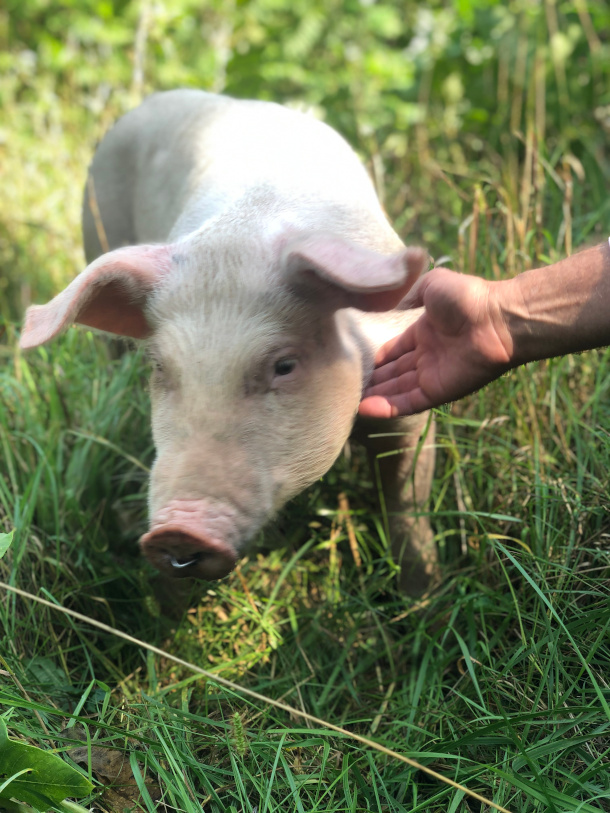
A pig living on a perennial nut farm in Wisconsin. Historically, many cultures have used nut trees as staple crops the same way we use corn and soy today—as food for both humans and livestock. (Photo: Elspeth Hay)
BELTRAN: And also the part of the genocide against indigenous people here in America was focused on destroying their food systems, specifically nut trees. Can you talk to us about that? You know, how did that history lead us to where we are today?
HAY: Yeah, I think you know, when I was a kid, I was taught settler history, which the basic version is, Europeans came to this continent and it was tragic, but a lot of indigenous people died from diseases that we brought, and so the land was sort of ours to take, and that story could not be farther from the truth. There were millions of indigenous people killed by Euro-American settler soldiers as we moved across this continent, and a lot of the fighting was really focused on destroying food systems. So here in the East that looked like enclosing woodlands so that areas that had been nut producing and tended as game woodlands, as nut woodlands, were divvied up into private property and farmed instead of being allowed to be owned communally, so that system spread west with the killing of the bison, and it moved all the way to the Pacific Coast into an area where acorn tending and oak tending as a staple food crop was really prevalent in a lot of California, present day California, before Euro Americans got there and there was this system that the government came up with to incentivize basically a system of forced farming to get indigenous people to stop tending these tree crops and to move toward row crop farming.
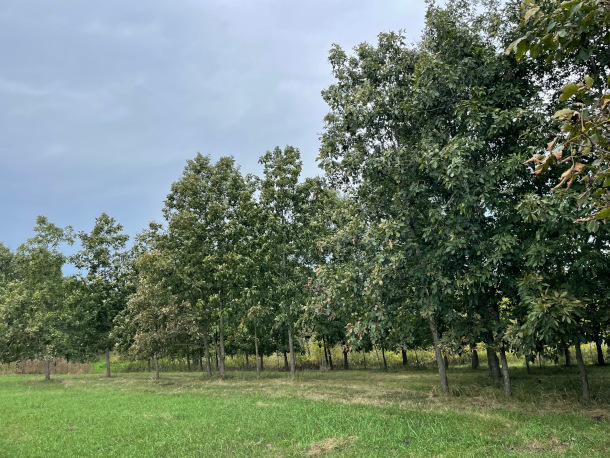
A grove of hickories in Canton, Minnesota that are experimentally being tended with fire. (Photo: Elspeth Hay)
They had a system called allotment and allotting agents went onto indigenous land, indigenous reservations, and told people that if they didn't farm the land, it would be taken by white settlers, and that legally they had to farm the land in order to gain title to it, so they forced people, you know, not only was there so much violence and so many other culturally insidious ways of enacting genocide on indigenous people, but there was also this forced change in food production, and it was so tied to so much of the other violence, and food is so culturally important, and so ecologically important, and tied to so much of how we see ourselves, and you know what creates a culture, and so targeting that was another way of targeting indigenous people and forcing them to assimilate to Euro-American settler culture.
BELTRAN: So, what does the cultivation of nut trees look like, and how does it compare to our industrial agriculture?
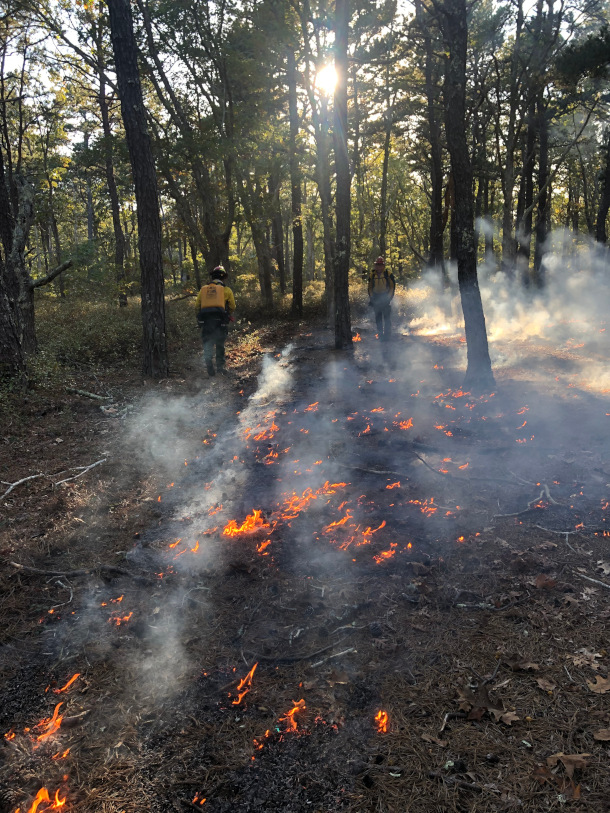
A prescribed fire near the author's house in an oak forest in Truro, MA. (Photo: Elspeth Hay)
HAY: So it's pretty different, and also almost exactly the same, which is kind of a confusing answer, but the ways that it's different, let's start with that. When you're tending an industrial agriculture field, you are turning over the land, so that process is emitting carbon dioxide, and when we think about the way that land is managed, that is a really big contributor to the climate chaos that we find ourselves in today. In contrast, when we tend these trees as staple crops, we are allowing them to keep their roots in the soil year after year, decade after decade. Some of these trees can actually live for hundreds, if not up to a thousand or more years, and every year that they are staying present on that land and in that soil, they're sending carbon into the ground instead of releasing it out. So, from an environmental perspective, that alone is a pretty big difference. But biodiversity is also incredibly important to the health of our ecosystems, and in a lot of cultures, traditionally, some of these nut trees, in particular oaks, have been called the “tree of life,” and I think we tend to think of that as like a quaint, beautiful phrase, but it's actually very literal. Scientists now are beginning to understand that some plants host a lot more biodiversity and foster much more life in their ecosystems than others, and oaks in most places where they occur are the top life-producing trees. So it's also really different in terms of biodiversity, you know.
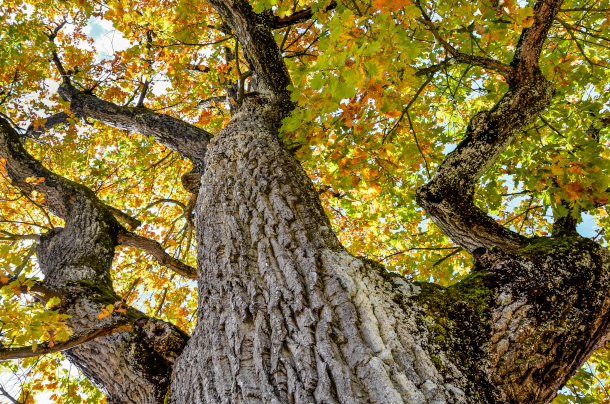
Oak trees are considered strongholds of biodiversity, with their acorns sustaining larger animals while their branches provide homes to birds and insects. (Photo: Johann Jaritz, Wikimedia Commons, CC BY-SA 4.0)
A monoculture of soy versus an oak tree creates a very different habitat and has a very different impact on the collection of species that's around it. So that's what I mean when I say they're very different. They have very different impacts on life cycles of our ecosystems, but they're also very similar in the fact that the jobs that we do to tend these tree systems are almost exactly the same as the jobs that we need to do to tend these industrial fields. We need to keep down weeds. We need to prepare the earth for the crop to seed well. We need to make sure that there's enough nutrients and that we're fertilizing the land. We need to control the water cycle, make sure things are getting enough water, but we are doing those jobs really differently. So same jobs, different tools. On an industrial farm, you know, those jobs might be done with pesticides and an irrigation system and tractor, whereas in a lot of traditional nut tending systems, those jobs are done either with fire, which is an incredible recycler of nutrients, it also prepares the land for crops, it can actually control the water cycle in really interesting ways, keep down pests and pathogens. So different tools, but same jobs and same systems that we're working to control these crops.
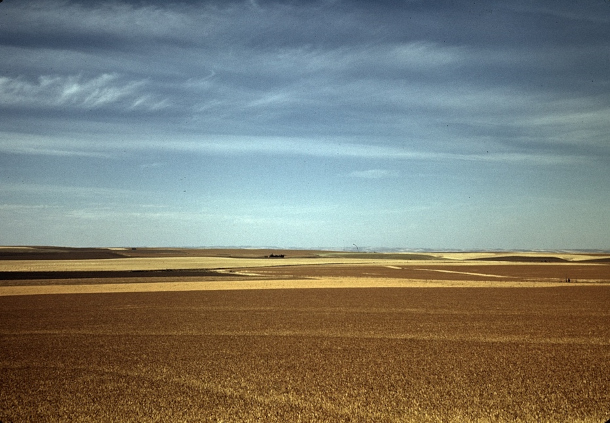
A wheat farm in Walla Walla, Washington. Industrial agriculture and monoculture crops are often depicted as highly productive. However, when inputs like fossil fuels and land are considered, yield calculations can decrease. (Photo: Russell Lee, Wikimedia Commons, public domain)
BELTRAN: You know, many people might wonder, how feasible is this? You know, can nut trees really produce enough food to feed the world?
HAY: Yeah, I had a lot of questions about that while I was researching my book. I got pretty hung up on it for a while. I called it the "yield question," and I was obsessed, because I knew that that would be the first way that people tried to pick this idea apart, right? And something really interesting happened when I started researching the yield question. The first is that I discovered that most of the food that we say, you know, oh, we have to have this system because we have to feed the world. Well, we're not eating most of the food that we're growing, so that argument falls apart pretty quickly. For instance, with corn in the United States, we eat 1% of the corn we grow, the rest is used to produce ethanol, or it's fed to animals, or it's exported to other countries where it destroys their local agricultural economies. So we are not doing this to feed ourselves, but you know, even then I thought, okay, I want to look at this on an acre-by-acre yield basis, right? Because if we're serious about feeding the world, it really matters how much these different crops can produce on an acre of land, and when I looked into that, I discovered a few things.
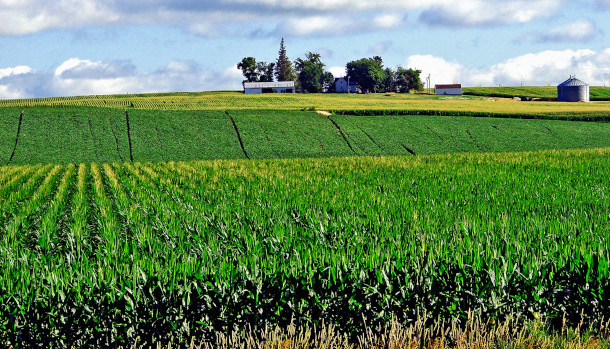
A corn field in Northwest Iowa. In the United States only about 1% of the corn we grow is the sweet corn we eat. Much of the rest is made into ethanol, used for animal feed, or shipped overseas. (Photo: inkknife_2000, Wikimedia Commons, CC BY-SA 2.0)
One is that the way that we're evaluating yield currently is really misleading, so we talk about yield and we say, okay, this acre of corn is yielding 12,000 pounds of corn or whatever it is, but we're not talking about all of the other land that is required to over produce on that sort of little fictional island of land, so when we're talking about yield, it's a ratio, right? It should count all of the energy or calories or nutrients that you're getting out from an acre of land for what you've put in, and when we look at our traditional yield numbers, they're not counting that ratio, they're counting the land that we're producing on, but they're not counting the land that we had to mine to get the fossil fuels to produce that crop, we're not counting so much other land that goes into this production, and when you do count that land, these diverse polyculture tree-based ecosystems or farms are significantly more productive than this industrial agriculture system that we think of as uber production. And there is another layer, so I was also comparing pounds, right? Okay, how many pounds of acorns can this oak savanna ecosystem produce versus a corn field, and when we look at that, that's also not that telling, because a pound of lettuce nutritionally is very different than a pound of hazelnuts, right? One is much more nutrient dense, you're getting more calories, more energy, and so again, in terms of the actual energy that they're producing, these nut trees out-produce our traditional row crop system. And I feel like I finally really fully understood it one day when a farmer told me, we were standing in a field and he said, "Look at this tree, and then look over at this field of corn, look how tall the tree is, look, how three dimensional it is. Look how much sunlight it can capture with its photosynthetic process. Now, look at the field of corn, and how small it looks in comparison." And he reminded me that photosynthesis is what produces these sugars, that it's what produces food, and any ecosystem that is capable of the most photosynthesis will sort of, by definition, also be producing the most food.
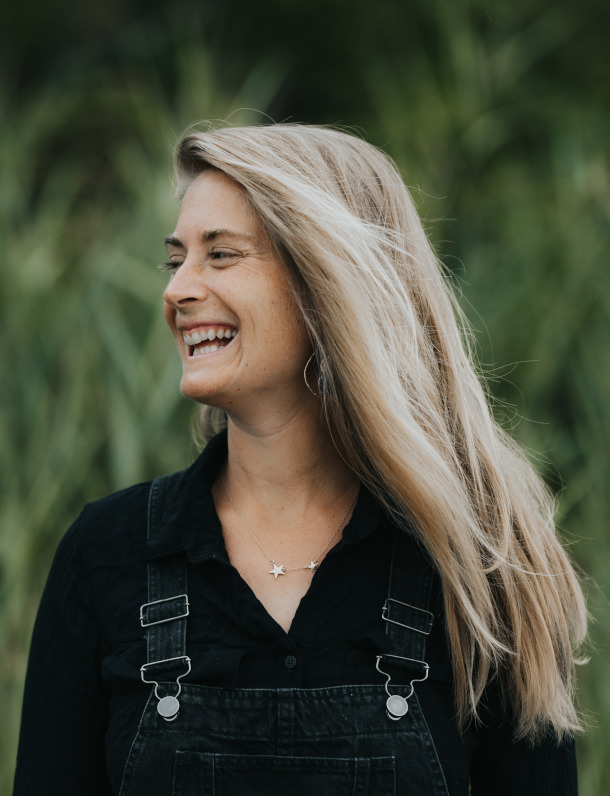
Elspeth Hay is the host of “The Local Food Report” on the Cape and Islands NPR station WCAI and the author of Feed Us With Trees: Nuts and the Future of Food. (Photo: Joe Navas)
BELTRAN: Yeah, so what food products can we potentially make from nuts? You know, it's not just acorn pancakes and roasted chestnuts, right?
HAY: Right, yeah. So there's five major food groups that you can think about coming from these nut trees. One is flour, right? And the second is milks. The third product is the most obvious, which is just nuts themselves, you know. And then there's oil. So I hadn't thought a lot about nut oils when I first started researching my book, but in fact, most nuts are really great for oil production. And then the last category, which really surprised me at first, because I'd never thought about it, is starch. So you think about it, most cultures need, they need staple starches, milks, oils, and nuts really have that covered in the same way that grains and some of these other staple foods that we are more familiar with do.
BELTRAN: So, where are we when it comes to increasing nut tree production in the US and around the world?
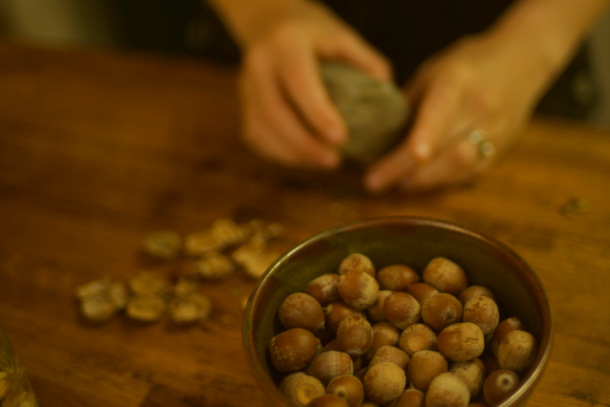
Cracking acorns by hand; the processing can also be done by machine. Nuts can produce five main types of food products: flours, milks, whole nuts, oils, and starches. (Photo: Elspeth Hay)
HAY: So other areas of the world are much farther ahead than we are. A lot of these nut trees are established crops in places like Europe and Asia, where people really haven't forgotten about them in the same way that we have here. I would say in the US there has been a really big surge in interest, and there are a lot of systems going into the ground right now, but that progress, which was really beginning to accelerate, has been hampered by recent political changes and changes in funding, so prior to the current administration, the last administration was putting a lot of money into agroforestry and really trying to help facilitate this transition to more tree-based agriculture, and a lot of that funding was taken away in the past few years, so in some ways that's a sign of success, which maybe sounds odd, but it was getting big enough, I think, for someone to start paying attention and say, "Wait, why are we funding this?" In other ways, it means there are a lot of challenges still to come, but I think that the conversation in the farming community has really ignited, and the number of conferences and presentations, and just farmer to farmer conversations that have some mention of these crops in them has really escalated to the point where, I don't think it's disappearing again, because it's become part of mainstream conversation in farming circles.
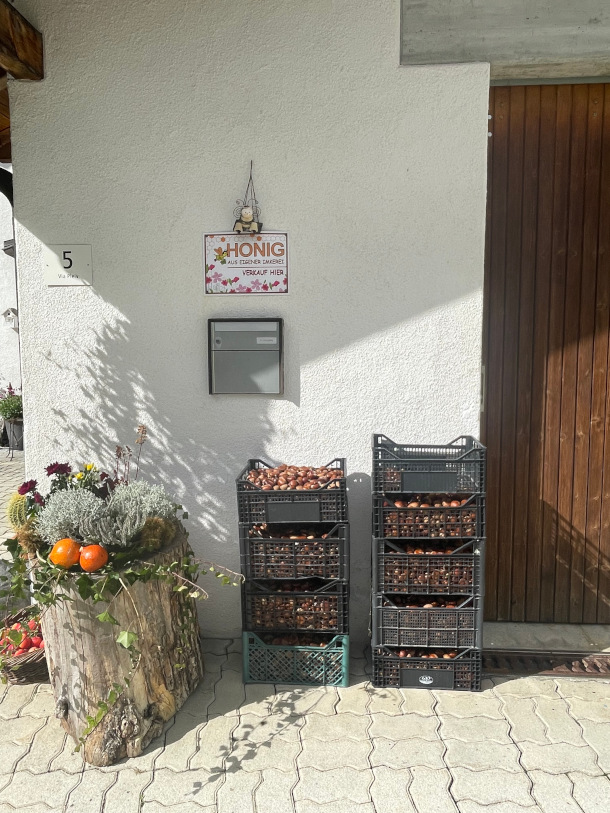
Fresh chestnuts for sale in the village of Soglio, in the Val Bregaglia valley on the border of Italy and Switzerland, where local people have been growing chestnuts as a staple food for thousands of years. (Photo: Elspeth Hay)
BELTRAN: Elspeth Hay is the host of "The Local Food Report" on Cape and Islands NPR station, and the author of Feed Us with Trees: Nuts and the Future of Food. Elspeth, thank you so much for joining us.
HAY: Thank you so much, Paloma. It's been a pleasure.
Related links:
- Learn more about Elspeth Hay
- Listen to “The Local Food Report” on CAI station
- Looking for a copy of the book? Consider purchasing through Living on Earth + Bookshop which supports independent bookstores and nonprofits like LOE.
[MUSIC: Woodland Hearth]
O’NEILL: Living on Earth is produced by the World Media Foundation. Our crew includes Naomi Arenberg, Mia DiLorenzo, Jenni Doering, Abby Edgecumbe, Swayam Gagneja, Mark Kausch, Mark Seth Lender, Don Lyman, Ashanti Mclean, Nhung Nguyen, Sophia Pandelidis, Jake Rego, Andrew Skerritt, Bella Smith, and El Wilson.
BELTRAN: Tom Tiger engineered our show. Allison Lirish Dean composed our themes. You can hear us anytime at L-O-E dot org, Apple Podcasts and YouTube Music, and like us please, on our Facebook page, Living on Earth. Find us on Instagram, Threads and BlueSky @livingonearthradio. And we always welcome your feedback at comments@loe.org. Steve Curwood is our Executive Producer. I’m Paloma Beltran.
O’NEILL: And I’m Aynsley O’Neill. Thanks for listening!
ANNOUNCER: Funding for Living on Earth comes from you, our listeners, and from the University of Massachusetts, Boston, in association with its School for the Environment, developing the next generation of environmental leaders. And from the Grantham Foundation for the protection of the environment, supporting strategic communications and collaboration in solving the world’s most pressing environmental problems.
ANNOUNCER 2: PRX.
Living on Earth wants to hear from you!
Living on Earth
62 Calef Highway, Suite 212
Lee, NH 03861
Telephone: 617-287-4121
E-mail: comments@loe.org
Newsletter [Click here]
Donate to Living on Earth!
Living on Earth is an independent media program and relies entirely on contributions from listeners and institutions supporting public service. Please donate now to preserve an independent environmental voice.
NewsletterLiving on Earth offers a weekly delivery of the show's rundown to your mailbox. Sign up for our newsletter today!
 Sailors For The Sea: Be the change you want to sea.
 The Grantham Foundation for the Protection of the Environment: Committed to protecting and improving the health of the global environment.
 Contribute to Living on Earth and receive, as our gift to you, an archival print of one of Mark Seth Lender's extraordinary wildlife photographs. Follow the link to see Mark's current collection of photographs.
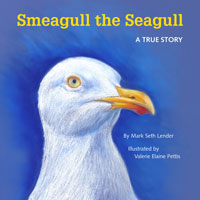 Buy a signed copy of Mark Seth Lender's book Smeagull the Seagull & support Living on Earth
© Copyright World Media Foundation. All Rights Reserved
Home | Contact | RSS | Donate | Newsletter