
Arctic Peatlands Expanding
Air Date: Week of July 10, 2026
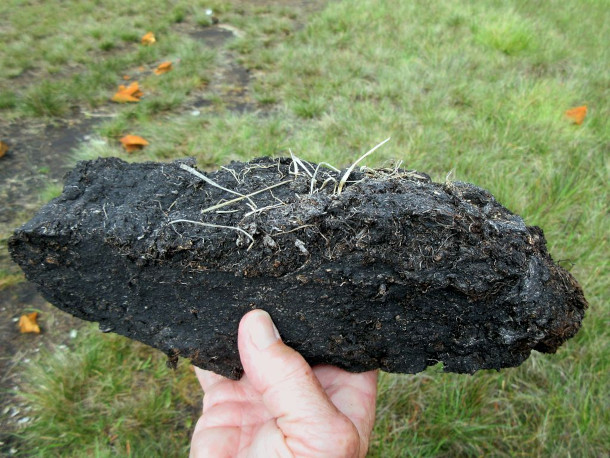
Peat comes in a wide range of appearances, but all types are formed from dead organic plant matter. (Photo: David Stanley, Wikimedia Commons, CC BY-SA 2.0)
Recent findings that peatlands are expanding northward as the Arctic warms might sound like good news, since peat has powerful carbon storage capabilities. But it takes millennia for peat to sequester large amounts of carbon, while we are burning fossil fuels far more quickly than the Earth can absorb. One of the authors of the 2026 study on Arctic peatland expansion is Angela Gallego-Sala, a professor and biogeochemist at the University of Exeter in the UK, who talked with Living on Earth’s Jenni Doering about what changes in peatland distribution could mean for the climate.
Transcript
BELTRAN: Millions of years before humans worried about climate change, the planet had already devised its own way of removing carbon from the atmosphere. In oxygen-deprived wetlands all over the world, dead plant material accumulates instead of fully decomposing, gradually forming peat that locks away its carbon. Over millions of years, peat eventually fossilizes to become coal. It’s how the planet has sequestered carbon to cool down since the much hotter times when dinosaurs roamed under palm trees near the North and South poles. So recent findings that peatlands are expanding northward as the Arctic warms might sound like good news. But it’s not that simple, and one problem is time, since it takes millennia for peat to sequester large amounts of carbon, while we are burning fossil fuels far more quickly than the Earth can absorb. One of the researchers studying the changes in peatlands is Angela Gallego-Sala, a professor and biogeochemist at the University of Exeter in the UK who coauthored a 2026 study on Arctic peatland expansion. She’s also a lead author for the IPCC, the Intergovernmental Panel on Climate Change, and spoke with Living on Earth’s Jenni Doering.
DOERING: So, Scotch Whiskey fans might perk up at hearing the word peat, but when it comes to the peatlands that you study, what exactly are they, and why are they significant?
GALLEGO-SALA: So, peatlands are fascinating ecosystems. They happen all over the world, from the poles to the tropics, and basically they are very wet ecosystems that, because of being wet, they store a lot of carbon on the soil, so they are basically defined by all of that carbon that accumulates as undecomposed organic matter that means plant matter on the soil.
DOERING: And these places, peatlands, they are places, as you say, where plants don't really decompose, or they decompose very slowly, so they build up a lot of carbon over time, carbon from the photosynthesis that the plants have been doing. What is the scale of the carbon that these peatlands contain?
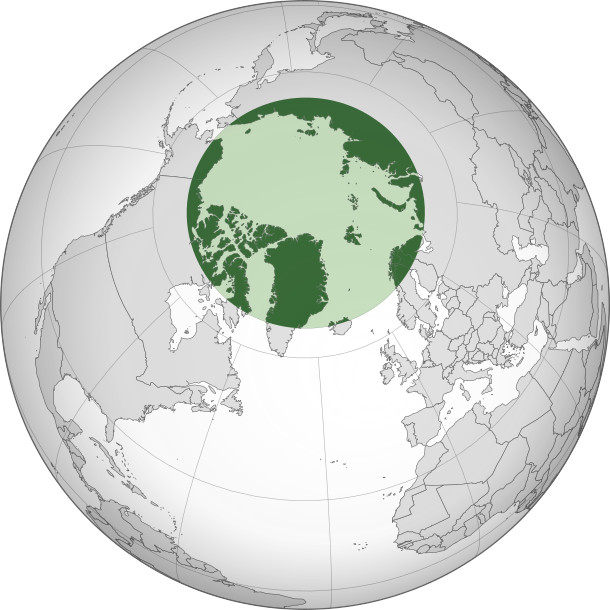
As temperatures rise, peatlands are expanding into regions that were previously too cold for them to grow in. This phenomenon is known as arctic greening. (Photo: Isochrone, Wikimedia Commons, CC BY-SA 3.0)
GALLEGO-SALA: So they basically all together they contain more carbon than there is in the atmosphere, or more carbon than all of the forests of the world combined. So that is a lot of carbon.
DOERING: That is a lot. And Angela, your study found that peatlands are expanding across the Arctic. This is part of a phenomenon known as Arctic greening. What's causing this?
GALLEGO-SALA: So, as the climate is warming, all of the biomes are expecting to be shifting polewards, so in the case of the Northern Hemisphere, northwards or higher up the mountain, if they're in a mountain setting, and peatlands are similarly, or they could be similarly shifting northwards. So we had a project that explored this possibility, and we found that indeed some of the peatlands in the Arctic are expanding, and this is because basically in their very high latitudes, plants have a very short window in the year where they can grow. As the climate is warming, that window is expanding, and so you get more input into the system, more carbon into the system, and if those systems are wet, then they can maybe the decomposition processes are slowed down enough to accumulate this peat.
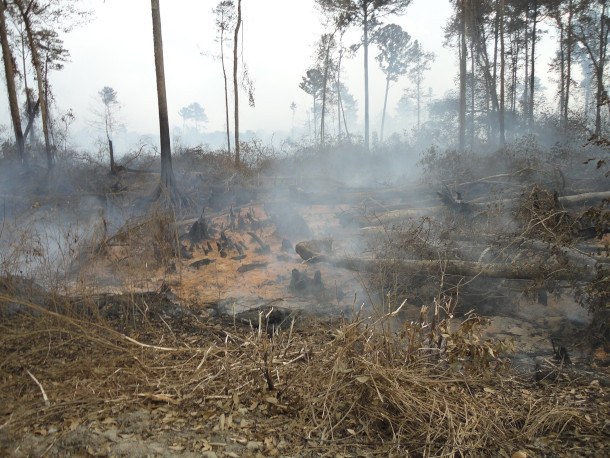
Although peatlands are great carbon sinks and absorb plenty of carbon, under hot dry seasons, they can paradoxically be a carbon emitter, with peat releasing carbon back into the atmosphere as it burns. Above, remnants of the Lateral West Fire in Great Dismal Swamp National Wildlife Refuge in Suffolk, Virginia. (Photo: U.S. Fish and Wildlife Services Northeast Region, Wikimedia Commons, CC BY-SA 2.0)
DOERING: I think anybody who's a gardener in many northern latitudes would understand, you know, I can't grow here in Boston vegetables for quite as long as someone in San Diego. So these places are getting warmer, the Arctic is getting warmer as the climate changes, and it's warming very quickly, as I understand. And then, what's the role of moisture, rainfall?
GALLEGO-SALA: Yeah, so this is the tricky part, that for other ecosystems we expect the biome just to shift northwards, but for peatlands the biome relies on really the soil being wet all year round, and the precipitation predictions are less certain, so we know less well how that will change, but even with that uncertainty, that most of the predictions say that the Arctic will become wetter, so it is likely that these peatlands will move northwards, but as you say, moisture will be key. So, if the areas are waterlogged, they will become peatlands, and if not, they will become something else, probably boreal forest, or whatever. The boreal forests are also moving northwards, for example.
DOERING: So, of course, peatlands are an important carbon sink. They are these places where the plants build up, where that carbon builds up. But I understand that this expansion of peatlands that you're documenting in the Arctic, that actually could become a source of carbon that could contribute to more warming over time. Why is that? Can you explain that sort of paradox for me?
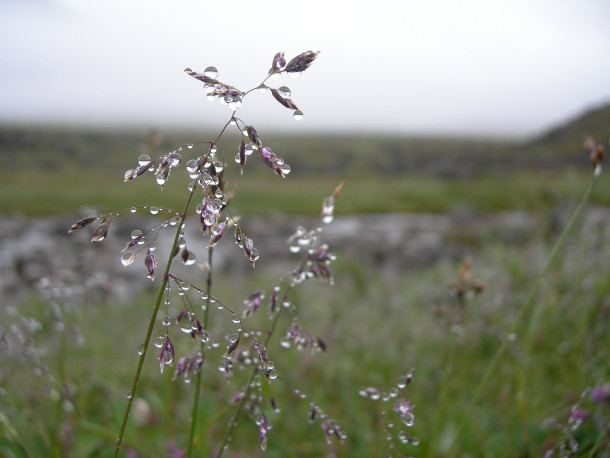
Precipitation and moisture are major components in the formation of peat, so a wetter Arctic calls for more opportunities for peat expansion. Here, grass grows near Pangniqtuuq, Nunavut, Canada. (Photo: Qaqqaqtunaaq, Wikimedia Commons, CC BY-SA 2.0)
GALLEGO-SALA: Yeah, so there is kind of like two hypotheses. So one is that because a lot of the Arctic is now under permafrost, so that means frozen, and that will thaw that all that thawing will release the carbon that is now in the soil, and that will, that carbon will be released into the atmosphere, and therefore you know it will contribute to warming, but our observations and our hypothesis is kind of saying, okay, that will may be the case for some parts of the Arctic, but for some parts of the Arctic, if they are wet enough, then that will not be the case, and they will be actually taking up carbon from the atmosphere, and both might be true, because you know the Arctic is complex, and these landscapes are complex, and there will be dry parts of the landscape and wet parts of the landscape, and also I would also say that there are other considerations that we of course, need to be aware of with climate change, that is not just the warming, but the extremes, and so we could have things like fire, for example, that could be an element that could tip the ecosystems into becoming sources, for example. So yes, we are documenting an expansion, but that doesn't mean that great, we can warm the earth, and you know nothing will happen. Actually, warming the earth can have, let's say, unwanted consequences beyond the greening of the Arctic, I would say.
DOERING: Right I mean, it sounds like you need a lot of moisture for these peatlands to form, but then let's say we get, you know, several really hot, really dry years, those peatlands dry out, maybe there's even fire that happens, and we've seen a lot of increasing fires in northern regions and boreal forest regions, especially, and then that contributes to a whole lot of carbon going into the atmosphere.
GALLEGO-SALA: Exactly, and that's the kind of real possibility for a lot of these peatlands, you know, not just the Arctic ones, but as you say, the boreal ones, they are suffering from more frequent fires, and this is something that is in some ways well unprecedented, in the sense that these wetter ecosystems don't normally catch fire if they are in a good climate, you know, in a favorable climate.
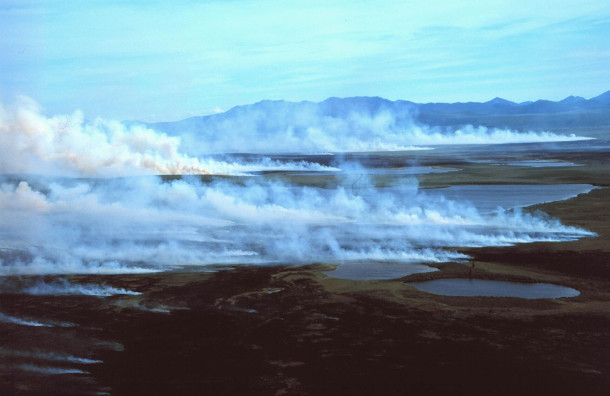
The hidden nature of zombie fires makes it more difficult to track and contain the damage they are causing to peat. Above, a smoky tundra landscape in front of the Baird Mountains in Alaska. (Photo: Western Arctic National Parklands, Wikimedia Commons, CC BY-SA 2.0)
DOERING: Angela, we've reported previously on the show about zombie fires, and I believe we were talking about, you know, when permafrost thaws and dries out enough, and then maybe the forest above it catches fire, and the soil itself, that carbon in the soil, that actually can catch fire, then be smoldering even throughout the whole winter. To what extent is that part of the concern here with peatlands, if they dry out, they could become these zombie fires?
GALLEGO-SALA: Yeah, so this is very real for peatlands all over the world, also in the tropics. So in the boreal area, but also in the tropics, when they are drained for agriculture, we also get these zombie fires, basically smoldering away, and you know, there is no visible flames, and therefore much harder to contain, much harder to stop. So, yeah, it's a real concern for peatlands, I would say all over the world, because you know they are very good at taking carbon away from the atmosphere, but actually this is a very slow process, so it happens over millennia, and these fires are releasing the carbon very fast, so all of the good work that the peatlands have done over all of that time is suddenly lost in a matter of months, or whatever, you know. So, really, this is definitely a concern for peatlands all over the world, I would say.
DOERING: There's a lot of different complicated things happening here. Some expansion of peatlands, as you've documented. How are you and other scientists responding to these findings, and what are your next steps?
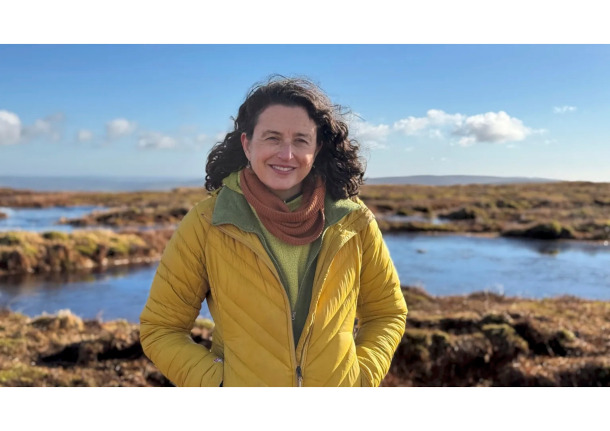
Angela Gallego-Sala is a professor and biogeochemist at the University of Exeter, as well as a lead author for the IPCC, the Intergovernmental Panel on Climate Change’s Seventh Assessment Report. She is in Working Group I, which examines the physical science underpinning past, present, and future climate change. (Photo: Courtesy of Angela Gallego-Sala)
GALLEGO-SALA: So, I think, as a scientist working in the natural environment, and trying to document changes due to climate change, I think there is a profound sadness, really. I mean, I love peatlands, and I love that they're expanding in the Arctic, but I'm still sad, you know, the fact that they are expanding is because we have a rapidly changing environment. We haven't mentioned them, but there is a lot of people that live in the Arctic, and their ways of life relies on having frozen ground and frozen seas, and you know their way of life is going to be profoundly affected by these changes. So I think it's not just me, but any of my colleagues that works in the natural environment, witnessing all of these changes, and kind of monitoring these changes. I think there is a part of us that is really sad, but on the other hand, I also, I'm a born optimist, and I think nature is extremely resilient, and that we still have time to do something about it, and to reverse these changes, and in a way, that's why my chapter in the IPCC is talking about, is talking about what are the consequences of not doing something about climate change, and can we reverse if we go too far in terms of temperature? Can we reverse that, and if so, how costly that is, and what is possible, and what is not. But I think sadness is probably a part of my job. I also very much enjoy my job, I have to say, and I enjoy very much working on these systems, but yes, I think we live in this kind of contradictory joy for studying the ecosystems that we love and sadness to be witness to what is happening really.
BELTRAN: Angela Gallego-Sala is a professor and biogeochemist at the University of Exeter and a lead author for the Intergovernmental Panel on Climate Change. She spoke with Living on Earth’s Jenni Doering.
Links
Living on Earth wants to hear from you!
Living on Earth
62 Calef Highway, Suite 212
Lee, NH 03861
Telephone: 617-287-4121
E-mail: comments@loe.org
Newsletter [Click here]
Donate to Living on Earth!
Living on Earth is an independent media program and relies entirely on contributions from listeners and institutions supporting public service. Please donate now to preserve an independent environmental voice.
NewsletterLiving on Earth offers a weekly delivery of the show's rundown to your mailbox. Sign up for our newsletter today!
 Sailors For The Sea: Be the change you want to sea.
 The Grantham Foundation for the Protection of the Environment: Committed to protecting and improving the health of the global environment.
 Contribute to Living on Earth and receive, as our gift to you, an archival print of one of Mark Seth Lender's extraordinary wildlife photographs. Follow the link to see Mark's current collection of photographs.
 Buy a signed copy of Mark Seth Lender's book Smeagull the Seagull & support Living on Earth
© Copyright World Media Foundation. All Rights Reserved
Home | Contact | RSS | Donate | Newsletter