

A Bend in the Creek
Air Date: Week of July 10, 2026
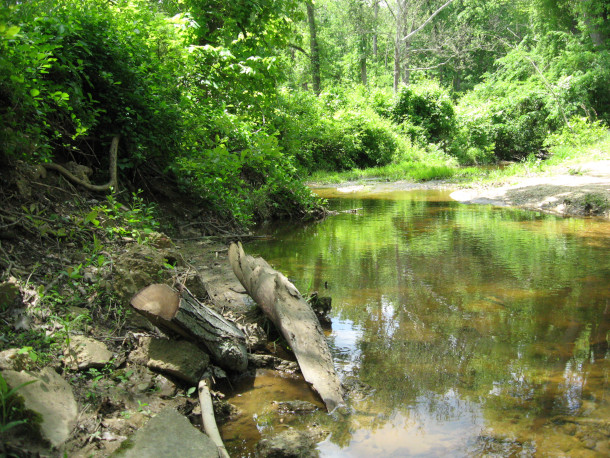
Little Creek borders Marine Corps Base Quantico in Virginia, where Don Lyman lived when his father was a Marine. (Photo: Don Lyman)
The long days of summer and freedom from school bring some kids the chance to explore the outdoors, sometimes with wildlife encounters. Living on Earth’s Don Lyman shares one of those memories from his boyhood and how it took on a new dimension later in life.
Transcript
O’NEILL: The long days of summer and freedom from school bring some kids the chance to explore the outdoors, sometimes with wildlife encounters. Living on Earth’s Don Lyman shares one of those memories from his boyhood and how it took on a new dimension later in life.
LYMAN: The winding course of Little Creek formed the boundary between Marine Corps Base Quantico and the town of Triangle, Virginia. On one side of the creek was the base golf course, bisected by the main road leading into Quantico. On the other side, beyond the tangle of green briars and blackberry brambles that lined the creek bank, was a small Southern town. Carefully manicured fairways, tidy red brick government buildings, and a gate guarded by armed Marine Corps sentries in their neatly pressed uniforms, contrasted sharply with the older homes, overgrown lawns, and even the occasional shack in Triangle.
The water in the creek was clear, but littered with discarded bottles, bits of paper and plastic, and slabs of broken concrete. Yet, for young boys with a love of nature, it seemed like paradise. Little Creek provided a place for my friends and I to explore, a mysterious world where we could find all manner of curious creatures.
Our dads were Marines, and we lived on the base. My friends Tom and Junior were brothers, 12 and 13 respectively. Steve was 12, and at 14, I was the oldest of our intrepid little group of budding biologists.
We shared an interest in nature and wildlife, especially herpetology ─ the study of reptiles and amphibians ─ and we loved to go exploring. Carefully traversing steep banks of eroded soil to the stream below, we'd spend hot, humid summer days splashing through the cool, shallow waters that flowed gently over sand and gravel. Shade from big oaks, tulip trees, and sweetgum that towered over the creek protected us from the hot sun. We flipped over rocks and pieces of concrete along the edges of the creek to see what treasures might be concealed beneath ─ striped queen snakes, feisty little water snakes, frogs, salamanders, crayfish. It seemed there was always some new discovery that awaited us.
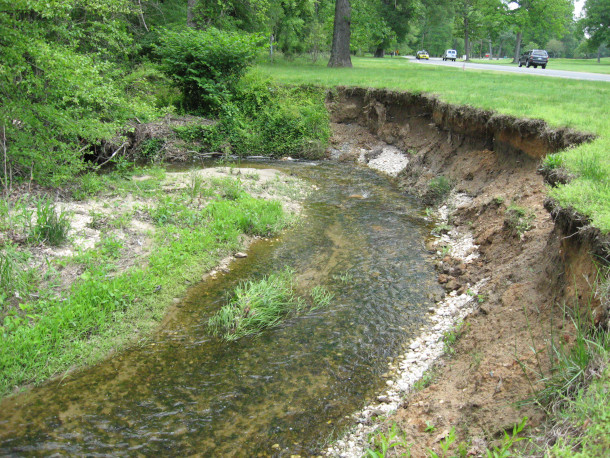
Lyman and his friends loved exploring the wildlife of the area, and once saw a snapping turtle at a bend in the creek. (Photo: Don Lyman)
One summer day we came upon a large snapping turtle that had crawled up onto a sandy bank at a bend in the creek. Its shell was nearly a foot-and-a-half-long, and the turtle probably weighed about 30 pounds. With a hooked beak, sharp jaws, and a powerful bite, snappers can be dangerous, so we kept a safe distance while we observed the ponderous reptile slowly making its way toward the water. Plodding along with its legs fully extended, and its long saw-toothed tail dragging behind it, the snapper looked prehistoric.
Suddenly from behind us someone shouted, "Catch that turtle! Don't let it get away!"
Startled, we turned to see an old man with white hair and a scraggly white beard hobbling toward us on a cane. A little black dog followed close behind him, barking furiously. The man lived in a small shack in Triangle a couple hundred feet from the creek.
By this time the turtle had reached the edge of the water.
"Grab him! I can eat him for dinner!", the old man shouted.
We were torn between disobeying an adult and not wanting the old man to kill the turtle, not to mention the danger of trying to capture such a large snapper.
"Just grab him by the tail and drag him up onto the bank!" he commanded.
Junior and I tentatively waded into the water, exchanging knowing glances, and made a half-hearted effort to catch the snapper, dancing around and grabbing at its tail as the turtle slipped into a deep pool and disappeared under a tangle of partially submerged tree roots. I felt relieved that the turtle was safely out of reach.
"I could have ‘et’ him for my supper," the old man grumbled.
"We tried to catch it but it got away," I nervously replied, feeling badly that I wasn't telling the truth.
"You should have grabbed it," the old man said as he walked away.
"I felt bad for him," I told Junior. "Maybe he didn't have anything to eat."
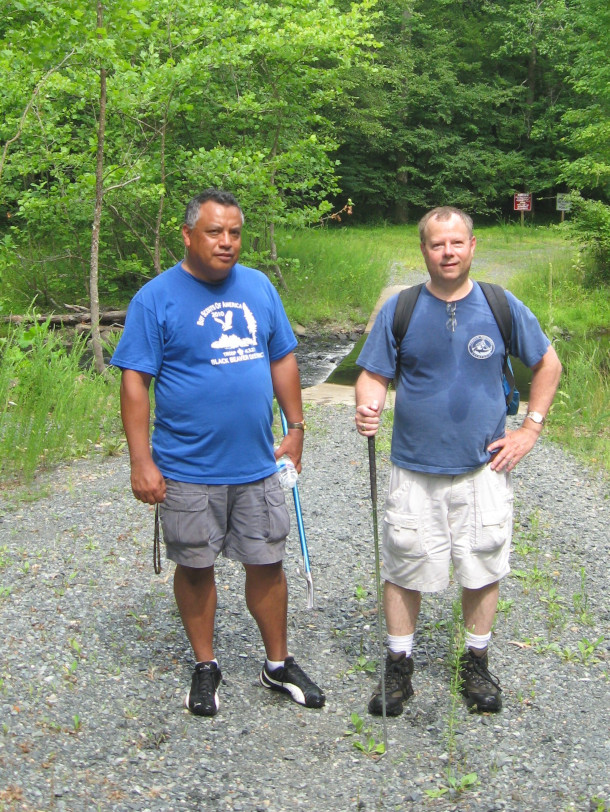
Don Lyman, right, with his childhood friend Junior Poolaw, left, at nearby Chopawamsic Creek during their 2010 reunion trip to Marine Corps Base Quantico. (Photo: Don Lyman)
"Me too," Junior replied. "But I didn't want him to kill the turtle."
"Me neither," I said. "Me neither."
In the summer of 2010, I headed south from New England for a reunion with Junior at Quantico. We’d both become teachers among other careers – Junior at the high school level and myself as an adjunct college professor—and we still shared a fervent love of herpetology.
We spent several wonderful days exploring our old boyhood haunts, including Little Creek, searching for reptiles and amphibians like we did when we were kids, this time accompanied by Junior’s oldest son, Dane, who had recently graduated from college.
Over 40 summers had passed since our youthful adventures at Quantico. The old man and the shack he lived in were gone, and the young boys who once explored the creek had long since grown into men.
Walking along Little Creek brought back memories of the snapping turtle incident. Reflecting on our experience, I realized that perhaps our encounter with the old man went much deeper than the inner turmoil between obeying or not obeying an adult, and even beyond not wanting to kill another living creature.
On another level the encounter represented a clash of cultures between our middle-class world on the Marine base and the poverty on the other side of the creek. It brought forth the stark reality that while some people enjoy nature for its recreational, scientific, and aesthetic value, others may depend on it for their very survival.
It was a hard lesson and a tough choice for young boys to make, but even looking back through the experienced lens of adulthood, I still don't think I could have brought myself to help kill that turtle. To my friends and me, Little Creek was a refuge, not only for us, but also for the creatures that lived there.
O’NEILL: That’s Living on Earth’s Don Lyman.
Links
Living on Earth wants to hear from you!
Living on Earth
62 Calef Highway, Suite 212
Lee, NH 03861
Telephone: 617-287-4121
E-mail: comments@loe.org
Newsletter [Click here]
Donate to Living on Earth!
Living on Earth is an independent media program and relies entirely on contributions from listeners and institutions supporting public service. Please donate now to preserve an independent environmental voice.
NewsletterLiving on Earth offers a weekly delivery of the show's rundown to your mailbox. Sign up for our newsletter today!
 Sailors For The Sea: Be the change you want to sea.
 The Grantham Foundation for the Protection of the Environment: Committed to protecting and improving the health of the global environment.
 Contribute to Living on Earth and receive, as our gift to you, an archival print of one of Mark Seth Lender's extraordinary wildlife photographs. Follow the link to see Mark's current collection of photographs.
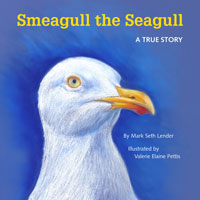 Buy a signed copy of Mark Seth Lender's book Smeagull the Seagull & support Living on Earth
© Copyright World Media Foundation. All Rights Reserved
Home | Contact | RSS | Donate | Newsletter