

Nuts to Feed the World
Air Date: Week of July 10, 2026
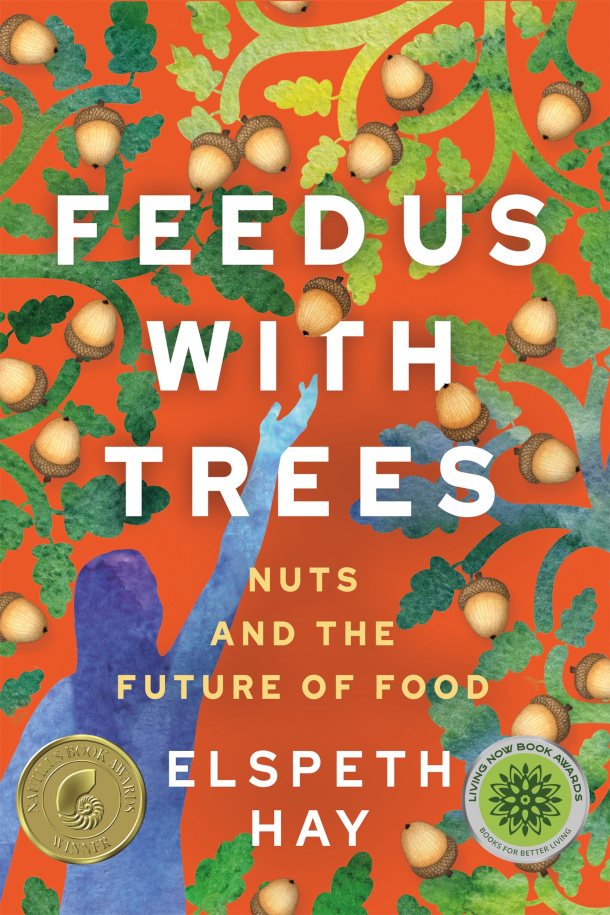
Feed Us With Trees: Nuts and the Future of Food by Elspeth Hay. (Cover design by Diane McIntosh)
Much of the world’s staple crops of corn, wheat, rice and soy are grown in huge monocultures that disrupt ecosystems and require massive amounts of fertilizer, pesticides, fossil fuels and water. In her book Feed Us with Trees: Nuts and the Future of Food, Elspeth Hay offers a more sustainable vision of food production. She joins Host Paloma Beltran to share how nut trees can offer alternative sources of starch, protein and healthy fats that integrate well into local ecosystems and can help feed a growing population.
Transcript
O’NEILL: It’s Living on Earth, I’m Aynsley O’Neill.
BELTRAN: And I’m Paloma Beltran.
Much of the world’s staple crops of corn, wheat, rice and soy are grown in massive monocultures. Backed by subsidies from the US federal government for nearly a century, this form of food production continues to be incentivized, despite negative environmental impacts like habitat destruction and the massive amounts of fertilizer, pesticides, fossil fuels and water it often involves. Much of that grain is fed to livestock with a huge carbon footprint and our food system accounts for as much as a quarter to a third of global greenhouse gas emissions. But there may be a more sustainable way to feed our growing population, if we’re willing to learn from an ancient, largely forgotten food system. Elspeth Hay is the host of “The Local Food Report” on WCAI and the author of Feed Us With Trees: Nuts and the Future of Food, and she joins me now. Elspeth, welcome to Living on Earth!
HAY: Thank you so much for having me. It's exciting to be here.
BELTRAN: So, tell me a bit about how you grew up. You know, what stories about humans and their relationship to the land were dominant in your culture?
HAY: So, I grew up in Maine with two parents who were bird watchers, and we spent a lot of time traveling around the state of Maine, looking at birds in different habitats, and I learned about the ways that bird species were really well adapted to the places where they lived. I remember learning about crossbills and how they had these mandibles perfectly adapted to extracting conifer seeds from the trees where they lived, sap suckers drilling neat little rows of holes into maples and birches, and then we would come home from these sort of field trips to different ecosystems and get our food from the grocery store, and as I started to get older and make my way through school, I realized that the way that we were getting our food was really different, and was actually destroying these same ecosystems that all of these wild species depended on, and I definitely couldn't have articulated it as a kid, but I always had this sense of wrongness, and of feeling like, what, what is wrong with our species? Why don't we fit into our habitat in the same way that these other species do? It didn't make sense.
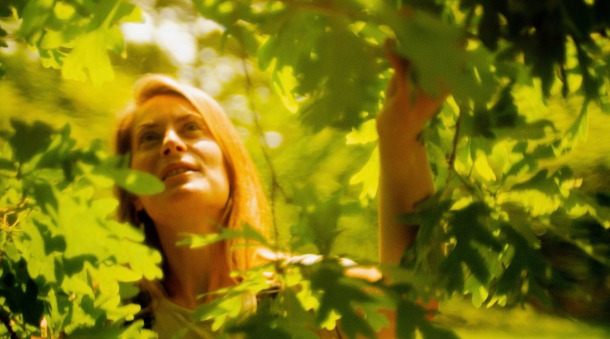
Our guest, Elspeth Hay, checking for acorns on a white oak, Quercus alba, at home on Cape Cod. Elspeth says she never considered acorns as a food source until hearing a TED talk by Marcy Mayer. (Photo: J. Elon Goodman)
BELTRAN: And Elspeth, you're the host and creator of "The Local Food Report," which airs on the Cape and Islands NPR station. So clearly you think a lot about food and where it comes from. What got you thinking, hey, maybe there's a better way of doing this?
HAY: Yeah, I get to talk to farmers and fishermen and policymakers all the time, and it's pretty rare that I hear something truly kind of revolutionary that catches me in a new way. But about six years ago now, a friend sent me a link to a TEDx talk by a woman in Greece named Marcy Mayer, and she said that acorns, which I had always seen as a nuisance in my yard, are edible and are human food, and not just edible, but actually one of our oldest human foods, and a super food, and that got my attention. I live in Cape Cod, on the Cape Cod National Seashore, and I am in a forest that is completely surrounding me, of oak trees, and so I had always seen these acorns falling in the yard and around the house as kind of a nuisance, maybe food for squirrel and deer, definitely not a human food source, I had never heard of people eating acorns. And I was shocked that all around me all this time had been this food source, while I had been seeing these trees and this protected land as basically an impediment to food production, because I had always understood food as coming from farmed fields, so that was a big moment of discovery for me and I immediately started trying to learn more, not just about acorns, but also about some other nut trees, once I started to realize how many different options there were for growing food on nut trees.
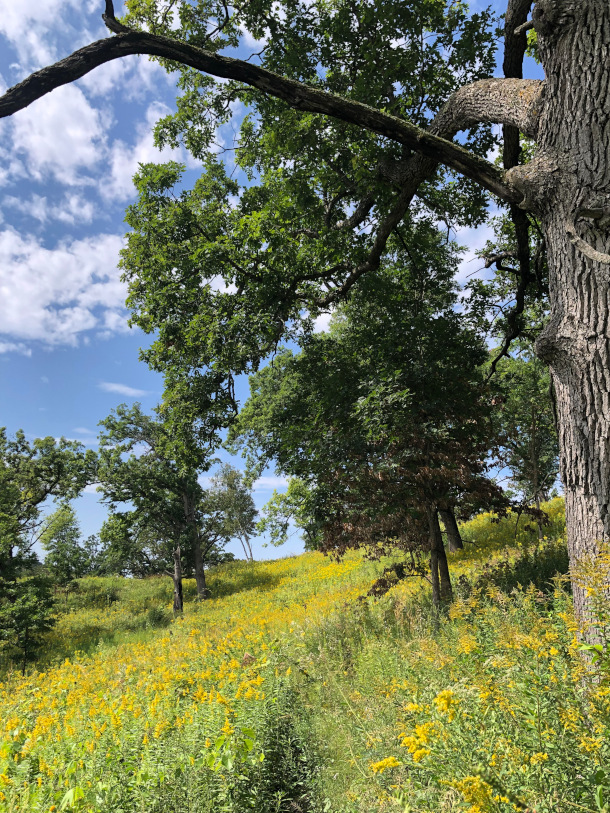
A restored oak savanna in Black Earth, Wisconsin with a canopy of open grown oaks, black walnuts, and hickories that tower over an understory filled with ripe hazelnuts. Under Midwest Indigenous management, oak savannas once covered much of what we think of today as American farm country and were tended with fire as a key management tool. (Photo: Elspeth Hay)
BELTRAN: So, what has the role of nut trees been historically for indigenous people here and beyond?
HAY: So all over the northern hemisphere, in an incredibly diverse range of cultures, nut trees, including oaks, chestnuts, walnuts, pecans, hazelnuts, a huge range of nut trees, have been staple crops, so that means they're growing everyday foods, like today we would consider wheat or corn or soy or rice a staple crop, and the history of these nut trees as staple crops actually stretches back much farther than grains. Ever since the end of the last ice age in the northern hemisphere, these trees have been staple foods in North America, in Europe, in Asia, Northern Africa, the Mediterranean, the Middle East, this incredible range of cultures. And people have learned how to have a relationship with these trees that ranges from intense cultivation to a more semi feral cultivation, but when you look at archeological records in Japan, for instance, you see the size of chestnut burrs increasing because of human interaction with trees. When you look at North America, you see indigenous peoples here in a variety of different cultures using fire to keep trees like oaks and hickories dominant on the landscape. People have relied on these foods as a major part of their diet.
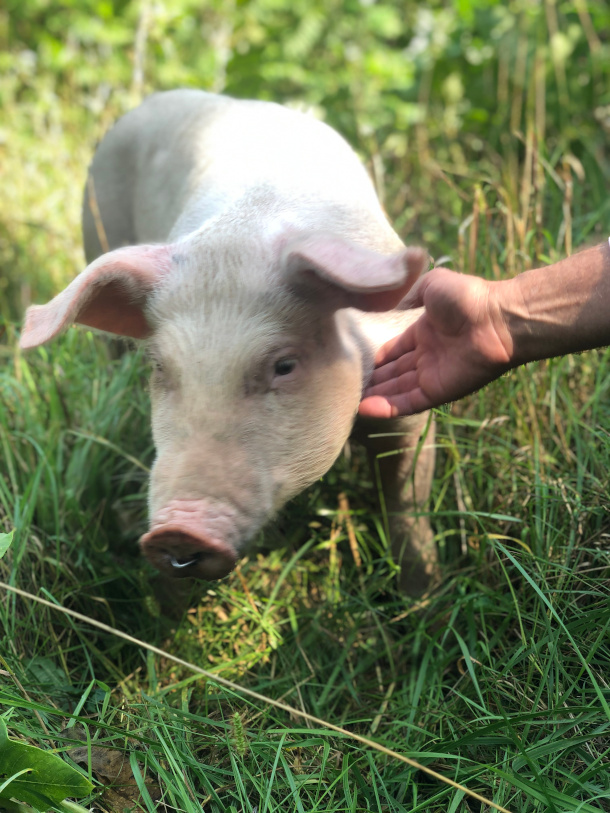
A pig living on a perennial nut farm in Wisconsin. Historically, many cultures have used nut trees as staple crops the same way we use corn and soy today—as food for both humans and livestock. (Photo: Elspeth Hay)
BELTRAN: And also the part of the genocide against indigenous people here in America was focused on destroying their food systems, specifically nut trees. Can you talk to us about that? You know, how did that history lead us to where we are today?
HAY: Yeah, I think you know, when I was a kid, I was taught settler history, which the basic version is, Europeans came to this continent and it was tragic, but a lot of indigenous people died from diseases that we brought, and so the land was sort of ours to take, and that story could not be farther from the truth. There were millions of indigenous people killed by Euro-American settler soldiers as we moved across this continent, and a lot of the fighting was really focused on destroying food systems. So here in the East that looked like enclosing woodlands so that areas that had been nut producing and tended as game woodlands, as nut woodlands, were divvied up into private property and farmed instead of being allowed to be owned communally, so that system spread west with the killing of the bison, and it moved all the way to the Pacific Coast into an area where acorn tending and oak tending as a staple food crop was really prevalent in a lot of California, present day California, before Euro Americans got there and there was this system that the government came up with to incentivize basically a system of forced farming to get indigenous people to stop tending these tree crops and to move toward row crop farming.
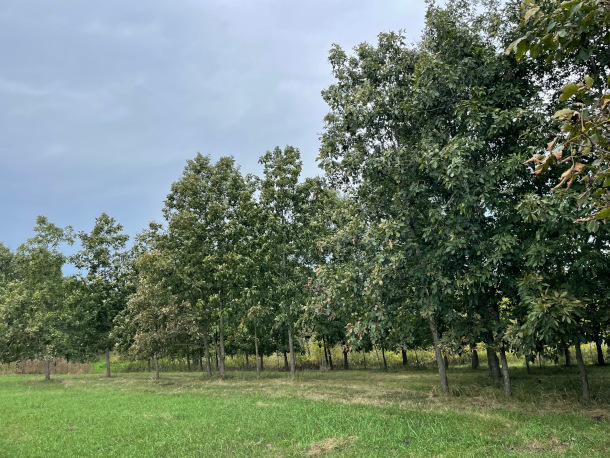
A grove of hickories in Canton, Minnesota that are experimentally being tended with fire. (Photo: Elspeth Hay)
They had a system called allotment and allotting agents went onto indigenous land, indigenous reservations, and told people that if they didn't farm the land, it would be taken by white settlers, and that legally they had to farm the land in order to gain title to it, so they forced people, you know, not only was there so much violence and so many other culturally insidious ways of enacting genocide on indigenous people, but there was also this forced change in food production, and it was so tied to so much of the other violence, and food is so culturally important, and so ecologically important, and tied to so much of how we see ourselves, and you know what creates a culture, and so targeting that was another way of targeting indigenous people and forcing them to assimilate to Euro-American settler culture.
BELTRAN: So, what does the cultivation of nut trees look like, and how does it compare to our industrial agriculture?
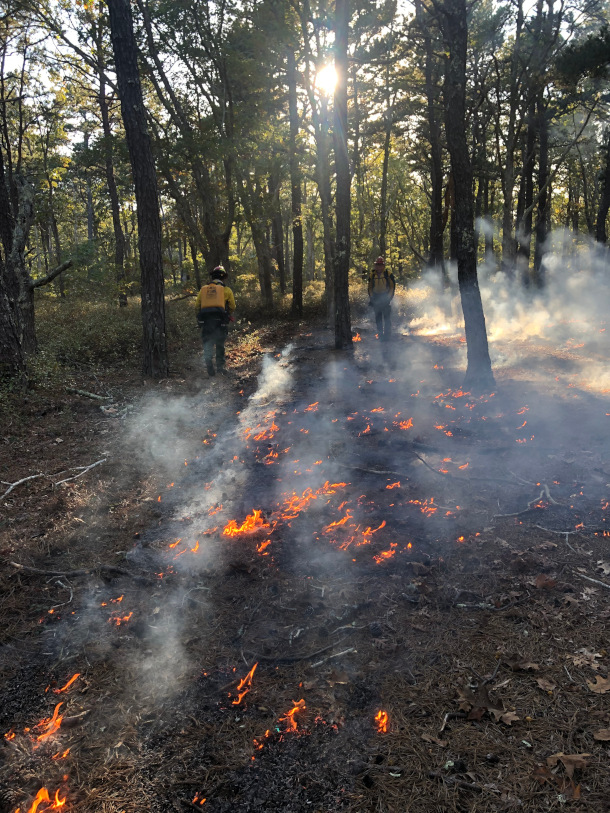
A prescribed fire near the author's house in an oak forest in Truro, MA. (Photo: Elspeth Hay)
HAY: So it's pretty different, and also almost exactly the same, which is kind of a confusing answer, but the ways that it's different, let's start with that. When you're tending an industrial agriculture field, you are turning over the land, so that process is emitting carbon dioxide, and when we think about the way that land is managed, that is a really big contributor to the climate chaos that we find ourselves in today. In contrast, when we tend these trees as staple crops, we are allowing them to keep their roots in the soil year after year, decade after decade. Some of these trees can actually live for hundreds, if not up to a thousand or more years, and every year that they are staying present on that land and in that soil, they're sending carbon into the ground instead of releasing it out. So, from an environmental perspective, that alone is a pretty big difference. But biodiversity is also incredibly important to the health of our ecosystems, and in a lot of cultures, traditionally, some of these nut trees, in particular oaks, have been called the “tree of life,” and I think we tend to think of that as like a quaint, beautiful phrase, but it's actually very literal. Scientists now are beginning to understand that some plants host a lot more biodiversity and foster much more life in their ecosystems than others, and oaks in most places where they occur are the top life-producing trees. So it's also really different in terms of biodiversity, you know.
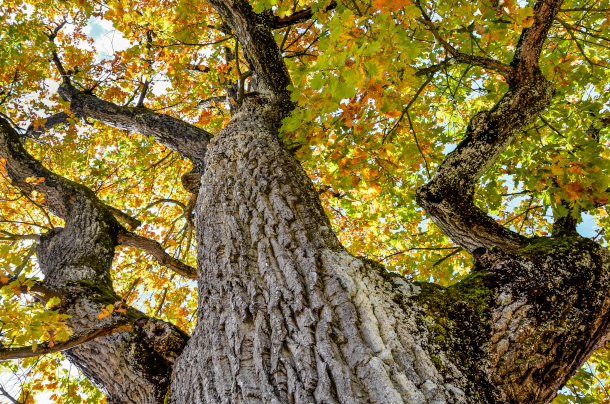
Oak trees are considered strongholds of biodiversity, with their acorns sustaining larger animals while their branches provide homes to birds and insects. (Photo: Johann Jaritz, Wikimedia Commons, CC BY-SA 4.0)
A monoculture of soy versus an oak tree creates a very different habitat and has a very different impact on the collection of species that's around it. So that's what I mean when I say they're very different. They have very different impacts on life cycles of our ecosystems, but they're also very similar in the fact that the jobs that we do to tend these tree systems are almost exactly the same as the jobs that we need to do to tend these industrial fields. We need to keep down weeds. We need to prepare the earth for the crop to seed well. We need to make sure that there's enough nutrients and that we're fertilizing the land. We need to control the water cycle, make sure things are getting enough water, but we are doing those jobs really differently. So same jobs, different tools. On an industrial farm, you know, those jobs might be done with pesticides and an irrigation system and tractor, whereas in a lot of traditional nut tending systems, those jobs are done either with fire, which is an incredible recycler of nutrients, it also prepares the land for crops, it can actually control the water cycle in really interesting ways, keep down pests and pathogens. So different tools, but same jobs and same systems that we're working to control these crops.
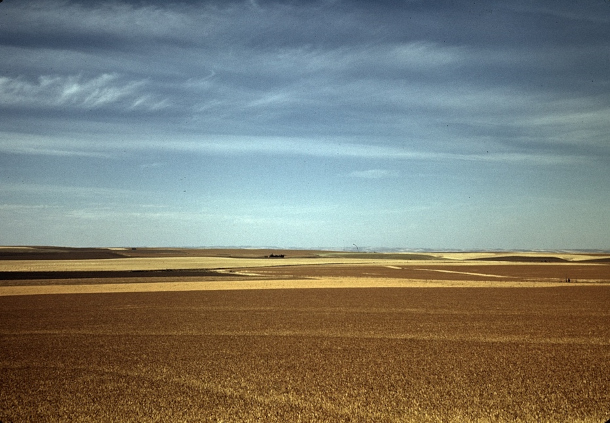
A wheat farm in Walla Walla, Washington. Industrial agriculture and monoculture crops are often depicted as highly productive. However, when inputs like fossil fuels and land are considered, yield calculations can decrease. (Photo: Russell Lee, Wikimedia Commons, public domain)
BELTRAN: You know, many people might wonder, how feasible is this? You know, can nut trees really produce enough food to feed the world?
HAY: Yeah, I had a lot of questions about that while I was researching my book. I got pretty hung up on it for a while. I called it the "yield question," and I was obsessed, because I knew that that would be the first way that people tried to pick this idea apart, right? And something really interesting happened when I started researching the yield question. The first is that I discovered that most of the food that we say, you know, oh, we have to have this system because we have to feed the world. Well, we're not eating most of the food that we're growing, so that argument falls apart pretty quickly. For instance, with corn in the United States, we eat 1% of the corn we grow, the rest is used to produce ethanol, or it's fed to animals, or it's exported to other countries where it destroys their local agricultural economies. So we are not doing this to feed ourselves, but you know, even then I thought, okay, I want to look at this on an acre-by-acre yield basis, right? Because if we're serious about feeding the world, it really matters how much these different crops can produce on an acre of land, and when I looked into that, I discovered a few things.
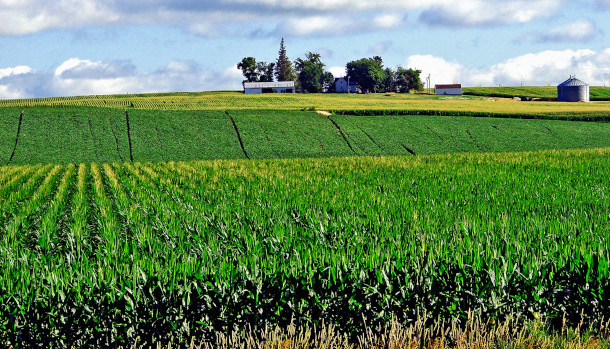
A corn field in Northwest Iowa. In the United States only about 1% of the corn we grow is the sweet corn we eat. Much of the rest is made into ethanol, used for animal feed, or shipped overseas. (Photo: inkknife_2000, Wikimedia Commons, CC BY-SA 2.0)
One is that the way that we're evaluating yield currently is really misleading, so we talk about yield and we say, okay, this acre of corn is yielding 12,000 pounds of corn or whatever it is, but we're not talking about all of the other land that is required to over produce on that sort of little fictional island of land, so when we're talking about yield, it's a ratio, right? It should count all of the energy or calories or nutrients that you're getting out from an acre of land for what you've put in, and when we look at our traditional yield numbers, they're not counting that ratio, they're counting the land that we're producing on, but they're not counting the land that we had to mine to get the fossil fuels to produce that crop, we're not counting so much other land that goes into this production, and when you do count that land, these diverse polyculture tree-based ecosystems or farms are significantly more productive than this industrial agriculture system that we think of as uber production. And there is another layer, so I was also comparing pounds, right? Okay, how many pounds of acorns can this oak savanna ecosystem produce versus a corn field, and when we look at that, that's also not that telling, because a pound of lettuce nutritionally is very different than a pound of hazelnuts, right? One is much more nutrient dense, you're getting more calories, more energy, and so again, in terms of the actual energy that they're producing, these nut trees out-produce our traditional row crop system. And I feel like I finally really fully understood it one day when a farmer told me, we were standing in a field and he said, "Look at this tree, and then look over at this field of corn, look how tall the tree is, look, how three dimensional it is. Look how much sunlight it can capture with its photosynthetic process. Now, look at the field of corn, and how small it looks in comparison." And he reminded me that photosynthesis is what produces these sugars, that it's what produces food, and any ecosystem that is capable of the most photosynthesis will sort of, by definition, also be producing the most food.
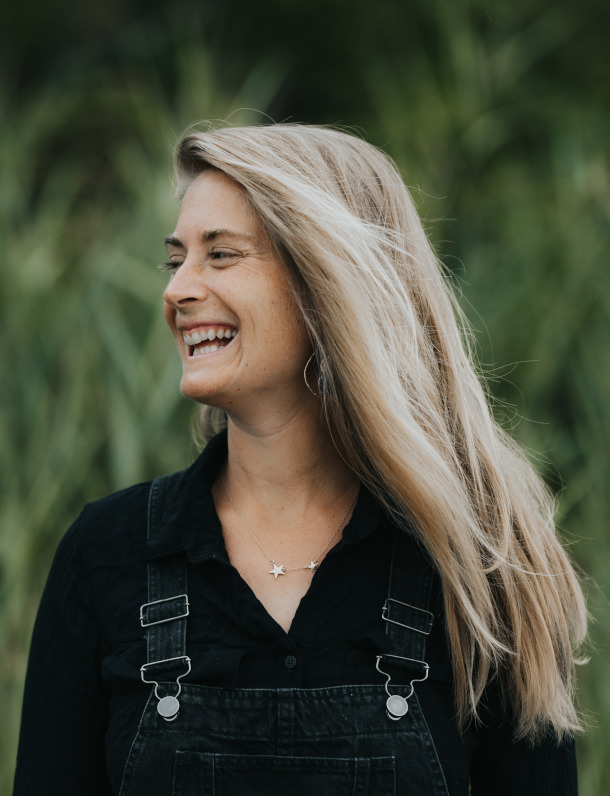
Elspeth Hay is the host of “The Local Food Report” on the Cape and Islands NPR station WCAI and the author of Feed Us With Trees: Nuts and the Future of Food. (Photo: Joe Navas)
BELTRAN: Yeah, so what food products can we potentially make from nuts? You know, it's not just acorn pancakes and roasted chestnuts, right?
HAY: Right, yeah. So there's five major food groups that you can think about coming from these nut trees. One is flour, right? And the second is milks. The third product is the most obvious, which is just nuts themselves, you know. And then there's oil. So I hadn't thought a lot about nut oils when I first started researching my book, but in fact, most nuts are really great for oil production. And then the last category, which really surprised me at first, because I'd never thought about it, is starch. So you think about it, most cultures need, they need staple starches, milks, oils, and nuts really have that covered in the same way that grains and some of these other staple foods that we are more familiar with do.
BELTRAN: So, where are we when it comes to increasing nut tree production in the US and around the world?
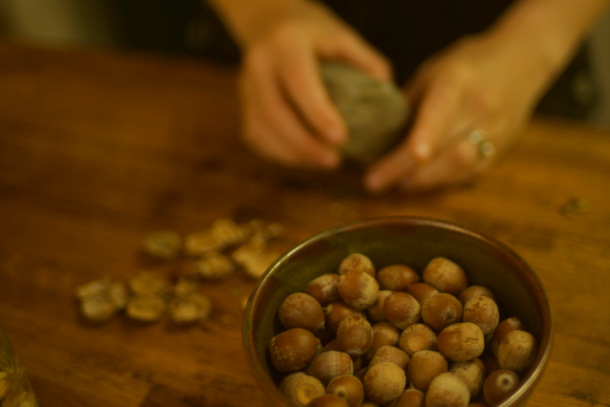
Cracking acorns by hand; the processing can also be done by machine. Nuts can produce five main types of food products: flours, milks, whole nuts, oils, and starches. (Photo: Elspeth Hay)
HAY: So other areas of the world are much farther ahead than we are. A lot of these nut trees are established crops in places like Europe and Asia, where people really haven't forgotten about them in the same way that we have here. I would say in the US there has been a really big surge in interest, and there are a lot of systems going into the ground right now, but that progress, which was really beginning to accelerate, has been hampered by recent political changes and changes in funding, so prior to the current administration, the last administration was putting a lot of money into agroforestry and really trying to help facilitate this transition to more tree-based agriculture, and a lot of that funding was taken away in the past few years, so in some ways that's a sign of success, which maybe sounds odd, but it was getting big enough, I think, for someone to start paying attention and say, "Wait, why are we funding this?" In other ways, it means there are a lot of challenges still to come, but I think that the conversation in the farming community has really ignited, and the number of conferences and presentations, and just farmer to farmer conversations that have some mention of these crops in them has really escalated to the point where, I don't think it's disappearing again, because it's become part of mainstream conversation in farming circles.
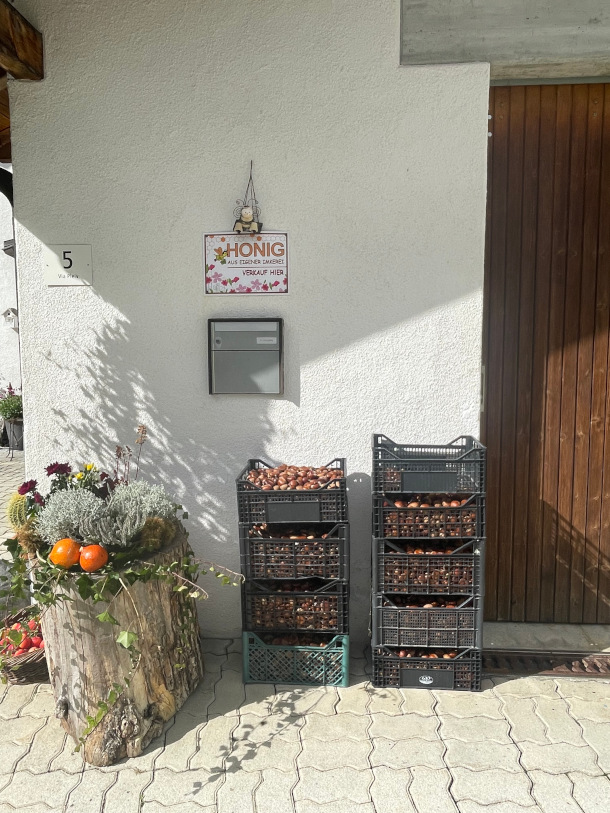
Fresh chestnuts for sale in the village of Soglio, in the Val Bregaglia valley on the border of Italy and Switzerland, where local people have been growing chestnuts as a staple food for thousands of years. (Photo: Elspeth Hay)
BELTRAN: Elspeth Hay is the host of "The Local Food Report" on Cape and Islands NPR station, and the author of Feed Us with Trees: Nuts and the Future of Food. Elspeth, thank you so much for joining us.
HAY: Thank you so much, Paloma. It's been a pleasure.
Links
Living on Earth wants to hear from you!
Living on Earth
62 Calef Highway, Suite 212
Lee, NH 03861
Telephone: 617-287-4121
E-mail: comments@loe.org
Newsletter [Click here]
Donate to Living on Earth!
Living on Earth is an independent media program and relies entirely on contributions from listeners and institutions supporting public service. Please donate now to preserve an independent environmental voice.
NewsletterLiving on Earth offers a weekly delivery of the show's rundown to your mailbox. Sign up for our newsletter today!
 Sailors For The Sea: Be the change you want to sea.
 The Grantham Foundation for the Protection of the Environment: Committed to protecting and improving the health of the global environment.
 Contribute to Living on Earth and receive, as our gift to you, an archival print of one of Mark Seth Lender's extraordinary wildlife photographs. Follow the link to see Mark's current collection of photographs.
 Buy a signed copy of Mark Seth Lender's book Smeagull the Seagull & support Living on Earth
© Copyright World Media Foundation. All Rights Reserved
Home | Contact | RSS | Donate | Newsletter