

April 10, 2026
Air Date: April 10, 2026
FULL SHOW
SEGMENTS
Floating Border Wall
/ Martha PskowskiView the page for this story
About two thirds of the US-Mexico border is along the Rio Grande, and the Trump Administration is working to install hundreds of miles of buoy barriers in the river, to prevent illegal crossings. Now residents of border towns, researchers, and activists are raising the alarm over how those buoys and other barriers could impact wildlife, restrict access to the river and sever cultural ties. Martha Pskowski, a reporter based in Texas for our media partner Inside Climate News, joins Host Paloma Beltran to discuss. (12:41)
$1 Billion to Abandon Offshore Wind
View the page for this story
The US Department of the Interior recently announced an agreement to pay the multinational company TotalEnergies nearly $1 Billion to abandon its offshore wind leases and instead invest in oil, natural gas and LNG production in the U.S. Yet several major offshore wind projects are coming online, including Revolution Wind in New England and Coastal Virginia Offshore Wind. Katharine Kollins, president of the advocacy group Southeastern Wind Coalition, speaks with Host Jenni Doering about the Trump administration deal with TotalEnergies and the state of offshore wind. (11:08)
Climate Coverage Dropoff
View the page for this story
News media outlets are retreating from covering climate change, according to the Media and Climate Change Observatory at the University of Colorado Boulder, which has been tracking this trend for decades. They report that since a peak in 2021, climate news stories across the globe have dropped nearly 40 percent. Professor Max Boykoff is director of the Media and Climate Change Observatory and spoke with Living on Earth Host and Executive Producer, Steve Curwood. (07:50)
"Night Owl" -- Poems by Aimee Nezhukumatathil
View the page for this story
The poems in Aimee Nezhukumatathil’s new book Night Owl offer a window into the magic of nature at night and a light in the darkness. She joins Host Jenni Doering to share selected poems from the collection and talk about how poetry can help us grapple with ecological loss and celebrate natural wonders alike. (15:03)
Show Credits and Funders
Show Transcript
260410 Transcript
HOSTS: Paloma Beltran, Jenni Doering
GUESTS: Max Boykoff, Katharine Kollins, Aimee Nezhukumatathil, Martha Pskowski
[THEME]
DOERING: From PRX – this is Living on Earth.
[THEME]
DOERING: I’m Jenni Doering.
BELTRAN: And I’m Paloma Beltran.
Communities across the U.S.-Mexico border raise concerns about barriers in the Rio Grande.
PSKOWSKI: It was their annual Charro Days celebration—that’s when some of the local environmental groups chose to have a protest about the buoys, because they really wanted to point out there's this huge project to put buoys in the river, which would just further sever the two countries.
DOERING: And poems about the magic of the nighttime world.
NEZHUKUMATATHIL: I'm seeing this thread throughout the poems that I was writing in the last decade, of noticing the world at night, you know, the outside world at night, how animals move or don't move, how plants and fungi move and percolate a little bit at night. The outdoors is so alive at night.
DOERING: That and more, this week on Living on Earth. Stick around!
[NEWSBREAK MUSIC: Boards Of Canada “Zoetrope” from “In A Beautiful Place Out In The Country” (Warp Records 2000)]
[THEME]
Floating Border Wall
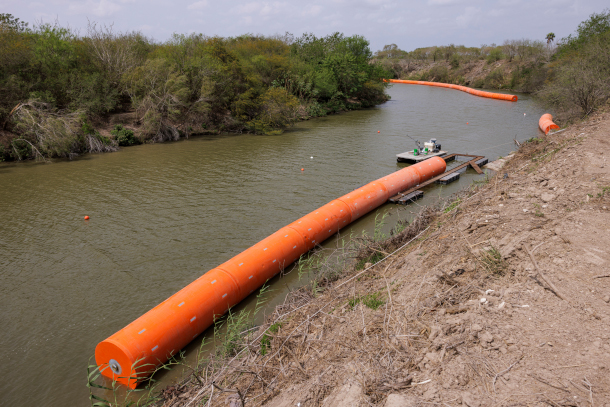
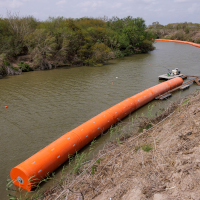
Water buoys were installed on the Rio Grande where it runs through Brownsville. (Photo: Michael Gonzalez, Inside Climate News)
DOERING: From PRX and the Jennifer and Ted Stanley Studios at the University of Massachusetts Boston, this is Living on Earth, I’m Jenni Doering.
BELTRAN: And I’m Paloma Beltran.
The Trump administration’s hard line on immigration includes efforts to seal off the U.S.-Mexico border, and not just with a wall or fence. About two thirds of the border is along the Rio Grande, and the federal government is working to install hundreds of miles of buoy barriers in the river, to prevent illegal crossings. Now residents of border towns, researchers, and activists are raising the alarm over how those buoys and other barriers could impact wildlife, restrict access to the river and sever cultural ties. For more, I’m joined by Martha Pskowski, a reporter based in Texas for our media partner Inside Climate News. Martha, welcome back to Living on Earth!
PSKOWSKI: Thank you, Paloma. It's great to be back.
BELTRAN: So I understand that the federal government wants to install over 500 miles of buoys stretching from the Gulf of Mexico deep into South Texas. How much of that has been accomplished so far?
PSKOWSKI: The contractor started with a section of buoys in Brownsville, so that's right at the mouth of the Rio Grande, where it meets the Gulf of Mexico. And they started with a 17-mile section. That began in January. And we're not getting a lot of information about progress, but that'll be the first piece that they're doing.
BELTRAN: And can you describe what these buoys look like? You know, how might they actually prevent illegal crossings?
PSKOWSKI: The buoys are these huge orange cylinders, so they're each about 12 to 15 feet long, and then about four to five feet in diameter, and they link together in a continuous chain. So it's supposed to create this barrier across the river that doesn't have any breaks in it. So if someone were trying to swim across the river to the Texas side, they would be stopped by this buoy, and they're designed to roll if someone tries to climb up on it. But part of what Customs and Border Patrol has said about these buoys is that it will buy them time, so they will be able to detect if someone's trying to get across and send agents out.
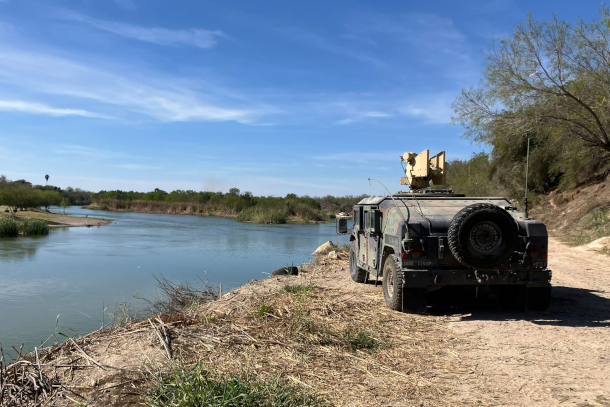
A Humvee is parked by a section of the Rio Grande in Texas where Custom and Border Protection plans to install buoys. (Photo: Martha Pskowski, Inside Climate News)
BELTRAN: And Martha, you talked to people who are raising concerns over how these buoys might impact the Rio Grande. What are some of those concerns?
PSKOWSKI: Well, the Rio Grande for the last few years has been relatively dry, but as we know with climate change, we do expect to see more extreme floods. So if a bigger flood comes through the region, the concern is that these buoys won't be able to withstand it, and they could break free from their moorings and cause damage. Customs and Border Patrol said that they're designed to withstand a hundred-year flood, but these specific design specifications haven't been released to the public because the Department of Homeland Security can waive any law that is in their way. This goes back to the Real ID Act in 2005. So last summer, the Department of Homeland Security waived over two dozen laws in an area of Cameron County where they were going to start with the buoy project that includes the National Environmental Policy Act, the Endangered Species Act, the Clean Water Act. So all of the steps that the government would normally have to go through for a project like this, they can get around that. And that's also why there isn't a lot of information available to the public, because all of that due diligence doesn't have to be followed.
BELTRAN: And this is not the first time buoys have been installed as a border security measure. Can you explain how this project differs from previous buoy projects across the border?
PSKOWSKI: Well, the earliest record I found of this idea goes back to the first Trump administration. There was a proposal to place buoys in the river. It wasn't implemented during that administration. But then a couple years later, Texas Governor Greg Abbott decided to put buoys in the Rio Grande at Eagle Pass. The buoys at Eagle Pass, it's only 2000 feet of buoys, so it's a much, much smaller area than what the federal government is doing now, but even so, it caused a lot of issues. There was a lawsuit with a kayaking guide who sued because he could no longer get kayaks in the river and operate his business. And there's also safety concerns that people could get trapped in the buoys and drown, and there was one person's body found in the buoys. It wasn't determined whether he had drowned further upstream or because he was trapped, but all those concerns came up with only 2000 feet of buoys, and now we're talking about over 500 miles.
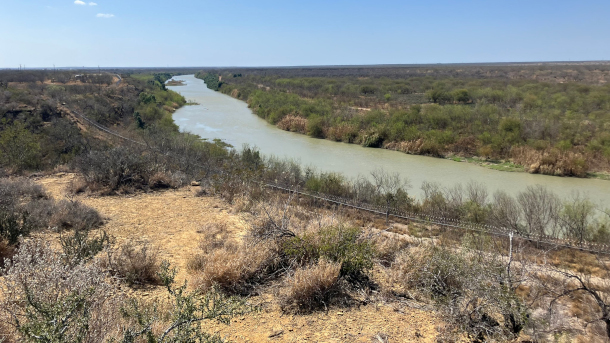
Customs and Border Protection plans to install buoys in the Rio Grande in Zapata County, Texas, where border fencing is also present on the banks of the river. (Photo: Martha Pskowski, Inside Climate News)
BELTRAN: And you wrote about Brownsville, a town in Texas that has deep connections to the Rio Grande. Can you tell us more about their connections, and how are they being impacted?
PSKOWSKI: Brownsville, Texas is right at the outlet of the Rio Grande into the Gulf of Mexico. On the other side of the river is Matamoros, Tamaulipas and the two cities have very deep connections. People go back and forth for work, for school, and while I was there reporting, it was their annual Charro Days celebration, when there's lots of music, dancing, just celebration of Mexican culture and border culture. I was there on February 26 which was the children's parade, which was very adorable. And then after the parade, that's when some of the local environmental groups chose to have a protest about the buoys, because they really wanted to point out at the same time as the city was celebrating its connections to Mexico, there's this huge project to put buoys in the river, which would just further sever the two cities and the two countries. So the protest really focused on that disconnect between the public celebration and then what the federal government's currently doing.
BELTRAN: And what about other towns in the region? How are they being impacted?
PSKOWSKI: Another city on the border where there's been a really active protest movement is in Laredo, Texas. That's also on the Rio Grande, and during the first Trump administration, they were successful in opposing border wall construction. So there's still city parks that are right on the river, and people can go fishing, go boating. So a lot of people there are really adamant about keeping that aspect of the community. And you know, there's lots of just small towns along the border where, you know, we see these images of the border in the media, sometimes that makes it seem very scary or intense, but if you go down to the river, people are fishing, people are picnicking. So in a lot of ways, there's still that just draw, that the water has, that exists everywhere, and people want to preserve that.
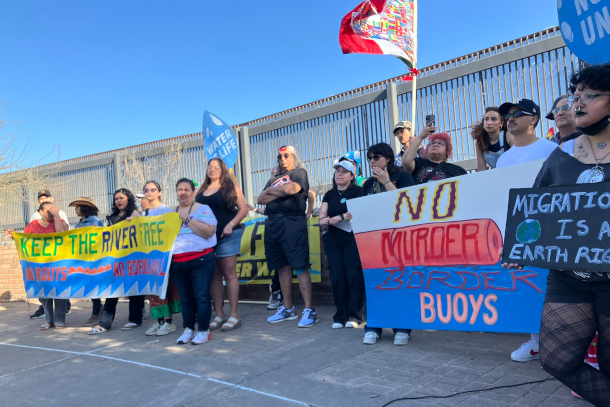
Local environmental groups in Brownsville, Texas protested the buoy project during Charro Days, a festival shared between Brownsville and its direct neighbor across the border, the Mexican city of Matamoros. (Photo: Martha Pskowski, Inside Climate News)
BELTRAN: Now, earlier this year, Customs and Border Protection released a map charting major construction and expansion of the border wall. The map has been updated a few times, but there's been protests from communities across the Southwest. Where does this construction stand?
PSKOWSKI: There's been a lot of changes just in the last few weeks of this map that Customs and Border Patrol has online. It's called the Smart wall map, and it is notable because in the past, there wasn't a map like this available, but now they show different lines along the border where they will be putting a wall or using new surveillance technology. It's changed a lot, so residents are skeptical of how accurate it really is. Around Big Bend National Park, for a couple weeks, it did show a physical wall for the National Park, but then they changed it back to surveillance technology. But the whole area is very remote, very wild. It's known for its dark skies, so the idea of having all of this construction, having a wall, is really upsetting to people who live there, and also all of the people who love visiting to go to the National Park, go camping, go hiking. So people are are still very much worried about new border wall construction in the Big Bend region, Rio Grande Valley, Arizona, a lot of different parts of the border.
BELTRAN: And what have conservationists said about biodiversity and how it may be impacted by both the buoy project and also the border wall?
PSKOWSKI: One source I spoke with in South Texas, she called this an experiment on a continental scale, which I think is a really good way to think about it, because what the federal government is trying to do is completely cut off the US from Mexico, and all of those species that move between the countries could also have their range cut off. So there's a couple big examples in Texas. The black bears have started to come back into Texas from northern Mexico. The population was completely wiped out in Texas, but now there is a black bear population reestablishing, which is really exciting for conservationists. And if there's a wall built through the Big Bend that would cut off that movement of black bears between the countries, the same with jaguars in Arizona. So the biodiversity of the border region is really deeply impacted by all of these projects.
BELTRAN: And you know, it seems like we're seeing more and more border projects at odds with the natural environment, and you've had a chance to talk to both conservationists and residents across the border. How do they feel about the situation so far, you know? What have they shared with you?
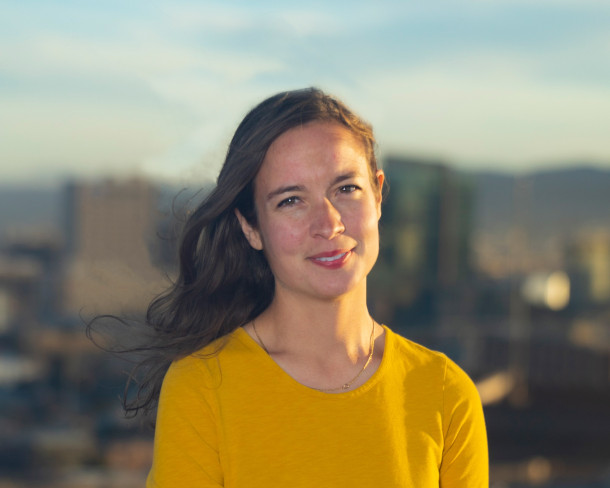
Martha Pskowski covers climate change and the environment in Texas for Inside Climate News. She has also reported for The Guardian and Yale E360. (Photo: Courtesy of Martha Pskowski)
PSKOWSKI: I think at this moment, people just feel frustrated that all of these projects are going forward without a lot of accountability and without very much justification from the federal government of why they're necessary. You know, there's already hundreds of miles of border wall, and we've seen the impacts on wildlife, and at this point in time, the number of people attempting to cross the border has really gone down. So just all of the impacts that these projects could have, people are questioning whether it's worth it. The big, beautiful bill last summer allocated $46.5 billion for these border wall projects. So there's really more money than they even need, and that's allowed so many of these contracts to be issued and for residents, these projects are just moving really quickly, and they're struggling to even get basic information about what's happening. So you know, as word is spreading more, there is more outcry in these different communities, but there just hasn't been a lot of transparency, and that's really frustrating for people who are impacted.
BELTRAN: Martha Pskowski is a journalist covering climate change and environment in Texas for our media partner Inside Climate News. Martha, thank you so much for joining us.
PSKOWSKI: Thank you for having me on.
BELTRAN: We reached out to the Department of Homeland Security for comment, but they did not respond in time for this broadcast. A press release from DHS reads in part: “waterborne barriers are intended to create a safer border environment for patrolling agents, as well as deter illegal aliens from attempting to illegally cross the border through dangerous waterways. The Secretary’s waiver authority allows DHS to waive any legal requirement, including environmental laws such as the National Environmental Policy Act, to ensure the expeditious construction of physical barriers and roads." You can find a link to the full press release on the Living on Earth website, loe.org.
Related links:
- Inside Climate News | “Border Communities Remain in the Dark About Federal Government’s Billion-Dollar Buoy Project”
- Inside Climate News | “Blasting Begins For Border Wall On Cherished New Mexico Mountain”
- More from Martha Pskowski.
- Read Custom and Border Protection’s press release on the buoy project.
[MUSIC: Stefan, “La Llorona (Duet)” on Guitarra Mexicana, Vol. 1, Stefan]
DOERING: Coming up, the media drop-off in climate coverage, and what we can do about it. Keep listening to Living on Earth.
ANNOUNCER: Support for Living on Earth comes from the Waverley Street Foundation, working to cultivate a healing planet with community-led programs for better food, healthy farmlands, and smarter building, energy and businesses.
[CUTAWAY MUSIC: Stefan, “La Llorona (Duet)” on Guitarra Mexicana, Vol. 1, Stefan]
$1 Billion to Abandon Offshore Wind
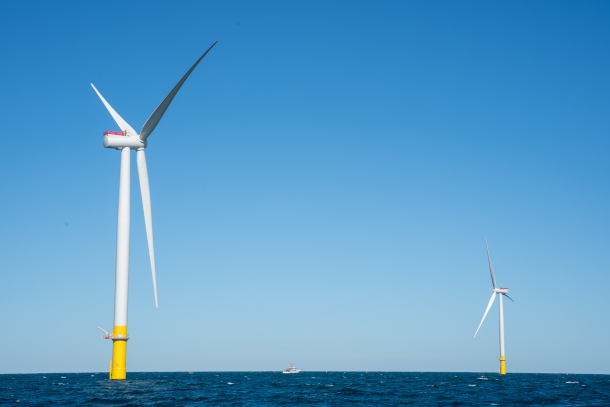
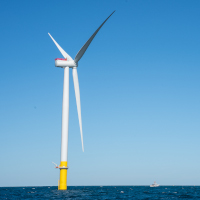
The Coastal Virginia Offshore Wind Project, built by Dominion Energy, began producing energy recently. When completed (expected to be in 2026), Coastal Virginia Offshore Wind is expected to provide electricity to 660,000 customers at peak demand. (Photo: Courtesy of Dominion Energy)
BELTRAN: It’s Living on Earth, I’m Paloma Beltran.
DOERING: And I’m Jenni Doering.
The US Department of the Interior recently announced an agreement to pay the multinational company TotalEnergies nearly $1 Billion to abandon its offshore wind leases and instead invest in fossil fuel production in the U.S. The federal government said it will reimburse TotalEnergies for money spent on US oil, natural gas and LNG production, up to the cost of the leases. Those projects were to be located off the coasts of New York and North Carolina. This is yet another move by the Trump administration to stifle the offshore wind industry, months after a federal judge reversed its attempt to kill projects along the East Coast. And now several of those major offshore wind projects are coming online, including Revolution Wind in New England and Coastal Virginia Offshore Wind. Joining us to discuss the Trump administration deal with TotalEnergies and the state of offshore wind is Katharine Kollins, president of the advocacy group Southeastern Wind Coalition. Katharine, welcome to Living on Earth!
KOLLINS: Thank you, Jenni, I'm glad to be here.
DOERING: So Katharine, what was your reaction when you heard the news of this $1 billion payment?
KOLLINS: I was surprised and disappointed. This is obviously another blow to offshore wind. We've seen a number of them throughout the current administration, and it's really a dual blow to the taxpayer. Because you've got consumers both paying TotalEnergies back for nearly a billion dollars of a lease payment, and then again, higher long-term costs of a less diverse and less efficient energy mix.
DOERING: Now, supporters of the Trump administration deal with TotalEnergies say that this $1 billion deal is merely a refund on money that TotalEnergies paid the government, and so taxpayers are breaking even. What's your response to that argument?
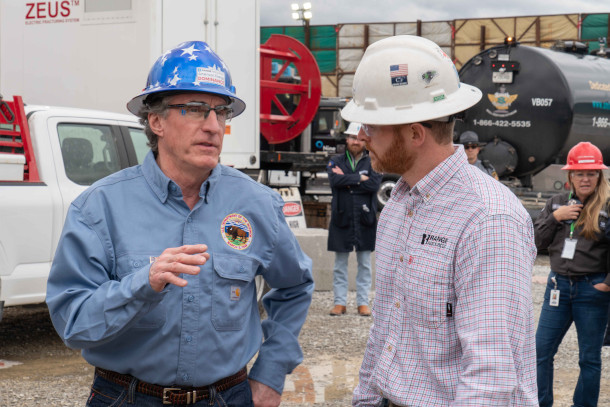
Secretary Doug Burgum visits a fracking site in Pittsburgh, Pennsylvania on April 3, 2025. Burgum signed a deal with TotalEnergies allowing the French company to abandon two off-shore wind leases in exchange for $1 billion investment in oil, natural gas and LNG. (Photo: U.S. Department of Interior, Flickr, public domain)
KOLLINS: My response to the argument is that these funds were already paid and accounted for, and I don't think that those same folks would be supportive of the administration refunding the tax dollars that we all paid last year. So just because we've already paid something doesn't mean that it is acceptable to then refund it a year later, when those funds were already allocated by the Treasury.
DOERING: So the courts overturned the Trump administration's order to shut down offshore wind projects on the grounds of national security. What do you make of this new strategy to pay companies like TotalEnergies to just give up their leases?
KOLLINS: It is a continuation of the President's strategy to do whatever he can to cripple this industry, and I think in the long run, it's futile, because offshore wind is a much-needed energy generation source, especially on the East Coast, and it's a phenomenal economic development tool. The fundamentals of offshore wind make sense for the U.S., but in the short term, he has made developing offshore wind very difficult and driven a lot of investors away from the U.S., away from offshore wind and toward other investments.
DOERING: What's the economic impact of canceling offshore wind farms? Who wins and who loses?
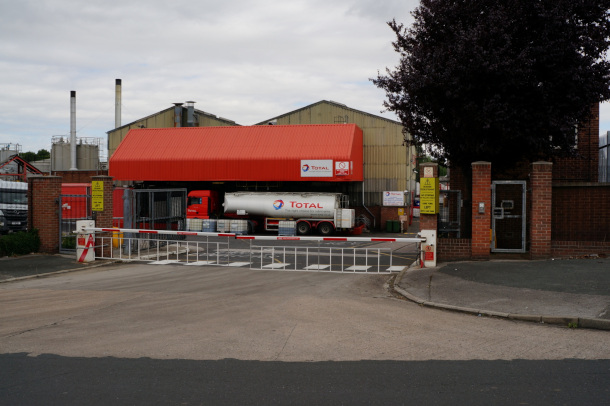
A Total Energies depot in the United Kingdom. The French company has signed an agreement with the Trump administration to abandon two offshore wind leases, and in exchange, be reimbursed for $1 billion invested in oil, natural gas and liquified natural gas projects in the United States. (Photo: Ian S, Wikipedia Commons, CC BY-SA 2.0)
KOLLINS: I would venture to say that we all lose and we all lose because we are talking about over $30 billion of fully permitted economic activity just in the five projects that are currently under construction. That's over $11 billion in supply chain assets that have spun up to support construction. The reason that these manufacturing facilities are being developed and that manufacturers are looking at the U.S. is because the components are so large that they can only be transported on water, and so right now we are getting a lot of those components from Europe. They are being shipped to the U.S., where the U.S. hasn't developed the manufacturing facilities as of yet, and then we're installing these machines. That said, if we can build a U.S.- based supply chain, we're talking about at least $100 billion of potential economic activity.
DOERING: It sounds like these wind farms already make a lot of sense in terms of the energy they're going to produce for the grid and jobs and installing them. And there's even more opportunity in the future to build out these manufacturing hubs in port cities.
KOLLINS: Yes, and in order for companies to invest again the billions of dollars that are required to manufacture these extremely large components, specialized equipment on the coast, they need to know that there is a stable permitting regime. They need a concrete pipeline of projects that developers are willing to commit to and know that they can continue to build. And unfortunately, what we are seeing right now is an erosion of that. And so that means that we will likely need to continue to purchase at least the major turbine components from places like Europe.
DOERING: Katharine, you know, given this country's growing electricity demands, in part because of AI, how can offshore wind help feed the power grid, especially when some skeptics say that, you know, the wind doesn't always blow?
KOLLINS: One of the really amazing things about offshore wind is that offshore wind is generating electrons when we need them most. So that happens to be in the wintertime when it is cold, when natural gas is constrained and prices are high. It happens to be winter mornings when folks are switching on heating. And it is also very highly correlated with winter storms. And what we've seen over the last few years with winter storms is gas prices become astronomical because of constrained supply, everybody is working very hard to heat their homes. And if we had offshore wind on the grid during those periods, that is effectively a hedge to those very high fuel costs, offshore wind has already proven itself to be integral to the power grid, especially along the East Coast. So there is an operating project South Fork Wind up in the Northeast and so over the course of its first year of energy production, it showed that it was delivering electrons to the grid nearly all of the time, and it had over an 80% capacity factor during winter storms, when that electricity is needed most.
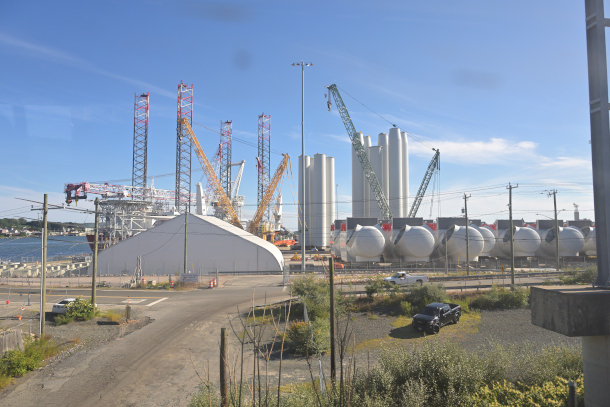
In the above photo, components for the Revolution Wind Offshore project were being staged in New London, Connecticut in August 2025. The 704 megawatt project, which began generating power on March 13, 2026, is expected to provide electricity to more than 350,000 homes and businesses in Rhode Island and Connecticut. (Photo: 4300streetcar, Wikimedia Commons, CC BY 4.0)
DOERING: And what is the current state of offshore wind off the Southeastern coast?
KOLLINS: Offshore wind in the Northeast has progressed much quicker than it has in the Southeast, because the Northeast has been fantastic about enacting state policies that really both encourage offshore wind and also provide the level of certainty that these large infrastructure projects require to get off the ground. In the Southeast, I think the shining light is the Coastal Virginia Offshore Wind project. It is the largest project in the U.S., at 2600 megawatts, and that project is actively under construction. They just started delivering power to the grid, and so we are very excited and proud in the Southeast to have such a phenomenal project bringing electricity to grids where it's needed most.
DOERING: So in terms of this new project off the coast of Virginia, I think it's called Coastal Virginia Offshore Wind, what made that project possible?
KOLLINS: Most energy policy is driven by states, and Virginia has been a huge supporter of offshore wind for a long time. So Virginia has invested in their ports. They have invested in offshore wind training development and made sure that the utility, the regulated utility, Dominion Virginia, was able to develop this project in a way that made sense for Virginians. This is the only project in the U.S. that has been developed by a regulated utility. What that allowed in this specific case is for that utility to contract for their components in advance of the inflationary pressures that we saw in the early 2020s. And so this project has really been, again, kind of a shining light, because it is providing low cost, reliable electricity into the, it's called the PJM grid. PJM is the regional transmission organization that covers the state of Virginia, and that grid is already constrained in a number of ways, and very much looking forward to having the full capacity of the 2600-megawatt project feeding electrons into their grid.
DOERING: Katharine, what do you see as the future for offshore wind energy?
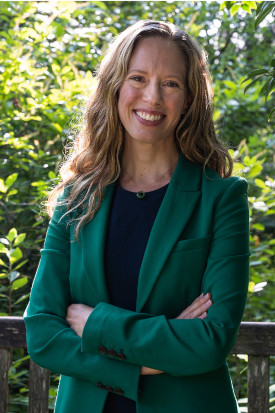
Katharine Kollins, president of the Southeastern Wind Coalition, said the U.S. is ceding offshore wind technological leadership to China and Europe and missing out on billions in economic development impact. (Photo: Courtesy of Katharine Kollins)
KOLLINS: The future globally is so strong. What I think a lot of Americans don't recognize is that countries like China have over 50 gigawatts of offshore wind installed and under construction. That is as much as the U.S. could hope to build in 20 years. Europe has over 35 gigawatts of installed offshore wind. These countries already have very robust manufacturing supply chains, have already invested in their ports and are already building these domestic machines that are generating clean, free fuel electricity for those countries. The U.S. is really ceding both the economic development, the technological know-how, things like ship building to Europe and Asia by not investing in this technology domestically.
DOERING: Katharine Kollins is president of the Southeast Wind Coalition, a nonprofit that advocates for wind energy across Southern states. Katharine, thanks so much for talking with us.
KOLLINS: Thank you for having me. Jenni.
DOERING: Regarding the billion-dollar deal with TotalEnergies, Interior Secretary Doug Burgum said: “Offshore wind is one of the most expensive, unreliable, environmentally disruptive, and subsidy-dependent schemes ever forced on American ratepayers and taxpayers. “We welcome TotalEnergies’ commitment to developing projects that produce dependable, affordable power to lower Americans' monthly bills while providing secure U.S. baseload power today—and in the future.” To read the full Interior Department statement and one from TotalEnergies visit the Living on Earth website, loe.org.
Related links:
- CNN | “Trump Administration Will Pay a French Company $1 Billion in Taxpayer Funds to Not Build Wind Farms”
- Canary Media | “Trump’s $1B Offshore Wind Payout to TotalEnergies Sparks Legal Concerns”
- TotalEnergies | “United States: TotalEnergies Signs Agreements with U.S. Department of Interior to End its U.S. Offshore Wind Projects
- U.S. Department of the Interior | “Interior and TotalEnergies Agree to End Offshore Wind Projects, Lowering Costs for American Families”
[MUSIC: Scorpions, “Wind Of Change” on Crazy World, The Island Def Jam Music Group]
Climate Coverage Dropoff
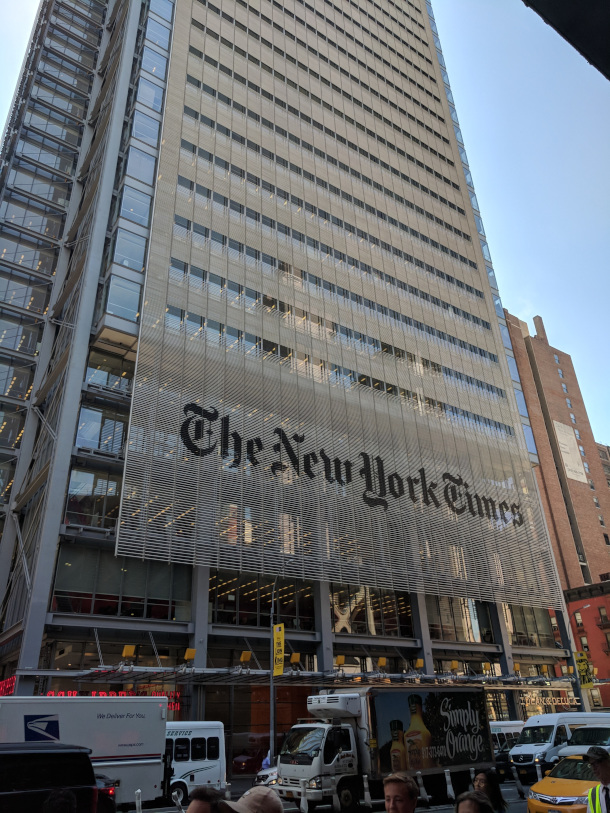
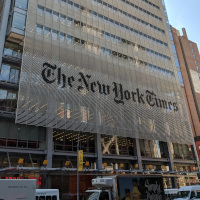
According to research from the University of Colorado Boulder’s Media and Climate Change Observatory, climate coverage has seen a 38% dropoff since its peak in 2021. Major news outlets like The New York Times (shown above), CBS News, and The Washington Post have decreased their coverage of climate change or gutted their climate reporters. (Photo: Kurt Kaiser, Wikimedia Commons, CC0)
BELTRAN: You hear a lot about climate change on this broadcast, and for good reason. The global temperature rise above pre-industrial levels is headed well past 1.5 degrees Celsius, and some climate scientists have recently warned that climate change appears to be accelerating. Yet news media outlets in general are retreating from covering this existential crisis. That’s according to the Media and Climate Change Observatory at the University of Colorado Boulder, which has been tracking this trend for decades. They report that since a peak in 2021, climate news stories across the globe have dropped nearly 40 percent. The decline comes amid disinformation from the fossil fuel industry and other interests on the right and left. Professor Max Boykoff is director of the Media and Climate Change Observatory at CU Boulder. He also contributed to the Intergovernmental Panel on Climate Change or IPCC Sixth Assessment and spoke with Living on Earth Host and Executive Producer, Steve Curwood.
CURWOOD: What's causing this drop off in coverage?
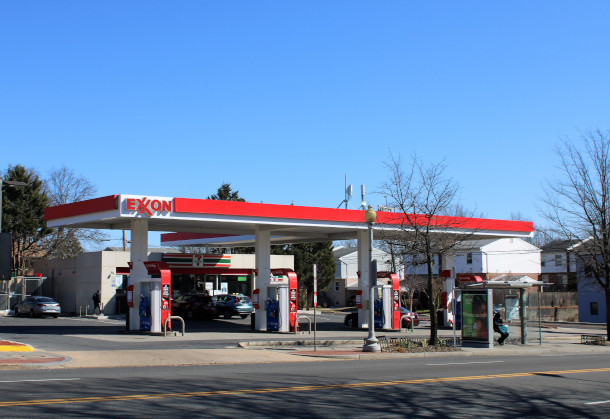
The effect of disinformation from fossil fuel companies like ExxonMobil, shown above, is more pronounced in the second Trump administration. Fossil fuel companies contributed to the Heritage Foundation’s Project 2025, which called for many of the climate rollbacks that the Trump administration has since implemented. (Photo: Farragutful, Wikimedia Commons, CC BY-SA 4.0)
BOYKOFF: There could be several factors involved. Among them, the ongoing media consolidation that we see around us, particularly pronounced in the United States, recent layoffs of Washington Post climate reporters, layoffs at CBS, an NBC reporter who's resigned in the face of fighting for media coverage of climate change, the political economic forces are strong currents that those who continue to cover climate change are swimming upstream against them. Another part of all of this, frankly, could be the way in which the zone, if you will, the news hole, has been flooded with other issues, developments, events and on that when there is just so much news you can cover in a day that unfortunately, the international conflicts that are happening, other kinds of activities are generating media attention and drowning out some of this news coverage around climate change. We saw it around the coronavirus pandemic in a most pronounced way in 2020. Another part of this, too, could be climate fatigue. I work with young people at the University of Colorado Boulder, and as I've been working with them, really have been in conversation with their frustrations about how they've been growing up in a world where this has been part of a conversation and not seeing concerted progress and action made, and there can be some fatigue of the ongoing news stories providing more strong diagnoses, largely through the sciences, not matched with progress in the policy space.
CURWOOD: How do you think disinformation from the fossil fuel industry and others complicate this issue?
BOYKOFF: As another part of my research over the years, I've been tracking mis and disinformation among right of center, sometimes multipurpose think tanks. I myself have tracked work of the Heartland Institute for several years. They work in partnership with the Heritage Foundation. Many of your listeners may be familiar with the Project 2025, with many of these planned rollbacks and ways in which the at the U.S. national level, at least, there was going to be a dismantling of science in the scientific process that lead to our understanding of climate change, and much of that has been taking place while I had been tracking that work for over a decade, and had actually documented some of that in the IPCC Sixth Assessment Report, I had been thinking that maybe that had been moving to the edges, that those outlier perspectives had reduced influence in the decision making halls of power. That has proven to be very much not the case in this second Trump administration, and so therefore the way in which contrarian communities have been feeding into, overall news coverage has been more pronounced now than before.
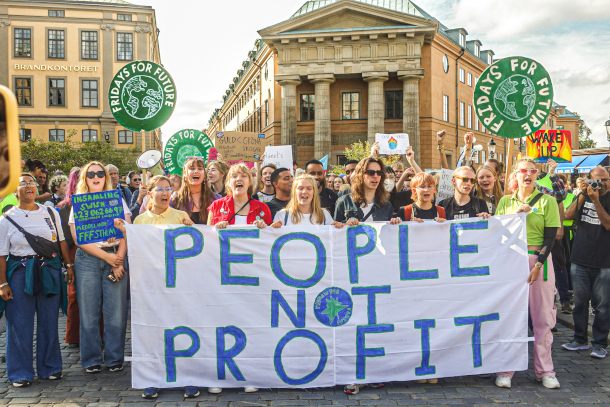
The dropoff in climate coverage could lead to a decline in climate action, as media coverage often affects public discourse around relevant issues and sets public policy priorities. (Photo: Frankie Fouganthin, Wikimedia Commons, CC BY-SA 4.0)
CURWOOD: What do you think are the effects of the drop off in climate coverage by the big media outlets such as the Washington Post or CBS News? How likely is this to have an impact on climate action, do you think?
BOYKOFF: Quite simply, when policy actors and their staffers are trying to get their finger on the pulse of what are public pressures, public concerns, they rely on news media to translate these considerations. When news media is diminished, they may perceive that public pressure is also diminished. When the public themselves, who don't read into the peer reviewed literature, who don't really follow policy decision making on a daily, weekly, monthly basis, they rely on media as well to understand that. And so when media coverage drops off, as it's done, the public themselves may feel as though this is a lower set of priorities now, and so it has negative impacts. I will say that other work that's done by fellow researchers in this community have found that 64% of people rarely, if ever, are talking about climate change in the United States nowadays. When there is diminished media coverage, that can only fuel the diminished way in which people are prompted to talk about this in their everyday lives with their neighbors and friends and colleagues and coworkers and roommates. And so diminished media coverage translates to fewer opportunities to make the connections about the urgent challenges we face through human caused climate change.
CURWOOD: All too often, climate change most affects those who are least able to cope with the impacts. Why does that make more coverage even more imperative in your view?
BOYKOFF: Yes, one of the many cruel paradoxes, if you will, is that those who are at the forefront of climate impacts often have the least voice, the least influence on the kinds of changes that are needed, and conversely, those that are in the halls of power often are insulated from the realities in those communities. And so media, again, really helped tell these stories and help bring these stories to these new spaces. And it's that kind of storytelling through media accounts that can, through creative ways, really help connect us up, help us connect the dots and help people understand that this is again a collective action problem that requires responses at scale, requires an international community to come together and make sustained commitments in order to alleviate those negative impacts for those frontline communities.
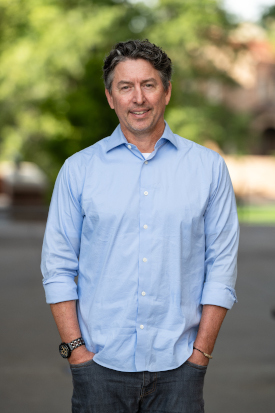
Max Boykoff is the director of the University of Colorado Boulder’s Media and Climate Change Observatory. (Photo: Courtesy of Max Boykoff)
CURWOOD: As coverage and engagement is dropping, the intensity of climate disruption is increasing. You have wildfires, you have these killer storms, you have flooding, you have drought. The list goes on. So what can citizens, media outlets and individual journalists do about this gap between the reality of the emerging climate emergency and the public response, or rather, rather lack of public response?
BOYKOFF: It's a big question. There are many different things that folks can do, though, for those who are able, who can frankly, contribute to independent news media in these times, it's more needed than ever, as there have been rollbacks, Public Broadcasting and others, that those who can't contribute, those contributions are well received in these times. Those who may not be able to contribute but want to contribute in other ways, letters to the editor, ways in which we can talk with one another about supporting media outlets that are covering these issues. Those are ways forward as well. And then there's direct engagement with our elected officials. They still remain to some extent accountable to us as members of the voting public within the United States, and so these are just opportunities that we can engage to increase the amount that we're talking about this as pathways to further engagement and action overall.
BETLRAN: That’s Max Boykoff, director of the Media and Climate Change Observatory at CU Boulder, speaking with Living on Earth Host and Executive Producer Steve Curwood.
Related links:
- Explore MeCCO’s work here:
- Read MeCCO’s annual report on trends in media coverage of climate change and global warming in 2025:
- Grist | “The Planet Is Overheating. Why Is the News Looking Away?”
- Explore examples of Max Boykoff’s work in communicating climate change through comedy:
[MUSIC: Go Fret, “A Day in the Life (Instrumental Guitar)” on The Beatles Instrumental Guitar Covers, Go Fret]
DOERING: Just ahead, poetry that illuminates the nighttime and more. Stay tuned to Living on Earth!
ANNOUNCER: Support for Living on Earth comes from the estate of Rosamund Stone Zander - celebrated painter, environmentalist, and author of The Art of Possibility – who inspired others to see the profound interconnectedness of all living things, and to act with courage and creativity on behalf of our planet. Support also comes from Sailors for the Sea and Oceana. Helping boaters race clean, sail green and protect the seas they love. More information @sailorsforthesea.org.
[CUTAWAY MUSIC: Go Fret, “A Day in the Life (Instrumental Guitar)” on The Beatles Instrumental Guitar Covers, Go Fret]
"Night Owl" -- Poems by Aimee Nezhukumatathil
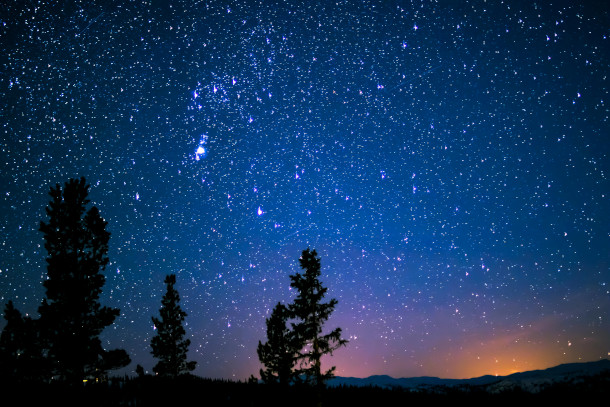
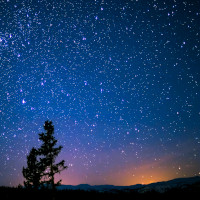
Author and poet Aimee Nezhukumatathil says she does her best creative work at night. (Photo: Sindre Fs, Pexels, public domain)
BELTRAN: It’s Living on Earth, I’m Paloma Beltran.
DOERING: And I’m Jenni Doering.
Maybe we turn away from bad news about the planet because the scale of ecological loss and the climate crisis is almost too much to bear. But oftentimes working through those complex emotions, instead of shoving them aside, is the only way to truly move forward. And for some, poetry offers a light in the darkness, including in Aimee Nezhukumatathil’s new book, Night Owl. The poems in her collection have names like “Firefly Nocturne,” “Dark Chocolate Universe,” and “How to Build a Moon Garden When the News Is All Horror.” Aimee has served as poetry editor for Orion and Sierra magazines, and she’s been a professor of English for 25 years in Oxford, Mississippi, where she joins me now as National Poetry Month turns 30. Welcome to Living on Earth, Aimee!
NEZHUKUMATATHIL: Thank you so much, Jenni. I'm so happy to be here.
DOERING: We're happy to have you. So we wanted to start off with the first poem in this collection. It kind of sets the tone for the rest of the poems in this book. Could you please read "Nocturne for Dark Things?"
NEZHUKUMATATHIL: Sure, and yes, a nocturne, as I say in the back of the book, is simply a poem that takes place at night, and this is kind of my introduction of like, why night, Aimee? Why is this book all about night? So here it is.
"Nocturne for Dark Things."
I do my finest listening in the dark.
My best friend has always been ink
and she lets me talk so much at night.
One of the marvels of my life—an
alphabet. A whole green and mossy
world can be made and remade
from just twenty-¬ six dark curlicues.
Here’s more dark: sometimes birds sleep
tucked under a giraffe’s dusky armpit
and sometimes fungi fatten only at night.
When I was a kid, I used to worry over
so many bugs and moths slamming
into our windshield. My sons have never
known that concern, which is another kind
of worry. But dark marvels still bloom
and snick the soil, swim the oceans and air—and
even on the moon: wide, flat plains
are called seas, lakes, and marshes. Bays
are named Joy, named Sorrow, named Hope,
named Nectar, named Softness, named Serpent,
named Stickiness, named Tranquility, named
Clouds, named Sleep, and my favorite—¬ named Love.
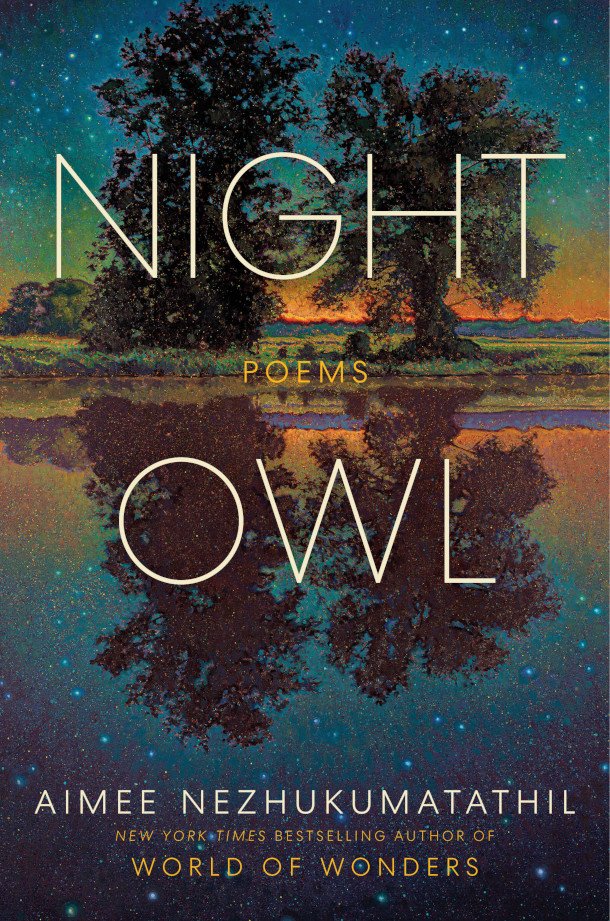
Night Owl: Poems by Aimee Nezhukumatathil. (Artwork: Charlie Buckley)
DOERING: It's beautiful, and I think my favorite line is, "sometimes fungi fatten only at night." I love that.
NEZHUKUMATATHIL: Thank you. Thank you.
DOERING: So this collection of poems is called Night Owl, and of course, references to nighttime are present throughout this body of work. What is your relationship with the night and to the darkness?
NEZHUKUMATATHIL: Yeah, you know, I mean, I think night for me is a time when everything slows down, you know, kind of with our technology-based world, that's when I can guarantee almost no little pings on my phone. Everybody I love is asleep. I feel like the world becomes more honest. I feel like I'm, am I most honest and most vulnerable? The poet Edward Hirsch calls it "loosening your night mind." And I really love that like, when you "loosen your night mind," all those things that that worry you, that delight you, that enthrall you, really can kind of come to the surface a little bit. And I don't know, there's a fearlessness there, even though it's maybe vulnerable, there's a fearlessness of sharing it at night, I think in some ways, you think of slumber parties, where growing up, that's when, like all of our deepest, darkest fears and crushes were revealed. It's just, there's a revelation, I think that happens at night for everybody.
DOERING: I mean, who hasn't had the experience of your head hitting the pillow, and then all of a sudden, all these ideas come to mind? And you're thinking, sometimes ruminating too much, but sometimes feeling the urge to, like, write things down.
NEZHUKUMATATHIL: Absolutely. My normal state is like, oh, I have the perfect comeback for something that happened when I was in sixth grade or something. So I just was like, oh, I've never written about this. I've never kind of collected or had an eye towards, kind of my truest creative self in that way. And I was like, I'm seeing this thread throughout the poems that I was writing in the last decade, of noticing the world at night. You know, the outside world at night. How animals move or don't move, how plants and fungi move and percolate a little bit at night. The outdoors is so alive at night.
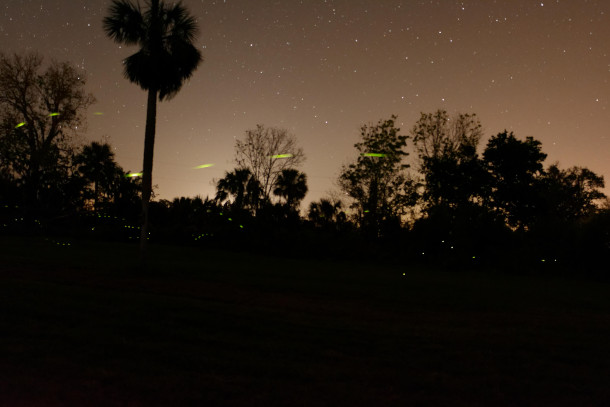
Artificial lights can disturb nighttime creatures like fireflies and migratory birds. (Photo: Jud McCranie, Wikimedia Commons, CC BY-SA 4.0)
DOERING: These days, it really is hard to connect with the nighttime world the way humans once did.
NEZHUKUMATATHIL: Yes!
DOERING: You know, we used to spend a lot more time looking up at the stars, but now we have light pollution. We have our noises of the city drowning out nighttime creatures. We have these screens that we are constantly looking at at night.
NEZHUKUMATATHIL: That's right.
DOERING: What do you think we miss out on when we lose access to nature at night?
NEZHUKUMATATHIL: Oh my gosh. I love that question. That's like, that's a whole essay collection right there. But one of the initial things is, like observing the outdoors at night, it's a good reminder that we're all connected and like our actions during the day, often, I mean, they do influence what goes on in the outside at night, you know. I mean, like, in a couple months, it's going to be firefly season here in northern Mississippi. And, you know, I am railing constantly in my neighborhood about, like, let's dim the lights. Let's turn the lights out at least for this, you know, it's like, late May early June. And then bird migration, for example, there's that as well. So both, you know, just two animals in particular, birds and lightning bugs, if we are just constantly flooding the night, birds don't actually get to where they need to be going for their nesting and things like that, because they get derailed. They think it's stars. When we are actually watching whole populations of lightning bugs and birds decline. And guess what, folks, if that declines, if those go away, we go away eventually, you know? So I don't know that completely answers your question, but I would say it's that connection of realizing like, oh my gosh, look at my actions influence all these creatures here, and then also more in the "woo woo" sense, when you're able to look up and see stars, stars that maybe your grandparents saw, or maybe a loved one on the other side of this country might be looking at as well. We just had a beautiful blood moon lunar eclipse, and my dad in Florida was watching that. So knowing that he was watching that also gives connections to other humans too. So it's not just oh, I'm connected to these lightning bugs. We're connected to each other as well by looking at these markers of time up in the sky as well.
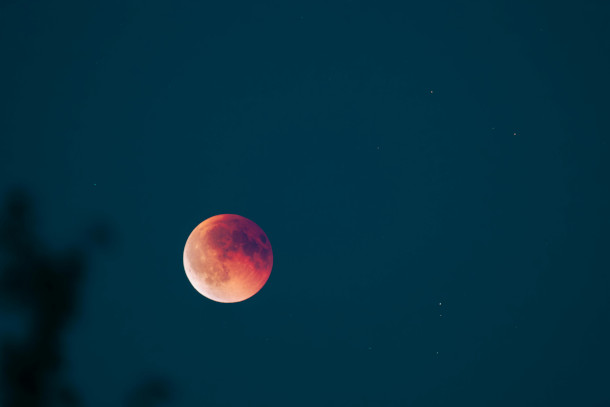
Our guest, Aimee Nezhukumatathil, discusses the wonder of seeing a blood moon at the same time as loved ones who are far away. (Photo: Jan Reichelt, Pexels, public domain)
DOERING: Another poem that hearing you talk made me think about a little bit was "Letter for Noctiluca."
NEZHUKUMATATHIL: Oh, okay.
DOERING: And you mentioned stars in this poem. There's sea sparkle, I guess, sort of the bioluminescence that we can see at night in the sea is that kind of what you're referring to in this poem?
NEZHUKUMATATHIL: Yeah, absolutely.
"Letter for Noctiluca," which is the proper name for sea sparkle or sea fire.
It’s been so long since I heard from you
when I finally did, I was like a sandpiper
hearing thunder for the first time. You used to visit
my shore often, lap my ankles with your foamy laugh.
When I see your name, my heart claps like clamshell
or coquina—¬ or a scallop tambourine with dark stars
of shark teeth along the wrack. Even just hearing
your laugh sends me into a fig-¬ sugar crumble. I hear
reports of lit-¬ up mangroves, full of reptiles
that don’t know what to call the flecks of light on their backs.
You kiss me on the cheek in full view of others. We hold
each other a beat too long. We pledge ourselves to snow
to pink sand to fresh redbud shoots iced overnight
when nothing moves except winter stars—like
Procyon like Betelgeuse like Sirius, the dog star.
DOERING: Where did this poem come from?
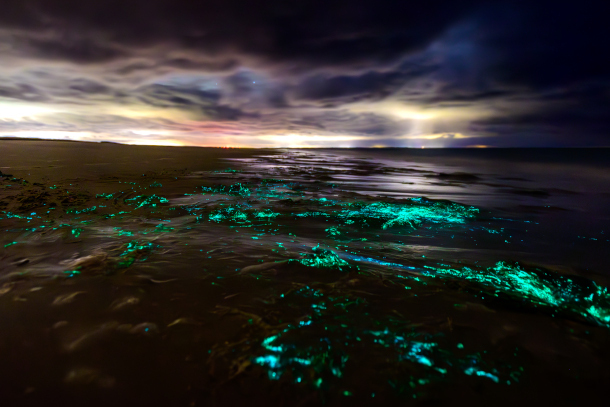
Luminescent particles (presumably dinoflaggelates noctiluca scintillans) caught in seagrass and washed up at the beach of Spiekeroog, Germany. (Photo: Stephan Sprinz, Wikimedia Commons, CC BY 4.0)
NEZHUKUMATATHIL: You know, I was imagining kind of like all the different stars, all the different versions of kind of sparkle in the outdoors, like non-manmade sparkle, you know. So instead of like these glaring house lights that drive me nuts here in the suburb, or car lights and things like that, this is just imagining the light that is created at night from these tiny dinoflagellates that light up.
DOERING: Some of your poems touch on your relationship with the environment around you, the simultaneous awe and grief that it can bring. How does writing help you personally make sense of the ecological crises that are facing our world, Aimee?
NEZHUKUMATATHIL: I love that. I don't know if you feel this way too, but oftentimes I'm reading poetry, and I will read a line or a stanza and I'll be like, oh, I didn't realize I feel that way too, but this gave me words, like I didn't know I felt that until I read it. That's poetry doing the quiet work. What I hope, I guess, is, I feel this way when I'm writing it, so I'm hoping my readers feel this way, poetry is like a little lantern, like a little flashlight or a little lantern, because it names the ache, it names the want, it names the love, it names the fear, the rage, anything that your heart aches about, and then it hands you like a lantern back. Like, what do you think of this? Or gives you a mirror to yourself. Like, when have you last felt like this?
DOERING: Absolutely, and there is sort of you call it a lantern, a way of understanding, holding up a light to what's happening. And I think one of the poems in your book that kind of grapples with this ecological crisis and maybe helps us understand it, feel it a little bit better, is called "Trigger Fish Invective."
NEZHUKUMATATHIL: All right, yeah, an "invective," and this is also in the back of the book, is a song of anger, a poem that goes back to ancient Rome, when people would write invectives against government or against anything that they saw was unjust or wrong. And it's a way to kind of corral that anger and rage. But this was inspired by, I went snorkeling on the island of Oahu, and in spite of there being so many signs, please don't step on the coral. Basically, if we're allowing you to snorkel here, you have to basically tread water. And then, of course, with the exception of my family and maybe one other, everybody was stepping and just like putting their giant gross flippers on all these precious corals. This part of the reef was just coming back. I just, oh, I just wanted to, like, play lifeguard or something and whistleblow on them. And it was really kind of heartbreaking to see.
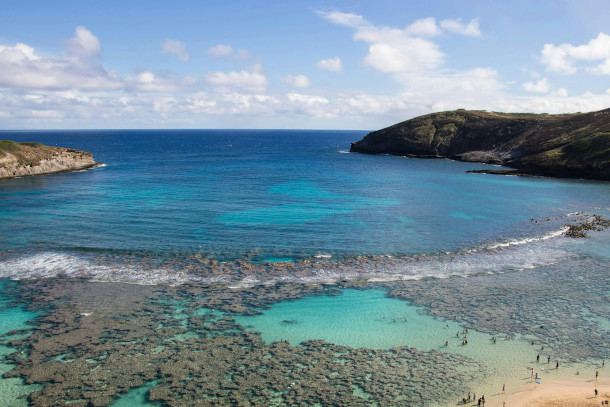
Hanauma Bay in Oahu, Hawai’i. (Photo: Olusola O, Pexels, public domain)
"Triggerfish Invective."
The last time I sank my face in the neritic ocean
I found only beige and bleached out bones, instead
of orange and green coral fans. I spoke to angry underwater
ghosts in other languages I forgot I knew—¬ my mouth grew
full of seaweed syllables and cracked shells. Too many
pale bodies have marched snorkel fins over this coral,
snagged selfies on the coral, and scraped coral clean
of leafy food. Too many pale bodies don’t even leave
a scintilla of small-¬ shelled meats. The fish ghosts cackle
and hiss. Sometimes they answer with light-¬ scatter.
The sea in this bay once curved full of cucumbers
and other funny vegetables, some with fin and some
with spine. Here the sea-¬ swollen ring of motion bursts—here
the sea throws a dozen fish with pointed snouts
towards me. I never thought I’d be lucky to see triggerfish
in real life but they remain—¬ almost a warning or last chance
for us. Why else would they activate their trigger fin
and hold on to coral bones if there was no more hope
of saving the bay? I am certain I will wear an anklet
of tiny bites from these ’humuhumunukunukuapua’a
and why not: for all the fish I see now, thousands more
swam just last year. And the last year. And the last.
The fish ghosts only send out mondegreens now.
Some scatter pale green light. Some scatter a cackle and a hiss—
DOERING: Not much resolution in there.
NEZHUKUMATATHIL: No, no, no.
DOERING: And there doesn't always have to be, I guess.
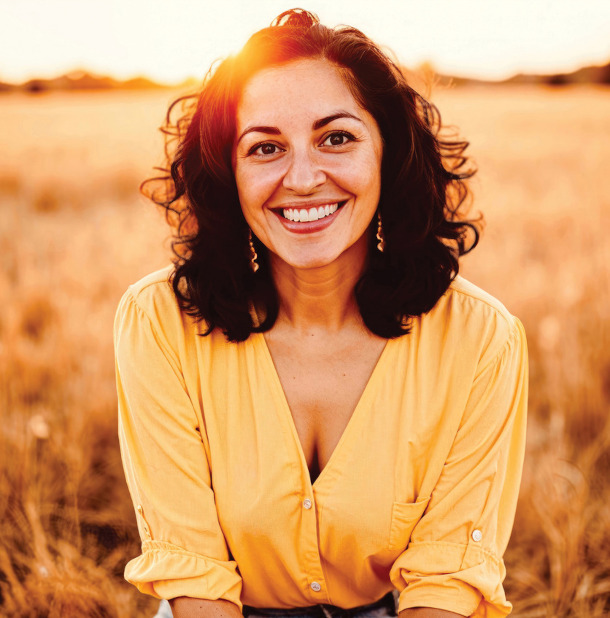
Aimee Nezhukumatathil served as poetry editor for Orion and Sierra magazines and has been a professor of English for 25 years, currently teaching at the University of Mississippi. (Photo: Dustin Parsons)
NEZHUKUMATATHIL: Yeah, I very much did not want this to be a thing like, look at Aimee. She's always talking about joy and beauty and light. I mean, that's not, I mean, I could do that, but that wouldn't feel authentic to me. That wouldn't feel authentic to what I've experienced in the planet. That's just not how the world works.
DOERING: Aimee, what do you see as the role of poetry amid the climate crisis? You know, violence and conflicts around the world? What do we gain by writing and reading poetry?
NEZHUKUMATATHIL: Oh, I love that question so much. My favorite scientist, who was Rachel Carson, one of her famous things that she said was, the more we get to know about the inhabitants of the earth, the less appetite we have for destruction. And so in my poems in particular, because I can't, almost not write a poem that doesn't have a plant or an animal in there as well, my hope is that if you get to know a little bit about this particular fish in Hanuma Bay in Oahu, or a little, an Indigo bunting. You know, I'm always writing about buntings, or a narwhal or something, you know, anything like that. I hope that these poems kind of become contagious for wanting to know more about the world.
DOERING: Aimee Nezhukumatathil is the author of the collection of poems, Night Owl. She served as poetry editor for Orion and Sierra magazines, and has been a professor of English for 25 years in Oxford, Mississippi. Thank you so much, Aimee. This has been such a treat.
NEZHUKUMATATHIL: Oh, Jenni, this has been so lovely to chat with you all. Thank you so much for such amazing, hard-hitting questions. Each one of them could be like an essay in itself.
Related links:
- Learn more about Aimee Nezhukumatathil:
- Learn more about National Poetry Month:
[MUSIC: Cyril Pahinui, "Hanauma Bay" on 6 & 12 String Slack Key Guitar]
BELTRAN: Next time on Living on Earth, pragmatic hope amid the climate crisis.
RITCHIE: The majority of people on the left care about climate, but also more than half of people on the right also care about climate, right, so this notion that it's only people on the left that care about climate is just not true.
BELTRAN: Data scientist Hannah Ritchie on her book, Clearing the Air. That’s next time on Living on Earth.
[MUSIC: Cyril Pahinui, "Hanauma Bay" on 6 & 12 String Slack Key Guitar]
BELTRAN: Living on Earth is produced by the World Media Foundation. Our crew includes Naomi Arenberg, Sophie Bokor, Swayam Gagneja, Mark Kausch, Mark Seth Lender, Don Lyman, Ashanti Mclean, Nana Mohammed, Aynsley O’Neill, Sophia Pandelidis, Jake Rego, Andrew Skerritt, Bella Smith, Julia Vaz, El Wilson, and Hedy Yang.
DOERING: Tom Tiger engineered our show. Alison Lirish Dean composed our themes. You can hear us anytime at L-O-E dot org, Apple Podcasts and YouTube Music, and like us please, on our Facebook page, Living on Earth. Find us on Instagram, Threads and BlueSky @livingonearthradio. And we always welcome your feedback at comments@loe.org. Steve Curwood is our Executive Producer. I’m Jenni Doering
BELTRAN: And I’m Paloma Beltran. Thanks for listening!
ANNOUNCER: Funding for Living on Earth comes from you, our listeners, and from the University of Massachusetts, Boston, in association with its School for the Environment, developing the next generation of environmental leaders. And from the Grantham Foundation for the protection of the environment, supporting strategic communications and collaboration in solving the world’s most pressing environmental problems.
ANNOUNCER 2: PRX.
Living on Earth wants to hear from you!
Living on Earth
62 Calef Highway, Suite 212
Lee, NH 03861
Telephone: 617-287-4121
E-mail: comments@loe.org
Newsletter [Click here]
Donate to Living on Earth!
Living on Earth is an independent media program and relies entirely on contributions from listeners and institutions supporting public service. Please donate now to preserve an independent environmental voice.
NewsletterLiving on Earth offers a weekly delivery of the show's rundown to your mailbox. Sign up for our newsletter today!
 Sailors For The Sea: Be the change you want to sea.
 The Grantham Foundation for the Protection of the Environment: Committed to protecting and improving the health of the global environment.
 Contribute to Living on Earth and receive, as our gift to you, an archival print of one of Mark Seth Lender's extraordinary wildlife photographs. Follow the link to see Mark's current collection of photographs.
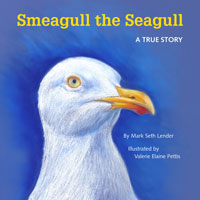 Buy a signed copy of Mark Seth Lender's book Smeagull the Seagull & support Living on Earth
© Copyright World Media Foundation. All Rights Reserved
Home | Contact | RSS | Donate | Newsletter