
Floating Border Wall
Air Date: Week of April 10, 2026
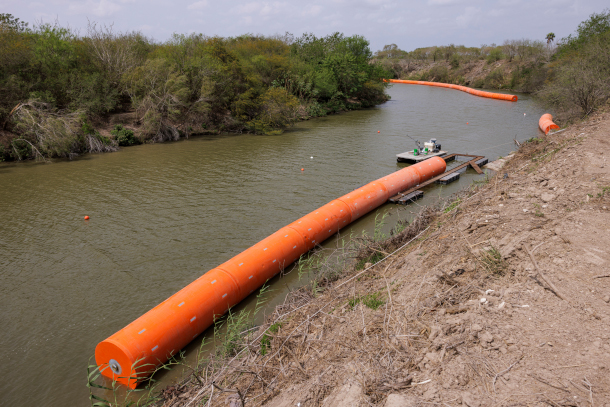
Water buoys were installed on the Rio Grande where it runs through Brownsville. (Photo: Michael Gonzalez, Inside Climate News)
About two thirds of the US-Mexico border is along the Rio Grande, and the Trump Administration is working to install hundreds of miles of buoy barriers in the river, to prevent illegal crossings. Now residents of border towns, researchers, and activists are raising the alarm over how those buoys and other barriers could impact wildlife, restrict access to the river and sever cultural ties. Martha Pskowski, a reporter based in Texas for our media partner Inside Climate News, joins Host Paloma Beltran to discuss.
Transcript
DOERING: From PRX and the Jennifer and Ted Stanley Studios at the University of Massachusetts Boston, this is Living on Earth, I’m Jenni Doering.
BELTRAN: And I’m Paloma Beltran.
The Trump administration’s hard line on immigration includes efforts to seal off the U.S.-Mexico border, and not just with a wall or fence. About two thirds of the border is along the Rio Grande, and the federal government is working to install hundreds of miles of buoy barriers in the river, to prevent illegal crossings. Now residents of border towns, researchers, and activists are raising the alarm over how those buoys and other barriers could impact wildlife, restrict access to the river and sever cultural ties. For more, I’m joined by Martha Pskowski, a reporter based in Texas for our media partner Inside Climate News. Martha, welcome back to Living on Earth!
PSKOWSKI: Thank you, Paloma. It's great to be back.
BELTRAN: So I understand that the federal government wants to install over 500 miles of buoys stretching from the Gulf of Mexico deep into South Texas. How much of that has been accomplished so far?
PSKOWSKI: The contractor started with a section of buoys in Brownsville, so that's right at the mouth of the Rio Grande, where it meets the Gulf of Mexico. And they started with a 17-mile section. That began in January. And we're not getting a lot of information about progress, but that'll be the first piece that they're doing.
BELTRAN: And can you describe what these buoys look like? You know, how might they actually prevent illegal crossings?
PSKOWSKI: The buoys are these huge orange cylinders, so they're each about 12 to 15 feet long, and then about four to five feet in diameter, and they link together in a continuous chain. So it's supposed to create this barrier across the river that doesn't have any breaks in it. So if someone were trying to swim across the river to the Texas side, they would be stopped by this buoy, and they're designed to roll if someone tries to climb up on it. But part of what Customs and Border Patrol has said about these buoys is that it will buy them time, so they will be able to detect if someone's trying to get across and send agents out.
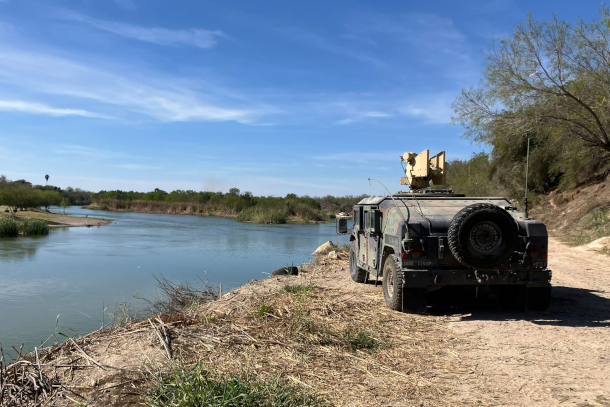
A Humvee is parked by a section of the Rio Grande in Texas where Custom and Border Protection plans to install buoys. (Photo: Martha Pskowski, Inside Climate News)
BELTRAN: And Martha, you talked to people who are raising concerns over how these buoys might impact the Rio Grande. What are some of those concerns?
PSKOWSKI: Well, the Rio Grande for the last few years has been relatively dry, but as we know with climate change, we do expect to see more extreme floods. So if a bigger flood comes through the region, the concern is that these buoys won't be able to withstand it, and they could break free from their moorings and cause damage. Customs and Border Patrol said that they're designed to withstand a hundred-year flood, but these specific design specifications haven't been released to the public because the Department of Homeland Security can waive any law that is in their way. This goes back to the Real ID Act in 2005. So last summer, the Department of Homeland Security waived over two dozen laws in an area of Cameron County where they were going to start with the buoy project that includes the National Environmental Policy Act, the Endangered Species Act, the Clean Water Act. So all of the steps that the government would normally have to go through for a project like this, they can get around that. And that's also why there isn't a lot of information available to the public, because all of that due diligence doesn't have to be followed.
BELTRAN: And this is not the first time buoys have been installed as a border security measure. Can you explain how this project differs from previous buoy projects across the border?
PSKOWSKI: Well, the earliest record I found of this idea goes back to the first Trump administration. There was a proposal to place buoys in the river. It wasn't implemented during that administration. But then a couple years later, Texas Governor Greg Abbott decided to put buoys in the Rio Grande at Eagle Pass. The buoys at Eagle Pass, it's only 2000 feet of buoys, so it's a much, much smaller area than what the federal government is doing now, but even so, it caused a lot of issues. There was a lawsuit with a kayaking guide who sued because he could no longer get kayaks in the river and operate his business. And there's also safety concerns that people could get trapped in the buoys and drown, and there was one person's body found in the buoys. It wasn't determined whether he had drowned further upstream or because he was trapped, but all those concerns came up with only 2000 feet of buoys, and now we're talking about over 500 miles.
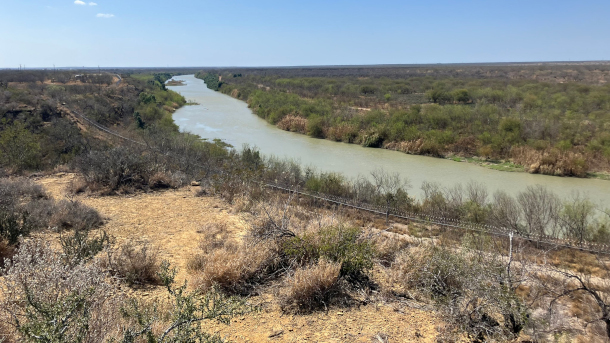
Customs and Border Protection plans to install buoys in the Rio Grande in Zapata County, Texas, where border fencing is also present on the banks of the river. (Photo: Martha Pskowski, Inside Climate News)
BELTRAN: And you wrote about Brownsville, a town in Texas that has deep connections to the Rio Grande. Can you tell us more about their connections, and how are they being impacted?
PSKOWSKI: Brownsville, Texas is right at the outlet of the Rio Grande into the Gulf of Mexico. On the other side of the river is Matamoros, Tamaulipas and the two cities have very deep connections. People go back and forth for work, for school, and while I was there reporting, it was their annual Charro Days celebration, when there's lots of music, dancing, just celebration of Mexican culture and border culture. I was there on February 26 which was the children's parade, which was very adorable. And then after the parade, that's when some of the local environmental groups chose to have a protest about the buoys, because they really wanted to point out at the same time as the city was celebrating its connections to Mexico, there's this huge project to put buoys in the river, which would just further sever the two cities and the two countries. So the protest really focused on that disconnect between the public celebration and then what the federal government's currently doing.
BELTRAN: And what about other towns in the region? How are they being impacted?
PSKOWSKI: Another city on the border where there's been a really active protest movement is in Laredo, Texas. That's also on the Rio Grande, and during the first Trump administration, they were successful in opposing border wall construction. So there's still city parks that are right on the river, and people can go fishing, go boating. So a lot of people there are really adamant about keeping that aspect of the community. And you know, there's lots of just small towns along the border where, you know, we see these images of the border in the media, sometimes that makes it seem very scary or intense, but if you go down to the river, people are fishing, people are picnicking. So in a lot of ways, there's still that just draw, that the water has, that exists everywhere, and people want to preserve that.
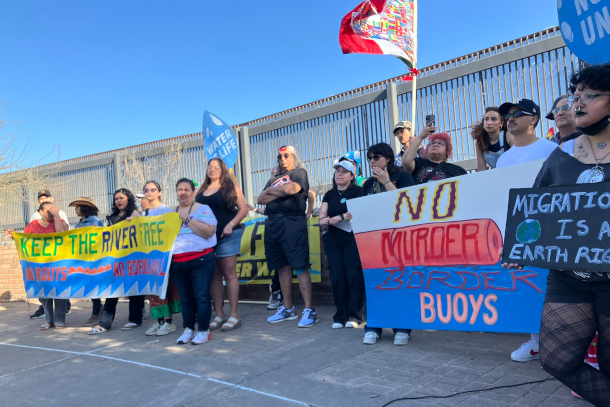
Local environmental groups in Brownsville, Texas protested the buoy project during Charro Days, a festival shared between Brownsville and its direct neighbor across the border, the Mexican city of Matamoros. (Photo: Martha Pskowski, Inside Climate News)
BELTRAN: Now, earlier this year, Customs and Border Protection released a map charting major construction and expansion of the border wall. The map has been updated a few times, but there's been protests from communities across the Southwest. Where does this construction stand?
PSKOWSKI: There's been a lot of changes just in the last few weeks of this map that Customs and Border Patrol has online. It's called the Smart wall map, and it is notable because in the past, there wasn't a map like this available, but now they show different lines along the border where they will be putting a wall or using new surveillance technology. It's changed a lot, so residents are skeptical of how accurate it really is. Around Big Bend National Park, for a couple weeks, it did show a physical wall for the National Park, but then they changed it back to surveillance technology. But the whole area is very remote, very wild. It's known for its dark skies, so the idea of having all of this construction, having a wall, is really upsetting to people who live there, and also all of the people who love visiting to go to the National Park, go camping, go hiking. So people are are still very much worried about new border wall construction in the Big Bend region, Rio Grande Valley, Arizona, a lot of different parts of the border.
BELTRAN: And what have conservationists said about biodiversity and how it may be impacted by both the buoy project and also the border wall?
PSKOWSKI: One source I spoke with in South Texas, she called this an experiment on a continental scale, which I think is a really good way to think about it, because what the federal government is trying to do is completely cut off the US from Mexico, and all of those species that move between the countries could also have their range cut off. So there's a couple big examples in Texas. The black bears have started to come back into Texas from northern Mexico. The population was completely wiped out in Texas, but now there is a black bear population reestablishing, which is really exciting for conservationists. And if there's a wall built through the Big Bend that would cut off that movement of black bears between the countries, the same with jaguars in Arizona. So the biodiversity of the border region is really deeply impacted by all of these projects.
BELTRAN: And you know, it seems like we're seeing more and more border projects at odds with the natural environment, and you've had a chance to talk to both conservationists and residents across the border. How do they feel about the situation so far, you know? What have they shared with you?
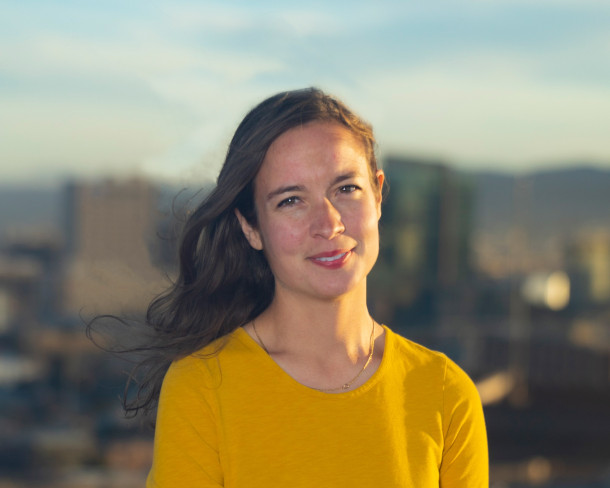
Martha Pskowski covers climate change and the environment in Texas for Inside Climate News. She has also reported for The Guardian and Yale E360. (Photo: Courtesy of Martha Pskowski)
PSKOWSKI: I think at this moment, people just feel frustrated that all of these projects are going forward without a lot of accountability and without very much justification from the federal government of why they're necessary. You know, there's already hundreds of miles of border wall, and we've seen the impacts on wildlife, and at this point in time, the number of people attempting to cross the border has really gone down. So just all of the impacts that these projects could have, people are questioning whether it's worth it. The big, beautiful bill last summer allocated $46.5 billion for these border wall projects. So there's really more money than they even need, and that's allowed so many of these contracts to be issued and for residents, these projects are just moving really quickly, and they're struggling to even get basic information about what's happening. So you know, as word is spreading more, there is more outcry in these different communities, but there just hasn't been a lot of transparency, and that's really frustrating for people who are impacted.
BELTRAN: Martha Pskowski is a journalist covering climate change and environment in Texas for our media partner Inside Climate News. Martha, thank you so much for joining us.
PSKOWSKI: Thank you for having me on.
BELTRAN: We reached out to the Department of Homeland Security for comment, but they did not respond in time for this broadcast. A press release from DHS reads in part: “waterborne barriers are intended to create a safer border environment for patrolling agents, as well as deter illegal aliens from attempting to illegally cross the border through dangerous waterways. The Secretary’s waiver authority allows DHS to waive any legal requirement, including environmental laws such as the National Environmental Policy Act, to ensure the expeditious construction of physical barriers and roads." You can find a link to the full press release on the Living on Earth website, loe.org.
Links
Inside Climate News | “Blasting Begins For Border Wall On Cherished New Mexico Mountain”
Read Custom and Border Protection’s press release on the buoy project.
Living on Earth wants to hear from you!
Living on Earth
62 Calef Highway, Suite 212
Lee, NH 03861
Telephone: 617-287-4121
E-mail: comments@loe.org
Newsletter [Click here]
Donate to Living on Earth!
Living on Earth is an independent media program and relies entirely on contributions from listeners and institutions supporting public service. Please donate now to preserve an independent environmental voice.
NewsletterLiving on Earth offers a weekly delivery of the show's rundown to your mailbox. Sign up for our newsletter today!
 Sailors For The Sea: Be the change you want to sea.
 The Grantham Foundation for the Protection of the Environment: Committed to protecting and improving the health of the global environment.
 Contribute to Living on Earth and receive, as our gift to you, an archival print of one of Mark Seth Lender's extraordinary wildlife photographs. Follow the link to see Mark's current collection of photographs.
 Buy a signed copy of Mark Seth Lender's book Smeagull the Seagull & support Living on Earth
© Copyright World Media Foundation. All Rights Reserved
Home | Contact | RSS | Donate | Newsletter