

$1 Billion to Abandon Offshore Wind
Air Date: Week of April 10, 2026
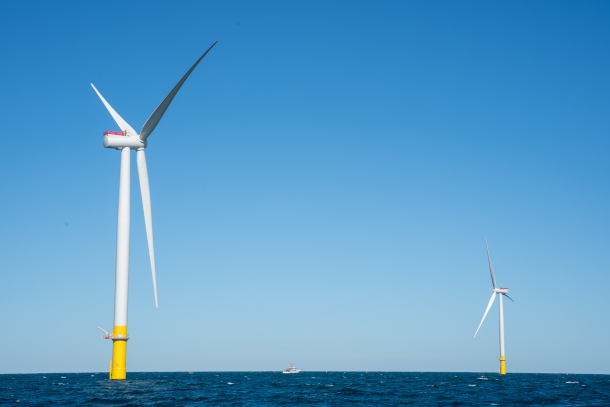
The Coastal Virginia Offshore Wind Project, built by Dominion Energy, began producing energy recently. When completed (expected to be in 2026), Coastal Virginia Offshore Wind is expected to provide electricity to 660,000 customers at peak demand. (Photo: Courtesy of Dominion Energy)
The US Department of the Interior recently announced an agreement to pay the multinational company TotalEnergies nearly $1 Billion to abandon its offshore wind leases and instead invest in oil, natural gas and LNG production in the U.S. Yet several major offshore wind projects are coming online, including Revolution Wind in New England and Coastal Virginia Offshore Wind. Katharine Kollins, president of the advocacy group Southeastern Wind Coalition, speaks with Host Jenni Doering about the Trump administration deal with TotalEnergies and the state of offshore wind.
Transcript
BELTRAN: It’s Living on Earth, I’m Paloma Beltran.
DOERING: And I’m Jenni Doering.
The US Department of the Interior recently announced an agreement to pay the multinational company TotalEnergies nearly $1 Billion to abandon its offshore wind leases and instead invest in fossil fuel production in the U.S. The federal government said it will reimburse TotalEnergies for money spent on US oil, natural gas and LNG production, up to the cost of the leases. Those projects were to be located off the coasts of New York and North Carolina. This is yet another move by the Trump administration to stifle the offshore wind industry, months after a federal judge reversed its attempt to kill projects along the East Coast. And now several of those major offshore wind projects are coming online, including Revolution Wind in New England and Coastal Virginia Offshore Wind. Joining us to discuss the Trump administration deal with TotalEnergies and the state of offshore wind is Katharine Kollins, president of the advocacy group Southeastern Wind Coalition. Katharine, welcome to Living on Earth!
KOLLINS: Thank you, Jenni, I'm glad to be here.
DOERING: So Katharine, what was your reaction when you heard the news of this $1 billion payment?
KOLLINS: I was surprised and disappointed. This is obviously another blow to offshore wind. We've seen a number of them throughout the current administration, and it's really a dual blow to the taxpayer. Because you've got consumers both paying TotalEnergies back for nearly a billion dollars of a lease payment, and then again, higher long-term costs of a less diverse and less efficient energy mix.
DOERING: Now, supporters of the Trump administration deal with TotalEnergies say that this $1 billion deal is merely a refund on money that TotalEnergies paid the government, and so taxpayers are breaking even. What's your response to that argument?
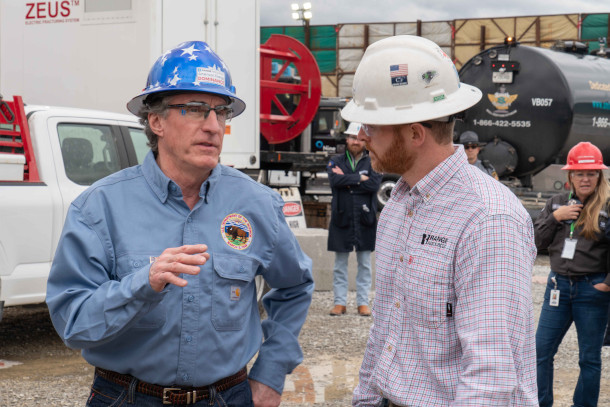
Secretary Doug Burgum visits a fracking site in Pittsburgh, Pennsylvania on April 3, 2025. Burgum signed a deal with TotalEnergies allowing the French company to abandon two off-shore wind leases in exchange for $1 billion investment in oil, natural gas and LNG. (Photo: U.S. Department of Interior, Flickr, public domain)
KOLLINS: My response to the argument is that these funds were already paid and accounted for, and I don't think that those same folks would be supportive of the administration refunding the tax dollars that we all paid last year. So just because we've already paid something doesn't mean that it is acceptable to then refund it a year later, when those funds were already allocated by the Treasury.
DOERING: So the courts overturned the Trump administration's order to shut down offshore wind projects on the grounds of national security. What do you make of this new strategy to pay companies like TotalEnergies to just give up their leases?
KOLLINS: It is a continuation of the President's strategy to do whatever he can to cripple this industry, and I think in the long run, it's futile, because offshore wind is a much-needed energy generation source, especially on the East Coast, and it's a phenomenal economic development tool. The fundamentals of offshore wind make sense for the U.S., but in the short term, he has made developing offshore wind very difficult and driven a lot of investors away from the U.S., away from offshore wind and toward other investments.
DOERING: What's the economic impact of canceling offshore wind farms? Who wins and who loses?
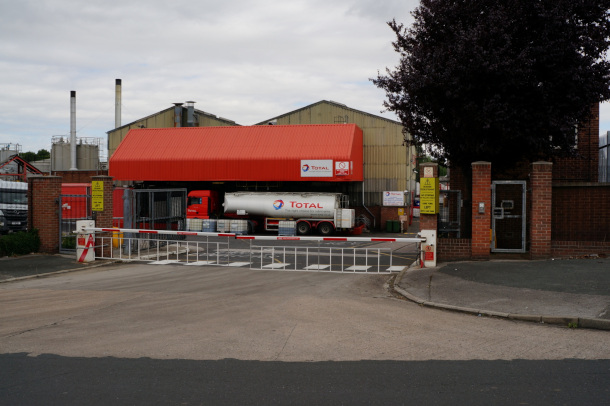
A Total Energies depot in the United Kingdom. The French company has signed an agreement with the Trump administration to abandon two offshore wind leases, and in exchange, be reimbursed for $1 billion invested in oil, natural gas and liquified natural gas projects in the United States. (Photo: Ian S, Wikipedia Commons, CC BY-SA 2.0)
KOLLINS: I would venture to say that we all lose and we all lose because we are talking about over $30 billion of fully permitted economic activity just in the five projects that are currently under construction. That's over $11 billion in supply chain assets that have spun up to support construction. The reason that these manufacturing facilities are being developed and that manufacturers are looking at the U.S. is because the components are so large that they can only be transported on water, and so right now we are getting a lot of those components from Europe. They are being shipped to the U.S., where the U.S. hasn't developed the manufacturing facilities as of yet, and then we're installing these machines. That said, if we can build a U.S.- based supply chain, we're talking about at least $100 billion of potential economic activity.
DOERING: It sounds like these wind farms already make a lot of sense in terms of the energy they're going to produce for the grid and jobs and installing them. And there's even more opportunity in the future to build out these manufacturing hubs in port cities.
KOLLINS: Yes, and in order for companies to invest again the billions of dollars that are required to manufacture these extremely large components, specialized equipment on the coast, they need to know that there is a stable permitting regime. They need a concrete pipeline of projects that developers are willing to commit to and know that they can continue to build. And unfortunately, what we are seeing right now is an erosion of that. And so that means that we will likely need to continue to purchase at least the major turbine components from places like Europe.
DOERING: Katharine, you know, given this country's growing electricity demands, in part because of AI, how can offshore wind help feed the power grid, especially when some skeptics say that, you know, the wind doesn't always blow?
KOLLINS: One of the really amazing things about offshore wind is that offshore wind is generating electrons when we need them most. So that happens to be in the wintertime when it is cold, when natural gas is constrained and prices are high. It happens to be winter mornings when folks are switching on heating. And it is also very highly correlated with winter storms. And what we've seen over the last few years with winter storms is gas prices become astronomical because of constrained supply, everybody is working very hard to heat their homes. And if we had offshore wind on the grid during those periods, that is effectively a hedge to those very high fuel costs, offshore wind has already proven itself to be integral to the power grid, especially along the East Coast. So there is an operating project South Fork Wind up in the Northeast and so over the course of its first year of energy production, it showed that it was delivering electrons to the grid nearly all of the time, and it had over an 80% capacity factor during winter storms, when that electricity is needed most.
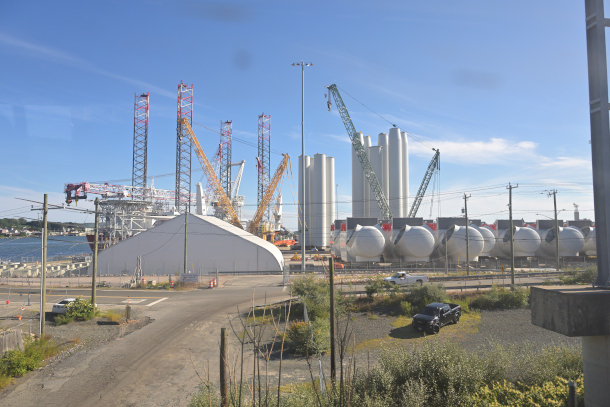
In the above photo, components for the Revolution Wind Offshore project were being staged in New London, Connecticut in August 2025. The 704 megawatt project, which began generating power on March 13, 2026, is expected to provide electricity to more than 350,000 homes and businesses in Rhode Island and Connecticut. (Photo: 4300streetcar, Wikimedia Commons, CC BY 4.0)
DOERING: And what is the current state of offshore wind off the Southeastern coast?
KOLLINS: Offshore wind in the Northeast has progressed much quicker than it has in the Southeast, because the Northeast has been fantastic about enacting state policies that really both encourage offshore wind and also provide the level of certainty that these large infrastructure projects require to get off the ground. In the Southeast, I think the shining light is the Coastal Virginia Offshore Wind project. It is the largest project in the U.S., at 2600 megawatts, and that project is actively under construction. They just started delivering power to the grid, and so we are very excited and proud in the Southeast to have such a phenomenal project bringing electricity to grids where it's needed most.
DOERING: So in terms of this new project off the coast of Virginia, I think it's called Coastal Virginia Offshore Wind, what made that project possible?
KOLLINS: Most energy policy is driven by states, and Virginia has been a huge supporter of offshore wind for a long time. So Virginia has invested in their ports. They have invested in offshore wind training development and made sure that the utility, the regulated utility, Dominion Virginia, was able to develop this project in a way that made sense for Virginians. This is the only project in the U.S. that has been developed by a regulated utility. What that allowed in this specific case is for that utility to contract for their components in advance of the inflationary pressures that we saw in the early 2020s. And so this project has really been, again, kind of a shining light, because it is providing low cost, reliable electricity into the, it's called the PJM grid. PJM is the regional transmission organization that covers the state of Virginia, and that grid is already constrained in a number of ways, and very much looking forward to having the full capacity of the 2600-megawatt project feeding electrons into their grid.
DOERING: Katharine, what do you see as the future for offshore wind energy?
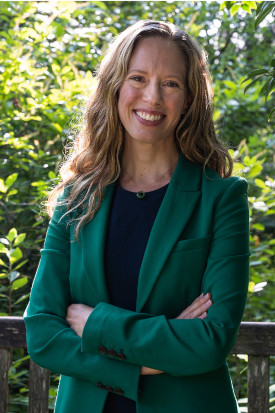
Katharine Kollins, president of the Southeastern Wind Coalition, said the U.S. is ceding offshore wind technological leadership to China and Europe and missing out on billions in economic development impact. (Photo: Courtesy of Katharine Kollins)
KOLLINS: The future globally is so strong. What I think a lot of Americans don't recognize is that countries like China have over 50 gigawatts of offshore wind installed and under construction. That is as much as the U.S. could hope to build in 20 years. Europe has over 35 gigawatts of installed offshore wind. These countries already have very robust manufacturing supply chains, have already invested in their ports and are already building these domestic machines that are generating clean, free fuel electricity for those countries. The U.S. is really ceding both the economic development, the technological know-how, things like ship building to Europe and Asia by not investing in this technology domestically.
DOERING: Katharine Kollins is president of the Southeast Wind Coalition, a nonprofit that advocates for wind energy across Southern states. Katharine, thanks so much for talking with us.
KOLLINS: Thank you for having me. Jenni.
DOERING: Regarding the billion-dollar deal with TotalEnergies, Interior Secretary Doug Burgum said: “Offshore wind is one of the most expensive, unreliable, environmentally disruptive, and subsidy-dependent schemes ever forced on American ratepayers and taxpayers. “We welcome TotalEnergies’ commitment to developing projects that produce dependable, affordable power to lower Americans' monthly bills while providing secure U.S. baseload power today—and in the future.” To read the full Interior Department statement and one from TotalEnergies visit the Living on Earth website, loe.org.
Links
Canary Media | “Trump’s $1B Offshore Wind Payout to TotalEnergies Sparks Legal Concerns”
Living on Earth wants to hear from you!
Living on Earth
62 Calef Highway, Suite 212
Lee, NH 03861
Telephone: 617-287-4121
E-mail: comments@loe.org
Newsletter [Click here]
Donate to Living on Earth!
Living on Earth is an independent media program and relies entirely on contributions from listeners and institutions supporting public service. Please donate now to preserve an independent environmental voice.
NewsletterLiving on Earth offers a weekly delivery of the show's rundown to your mailbox. Sign up for our newsletter today!
 Sailors For The Sea: Be the change you want to sea.
 The Grantham Foundation for the Protection of the Environment: Committed to protecting and improving the health of the global environment.
 Contribute to Living on Earth and receive, as our gift to you, an archival print of one of Mark Seth Lender's extraordinary wildlife photographs. Follow the link to see Mark's current collection of photographs.
 Buy a signed copy of Mark Seth Lender's book Smeagull the Seagull & support Living on Earth
© Copyright World Media Foundation. All Rights Reserved
Home | Contact | RSS | Donate | Newsletter