

"Night Owl" -- Poems by Aimee Nezhukumatathil
Air Date: Week of April 10, 2026
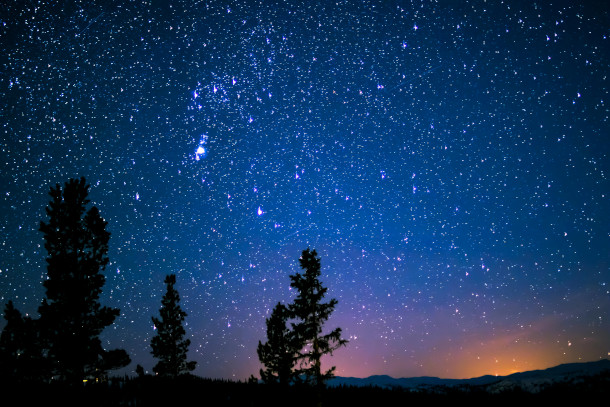
Author and poet Aimee Nezhukumatathil says she does her best creative work at night. (Photo: Sindre Fs, Pexels, public domain)
The poems in Aimee Nezhukumatathil’s new book Night Owl offer a window into the magic of nature at night and a light in the darkness. She joins Host Jenni Doering to share selected poems from the collection and talk about how poetry can help us grapple with ecological loss and celebrate natural wonders alike.
Transcript
BELTRAN: It’s Living on Earth, I’m Paloma Beltran.
DOERING: And I’m Jenni Doering.
Maybe we turn away from bad news about the planet because the scale of ecological loss and the climate crisis is almost too much to bear. But oftentimes working through those complex emotions, instead of shoving them aside, is the only way to truly move forward. And for some, poetry offers a light in the darkness, including in Aimee Nezhukumatathil’s new book, Night Owl. The poems in her collection have names like “Firefly Nocturne,” “Dark Chocolate Universe,” and “How to Build a Moon Garden When the News Is All Horror.” Aimee has served as poetry editor for Orion and Sierra magazines, and she’s been a professor of English for 25 years in Oxford, Mississippi, where she joins me now as National Poetry Month turns 30. Welcome to Living on Earth, Aimee!
NEZHUKUMATATHIL: Thank you so much, Jenni. I'm so happy to be here.
DOERING: We're happy to have you. So we wanted to start off with the first poem in this collection. It kind of sets the tone for the rest of the poems in this book. Could you please read "Nocturne for Dark Things?"
NEZHUKUMATATHIL: Sure, and yes, a nocturne, as I say in the back of the book, is simply a poem that takes place at night, and this is kind of my introduction of like, why night, Aimee? Why is this book all about night? So here it is.
"Nocturne for Dark Things."
I do my finest listening in the dark.
My best friend has always been ink
and she lets me talk so much at night.
One of the marvels of my life—an
alphabet. A whole green and mossy
world can be made and remade
from just twenty-¬ six dark curlicues.
Here’s more dark: sometimes birds sleep
tucked under a giraffe’s dusky armpit
and sometimes fungi fatten only at night.
When I was a kid, I used to worry over
so many bugs and moths slamming
into our windshield. My sons have never
known that concern, which is another kind
of worry. But dark marvels still bloom
and snick the soil, swim the oceans and air—and
even on the moon: wide, flat plains
are called seas, lakes, and marshes. Bays
are named Joy, named Sorrow, named Hope,
named Nectar, named Softness, named Serpent,
named Stickiness, named Tranquility, named
Clouds, named Sleep, and my favorite—¬ named Love.
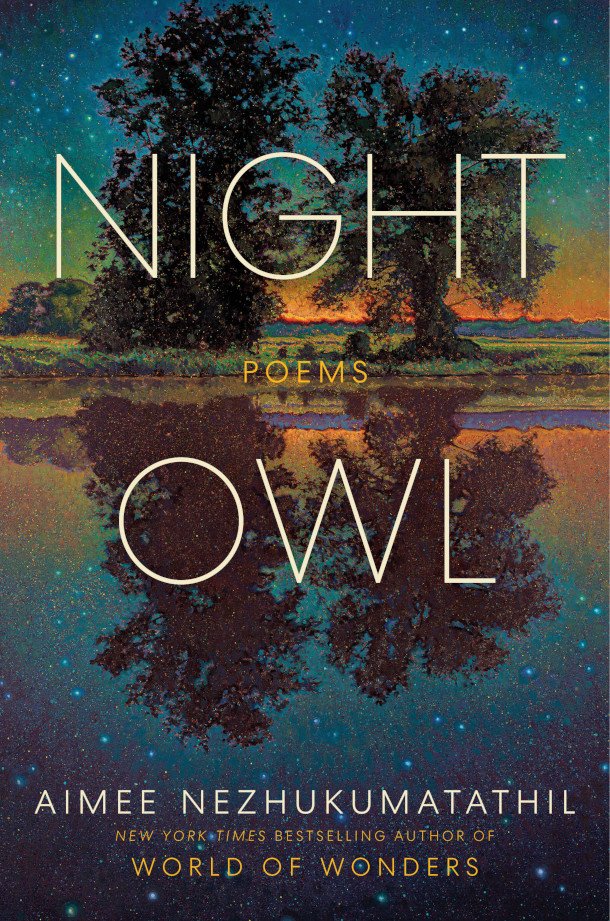
Night Owl: Poems by Aimee Nezhukumatathil. (Artwork: Charlie Buckley)
DOERING: It's beautiful, and I think my favorite line is, "sometimes fungi fatten only at night." I love that.
NEZHUKUMATATHIL: Thank you. Thank you.
DOERING: So this collection of poems is called Night Owl, and of course, references to nighttime are present throughout this body of work. What is your relationship with the night and to the darkness?
NEZHUKUMATATHIL: Yeah, you know, I mean, I think night for me is a time when everything slows down, you know, kind of with our technology-based world, that's when I can guarantee almost no little pings on my phone. Everybody I love is asleep. I feel like the world becomes more honest. I feel like I'm, am I most honest and most vulnerable? The poet Edward Hirsch calls it "loosening your night mind." And I really love that like, when you "loosen your night mind," all those things that that worry you, that delight you, that enthrall you, really can kind of come to the surface a little bit. And I don't know, there's a fearlessness there, even though it's maybe vulnerable, there's a fearlessness of sharing it at night, I think in some ways, you think of slumber parties, where growing up, that's when, like all of our deepest, darkest fears and crushes were revealed. It's just, there's a revelation, I think that happens at night for everybody.
DOERING: I mean, who hasn't had the experience of your head hitting the pillow, and then all of a sudden, all these ideas come to mind? And you're thinking, sometimes ruminating too much, but sometimes feeling the urge to, like, write things down.
NEZHUKUMATATHIL: Absolutely. My normal state is like, oh, I have the perfect comeback for something that happened when I was in sixth grade or something. So I just was like, oh, I've never written about this. I've never kind of collected or had an eye towards, kind of my truest creative self in that way. And I was like, I'm seeing this thread throughout the poems that I was writing in the last decade, of noticing the world at night. You know, the outside world at night. How animals move or don't move, how plants and fungi move and percolate a little bit at night. The outdoors is so alive at night.
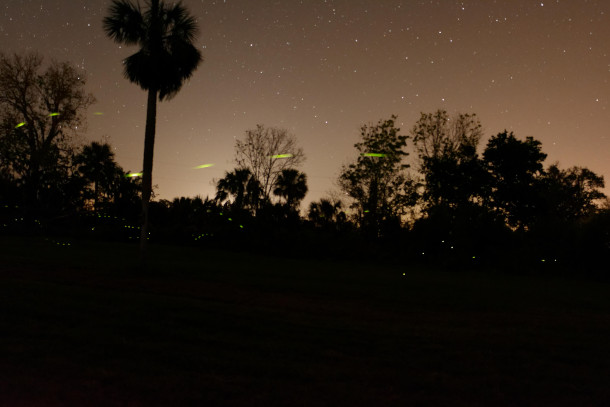
Artificial lights can disturb nighttime creatures like fireflies and migratory birds. (Photo: Jud McCranie, Wikimedia Commons, CC BY-SA 4.0)
DOERING: These days, it really is hard to connect with the nighttime world the way humans once did.
NEZHUKUMATATHIL: Yes!
DOERING: You know, we used to spend a lot more time looking up at the stars, but now we have light pollution. We have our noises of the city drowning out nighttime creatures. We have these screens that we are constantly looking at at night.
NEZHUKUMATATHIL: That's right.
DOERING: What do you think we miss out on when we lose access to nature at night?
NEZHUKUMATATHIL: Oh my gosh. I love that question. That's like, that's a whole essay collection right there. But one of the initial things is, like observing the outdoors at night, it's a good reminder that we're all connected and like our actions during the day, often, I mean, they do influence what goes on in the outside at night, you know. I mean, like, in a couple months, it's going to be firefly season here in northern Mississippi. And, you know, I am railing constantly in my neighborhood about, like, let's dim the lights. Let's turn the lights out at least for this, you know, it's like, late May early June. And then bird migration, for example, there's that as well. So both, you know, just two animals in particular, birds and lightning bugs, if we are just constantly flooding the night, birds don't actually get to where they need to be going for their nesting and things like that, because they get derailed. They think it's stars. When we are actually watching whole populations of lightning bugs and birds decline. And guess what, folks, if that declines, if those go away, we go away eventually, you know? So I don't know that completely answers your question, but I would say it's that connection of realizing like, oh my gosh, look at my actions influence all these creatures here, and then also more in the "woo woo" sense, when you're able to look up and see stars, stars that maybe your grandparents saw, or maybe a loved one on the other side of this country might be looking at as well. We just had a beautiful blood moon lunar eclipse, and my dad in Florida was watching that. So knowing that he was watching that also gives connections to other humans too. So it's not just oh, I'm connected to these lightning bugs. We're connected to each other as well by looking at these markers of time up in the sky as well.
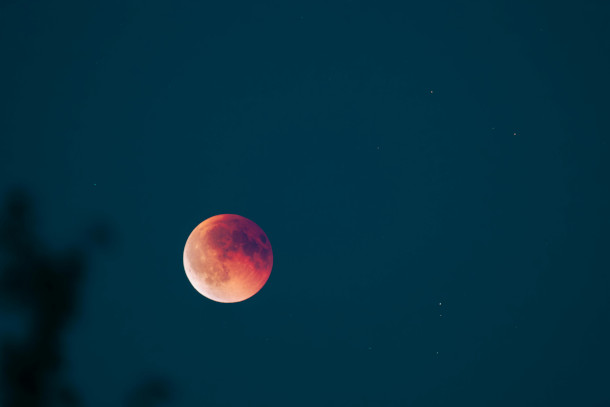
Our guest, Aimee Nezhukumatathil, discusses the wonder of seeing a blood moon at the same time as loved ones who are far away. (Photo: Jan Reichelt, Pexels, public domain)
DOERING: Another poem that hearing you talk made me think about a little bit was "Letter for Noctiluca."
NEZHUKUMATATHIL: Oh, okay.
DOERING: And you mentioned stars in this poem. There's sea sparkle, I guess, sort of the bioluminescence that we can see at night in the sea is that kind of what you're referring to in this poem?
NEZHUKUMATATHIL: Yeah, absolutely.
"Letter for Noctiluca," which is the proper name for sea sparkle or sea fire.
It’s been so long since I heard from you
when I finally did, I was like a sandpiper
hearing thunder for the first time. You used to visit
my shore often, lap my ankles with your foamy laugh.
When I see your name, my heart claps like clamshell
or coquina—¬ or a scallop tambourine with dark stars
of shark teeth along the wrack. Even just hearing
your laugh sends me into a fig-¬ sugar crumble. I hear
reports of lit-¬ up mangroves, full of reptiles
that don’t know what to call the flecks of light on their backs.
You kiss me on the cheek in full view of others. We hold
each other a beat too long. We pledge ourselves to snow
to pink sand to fresh redbud shoots iced overnight
when nothing moves except winter stars—like
Procyon like Betelgeuse like Sirius, the dog star.
DOERING: Where did this poem come from?
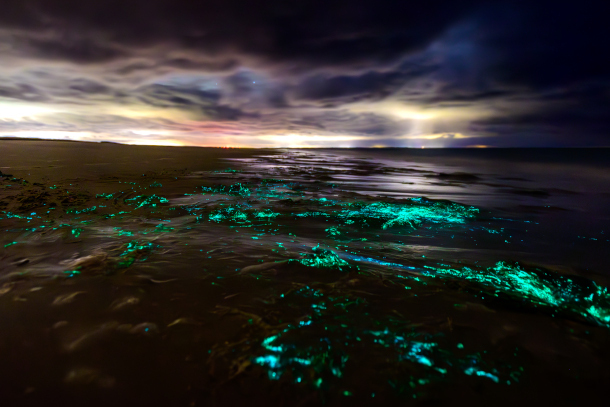
Luminescent particles (presumably dinoflaggelates noctiluca scintillans) caught in seagrass and washed up at the beach of Spiekeroog, Germany. (Photo: Stephan Sprinz, Wikimedia Commons, CC BY 4.0)
NEZHUKUMATATHIL: You know, I was imagining kind of like all the different stars, all the different versions of kind of sparkle in the outdoors, like non-manmade sparkle, you know. So instead of like these glaring house lights that drive me nuts here in the suburb, or car lights and things like that, this is just imagining the light that is created at night from these tiny dinoflagellates that light up.
DOERING: Some of your poems touch on your relationship with the environment around you, the simultaneous awe and grief that it can bring. How does writing help you personally make sense of the ecological crises that are facing our world, Aimee?
NEZHUKUMATATHIL: I love that. I don't know if you feel this way too, but oftentimes I'm reading poetry, and I will read a line or a stanza and I'll be like, oh, I didn't realize I feel that way too, but this gave me words, like I didn't know I felt that until I read it. That's poetry doing the quiet work. What I hope, I guess, is, I feel this way when I'm writing it, so I'm hoping my readers feel this way, poetry is like a little lantern, like a little flashlight or a little lantern, because it names the ache, it names the want, it names the love, it names the fear, the rage, anything that your heart aches about, and then it hands you like a lantern back. Like, what do you think of this? Or gives you a mirror to yourself. Like, when have you last felt like this?
DOERING: Absolutely, and there is sort of you call it a lantern, a way of understanding, holding up a light to what's happening. And I think one of the poems in your book that kind of grapples with this ecological crisis and maybe helps us understand it, feel it a little bit better, is called "Trigger Fish Invective."
NEZHUKUMATATHIL: All right, yeah, an "invective," and this is also in the back of the book, is a song of anger, a poem that goes back to ancient Rome, when people would write invectives against government or against anything that they saw was unjust or wrong. And it's a way to kind of corral that anger and rage. But this was inspired by, I went snorkeling on the island of Oahu, and in spite of there being so many signs, please don't step on the coral. Basically, if we're allowing you to snorkel here, you have to basically tread water. And then, of course, with the exception of my family and maybe one other, everybody was stepping and just like putting their giant gross flippers on all these precious corals. This part of the reef was just coming back. I just, oh, I just wanted to, like, play lifeguard or something and whistleblow on them. And it was really kind of heartbreaking to see.
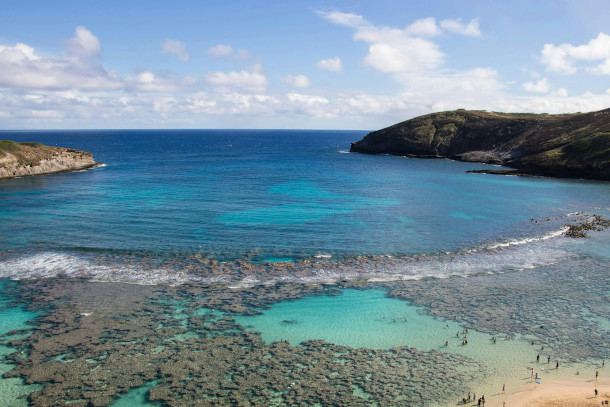
Hanauma Bay in Oahu, Hawai’i. (Photo: Olusola O, Pexels, public domain)
"Triggerfish Invective."
The last time I sank my face in the neritic ocean
I found only beige and bleached out bones, instead
of orange and green coral fans. I spoke to angry underwater
ghosts in other languages I forgot I knew—¬ my mouth grew
full of seaweed syllables and cracked shells. Too many
pale bodies have marched snorkel fins over this coral,
snagged selfies on the coral, and scraped coral clean
of leafy food. Too many pale bodies don’t even leave
a scintilla of small-¬ shelled meats. The fish ghosts cackle
and hiss. Sometimes they answer with light-¬ scatter.
The sea in this bay once curved full of cucumbers
and other funny vegetables, some with fin and some
with spine. Here the sea-¬ swollen ring of motion bursts—here
the sea throws a dozen fish with pointed snouts
towards me. I never thought I’d be lucky to see triggerfish
in real life but they remain—¬ almost a warning or last chance
for us. Why else would they activate their trigger fin
and hold on to coral bones if there was no more hope
of saving the bay? I am certain I will wear an anklet
of tiny bites from these ’humuhumunukunukuapua’a
and why not: for all the fish I see now, thousands more
swam just last year. And the last year. And the last.
The fish ghosts only send out mondegreens now.
Some scatter pale green light. Some scatter a cackle and a hiss—
DOERING: Not much resolution in there.
NEZHUKUMATATHIL: No, no, no.
DOERING: And there doesn't always have to be, I guess.
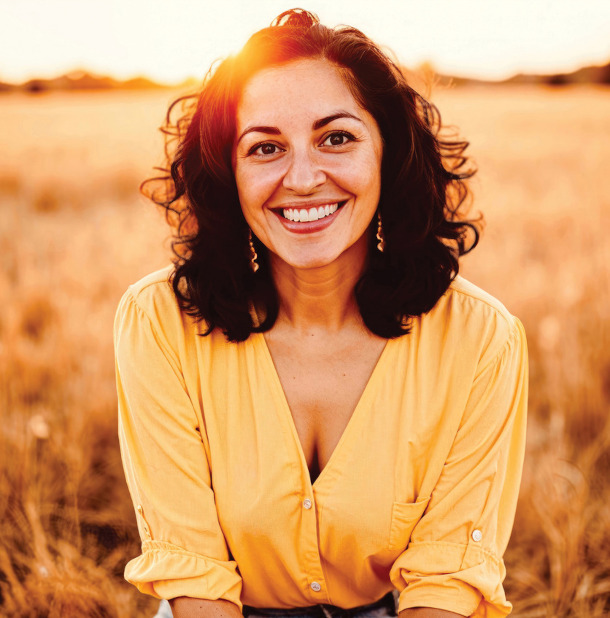
Aimee Nezhukumatathil served as poetry editor for Orion and Sierra magazines and has been a professor of English for 25 years, currently teaching at the University of Mississippi. (Photo: Dustin Parsons)
NEZHUKUMATATHIL: Yeah, I very much did not want this to be a thing like, look at Aimee. She's always talking about joy and beauty and light. I mean, that's not, I mean, I could do that, but that wouldn't feel authentic to me. That wouldn't feel authentic to what I've experienced in the planet. That's just not how the world works.
DOERING: Aimee, what do you see as the role of poetry amid the climate crisis? You know, violence and conflicts around the world? What do we gain by writing and reading poetry?
NEZHUKUMATATHIL: Oh, I love that question so much. My favorite scientist, who was Rachel Carson, one of her famous things that she said was, the more we get to know about the inhabitants of the earth, the less appetite we have for destruction. And so in my poems in particular, because I can't, almost not write a poem that doesn't have a plant or an animal in there as well, my hope is that if you get to know a little bit about this particular fish in Hanuma Bay in Oahu, or a little, an Indigo bunting. You know, I'm always writing about buntings, or a narwhal or something, you know, anything like that. I hope that these poems kind of become contagious for wanting to know more about the world.
DOERING: Aimee Nezhukumatathil is the author of the collection of poems, Night Owl. She served as poetry editor for Orion and Sierra magazines, and has been a professor of English for 25 years in Oxford, Mississippi. Thank you so much, Aimee. This has been such a treat.
NEZHUKUMATATHIL: Oh, Jenni, this has been so lovely to chat with you all. Thank you so much for such amazing, hard-hitting questions. Each one of them could be like an essay in itself.
Links
Living on Earth wants to hear from you!
Living on Earth
62 Calef Highway, Suite 212
Lee, NH 03861
Telephone: 617-287-4121
E-mail: comments@loe.org
Newsletter [Click here]
Donate to Living on Earth!
Living on Earth is an independent media program and relies entirely on contributions from listeners and institutions supporting public service. Please donate now to preserve an independent environmental voice.
NewsletterLiving on Earth offers a weekly delivery of the show's rundown to your mailbox. Sign up for our newsletter today!
 Sailors For The Sea: Be the change you want to sea.
 The Grantham Foundation for the Protection of the Environment: Committed to protecting and improving the health of the global environment.
 Contribute to Living on Earth and receive, as our gift to you, an archival print of one of Mark Seth Lender's extraordinary wildlife photographs. Follow the link to see Mark's current collection of photographs.
 Buy a signed copy of Mark Seth Lender's book Smeagull the Seagull & support Living on Earth
© Copyright World Media Foundation. All Rights Reserved
Home | Contact | RSS | Donate | Newsletter