
Lead in the Developing World
Air Date: Week of February 20, 2009
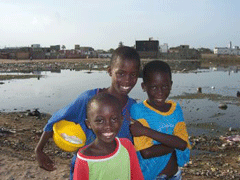
Dakar, Senegal is a suburb of Thiaroye sur Mer, where 18 children died from lead poisoning over a three-month period in 2008. (Courtesy of OK International)
The U.S. recycles almost all car batteries, but that’s not true in many developing countries. Sifting through waste to retrieve lead is a major source of income, and lead exposure, for many people in poorer countries. Perry Gottesfeld, executive director of Occupational Knowledge International explains.
Transcript
GELLERMAN: Eighty percent of the lead produced in the United States goes into car batteries. Virtually all of the batteries here are recycled, but overseas, in developing countries, they’re a deadly problem.
Perry Gottesfeld is working to reduce the risks from exposure to lead batteries and other industrial pollutants. He’s Executive Director of Occupational Knowledge International.
GOTTESFELD: There are 120 million people who are overexposed to lead around the world. That’s three times the number infected by HIV AIDS. And this problem is going largely unnoticed, under the radar screen, because people are not aware that the common battery used in vehicles and other appliances are causing severe poisoning around the world.
GELLERMAN: So where are we seeing problems with lead and how do they manifest themselves?
GOTTESFELD: Well, the problem is a global problem. It’s occurring in every country in the world. In most of the world they’re being recycled on the side of the road, somebody’s melting them down and selling the metal for scrap. And whenever lead is melted in the process of manufacturing a battery or recycling a battery, you’re releasing it to the environment. The lead will settle in soil and dust and that’s how most kids and adults get their exposure.
GELLERMAN: I was reading about one recently last spring, I think it was, or early summer, that took place in Senegal. It was an awful case involving scores of kids.
GOTTESFELD: Yeah, that was a particularly sad situation. You had an acute poisoning that caused eighteen deaths according to the World Health Organization outside of Dakar, Senegal. Lead batteries were brought to this village that specializes in recycling and many women and children got involved in taking apart the batteries, taking out the lead and melting down this material to sell for scrap. The price of lead had jumped up to over 4,000 dollars per ton at one point, and of course, this created a great demand for lead in any form, even in the case where these smelters are losing fifty percent of the lead to the environment in the process of recycling, there’s still some profit to be made by melting down lead batteries.
Dakar, a Senegal suburb of Thiaroye sur Mer, where 18 children died from lead poisoning over a three-month period in 2008. (Courtesy of OK International)
GOTTESFELD: Exactly. The efficiency of these crude smelters is something like 50 percent. Lead is very heavy so it will settle in soil and dust and most exposure to children will occur from contact with household dust and playing close to the ground. In the case of Senegal, these children were reportedly strapped to their mothers’ back while they were dismantling and then melting down these lead batteries. And, of course, they got exposed as their mothers did, but the same exposure has much more detrimental impacts on very small children than it does adults.
GELLERMAN: So you’ve got women in these third world countries who are gathering up this lead, and who’s actually buying it? Does somebody show up and they sell it to somebody and they sell it to somebody else?
GOTTESFELD: Well in the case of Senegal, reportedly there was an Indian company that had moved in, in an area very close to the village where this occurred, and they were offering to buy lead at a fairly high price and encouraging those in the village to smelt lead and to provide the scrap to them. India is lead-starved as are many other developing countries that don’t have internal sources of lead, and the battery industry is growing very rapidly in these countries, in the range of 20 percent per year, so they need a lot of imports in order to feed this growing industry.
GELLERMAN: What about China? A lot of batteries. What, if anything, is happening there?
GOTTESFELD: There have been number of large, widespread lead poisoning incidents in China. The problem is huge there; it’s occurring throughout the country, as there are something like a thousand lead battery manufacturing companies and, of course, an unknown number of battery recyclers.
GELLERMAN: Well what can we do about it? What is being done about it?
GOTTESFELD: Our organization OK International is proposing that battery companies go forward to obtain an environmental certification in order to demonstrate that their manufacturing facilities meet specific environmental standards and that they agree to take back used batteries for proper recycling.
GELLERMAN: So what have the battery makers said in response?
GOTTESFELD: Well we launched this program about a year back in India and we’re working with some of the largest battery companies in that country. And these companies have come forward voluntarily to meet the standards in our Better Environmental Sustainability Targets or BEST standard. And companies that meet this will be able to place an eco label on their product and demonstrate to consumers that they are meeting these environmental standards.
GELLERMAN: We hear a lot about the development of new batteries, new types of batteries, lithium, hydride, and that kind of thing. If the world does move into these new exotic materials, would we have a similar problem from those chemicals?
GOTTESFELD: That might be a good story for another day, because there are significant issues with lithium ion batteries. You can’t actually take a lithium ion battery, melt it down and make a new one from that process. In the laboratory, there are some methods to recycle them, but unfortunately the infrastructure does not exist to recycle lithium ion batteries today.
GELLERMAN: Well Mr. Gottesfeld, thank you. I appreciate your time.
GOTTESFELD: Thank you.
GELLERMAN: Perry Gottesfeld is Executive Director of Occupational Knowledge International.
Links
Living on Earth wants to hear from you!
Living on Earth
62 Calef Highway, Suite 212
Lee, NH 03861
Telephone: 617-287-4121
E-mail: comments@loe.org
Newsletter [Click here]
Donate to Living on Earth!
Living on Earth is an independent media program and relies entirely on contributions from listeners and institutions supporting public service. Please donate now to preserve an independent environmental voice.
NewsletterLiving on Earth offers a weekly delivery of the show's rundown to your mailbox. Sign up for our newsletter today!
 Sailors For The Sea: Be the change you want to sea.
 The Grantham Foundation for the Protection of the Environment: Committed to protecting and improving the health of the global environment.
 Contribute to Living on Earth and receive, as our gift to you, an archival print of one of Mark Seth Lender's extraordinary wildlife photographs. Follow the link to see Mark's current collection of photographs.
 Buy a signed copy of Mark Seth Lender's book Smeagull the Seagull & support Living on Earth
© Copyright World Media Foundation. All Rights Reserved
Home | Contact | RSS | Donate | Newsletter