

Primates in Peril
Air Date: Week of November 2, 2007
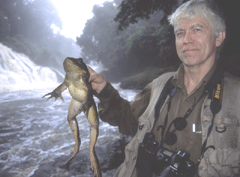
Russ Mittermeier in Equatorial Guinea (Courtesy of Conservation International)
One in four species of non-human primates are in danger of going extinct, according to a new report released by Conservation International and the World Conservation Union. Host Bruce Gellerman hears the sounds of the Sumatran Orangutan and talks with Russ Mittermeier, president of Conservation International, and chairman of the report.
Transcript
GELLERMAN: It’s Living on Earth. I’m Bruce Gellerman. Genetically speaking, humans are 99 percent the same as other primates. And, of course, we share not only genes with our closest cousins, but the planet. Now, a new report, “The World’s 25 Most Endangered Primates” finds that non-human primates are in peril and so are their habitats. Russell Mittermeier is president of Conservation International and chaired the panel that prepared the report. Hello, Mr. Mittermeier.
MITTERMEIER: Hi, how’re you doing?
GELLERMAN: I’m fine, but it seems like mankind’s closest living relatives—apes, monkeys, lemurs, other primates—aren’t doing as well.
MITTERMEIER: Well, a good percentage of the primates are in pretty serious trouble. Roughly one in every four species of primates—and there are about 650 different kinds of primates out there—about one in every four are going to be either in the critically endangered or the endangered categories, which means, you know, they’re hanging on by the skin of their teeth and they’re really—some of them are quite close to extinction. And what we’re trying to do with this top "25 Most Endangered Primates" list is highlight some of those species that are really, really in grave danger of disappearing. But one of the ways I like to convey how severely depleted these animals actually are is to say that if you gave every individual of those 25 species a seat in a football stadium, you probably wouldn’t be able to fill an entire large football stadium with all the remaining individuals representing these 25 species, which I think is pretty sobering. We’re looking at less than 100,000 individuals of all of these species combined.
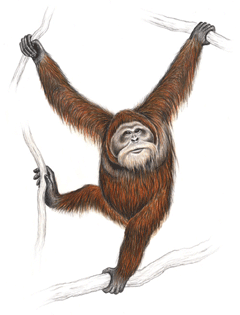
A Sumatran Orangutan (Courtesy of Conservation International)
MITTERMEIER: Well there are a number of different threats to nonhuman primate populations. Firs of all, about 90 percent of them are—90 percent of primates are tropical rainforest animals and of course rainforests have suffered a lot over the past 40 or 50 years. On top of that you have the issue of bush meat huntings as a source of food and in Asia in particular, as a medicinal products, a source of medicinal products.
GELLERMAN: We have some sound from an orangutan—the Sumatran Orangutan? Have I pronounced that correctly?
MITTERMEIER: Mmm hmm. Yes, orangutan. Mmm hmm. Man of the forest.
GELLERMAN: Man of the forest?
MITTERMEIER: ‘Oran’ is man in Indonesian and ‘gutan’ is forest.
GELLERMAN: Well, here’s some sound from the man of the forest.
[SOUNDS OF MAN OF THE FOREST]
GELLERMAN: What’s going on there?
MITTERMEIER: I’m not entirely sure. But it sounds like there’s a young one that’s perhaps a little distressed. I can’t quite make the sound out but they should be distressed because the Sumatran orangs are down to just a few thousand individuals. They’ve suffered a great deal from oil palm plantations, for example, and heavy logging in Sumatra. Sumatra’s lost a large portion of its habitat over the past 20 or 30 years and they’re just hanging on in a handful of protected areas there. But this is a wonderful creature. It’s not only a great ape. It’s also the largest tree dwelling animal on earth. Great creatures make great potential targets for ecotourism, which could generate a lot of revenue for local communities and yet, they’ve really suffered quite a bit in the past few decades.
Russ Mittermeier in Equatorial Guinea (Courtesy of Conservation International)
MITTERMEIER: The rarest primate that I have ever seen—well I just went looking for the Hainon gibbon, which is down to 19 individuals and I missed it. I didn’t get to see it on this trip. I’m going to have to go back and try again. I guess that on that list—the rarest species on that list that I have seen would have to be the greater bamboo lemur from Madagascar. This is a fascinating animal. It’s a bamboo specialist, rather like a little primate version of a giant panda. It can crack open—it only weighs about 2 kilos, about five pounds – yet it can crack open stems of giant bamboo, really hard stems. And it can digest cyanide. It’s quite an amazing creature. And right now there are probably less than 100 of those that we know of, and I think the latest estimate—we’re probably up around 60-70 documented individuals remaining of this species. And it’s not just a unique species. It’s also a unique genus of primates that’s found only in a few remaining forest patches that’s found in the few remaining rainforests of Madagascar. Another interesting thing about primates is that we’re still discovering new species all over the place, which is remarkable. Here we are in the 21st century, you would think that all of the species of our closest living relatives would have already have been catalogued and described by scientists, but that’s not the case and in fact, in places like Madagascar, and parts of the Amazon, we’re finding new species every year.
GELLERMAN: So some primates are actually doing well then?
MITTERMEIER: Well I wouldn’t say necessarily that the new ones being discovered are doing well, it’s just that we’ve overlooked them up until now. I mean, that’s one of the most exciting aspects of our work. That, while we’re trying very hard to conserve those that are threatened with extinction, we’re also making some wonderful new discoveries of species that were previously unknown. And some of those that we discover are already in such a depleted condition, there are such tiny ranges under threat that as we describe them we have to put them in the endangered category.
GELLERMAN: Russell Mittermeier is the president of Conservation International. To learn more about “The World’s 25 Most Endangered Primates” list, go to our website: loe.org. Mr. Mittermeier, thank you very much.
MITTERMEIER: Thank you. It’s my pleasure.
Links
To see the report from Conservation International and the World Conservation Union click here.
Living on Earth wants to hear from you!
Living on Earth
62 Calef Highway, Suite 212
Lee, NH 03861
Telephone: 617-287-4121
E-mail: comments@loe.org
Newsletter [Click here]
Donate to Living on Earth!
Living on Earth is an independent media program and relies entirely on contributions from listeners and institutions supporting public service. Please donate now to preserve an independent environmental voice.
NewsletterLiving on Earth offers a weekly delivery of the show's rundown to your mailbox. Sign up for our newsletter today!
 Sailors For The Sea: Be the change you want to sea.
 The Grantham Foundation for the Protection of the Environment: Committed to protecting and improving the health of the global environment.
 Contribute to Living on Earth and receive, as our gift to you, an archival print of one of Mark Seth Lender's extraordinary wildlife photographs. Follow the link to see Mark's current collection of photographs.
 Buy a signed copy of Mark Seth Lender's book Smeagull the Seagull & support Living on Earth
© Copyright World Media Foundation. All Rights Reserved
Home | Contact | RSS | Donate | Newsletter