

This Week's Show
This Week’s Show
September 18, 2026
listen / download
Alarming Global Temperature Rise
listen / download
2026 was recorded as one of the hottest summers globally, with deadly heatwaves in Europe and catastrophic floods in Nepal. Ahead of a September meeting, the United Nations put out a report warning that current climate policies will lead to at least 1.8°C of global warming, well beyond the 1.5°C goal of the Paris Agreement. We discuss the recent UN report and where we stand in the climate emergency.
Batteries Kicking Out Natural Gas
listen / download
California is reducing its natural gas consumption by increasing its solar energy battery energy storage and utility scale solar systems. Compared to the rest of the nation, in 2014 the state was producing 10 percent of the country’s total gas-fired electricity, but by 2025 it was down to just 4 percent. We discuss how battery systems are helping the sunny state curb natural gas consumption.
Tree Swallows and Feathers
listen / download
BirdNote’s Mary McCann recounts the magical aerial dance of the tree swallows. We also commemorate Mary McCann’s beloved voice and over 700 BirdNote segments after her passing on August 7, 2026.
In Trees
listen / download
Trees provide us with shade, food, beauty and of course, oxygen to breathe. They often outlive humans, and can teach us about life, aging, and how to be better stewards of the earth. We talk about Robert Moor’s book “ In Trees: An Exploration”.
Air Date: September 18, 2026
FULL SHOW
SEGMENTS
Alarming Global Temperature Rise
View the page for this story
2026 was recorded as one of the hottest summers globally, with deadly heatwaves in Europe and catastrophic floods in Nepal. Ahead of a September meeting, the United Nations put out a report warning that current climate policies will lead to at least 1.8°C of global temperature increase, well beyond the 1.5°C goal of the Paris Agreement. Michael Mann, a distinguished professor of earth & environmental science and director of the Penn Center for Science, Sustainability, and the Media at the University of Pennsylvania joined Living on Earth’s Steve Curwood to give his assessment on where we stand on the climate emergency. (17:31)
Batteries Kicking Out Natural Gas
/ Dan GearinoView the page for this story
California is reducing its natural gas consumption by increasing its solar energy battery energy storage and utility scale solar systems. Compared to the rest of the nation, in 2014 the state was producing 10 percent of the country’s total gas-fired electricity, but by 2025 it was down to just 4 percent. Dan Gearino, a clean energy reporter with our media partner Inside Climate News, joined Living on Earth’s co-host Paloma Beltran to discuss how battery systems are helping the sunny state curb natural gas consumption. (09:23)
Tree Swallows and Feathers
/ Mary McCannView the page for this story
BirdNote’s Mary McCann recounts the magical aerial dance of the tree swallows. Living on Earth’s Paloma Beltran commemorates Mary McCann’s beloved voice and over 700 BirdNote segments after her passing on August 7, 2026. (02:40)
In Trees
View the page for this story
Trees provide us with shade, food, beauty and of course, oxygen to breathe. They often outlive humans, and can teach us about life, aging, and how to be better stewards of the earth. Journalist and author Robert Moor joined Steve Curwood to talk about Moor’s newest book “In Trees: An Exploration” while sitting under grand trees in a famous Boston area cemetery. (16:52)
Show Credits and Funders
Show Transcript
260918 Transcript
HOSTS: Paloma Beltran, Steve Curwood
GUESTS: Dan Gearino, Michael Mann, Rob Moor
REPORTERS: Mary McCann
[THEME]
CURWOOD: From PRX – this is Living On Earth.
[THEME]
CURWOOD: I’m Steve Curwood.
BELTRAN: And I’m Paloma Beltran.
In the runup to the UN Climate Summit, a recent report raises the alarm.
MANN: It might sound like a small amount of warming, right, you know, 1.5, 2 °C, but I'll tell you, when the human body warms up that much, it's called a fever. It's called a pretty serious fever. And in fact, even though you're only talking about a couple degrees on the thermometer scale, you're suffering all sorts of health consequences.
CURWOOD: Also, learning wisdom from trees.
MOOR: If possible, we should try to think like a tree, to think in a way that's branchy, in a way that's rigorous and pruning away the things that don't work, in a way that's resilient and gnarls around the things that do, and most importantly in a way that's deeply rooted. And I think if more people could think like a tree, the world we live in would be a very different place.
CURWOOD: That and more, this week on Living on Earth. Stick around!
[NEWSBREAK MUSIC: Boards Of Canada “Zoetrope” from “In A Beautiful Place Out In The Country” (Warp Records 2000)]
[THEME]
Alarming Global Temperature Rise
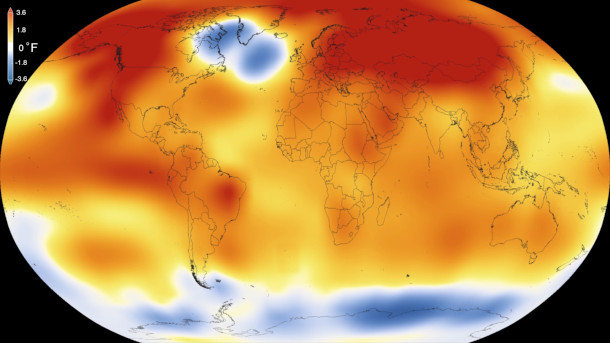
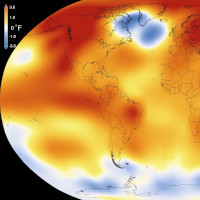
At a global scale, soaring temperatures are responsible for melting glaciers, wildfires, and accelerated death tolls. (Photo: NASA, Wikimedia Commons, Public Domain)
BELTRAN: From PRX and the Jennifer and Ted Stanley Studios at the University of Massachusetts Boston, this is Living on Earth. I’m Paloma Beltran
CURWOOD: And I’m Steve Curwood.
As the UN prepares to hold a climate summit near the end of September, it’s warning that current climate policies will lead to at least 1.8°C of global warming, well beyond the 1.5 degrees of the Paris Agreement. 2026 has already recorded one of the hottest summers globally, with deadly heatwaves in Europe and catastrophic floods in Nepal, and July became the single hottest month ever recorded in the US. Despite the evidence of growing danger, the Trump Administration is moving to get rid of regulations that constrain warming emissions from power plants, and other sources. We will have more on the UN moves and US climate regulatory changes in the weeks ahead, but today for an assessment of just where we stand in the climate emergency and what the numbers mean, we turn to Michael Mann, climate expert and distinguished professor at the University of Pennsylvania. Welcome back to Living on Earth.
MANN: Thanks, Steve. Always great to be with you.
CURWOOD: So first, a quick update on how much warmer it's gotten this year. I mean, there's been some news about it. What do you make of these records that are being or have been broken? And what is hottest versus warmest, anyway?
MANN: I guess it's just a matter of word choice. Hottest sounds a little more serious, more problematic, and scientists are sometimes known for their reticence, using mild language that won't offend people. So maybe we like to use warmest, but journalists who want to get our attention will say no, it's hottest because that's what people think about. They think about those hot summer days, and those are going to get hotter. So it's about the framing, and it doesn't matter whether it's warmest, whether it's hottest. We are seeing that. We're seeing that at the global scale. We're seeing that at the regional scale with those heat domes that we witnessed here in the U.S. this summer, that they were experiencing in Europe. And so, yeah, as long as we continue to burn fossil fuels and generate carbon pollution, the planet continues to warm up. Now you get a big El Nino event on top of that, which is a natural short-term warming, and you reach brand new levels of warmth or heat that the planet's never seen before. And that's what happened in 2024. That's what is probably going to happen when we look back at 2026, and almost certainly with 2027, with this even bigger El Nino event that is now peaking as we go into the northern hemisphere fall.
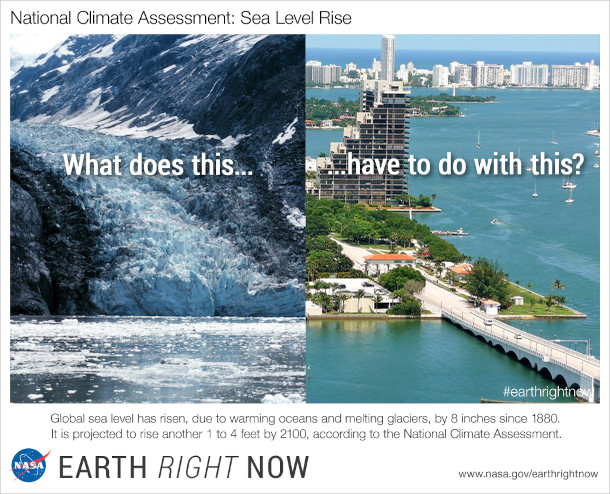
Though the terms are often used interchangeably, ‘climate change’ and ‘global warming’ are distinct. ‘Climate change’ encompasses an array of environmental issues, including temperature increases, extreme weather, and changing rain patterns, while ‘global warming’ focuses solely on the temperature aspect of the broader crisis. (Photo: NASA, Wikimedia Commons, Public Domain)
CURWOOD: By the way, Michael, to what extent do you think a difference would be made if we reframed the conversation to use the words “global warming” again instead of referring to what's going on as “climate change”?
MANN: Yeah, you know it's funny because when you talk to scientists who are always looking to be precise about the language, they'll say, "Well, global warming is just one dimension of climate change. Climate change is the full array of changes that we're seeing in the Earth system as we heat it with carbon pollution.” The surface is warming up, but the ice is melting. Air currents are shifting. Ocean currents are shifting, drought patterns, extreme weather, Arctic sea ice is declining, and so that full array of changes in the climate, that's what we mean by climate change and global warming in a sense, is only talking about one component. So, if you're a purist, you would make that distinction. To the public, it seems like, hey, why are they changing the language? This was one of the standard contrarian arguments. They used to call it global warming, and then they changed to climate change because they wanted to make it scarier. The irony, of course, is that back in around 2000, the Republican pollster Frank Luntz did a focus group, and there was a secret memo that eventually got released, and he was advising his clients, basically Republicans, that they should use climate change instead of global warming because it sounds less threatening. So if you go by what Frank Luntz said, it would be just the opposite of what the critics are saying. The scientists have used tamer language because they're calling it climate change. If you ask the scientists, they'll say no. Climate change is the better term for the rich array of changes that we are seeing in the planet's climate, and global warming is just part of that.
CURWOOD: So, one and a half degrees centigrade above pre-industrial levels is the number that many in the climate space are quite familiar with, especially of course in association with the development of the Paris Agreement. Keeping the average rise in global temperatures ideally at that level or at least below two degrees centigrade is what we're hoping for. But what's the importance of maintaining these values of aspiring to one and a half degrees, certainly keeping below two degrees. What's the harm of going above those numbers?
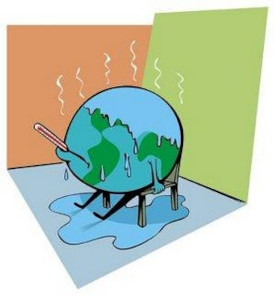
A 1.5C rise in global temperatures may sound small, but its effects are significant. Much like a fever signals a change in the body, even a small increase in Earth’s average temperature can contribute to more extreme heat, rising sea levels, and disruptions to ecosystems and communities. (Photo: Baluchi5, Wikimedia Commons, CC BY-SA 3.0)
MANN: Yeah, you know, there's sort of a shorthand because it's a simple number to talk about the average temperature of the planet. But what it's a shorthand for is all of the impacts that that amount of warming happens. Because there's more warming over the continents than the global average, there's even more warming in the higher latitudes in the melting Arctic. There are all of the changes in extreme weather events: the heat domes, the wildfires, the floods, and so in essence, this is a thermometer scale, the global average temperature, that is sort of a catch-all for the full array of consequences when the planet warms that much. It might sound like a small amount of warming, right? You know, one and a half, two degrees Celsius. But I'll tell you, when the human body warms up that much, it's called a fever. It's called a pretty serious fever. And in fact, even though you're only talking about a couple degrees on the thermometer scale, you know what the consequences of that fever are for you. You're coughing, difficult breathing. You're delirious. You're suffering all sorts of health consequences, and so in a sense, that's the same thing here. That thermometer scale is telling us that Earth is running a fever, and we're seeing the consequence of that fever in terms of the heat domes, the wildfires, the floods, and all of the impacts that it's already having. We're not even at one and a half Celsius yet, three degrees Fahrenheit basically, and already we're seeing dangerous climate change. So at this point, it's not like we're going to avoid dangerous climate change. It's here, and it's a matter of limiting it as much as we can, we may miss the 1.5 Celsius exit. It looks very likely that will happen now, especially because of two years of inaction here in the U.S. with the current administration. But we still go for that next exit. That next exit, 1.8 Celsius, would be a whole lot better than two, and it's still absolutely achievable. The rest of the world continues to make progress. The U.S. starts to right its course. We can get there.
CURWOOD: And talk to me about the health and social implications of increases at this scale in climate disruption.
MANN: We think about the extreme heat is a killer, and thousands of people are dying from just extreme heat events here in the United States that have been made more extreme because of human-caused warming, you have dangerous and deadly flood events, superstorms. So there is a toll that climate change is taking directly that can be measured in terms of lost human lives. We saw several thousand with that Tibetan flood, that glacial collapse, and we can say that was caused by climate change. Those floods were directly related to the melting of a glacier that only happened because of human-caused warming of this planet. So that several thousand people, just in that one event, that mortality is attributable to human-caused climate change, and that's not even getting into all of the wildfires and the extreme heat events that we saw this summer. thousands of people who died in Europe because of extreme heat. And so far, I'm just talking about the climate impacts. Now, when you take into account the health consequences of fossil fuel extraction and fossil fuel processing, there are as many as I think the estimate is that 20 percent of all excess mortality today can be tied to air and water pollution that's linked to fossil fuels. And so, when you put all that together, the climate crisis and fossil fuel dependence is more deadly than the deadliest pandemic that we've experienced yet.
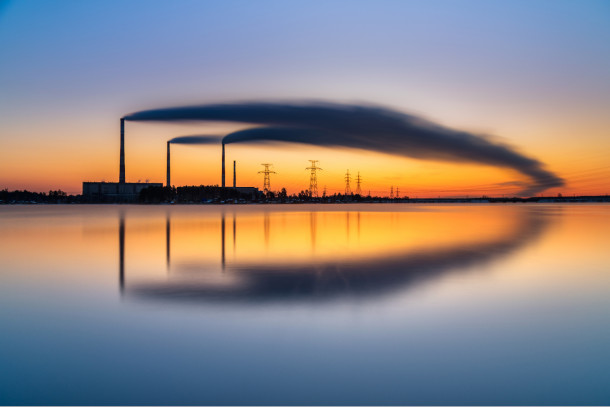
According to the Harvard T.H. Chan School of Public Health, air pollution from burning fossil fuels is responsible for roughly 1 in 5 excess deaths worldwide. (Photo: Vasily Iakovlev, Wikimedia Commons, CC BY-SA 4.0)
CURWOOD: Michael, to what extent is the planet warming faster than many scientists had predicted or speculated might not happen?
MANN: Yeah, so there's a lot of sort of misinformation out there about this, and there's some scientists who are making extravagant claims that I would argue don't actually measure up to, don't actually match the evidence. The planet's average temperature right now has increased almost exactly as much as the models said it would, given our continued burning of fossil fuels. And so, if you look at sort of the observations, the global average temperature record, along with the spread among the models that the Intergovernmental Panel on Climate Change used in their last assessment, the observations are right in the center of those model simulations. I like to say the truth is bad enough. We don't have to exaggerate that. It's just the reality is that the planet is warming up exactly as we said it would, and those models tell us it will continue to warm more if we continue to burn fossil fuels. So the models have gotten right the overall warming of the planet.
CURWOOD: But to what extent are the impacts coming faster than what science had predicted? What about the impacts, though? I mean, glaciers cutting loose, these heat waves and fires and all that. To what extent did science predict that?
MANN: That's exactly right. So many of these impacts are actually happening earlier, or the magnitude of the impact is greater than what we predicted. And the truth is bad enough. The planet is warming up as much as we expected, and the reality is that a lot of the consequences of that warming are worse than expected with regard to extreme weather events, with regard to the disintegration of ice sheets and the sea level rise that goes with that, with regard to any array of impacts we're seeing in many cases impacts that go beyond what we predicted.
[MUSIC: On The Record]
BELTRAN: Coming up, Steve continues his conversation with Michael Mann, Distinguished Professor of Earth & Environmental Science and Director of the Penn Center for Science, Sustainability, and the Media at the University of Pennsylvania. Stay tuned to Living on Earth!
ANNOUNCER: Support for Living on Earth comes from the Waverley Street Foundation, working to cultivate a healing planet with community-led programs for better food, healthy farmlands, and smarter building, energy and businesses.
[CUTAWAY MUSIC: Flatland Park, “Revelation” single, Flatland Park]
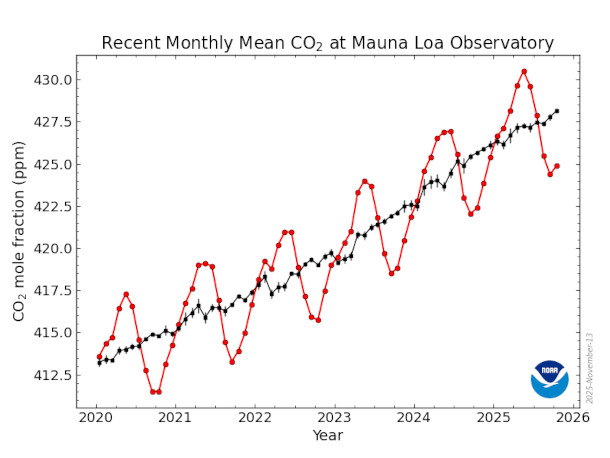
Since 1958, the Mauna Loa Observatory has tracked rising atmospheric CO2. Climate models have projected that increasing CO₂ would lead to warming and observations today closely align with many of those early projections. (Photo: Mauna Loa Observatory, Wikimedia Commons, Public Domain)
BELTRAN: It’s Living on Earth. I’m Paloma Beltran
CURWOOD: And I’m Steve Curwood.
We are back now with Michael Mann, climate expert and UPenn professor.
CURWOOD: What do you think it would take to get the public level of concern about the climate, equal what's being said loudly about artificial intelligence risks?
MANN: Yeah, that's a great question, Steve. Because it's sort of ironic, isn't it, that here we've been sort of yelling at the top of our lungs, we climate scientists for you know decades now, that we've got an existential planetary crisis. You know, it's the warming of the planet. We're seeing the consequences of that every day, and it is jarring in a way to see so much public concern about a potential threat that isn't nearly as far along at this point. It's sort of jarring because, like we've been telling you, we have a crisis for decades. And not enough action has been taken. Here, we're just starting to hear, you know, murmurs of a crisis, and the alarm bells are ringing far more loudly. And why is that? And I can tell you, my theory is that it aligns with some of the dystopian narratives that we've been fed. You know, the Terminator, the Matrix, Machine World, Cybernet. People have been served warning through these dystopian Hollywood narratives for a number of years now, and when things happen in the real world that start to align with those narratives, it understandably causes great concern. We haven't, I would say, maybe the entertainment community, our friends in the world of communication, haven't done as good a job in portraying the climate crisis as the existential threat that it is. It's it's sort of there in the background, and films like Avatar, which are actually premised on environmental destruction, but it's sort of in the background. It's not in the front. It's not really platformed in the narrative, so I think that's part of it. That the public has been led to be concerned about dystopian narratives that look like what's happening in the AI space, but they haven't been as well prepared to see the climate crisis as the existential crisis that it is.

Movies like Terminator have shaped public perception of artificial intelligence as an immediate threat, while climate change hasn’t been as popularized in the media as an urgent issue. (Photo: Daniel Juřena, Wikimedia Commons, CC BY-SA 2.0)
CURWOOD: So the most recent UN report is saying, "Look, we're on our way to 1.8 degrees centigrade, global increase in temperatures, largely tied to greenhouse gasses we're emitting.” How inevitable is this? How reversible is this? What can be done at this point if people were to get quite alarmed about this?
MANN: Yeah, good question, Steve. I mean, the fact is, you know, there's good news and bad news when it comes to what the climate science tells us. With the climate science, the most comprehensive Earth system models that we have now give us a little bit of good news. The good news is that we know that the surface warming ends almost immediately when we bring carbon emissions down to zero. We stop adding carbon pollution to the atmosphere. The surface of the planet stops warming up, and that has in part to do with the way that the oceans and the plants are continuing to take CO2 out of the atmosphere. So once we stop producing it, those levels start to come down, and it turns out it leads to a stabilization. You basically stop, the surface temperature remains where it was when you stopped emitting carbon. That's the good news, but that's also the bad news. The bad news is that the surface temperature remains where it is when you stop emitting carbon. It means it's elevated at that level for perpetuity, and to the extent that we're already seeing very harmful impacts of less than 1.5 warming, you can imagine how bad it looks if we even elevate temperatures at 1.8 for decades into the future. So there are really two things here. When you're in a climate hole, as I like to say, you've got to stop digging fossil fuels. So we're in a climate hole. We've got to prevent it from getting worse. We've got to decarbonize as quickly as we can. That's task one. That's where our primary focus needs to be. Yes, we may decide that we need to use technology that isn't available at scale now. It may be available at scale decades from now, to actually bring those carbon dioxide levels back down, so that we can maybe start to cool the planet back down, bring it back to 1.5 or somewhere low enough that it remains more within our adaptive capacity. 1.8 Celsius is going to be tough. More than two degrees is going to be really tough. Three degrees Celsius warming of the planet, where, by the way, we will be if we make no additional progress. If we go with just sort of current policies into the future, the planet will warm up more than three degrees Celsius, the better part of six degrees Fahrenheit, later this century. That would be catastrophic in terms where we start to use words like civilization-ending, where we can no longer envision meeting the needs of more than 8 billion people on this planet with diminished food and water and space.
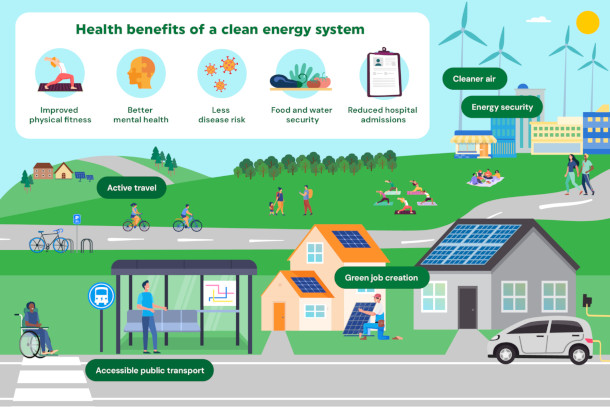
With current projections putting the world on track for 3.0°C of warming unless more action is taken, rapid decarbonization and a transition to renewable energy would be pivotal to trying to keep something like 1.8 °C within reach. (Photo: UK Health Alliance on Climate Change, Wikimedia Commons, CC BY-SA 4.0)
CURWOOD: So, before you go, what keeps you up at night, and what lets you go to sleep?
MANN: Great questions. What keeps me up at night is, is the fear that there's an overriding danger here, beyond the climate crisis, beyond the environmental crises we face. But in, in some ways, it's tied to developments in the AI space and the machine learning space. It's disinformation. The greatest threat we face right now, because it's a fundamental threat to democratic governance, is disinformation, the deliberate spread of misinformation for ideological reasons, whether it's climate denial or anti-vax viewpoints that are paralyzing, you know, our ability to deal once defeated. Epidemics like measles that are now coming back; these are all tremendous threats. But the greater threat is the way that our information ecosystem is being polluted with massive amounts of disinformation, especially through social media. Much of it by bad actors who have weaponized social media and are using AI to help make disinformation, as one colleague of mine put it, go infinite. The infinite disinformation, where our environment is so permeated with disinformation that there's no hope of pushing back on it and correcting the record. That's what keeps me up at night. What allows me to sleep is the fact that I have a daughter who's a student here at Penn who's studying AI herself. She's doing AI research, and there is a generation, a young generation of really smart kids who understand the crises we face, including the threat of misaligned AI, and are working hard to try to avert the catastrophes that could lie in store if we make all the wrong choices, and so I guess put more simply, it's the younger generation there what put my mind at ease and allow me to sleep.
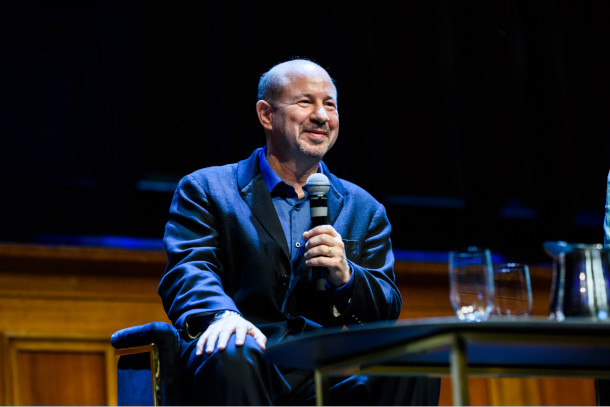
Michael Mann is the Presidential Distinguished Professor of Earth & Environmental Science and Director of the Penn Center for Science, Sustainability, and the Media. (Photo: Courtesy of Michael Mann)
CURWOOD: Michael Mann is the Presidential Distinguished Professor of Earth and Environmental Science and directs the Penn Center for Science, Sustainability, and the Media. Thank you so much for taking time with us today.
MANN: Thank you, Steve. Always a pleasure, my friend.
CURWOOD: And if you want to know more about Professor Mann's concerns and experiences, his new book is called "Science Under Siege."
Related links:
- The Guardian | “Global Heating Will Hit at Least 1.8C, UN Warns, and There Are ‘No Good Outcomes’”
- The Harvard T. H. Chan School of Public Health | “Fossil Fuel Air Pollution Responsible for 1 in 5 Deaths Worldwide”
- Find Professor Michael Mann’s latest book Science Under Siege: How to Fight the Five Most Powerful Forces That Threaten Our World , co-written with Dr. Peter Hotez here.
[MUSIC: Toward the First Light]
Batteries Kicking Out Natural Gas
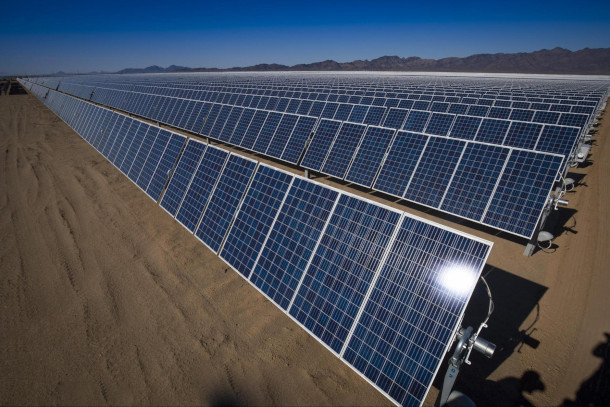
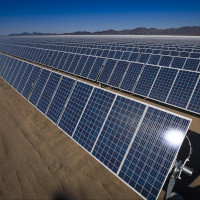
A solar field in the California desert. (Photo: Tom Brewster Photography, Courtesy of Bureau of Land Management, Flickr, CC BY 2.0.)
BELTRAN: Despite federal efforts to keep using coal and natural gas for energy, in California at least, renewable energy is ascendant while gas is on the decline. According to the U.S. Energy Information Administration, there was a 15 percent decrease in gas-fired electricity in California in 2025 compared to 2024, and a 26 percent drop in the first half of this year compared to the first half of last year. And if you look at how the Golden state compares to the rest of the nation, in 2014 it was producing 10 percent of the country’s total gas-fired electricity, but by 2025, it was down to just 4 percent. Gas is still needed as a backup and energy source in the cold winter months, but solar and other renewables now power more of the California grid than gas. The renewable advance is thanks in part to an extensive battery energy storage system that can make the most of solar energy even when the sun doesn’t shine. Dan Gearino, a clean energy reporter with our media partner Inside Climate News recently reported on how California is kicking its gas habit.
GEARINO: It's really striking when you look at it in terms of lines on a chart that you see from the California grid. You used to see gas as the number one resource, especially on days with high demand. So gas is this line very close to the top, if not at the top. And then you see this big bump in the middle of the day for when solar went up. But now you see this other line, this line for batteries, which is batteries that are charging during the day when there's tons of solar power and solar power is inexpensive. And then when the sun comes down, those batteries, many of which are four-hour batteries, are discharging to support the grid. Having all those batteries, I should say maybe almost completely changes the way that we understand this mix of resources that we need to put together to kind of have power to cover peak hours. So just think of this: like when the sun goes down, if you then have about four hours of power from a gigantic group of batteries. If you look at when those batteries can kind of start to come online, and then when they would go offline, you have taken the state almost completely through those evening peak hours, and then you go into this late night period when power demand on the grid is much lower because people are going to bed, people are not using resources as much in the summer, people aren't using air conditioning as much because it's cooling off. So it's this transformation in a way that I haven't seen before, and it's really remarkable to look at a typical summer day in the California grid today compared to even like, four or five years ago. The change has been so great.
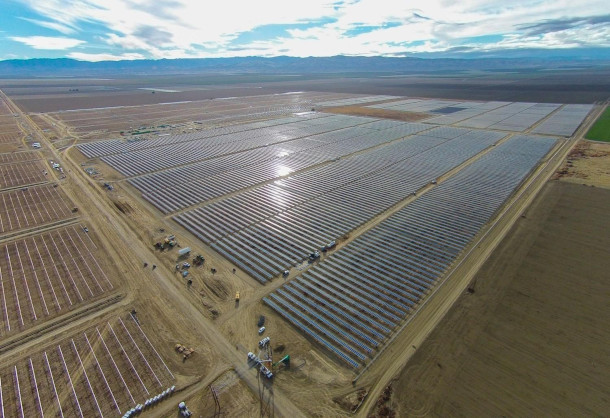
A solar array in California, viewed from above. California has nearly 1,000 utility-scale solar farms, with tracking databases and industry data reporting approximately 982 active projects. (Photo: Recurrent Energy, Courtesy of Bureau of Land Management, Flickr, Public Domain)
BELTRAN: And Dan, what does California actually do differently from other states across the U.S.?
GEARINO: So there are the things that are just the results of California's good fortune, and that is having a ton of sunlight. But then a lot of these things are policy decisions. California made policy decisions to encourage solar power, to have rules that made it so that power providers needed to get certain amounts of renewable or carbon-free resources, and then there were policy decisions later on that encouraged the acquisition of battery power. So you look at vast amounts of solar and vast amounts of battery. Some of this is market driven. Some of it is because you can put up a battery system and it's going to make money by buying power when it's cheap and selling power when it's expensive. But it is this kind of one-two relationship between policy, kind of nudging the whole system in a direction, and then those resources coming online and being able to succeed in the market.
BELTRAN: And to what extent is utility scale solar and utility scale battery storage helping California's wallets here? You know, to what extent are they easing energy costs for Californians?
GEARINO: So there are a bunch of different ways to look at that. One is that solar and batteries are resources with really big upfront costs, and then you don't have to pay for fuel. And California just built a whole bunch of batteries and storage. The kind of benefits of having those upfront costs been made already will become evident in the future. The other thing you need to talk about in California is just that they are some of the highest electricity rates in the country for a bunch of different reasons. One of the ones I'll name is that wildfire costs and wildfire liability, but it becomes challenging to talk about batteries and solar and their relation to electricity bills because it becomes tough to kind of disentangle them from all the other things that are going on, but I think that over time, having more resources where you don't have to pay for fuel, that would be a net positive.
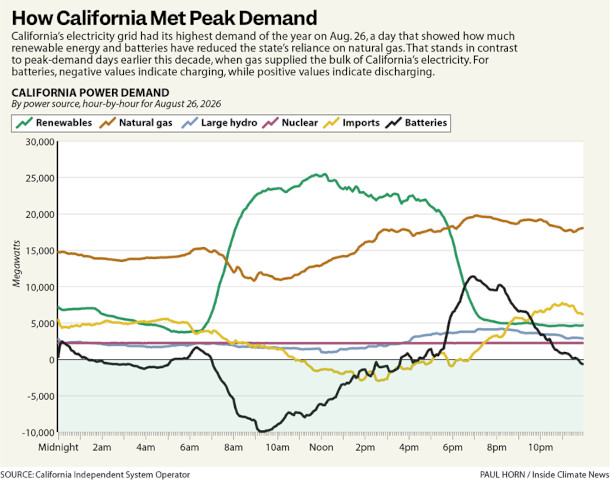
California’s power demand by power source, hour-by-hour on August 26 2026, when the grid had its highest demand of the year. (Chart: Paul Horn, Courtesy of Inside Climate News)
BELTRAN: And as you've covered, Dan, California is kicking its natural gas habit. So aside from battery abundance, what other factors help California be less reliant on gas-fired power?
GEARINO: One of the most interesting ones is that the regional grids are getting better at communicating with each other. So California has a grid that is pretty close to just the borders of the state. It's not quite exactly the borders of California. And there are other grids just right outside of that, and they all have different mixes of resources. They have different power plants that they are dispatching and that are generating electricity. The different regions have gotten to the point that they can share electricity on shorter notice than they did before. And what that means is, when there's a whole bunch of excess hydropower in Washington and in Oregon, and there are days where there's just more of that than they need up there, California can get some of that electricity. There are greater regions that bump right up against each other, where before they just wouldn't have had that information in time to be able to use it. That makes a big difference. Also, California exports power now. You look at peak summer days. California is sending power to some of those other grid regions. Its increased cooperation and increased sharing generally helps to drive down costs.
BELTRAN: And Dan, what role does gas still play in keeping the lights on?
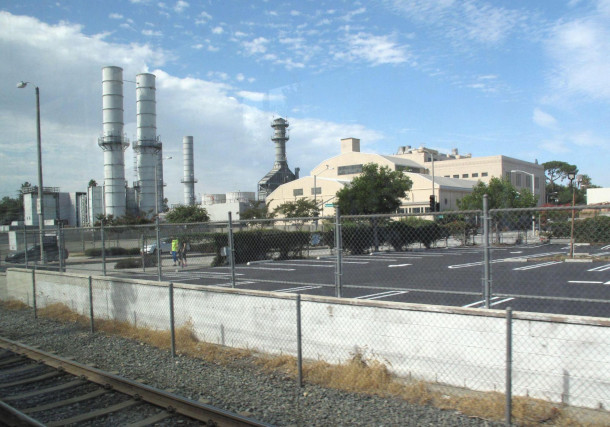
The gas-fired Glenarm Power Plant in Pasadena, California, viewed from the Gold Line train. As of 2023, California had more than 1,600 power plants using a broad range of technologies. Natural gas-fired plants accounted for the largest share of generating capacity, at 39,689 MW, or 45 percent of the state total. (Photo: Downtowngal, Wikimedia Commons, Public Domain)
GEARINO: Well, when we say that gas use in California has gone down substantially, it's gone down in eight of the last 11 years. Gas is still a pretty significant presence on the California grid, and there's still a whole bunch of natural gas plants. It's a resource that is more useful in the winter when the days are shorter. And remember, California, it's not all sunny Southern California. California is a big state that has a lot of different parts that have different weather patterns. But gas is, while it's down, is still an essential part of the California grid, and it probably will be for a little while. They're kind of this insurance policy. They're basically backup capacity that's available when needed, but it's just not needed very much. And at some point, the cost of having all those plants ready to run, you know you'll see some of them that are just not worth it to continue to operate them, especially the older ones. It'll be interesting to see over the next, say, five years or so, what that looks like.
BELTRAN: Yeah, and California is, of course, also a leader in electric vehicles. It represents about 35% of all electric cars on American roads. How does the large and growing electric vehicle fleet option factor into the state's efforts to better manage energy loads?
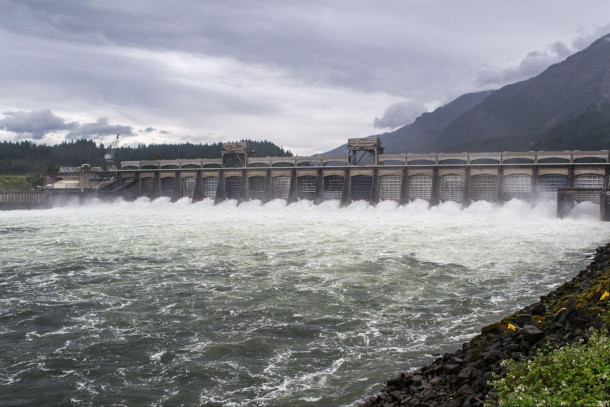
The spillway at Bonneville Dam, located about 40 miles (64 kilometers) east of Portland, Oregon, in the Columbia River Gorge. (Photo: Visitor7, Wikimedia Commons, CC BY-SA 3.0)
GEARINO: Well, I think some of the best opportunities there are ahead. Every single one of those electric vehicles has a big battery on it, and there are some automakers that are making available the equipment to be able to connect those batteries to your houses to act as backup power for the house, and then another step is to be able to have all of those batteries be able to export power for use even beyond the house. It's like if you have a market where, let's say, we get to 50% plus electric vehicles, what you have is this battery resource that is absolutely gigantic, and you can find ways to use it. So I'm curious what will happen. That's a logical place for us to see, kind of, vehicle to home and vehicle to grid technologies used in the U.S..
BELTRAN: So Dan, what's the big takeaway here from California's transition away from gas-powered energy into renewables and battery storage?
GEARINO: The big takeaway for me is that having this level of renewables doing most of the heavy lifting on the grid is something that a lot of people in the energy business and in the energy world would have said is impossible not that long ago. You go back 10, 15, years, this seems like total fantasy land, what California is doing right now, and keeping the lights on. So it just shows that significant change can happen, and there are ways to design a system. You can design a system that has significantly higher levels of renewables than California does now, and we kind of have figured out how to do that. The question is kind of, how do we do it, and how soon are we going to do it?
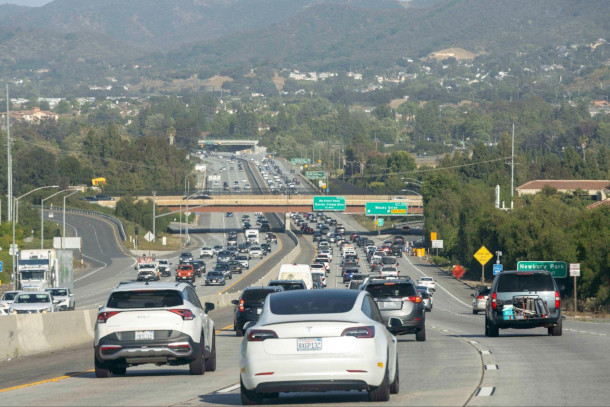
An electric vehicle (center) in traffic on a Los Angeles highway. California has more than 2.5 million cumulative zero-emission vehicle (ZEV) sales as of 2026. (Photo: Kadeem J, Pexels, Pexels license)
BELTRAN: Dan Gearino is a clean energy reporter with our media partner, Inside Climate News. Dan, thank you so much for joining us.
GEARINO: Yeah, thank you.
Related link:
Inside Climate News | “How California Is Kicking Its Natural Gas Habit - Inside Climate News”
[BIRDNOTE THEME]
Tree Swallows and Feathers
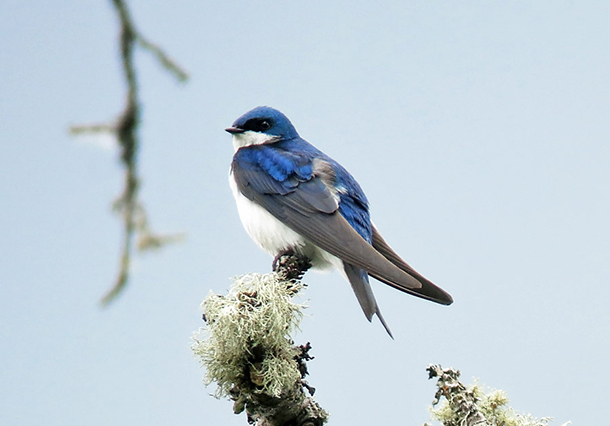
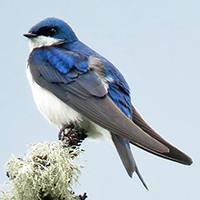
During the Northern Hemisphere’s summer, tree swallows inhabit much of the Western and Northern United States and most of Canada. But come fall, these birds migrate to the Gulf Coast, the Caribbean, and Central America. (Photo: Mike Hamilton, CC)
BELTRAN: Autumn is here in the Northern Hemisphere, and the days are growing noticeably shorter. But many of the songbirds of the summer are still with us, and as Mary McCann points out in today’s BirdNote, they continue to put on spectacular shows.
BirdNote®
Tree Swallow Roost –
The Swarm in Connecticut
[MULTIPLE TREE SWALLOWS CALLING; WAVES LAPPING AGAINST A BOAT]
As the sun sets over the Connecticut River, an astounding natural spectacle unfolds. As many as 300,000 sparkling blue swallows—Tree Swallows—wing their way from miles around, to roost for the evening on Goose Island, near Old Lyme.
[MULTIPLE TREE SWALLOWS CALLING; WAVES LAPPING AGAINST A BOAT]
The birds gather on the wing in one immense, tightly choreographed flock, a swirling mass that changes shape from one second to the next, like an immense silken banner or plume of smoke racing with the wind. With dusk at hand, the aerobatic flock – now shaped like a tornado – swoops down into the island’s tall reeds. It takes but 15 seconds for the 300,000 birds to vanish into the marsh, where they
remain until dawn.
[CALL OF TREE SWALLOW FLOCK]
Roger Tory Peterson, dean of American birdwatching, wrote of the swallows: “I have seen a million flamingos on the lakes of East Africa and as many seabirds on the cliffs of the Alaska Pribilofs, but for sheer drama, the tornadoes of tree swallows eclipsed any other avian spectacle I have ever seen." *
[TREE SWALLOWS CALLING]
Soon all of Goose Island’s swallows will disappear below the southern horizon for the winter. But witnesses will long remember the autumnal spectacle of the birds’ massed flight.
[TREE SWALLOWS CALLING]
Tree Swallows coast to coast are swirling down to roost this month. Maybe there’s a roost near you.
I’m Mary McCann.
###
Written by Bob Sundstrom
Call of Tree Swallow flock provided by The Macaulay Library at the Cornell Lab of Ornithology, Ithaca, New York. Song recorded by
G.F. Budney. Massive flock sounds recorded by O.H. Hewitt.
Producer: John Kessler
Executive Producer: Chris Peterson
© 2008-2017 Tune In to Nature.org September 2017 Narrator: Mary McCann
Tree Swallow photo by Dan Dzurisin https://www.flickr.com/photos/ndomer73/2544385868/
Tree Swallows coming to roost, by Dan Irizarry https://www.flickr.com/photos/danirizarry/6628440837/
*Peterson quotation taken from RiverQuest tour ad for swallow trips.
BELTRAN: For many years you’ve heard Mary McCann’s warm and lively voice on Living on Earth in BirdNote segments just like this one. But we are saddened to share that on August 7th, 2026, Mary passed away at the age of 70 after battling bone cancer. Over the years, Mary McCann brought over 700 BirdNote segments to life, and her beloved voice will live on. And we’d like to think she’s out there somewhere, soaring with the tree swallows and other winged wonders. Thanks, Mary, and we’ll miss you.
Related links:
- The story about the tree swallows on the BirdNote® website
- Cornell Lab of Ornithology: About the Tree Swallow
[MUSIC: Remember When We Danced]
CURWOOD: Just ahead, the wisdom of trees. Keep listening to Living on Earth!
ANNOUNCER: Support for Living on Earth comes from Hansjörg Wyss in honor of Rosamund Stone Zander. Celebrated painter, environmentalist, and author of The Art of Possibility, who inspired others to see the profound interconnectedness of all living things, and to act with courage and creativity on behalf of our planet. Support also comes from Sailors for the Sea and Oceana. Helping boaters race clean, sail green and protect the seas they love. More information at sailorsforthesea.org
[CUTAWAY MUSIC: Remember When We Danced]
In Trees
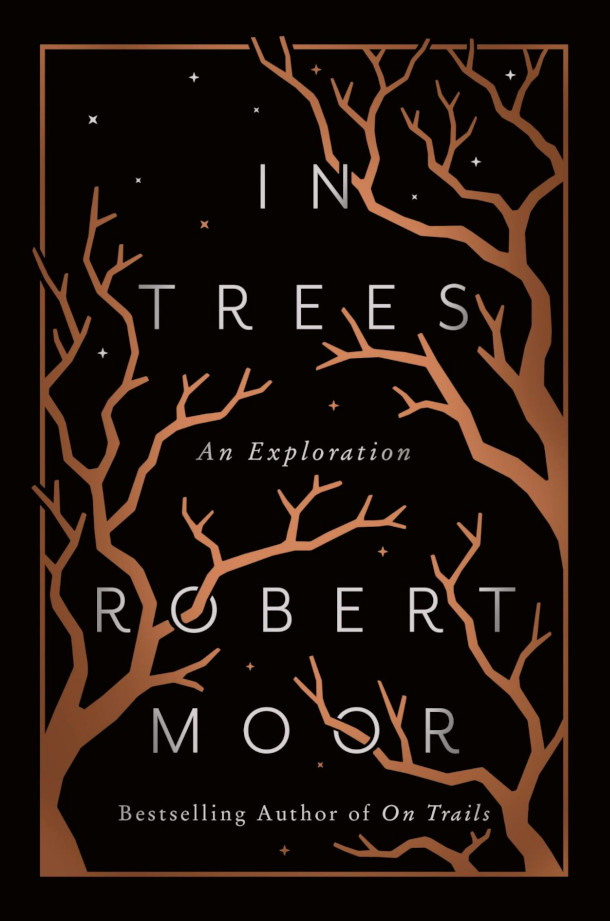
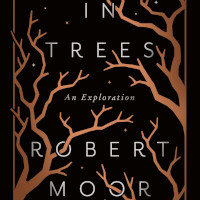
Robert Moor’s latest book is In Trees: An Exploration. (Photo: Courtesy of Robert Moor)
BELTRAN: It’s Living on Earth, I’m Paloma Beltran.
CURWOOD: And I’m Steve Curwood.
Our ancestors swung from their branches. They provide shade, fruits, nuts, oxygen to breathe, and stunning foliage. They outlive us ten times over, and more. And they may hold answers to some of the great questions in life. Journalist and author Robert Moor has been thinking a lot about what trees can teach us about life, aging, thinking, and even how to be better humans. We met up in the summer of 2026 for a meander and chat under the grand trees in a famous Boston-area cemetery.
CURWOOD: With me now is Robert Moor. He's a journalist and author whose latest book is "In Trees: An Exploration." Rob, welcome to Living on Earth.
MOOR: Thank you so much for having me.
CURWOOD: And here we are in Mount Auburn Cemetery in Cambridge. This is probably the most amazing assemblage of trees inside the city limits here because well, you know a lot about trees.
MOOR: I do, it's true. And I want to add that this is a place I've always wanted to come. This was the first garden cemetery in the United States which then becomes essentially the blueprint for Central Park, which in some sense becomes the blueprint for, for the national parks.
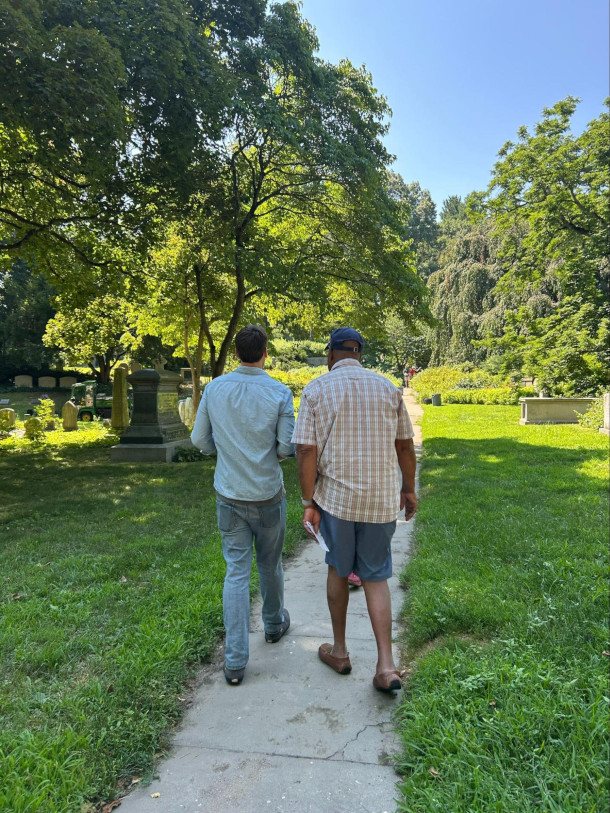
Host Steve Curwood (right) joins Robert Moor (left) in Cambridge’s Mount Auburn Cemetery. Moor says the cemetery inspired Ralph Waldo Emerson’s concept of the “noble earth” in the 1830s. (Photo: Bella Smith)
CURWOOD: Wow, I never knew. I just thought this was a great place to go birding during migration season.
MOOR: Well, it's also a beautiful place to look at all these wonderful trees and sit in their shade. And there were a lot of people who did, including Ralph Waldo Emerson, who was strolling through this cemetery in the 1830s and had this profound realization of what he called the "noble earth." That was one of the transformative experiences of his life, was walking right here through this very cemetery.
CURWOOD: So when we think of a tree, Rob, it's usually you know, the biological definition. But your book, you know, I guess you mention bark, you do mention leaves, but mostly it's a philosophical treatise. So what is a tree then, in your view?
MOOR: Yes, so it's a really hard thing to answer actually, it's funny. This is something that tree biologists will frequently tell you is that it is much harder to say what a tree is than people would commonly think. Colin Tudge has a definition. He said a tree is just a big plant with a stick up the middle, and what that means is that it's a plant, it branches, and it has wood. Wood is a really important component because it allows the tree to grow tall. But then, if you start thinking about family trees or evolutionary trees, the branching structures that make up our brains, you start to see that it's actually something even larger than that. It's a growth form. It's a way that things grow. They grow by branching, by pruning, by gnarling around the things that work, and then by setting down deep roots. That's what I think that the soul of a tree really is.
CURWOOD: And we're leaning up against a tree here as we talk. What are we looking at? This thing is humongous and well, amazing.
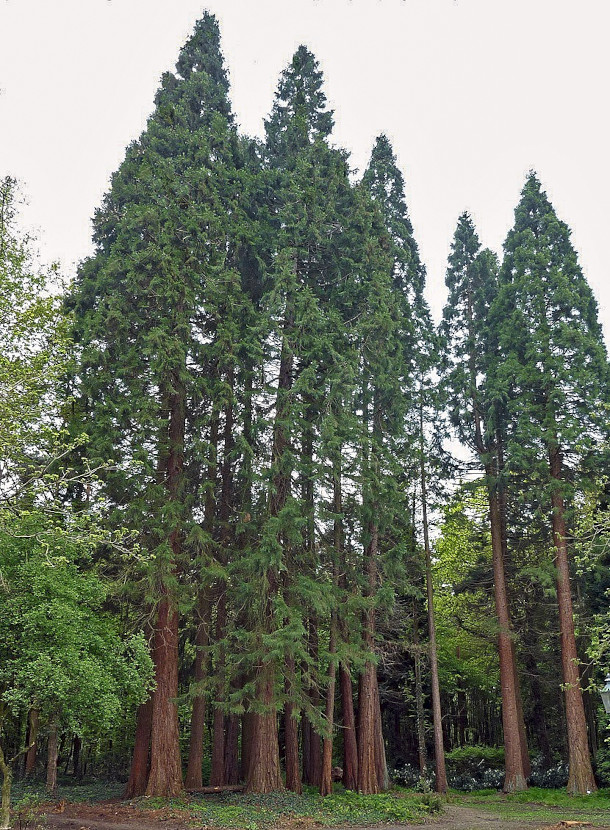
Moor describes climbing to the top of a giant sequoia, the world’s largest tree species by volume, in Sequoia National Park. (Photo: Sverrir Mirdsson, Wikimedia Commons, CC BY-SA 3.0)
MOOR: It is. I was just saying I would love to climb this tree. I believe the tag there says Castor Aralia, which is not actually a species I'm familiar with, says it's from East Asia. But one of the things that I love about trees in cemeteries and parks, is that they get this wide open branching crown, and it makes them a lot more fun to climb than the trees in British Columbia, where I live in the forest, which just shoot straight up out of the ground. You know, when they're growing in a forest, they're shading each other out, so they drop their lower limbs, makes them a lot harder to climb. This one would be a lot of fun. I mean, it's a beautiful tree, and it has this wide open crown, these long lateral branches. I actually took a tree climbing course with a guy named Ben Atkinson. He's this sort of barefoot, you know, roadkill-eating eccentric guy in England, and he makes these videos of himself walking on trees like this. He walks way out onto the branches, sort of tiptoeing out as if on a balance beam, and then he'll jump from branch to branch. And I saw these videos, and I was, I was so moved by them. They're so, they're so beautiful. It was kind of taking tree climbing and extending it into the realm of art or dance. And I had tried to climb a tree near where I live not long before that, and had this sort of, almost a panic attack. I was gripped by vertigo, and I couldn't make it any higher, and I started to kind of obsess about this question of like, why do we stop climbing trees? Right, every kid climbed trees that I know. Did you climb trees when you were a kid?
CURWOOD: Well, of course, but what about you?
MOOR: I did. Yeah, I mean, I was a big tree climber when I was a kid, and then I stopped. Right, and it happened sometime in my teenage years. You just sort of start to get interested in other things, but also something starts to grow in you. It's a kind of a reluctance, a hesitancy, a fear of taking chances. And as you get older, I think that that sort of pruning away of that wild spirit, that tree climber spirit you have as a kid, I think that that really becomes debilitating. And so I was trying to find a way to break myself out of that and refind that wild spirit, and I thought taking a tree climbing course might be one good way to do that.
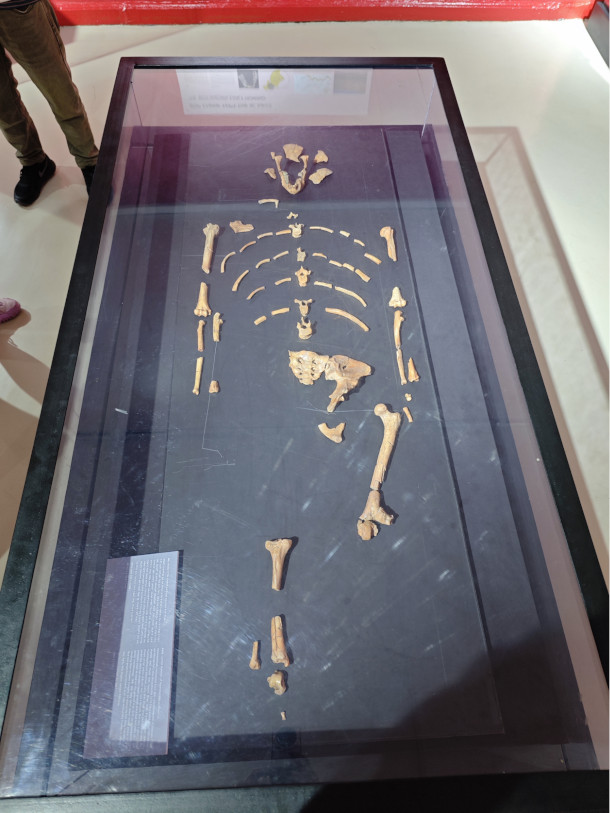
Lucy, the early human ancestor, slept in the treetops and came down during the day. Above, Lucy’s skeleton at the National Museum of Ethiopia. (Photo: FrogsLegs71, Wikimedia Commons, CC BY-SA 3.0)
CURWOOD: And you've climbed some big trees. I mean, I think famously in your book you talk about being with David Attenborough in the Sequoia land. Those trees are tall. It's like a 20 story building. How did you feel up there?
MOOR: I mean, that was one of the most profound experiences I've ever had in a tree, is climbing to the top of that giant sequoia. I climbed to the top of a couple of them there in Sequoia National Park, which was such an honor because most people are not allowed to climb those trees. So you're scaling up a rope, you know, an inch-thick nylon rope, 250 feet in the air, and you're dangling from a branch. You feel incredibly precarious, but you also feel this, this sense of awe because you're experiencing the size of that tree, right? I mean, physically, you're experiencing how huge it is, and it's exhausting, and it's scary, and it's beautiful, and you get this incredible view of the forest and the mountains beyond that you would never get otherwise.
CURWOOD: What's so special about tree canopies? I think you say that biologists said, ah, there's nothing up there. But in fact, there's all kinds of things.
MOOR: Yeah, so one of the fascinating things about climbing up into a giant sequoia is that you can feel the tree changing as you climb it. The shape of the bark changes, the shape of the needles change. You get to the top, and there's a different ecosystem up there. There's all these little wolf lichens and different species that are clinging to the tree, and this is especially true in the coast redwoods. I've climbed a coast redwood as well, which is sort of, you know, cousin to the giant sequoia, and in the tops of those you find whole worlds. I mean, you find huckleberry bushes, you find aquatic species that have been living up there for many many generations. In fact, I once found a bonsai tree, you know, a natural bonsai, a tan oak that was about 30 years old. It was only about a foot tall, and it was growing in the crook of this branch. There's a tree growing atop another tree, and that is something that is maybe the last you know, 30 years has has been this realization. They used to think it was an ecological desert up there. They thought it was just bare branches, and now they realize it's an entire ecosystem and trees are doing remarkable things up there. Redwood trees are learning to drink in the fog through their foliage. Big-leaf maples are learning to extend roots out of their branches into the patches of soil and moss to drink in that water. It's really one of the most unexplored regions of our planet, is the tops of trees, and scientists are just starting to divine all these amazing facts.
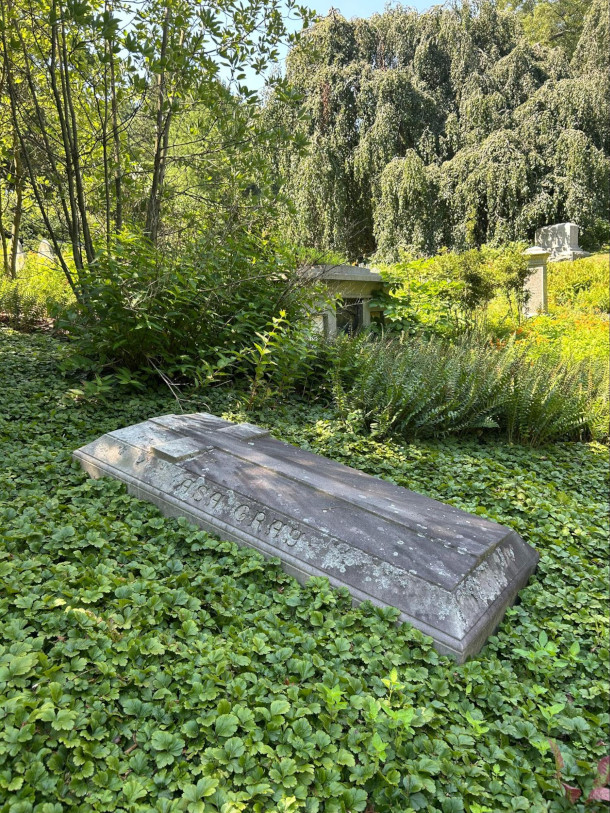
Asa Gray, the American botanist, was close friends with Charles Darwin while he was developing his theory of evolution. Above, Gray’s grave at Mount Auburn Cemetery. (Photo: Bella Smith)
CURWOOD: A number of people in your book are climbing trees. I'm thinking of Julia Butterfly Hill for one. What is it that brings these people to the treetops to say something to the rest of us?
MOOR: Yeah, I mean this is actually not a recent history. This is an unfathomably long history, if you think about it, because we are descended from an arboreal species. We're descended from arboreal mammals, but to some degree we remain an arboreal species. If you think about it, humans have always been climbing trees, and we're still climbing trees, going all the way back to our ancient hominid ancestors. You know, they were sleeping in nests. They believe that Lucy, the Australopithecus afarensis, would have spent her nights in a nest, and then we came down to the ground. But we were always climbing back up. We were climbing back up to gather fruits and honey, and in fact, there are peoples in, for example, the Congo who can still climb hundreds of feet high to gather honey, and their bodies are actually shaped differently. They have more dorsiflexion in their ankles. They've trained their bodies to become more arboreal than ours are through this daily practice, and so if you climb trees all the time, from the time you're a child until you're an adult, it's incredibly easy for you. I visited a group of people called the Korowai in Papua who live in treehouses, and one of their elders, this guy named Marcus, offered to climb a tree for me so I could just see how good he was at it, and it was astonishing. It was like watching a professional rock climber. He was so graceful. He was so agile, and he climbed to the top of this tree, grabbed a vine, swung into another tree, sat in those branches, you know, with this look of total nonchalance, and as if just to say, this is our home. This is where we, as a species, belong. We have always been arboreal.
CURWOOD: So you have a number of interesting factors in your book, or issues. Let's see, there's race. There's colonialism. There's Karl Marx. Okay, why do you explore these topics in this book that's called "In Trees?"
MOOR: Yeah. I mean, I think that that's been a blind spot of nature writing for a long time. The realm of human messiness and human history and domination and injustice are things that we tended to kind of sweep aside so that we could look at the beautiful parts of nature. And this is something that really came to the fore for me when I was talking to a relative of mine. We discovered by tracing my family tree that there's an entire branch of my family tree who are Black. And this cousin of mine, Gia, we traveled through Alabama together researching our family history, and one of the points she hammered home, and I subsequently ran across in other people's writings, is that for many Black Americans, the experience of a forest and of trees is very different than for for white people. For for me, I look at trees like these ones, and you know these symbols of health and nature and peace, and that's it. It's very simple. And for Gia and many other Black people in America, there's also a darker history, which is the history of lynching, the history of racial terror, that has extended from the time of slavery up to the present day. I mean, in many places, the town's lynching tree still stands in front of the courthouse, and in some cases they've tried to take that tree down, and the locals have fought to keep it there. So it's still standing today as a reminder of that, that painful history, and I think it's important to look at that history.
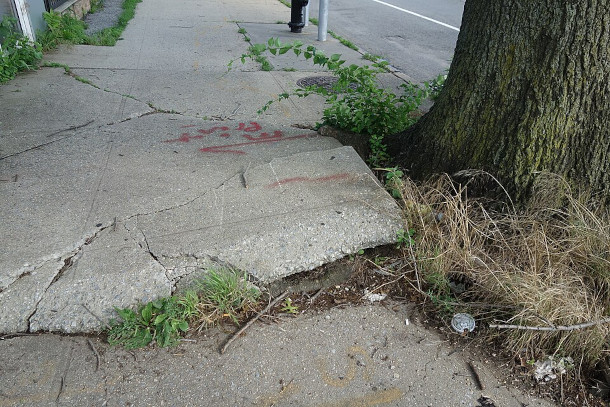
Moor likens history to tree roots bursting through a sidewalk – it will always find a way to come to light. (Photo: Tdorante10, Wikimedia Commons, CC BY-SA 4.0)
[FOOTSTEPS]
CURWOOD: So tell us where are we going?
MOOR: So what I'd like to do is find the grave of Asa Gray. Asa Gray is known as the father of American botany. He was an important botanist in the 19th century, and is someone who I'm kind of fascinated with, both because of that work, but also because he was close friends with Charles Darwin. And there's a great story about Darwin. He sent a letter to Asa Gray in 1857, outlining his theory of evolution. And in that letter, he uses the metaphor of a tree. This is one of the things you find when you look at Darwin's old notes, is that he was thinking in trees. He was drawing little sketches of trees. He was constantly referring to the metaphor of the tree, and that was his way of breaking out of this other model of evolution, which was the tower, the great chain of being, in which human beings are at the top and everything else is sort of arrayed down below. By thinking in trees, he managed to break that apart into something that was quite radical, which was to say that everything that is alive is equally evolved, and it's all related. The term they used back then was consanguinity. Wait, actually, let's ask these people. Sorry. Hi. Do you know where Asa Gray's grave is? Is it straight up here?
CEMETERY WORKER: I think it's that one right by that vehicle.
MOOR: Oh, there we go. Yeah. Okay. Thank you. [FOOTSTEPS] But so that, that letter that Darwin writes to Asa Gray ends up being really important because a year later, Alfred Russel Wallace comes forward with his theory of evolution, which is essentially the same as Darwin's. And Darwin had been sitting on his theory of natural selection for for decades, and had never put it forward. He was trying to really bolster it before he put it out, and that letter from Darwin to Asa Gray ends up being the key piece of evidence which secures Darwin's reputation, and it's why we think of him as the father of Darwinism and not Alfred Russel Wallace today.
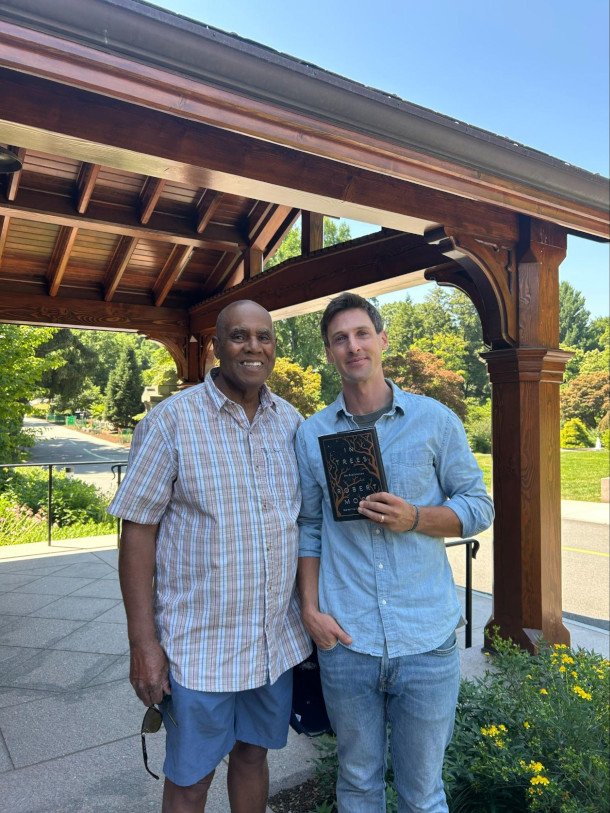
Host Steve Curwood (left) with guest Robert Moor (right). (Photo: Bella Smith)
CURWOOD: So we're headed up the ivy path here, huh?
MOOR: That's right.
CURWOOD: Let's see. Is it in here, maybe?
CEMETERY WORKER: Oh, it's right here. It's this one.
MOOR: Oh, we were standing right in front of it. So there you go, there's, let's see what it says on the side. Oh yeah, Asa Gray. Yeah, so this is really a formative figure in not just the history of botany, but the history of our understanding of evolution, and also I would say you know one of the people who really helped spread Darwin's tree-like understanding of the world, his, his notion of of tree thinking, and it's actually a term that evolutionary biologists use is tree thinking, which means seeing evolution as a branching process and not just as a straight road, right, from tiny bacteria to humans, as if we were always evolving towards this state of being human or something. Tree thinking is a really powerful tool to break yourself out of that.
CURWOOD: So you say that tree thinking is a way people should look at aging and the human experience.
MOOR: I do think so. I think that there's a distinction that is sometimes made between getting old and growing old, and that's one way in which trees can really inform our understanding of how to grow old, because trees grow old beautifully. They're always growing throughout their lives, and they're always shedding. They're always dropping the limbs that don't work. And so I think studying trees is a way that we can learn to to grow old gracefully and creatively, and to stay branchy throughout our lives. This is something that neuroscientists will tell you is one of the most important things about growing old in a healthy way is that you got to stay branchy. You got to try new things. You have to take risks. You can't just get winnowed away into these little ruts. You know, I think that that's something that the modern world does to us, is it forces you to specialize and it makes it so that you just become narrower and narrower as you get older. In some ways, staying branchy is an act of resistance. You know, it's it's resisting that system that wants to make us into these narrow little instruments.
CURWOOD: So America is actually very young as a nation. How do you think it could take the power of a tree to grow older in a graceful way?
MOOR: Well, I think one of the beautiful ideas of America has always been that branchiness, the notion of diversity, but diversity and unity, right? E pluribus unum. That is what a tree is. A tree is e pluribus unum. It is many branches and one trunk, and that arborescent growth of the United States has been one of its greatest assets throughout its history. Unfortunately, I feel that we're now living in a time when diversity has become a dirty word, and people want to return to some kind of simplistic notion of what America is, that America is a certain type of person. It's a person of a certain race or a certain culture, and of course, that is not true. It's not true historically, but it's also not true in the larger philosophical sense. It's not a beautiful idea. It's not a useful idea. It's a corrupt idea.
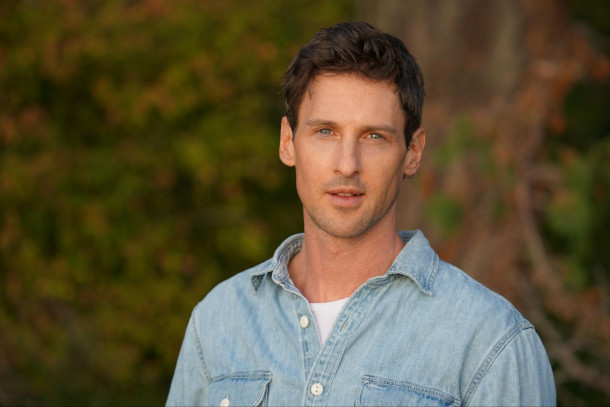
Robert Moor is an author and journalist whose latest book is In Trees: An Exploration. (Photo: Remi Morawski)
I mean, I think that one of the great lessons of studying history is to to see those gnarls, right? To see all of the challenges that America has gone through, all of the wounds that its people have suffered, and how we've grown around those moments, and hopefully outgrown them. That is, I think, one of the big takeaways of tracing my family tree, and then also looking into the history of slavery and Jim Crow, and the relationship that Black Americans have with trees, forced me to grapple with that in a very concrete way. You can't just paper over history. You know, it's kind of like when you look around and you see the tree roots bulging through the, the sidewalks. That's what history does. It will, it will come to the fore again, even when you try to cover it up. And the only healthy thing to do, the only useful thing to do, the only wise thing to do, is to grapple with that history and, and to be honest about it, and then hope that we can outgrow it.
CURWOOD: Tell me, what should people take away from your book?
MOOR: I think that the biggest lesson I try to impart is that, if possible, we should try to think like a tree. What I mean by that is to think in that growth form, to think in a way that's branchy, in a way that's rigorous and pruning away the things that don't work, in a way that's resilient and gnarls around the things that do, and most importantly in a way that's deeply rooted. And when you start thinking in that shape of mind, I think that what you find is that a lot of our bad habits of thinking, being reductive and simplistic, thinking in binaries, the tree starts to split them apart, and you start to find this broader, more creative, and more relational way of seeing the world. And I think if more people could think like a tree, the world we live in would be a very different place.
CURWOOD: Robert Moor is a journalist and author, and his latest book is "In Trees: An Exploration." Rob, thanks so much for taking the time with us today.
MOOR: Thank you so much. It's been a lot of fun.
Related links:
- Purchase In Trees: An Exploration and support Living on Earth and independent booksellers
- Learn more about Robert Moor
[MUSIC: A Thousand Branches]
BELTRAN: Next time on Living on Earth, a journey of nine nights, from the blinding lights of Las Vegas to the darkest, starlit desert.
CHILDS: You're not looking at a picture, you're looking at depth, you're looking at light years, and you can really feel it. You can feel distances between stars, and I hear from people that it makes them feel small. And I think our default is to go, oh, I feel so insignificant, but you could also feel like a giant, because what is small and large when you're seeing stars at that magnitude? It really changes the way you see the sky, the way you see yourself, the way you see this planet -- changes everything.
BELTRAN: “The Wild Dark: Finding the Night Sky in the Age of Light,” next time on Living on Earth.
[MUSIC: A Thousand Branches]
CURWOOD: Living on Earth is produced by the World Media Foundation. Our crew includes Naomi Arenberg, Jenni Doering, Abby Edgecumbe, Swayam Gagneja, Mark Kausch, Mark Seth Lender, Don Lyman, Ashanti Mclean, Nhung Nguyen, Aynsley O’Neill, Sophia Pandelidis, Jake Rego, Andrew Skerritt, Bella Smith, and El Wilson.
BELTRAN: Tom Tiger engineered our show. Allison Lirish Dean composed our themes. You can hear us anytime at L-O-E dot org, Apple Podcasts and YouTube Music, and like us please, on our Facebook page, Living on Earth. Find us on Instagram, Threads and BlueSky at living on earth radio. And we always welcome your feedback at comments at loe.org. I’m Paloma Beltran.
CURWOOD: And I’m Steve Curwood. Thanks for listening!
ANNOUNCER: Funding for Living on Earth comes from you, our listeners, and from the University of Massachusetts, Boston, in association with its School for the Environment, developing the next generation of environmental leaders. And from the Grantham Foundation for the protection of the environment, supporting strategic communications and collaboration in solving the world’s most pressing environmental problems.
ANNOUNCER 2: PRX.
Living on Earth wants to hear from you!
Living on Earth
62 Calef Highway, Suite 212
Lee, NH 03861
Telephone: 617-287-4121
E-mail: comments@loe.org
Newsletter [Click here]
Donate to Living on Earth!
Living on Earth is an independent media program and relies entirely on contributions from listeners and institutions supporting public service. Please donate now to preserve an independent environmental voice.
NewsletterLiving on Earth offers a weekly delivery of the show's rundown to your mailbox. Sign up for our newsletter today!
 Sailors For The Sea: Be the change you want to sea.
 The Grantham Foundation for the Protection of the Environment: Committed to protecting and improving the health of the global environment.
 Contribute to Living on Earth and receive, as our gift to you, an archival print of one of Mark Seth Lender's extraordinary wildlife photographs. Follow the link to see Mark's current collection of photographs.
 Buy a signed copy of Mark Seth Lender's book Smeagull the Seagull & support Living on Earth
© Copyright World Media Foundation. All Rights Reserved
Home | Contact | RSS | Donate | Newsletter