

Alarming Global Temperature Rise
Air Date: Week of September 18, 2026
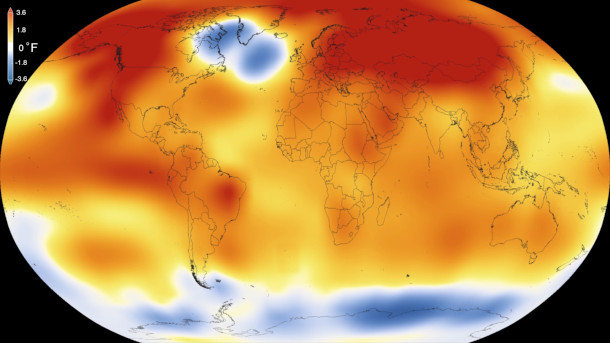
At a global scale, soaring temperatures are responsible for melting glaciers, wildfires, and accelerated death tolls. (Photo: NASA, Wikimedia Commons, Public Domain)
2026 was recorded as one of the hottest summers globally, with deadly heatwaves in Europe and catastrophic floods in Nepal. Ahead of a September meeting, the United Nations put out a report warning that current climate policies will lead to at least 1.8°C of global temperature increase, well beyond the 1.5°C goal of the Paris Agreement. Michael Mann, a distinguished professor of earth & environmental science and director of the Penn Center for Science, Sustainability, and the Media at the University of Pennsylvania joined Living on Earth’s Steve Curwood to give his assessment on where we stand on the climate emergency.
Transcript
BELTRAN: From PRX and the Jennifer and Ted Stanley Studios at the University of Massachusetts Boston, this is Living on Earth. I’m Paloma Beltran
CURWOOD: And I’m Steve Curwood.
As the UN prepares to hold a climate summit near the end of September, it’s warning that current climate policies will lead to at least 1.8°C of global warming, well beyond the 1.5 degrees of the Paris Agreement. 2026 has already recorded one of the hottest summers globally, with deadly heatwaves in Europe and catastrophic floods in Nepal, and July became the single hottest month ever recorded in the US. Despite the evidence of growing danger, the Trump Administration is moving to get rid of regulations that constrain warming emissions from power plants, and other sources. We will have more on the UN moves and US climate regulatory changes in the weeks ahead, but today for an assessment of just where we stand in the climate emergency and what the numbers mean, we turn to Michael Mann, climate expert and distinguished professor at the University of Pennsylvania. Welcome back to Living on Earth.
MANN: Thanks, Steve. Always great to be with you.
CURWOOD: So first, a quick update on how much warmer it's gotten this year. I mean, there's been some news about it. What do you make of these records that are being or have been broken? And what is hottest versus warmest, anyway?
MANN: I guess it's just a matter of word choice. Hottest sounds a little more serious, more problematic, and scientists are sometimes known for their reticence, using mild language that won't offend people. So maybe we like to use warmest, but journalists who want to get our attention will say no, it's hottest because that's what people think about. They think about those hot summer days, and those are going to get hotter. So it's about the framing, and it doesn't matter whether it's warmest, whether it's hottest. We are seeing that. We're seeing that at the global scale. We're seeing that at the regional scale with those heat domes that we witnessed here in the U.S. this summer, that they were experiencing in Europe. And so, yeah, as long as we continue to burn fossil fuels and generate carbon pollution, the planet continues to warm up. Now you get a big El Nino event on top of that, which is a natural short-term warming, and you reach brand new levels of warmth or heat that the planet's never seen before. And that's what happened in 2024. That's what is probably going to happen when we look back at 2026, and almost certainly with 2027, with this even bigger El Nino event that is now peaking as we go into the northern hemisphere fall.
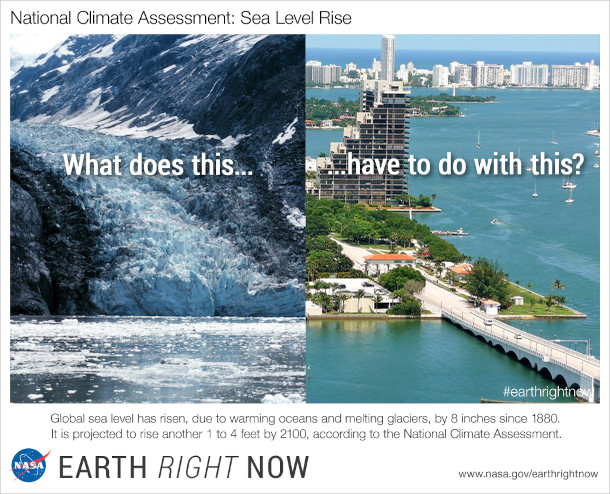
Though the terms are often used interchangeably, ‘climate change’ and ‘global warming’ are distinct. ‘Climate change’ encompasses an array of environmental issues, including temperature increases, extreme weather, and changing rain patterns, while ‘global warming’ focuses solely on the temperature aspect of the broader crisis. (Photo: NASA, Wikimedia Commons, Public Domain)
CURWOOD: By the way, Michael, to what extent do you think a difference would be made if we reframed the conversation to use the words “global warming” again instead of referring to what's going on as “climate change”?
MANN: Yeah, you know it's funny because when you talk to scientists who are always looking to be precise about the language, they'll say, "Well, global warming is just one dimension of climate change. Climate change is the full array of changes that we're seeing in the Earth system as we heat it with carbon pollution.” The surface is warming up, but the ice is melting. Air currents are shifting. Ocean currents are shifting, drought patterns, extreme weather, Arctic sea ice is declining, and so that full array of changes in the climate, that's what we mean by climate change and global warming in a sense, is only talking about one component. So, if you're a purist, you would make that distinction. To the public, it seems like, hey, why are they changing the language? This was one of the standard contrarian arguments. They used to call it global warming, and then they changed to climate change because they wanted to make it scarier. The irony, of course, is that back in around 2000, the Republican pollster Frank Luntz did a focus group, and there was a secret memo that eventually got released, and he was advising his clients, basically Republicans, that they should use climate change instead of global warming because it sounds less threatening. So if you go by what Frank Luntz said, it would be just the opposite of what the critics are saying. The scientists have used tamer language because they're calling it climate change. If you ask the scientists, they'll say no. Climate change is the better term for the rich array of changes that we are seeing in the planet's climate, and global warming is just part of that.
CURWOOD: So, one and a half degrees centigrade above pre-industrial levels is the number that many in the climate space are quite familiar with, especially of course in association with the development of the Paris Agreement. Keeping the average rise in global temperatures ideally at that level or at least below two degrees centigrade is what we're hoping for. But what's the importance of maintaining these values of aspiring to one and a half degrees, certainly keeping below two degrees. What's the harm of going above those numbers?
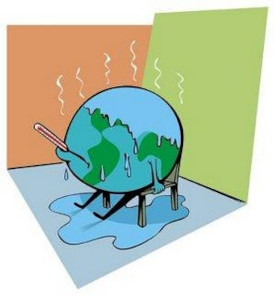
A 1.5C rise in global temperatures may sound small, but its effects are significant. Much like a fever signals a change in the body, even a small increase in Earth’s average temperature can contribute to more extreme heat, rising sea levels, and disruptions to ecosystems and communities. (Photo: Baluchi5, Wikimedia Commons, CC BY-SA 3.0)
MANN: Yeah, you know, there's sort of a shorthand because it's a simple number to talk about the average temperature of the planet. But what it's a shorthand for is all of the impacts that that amount of warming happens. Because there's more warming over the continents than the global average, there's even more warming in the higher latitudes in the melting Arctic. There are all of the changes in extreme weather events: the heat domes, the wildfires, the floods, and so in essence, this is a thermometer scale, the global average temperature, that is sort of a catch-all for the full array of consequences when the planet warms that much. It might sound like a small amount of warming, right? You know, one and a half, two degrees Celsius. But I'll tell you, when the human body warms up that much, it's called a fever. It's called a pretty serious fever. And in fact, even though you're only talking about a couple degrees on the thermometer scale, you know what the consequences of that fever are for you. You're coughing, difficult breathing. You're delirious. You're suffering all sorts of health consequences, and so in a sense, that's the same thing here. That thermometer scale is telling us that Earth is running a fever, and we're seeing the consequence of that fever in terms of the heat domes, the wildfires, the floods, and all of the impacts that it's already having. We're not even at one and a half Celsius yet, three degrees Fahrenheit basically, and already we're seeing dangerous climate change. So at this point, it's not like we're going to avoid dangerous climate change. It's here, and it's a matter of limiting it as much as we can, we may miss the 1.5 Celsius exit. It looks very likely that will happen now, especially because of two years of inaction here in the U.S. with the current administration. But we still go for that next exit. That next exit, 1.8 Celsius, would be a whole lot better than two, and it's still absolutely achievable. The rest of the world continues to make progress. The U.S. starts to right its course. We can get there.
CURWOOD: And talk to me about the health and social implications of increases at this scale in climate disruption.
MANN: We think about the extreme heat is a killer, and thousands of people are dying from just extreme heat events here in the United States that have been made more extreme because of human-caused warming, you have dangerous and deadly flood events, superstorms. So there is a toll that climate change is taking directly that can be measured in terms of lost human lives. We saw several thousand with that Tibetan flood, that glacial collapse, and we can say that was caused by climate change. Those floods were directly related to the melting of a glacier that only happened because of human-caused warming of this planet. So that several thousand people, just in that one event, that mortality is attributable to human-caused climate change, and that's not even getting into all of the wildfires and the extreme heat events that we saw this summer. thousands of people who died in Europe because of extreme heat. And so far, I'm just talking about the climate impacts. Now, when you take into account the health consequences of fossil fuel extraction and fossil fuel processing, there are as many as I think the estimate is that 20 percent of all excess mortality today can be tied to air and water pollution that's linked to fossil fuels. And so, when you put all that together, the climate crisis and fossil fuel dependence is more deadly than the deadliest pandemic that we've experienced yet.
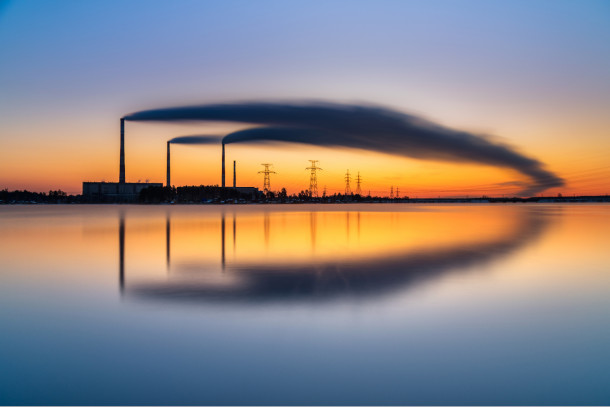
According to the Harvard T.H. Chan School of Public Health, air pollution from burning fossil fuels is responsible for roughly 1 in 5 excess deaths worldwide. (Photo: Vasily Iakovlev, Wikimedia Commons, CC BY-SA 4.0)
CURWOOD: Michael, to what extent is the planet warming faster than many scientists had predicted or speculated might not happen?
MANN: Yeah, so there's a lot of sort of misinformation out there about this, and there's some scientists who are making extravagant claims that I would argue don't actually measure up to, don't actually match the evidence. The planet's average temperature right now has increased almost exactly as much as the models said it would, given our continued burning of fossil fuels. And so, if you look at sort of the observations, the global average temperature record, along with the spread among the models that the Intergovernmental Panel on Climate Change used in their last assessment, the observations are right in the center of those model simulations. I like to say the truth is bad enough. We don't have to exaggerate that. It's just the reality is that the planet is warming up exactly as we said it would, and those models tell us it will continue to warm more if we continue to burn fossil fuels. So the models have gotten right the overall warming of the planet.
CURWOOD: But to what extent are the impacts coming faster than what science had predicted? What about the impacts, though? I mean, glaciers cutting loose, these heat waves and fires and all that. To what extent did science predict that?
MANN: That's exactly right. So many of these impacts are actually happening earlier, or the magnitude of the impact is greater than what we predicted. And the truth is bad enough. The planet is warming up as much as we expected, and the reality is that a lot of the consequences of that warming are worse than expected with regard to extreme weather events, with regard to the disintegration of ice sheets and the sea level rise that goes with that, with regard to any array of impacts we're seeing in many cases impacts that go beyond what we predicted.
[MUSIC: On The Record]
BELTRAN: Coming up, Steve continues his conversation with Michael Mann, Distinguished Professor of Earth & Environmental Science and Director of the Penn Center for Science, Sustainability, and the Media at the University of Pennsylvania. Stay tuned to Living on Earth!
ANNOUNCER: Support for Living on Earth comes from the Waverley Street Foundation, working to cultivate a healing planet with community-led programs for better food, healthy farmlands, and smarter building, energy and businesses.
[CUTAWAY MUSIC: Flatland Park, “Revelation” single, Flatland Park]
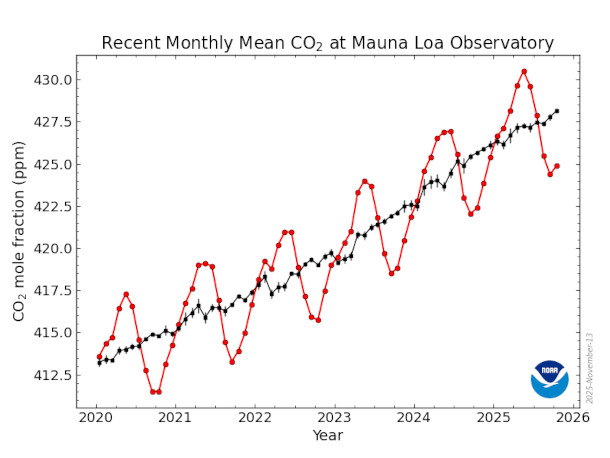
Since 1958, the Mauna Loa Observatory has tracked rising atmospheric CO2. Climate models have projected that increasing CO₂ would lead to warming and observations today closely align with many of those early projections. (Photo: Mauna Loa Observatory, Wikimedia Commons, Public Domain)
BELTRAN: It’s Living on Earth. I’m Paloma Beltran
CURWOOD: And I’m Steve Curwood.
We are back now with Michael Mann, climate expert and UPenn professor.
CURWOOD: What do you think it would take to get the public level of concern about the climate, equal what's being said loudly about artificial intelligence risks?
MANN: Yeah, that's a great question, Steve. Because it's sort of ironic, isn't it, that here we've been sort of yelling at the top of our lungs, we climate scientists for you know decades now, that we've got an existential planetary crisis. You know, it's the warming of the planet. We're seeing the consequences of that every day, and it is jarring in a way to see so much public concern about a potential threat that isn't nearly as far along at this point. It's sort of jarring because, like we've been telling you, we have a crisis for decades. And not enough action has been taken. Here, we're just starting to hear, you know, murmurs of a crisis, and the alarm bells are ringing far more loudly. And why is that? And I can tell you, my theory is that it aligns with some of the dystopian narratives that we've been fed. You know, the Terminator, the Matrix, Machine World, Cybernet. People have been served warning through these dystopian Hollywood narratives for a number of years now, and when things happen in the real world that start to align with those narratives, it understandably causes great concern. We haven't, I would say, maybe the entertainment community, our friends in the world of communication, haven't done as good a job in portraying the climate crisis as the existential threat that it is. It's it's sort of there in the background, and films like Avatar, which are actually premised on environmental destruction, but it's sort of in the background. It's not in the front. It's not really platformed in the narrative, so I think that's part of it. That the public has been led to be concerned about dystopian narratives that look like what's happening in the AI space, but they haven't been as well prepared to see the climate crisis as the existential crisis that it is.

Movies like Terminator have shaped public perception of artificial intelligence as an immediate threat, while climate change hasn’t been as popularized in the media as an urgent issue. (Photo: Daniel Juřena, Wikimedia Commons, CC BY-SA 2.0)
CURWOOD: So the most recent UN report is saying, "Look, we're on our way to 1.8 degrees centigrade, global increase in temperatures, largely tied to greenhouse gasses we're emitting.” How inevitable is this? How reversible is this? What can be done at this point if people were to get quite alarmed about this?
MANN: Yeah, good question, Steve. I mean, the fact is, you know, there's good news and bad news when it comes to what the climate science tells us. With the climate science, the most comprehensive Earth system models that we have now give us a little bit of good news. The good news is that we know that the surface warming ends almost immediately when we bring carbon emissions down to zero. We stop adding carbon pollution to the atmosphere. The surface of the planet stops warming up, and that has in part to do with the way that the oceans and the plants are continuing to take CO2 out of the atmosphere. So once we stop producing it, those levels start to come down, and it turns out it leads to a stabilization. You basically stop, the surface temperature remains where it was when you stopped emitting carbon. That's the good news, but that's also the bad news. The bad news is that the surface temperature remains where it is when you stop emitting carbon. It means it's elevated at that level for perpetuity, and to the extent that we're already seeing very harmful impacts of less than 1.5 warming, you can imagine how bad it looks if we even elevate temperatures at 1.8 for decades into the future. So there are really two things here. When you're in a climate hole, as I like to say, you've got to stop digging fossil fuels. So we're in a climate hole. We've got to prevent it from getting worse. We've got to decarbonize as quickly as we can. That's task one. That's where our primary focus needs to be. Yes, we may decide that we need to use technology that isn't available at scale now. It may be available at scale decades from now, to actually bring those carbon dioxide levels back down, so that we can maybe start to cool the planet back down, bring it back to 1.5 or somewhere low enough that it remains more within our adaptive capacity. 1.8 Celsius is going to be tough. More than two degrees is going to be really tough. Three degrees Celsius warming of the planet, where, by the way, we will be if we make no additional progress. If we go with just sort of current policies into the future, the planet will warm up more than three degrees Celsius, the better part of six degrees Fahrenheit, later this century. That would be catastrophic in terms where we start to use words like civilization-ending, where we can no longer envision meeting the needs of more than 8 billion people on this planet with diminished food and water and space.
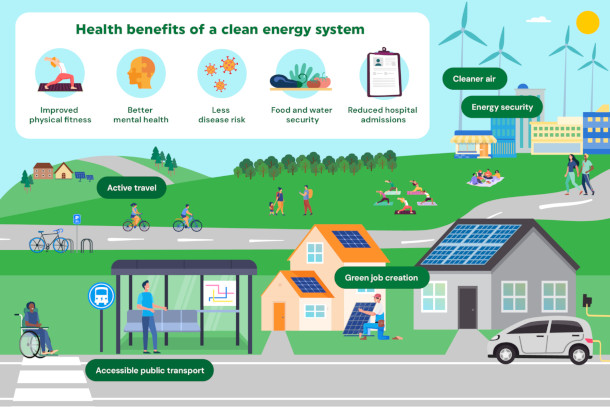
With current projections putting the world on track for 3.0°C of warming unless more action is taken, rapid decarbonization and a transition to renewable energy would be pivotal to trying to keep something like 1.8 °C within reach. (Photo: UK Health Alliance on Climate Change, Wikimedia Commons, CC BY-SA 4.0)
CURWOOD: So, before you go, what keeps you up at night, and what lets you go to sleep?
MANN: Great questions. What keeps me up at night is, is the fear that there's an overriding danger here, beyond the climate crisis, beyond the environmental crises we face. But in, in some ways, it's tied to developments in the AI space and the machine learning space. It's disinformation. The greatest threat we face right now, because it's a fundamental threat to democratic governance, is disinformation, the deliberate spread of misinformation for ideological reasons, whether it's climate denial or anti-vax viewpoints that are paralyzing, you know, our ability to deal once defeated. Epidemics like measles that are now coming back; these are all tremendous threats. But the greater threat is the way that our information ecosystem is being polluted with massive amounts of disinformation, especially through social media. Much of it by bad actors who have weaponized social media and are using AI to help make disinformation, as one colleague of mine put it, go infinite. The infinite disinformation, where our environment is so permeated with disinformation that there's no hope of pushing back on it and correcting the record. That's what keeps me up at night. What allows me to sleep is the fact that I have a daughter who's a student here at Penn who's studying AI herself. She's doing AI research, and there is a generation, a young generation of really smart kids who understand the crises we face, including the threat of misaligned AI, and are working hard to try to avert the catastrophes that could lie in store if we make all the wrong choices, and so I guess put more simply, it's the younger generation there what put my mind at ease and allow me to sleep.
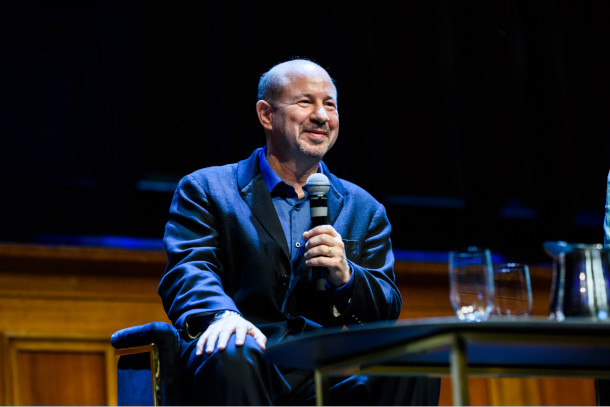
Michael Mann is the Presidential Distinguished Professor of Earth & Environmental Science and Director of the Penn Center for Science, Sustainability, and the Media. (Photo: Courtesy of Michael Mann)
CURWOOD: Michael Mann is the Presidential Distinguished Professor of Earth and Environmental Science and directs the Penn Center for Science, Sustainability, and the Media. Thank you so much for taking time with us today.
MANN: Thank you, Steve. Always a pleasure, my friend.
CURWOOD: And if you want to know more about Professor Mann's concerns and experiences, his new book is called "Science Under Siege."
Links
The Guardian | “Global Heating Will Hit at Least 1.8C, UN Warns, and There Are ‘No Good Outcomes’”
Living on Earth wants to hear from you!
Living on Earth
62 Calef Highway, Suite 212
Lee, NH 03861
Telephone: 617-287-4121
E-mail: comments@loe.org
Newsletter [Click here]
Donate to Living on Earth!
Living on Earth is an independent media program and relies entirely on contributions from listeners and institutions supporting public service. Please donate now to preserve an independent environmental voice.
NewsletterLiving on Earth offers a weekly delivery of the show's rundown to your mailbox. Sign up for our newsletter today!
 Sailors For The Sea: Be the change you want to sea.
 The Grantham Foundation for the Protection of the Environment: Committed to protecting and improving the health of the global environment.
 Contribute to Living on Earth and receive, as our gift to you, an archival print of one of Mark Seth Lender's extraordinary wildlife photographs. Follow the link to see Mark's current collection of photographs.
 Buy a signed copy of Mark Seth Lender's book Smeagull the Seagull & support Living on Earth
© Copyright World Media Foundation. All Rights Reserved
Home | Contact | RSS | Donate | Newsletter