

September 11, 2026
Air Date: September 11, 2026
FULL SHOW
SEGMENTS

Glaciers Crumble as Earth Warms
View the page for this story
The devastating August 2026 flash floods in Nepal and Tibet were triggered in part by a glacial collapse, a phenomenon likely to become more frequent as the Earth continues to rapidly warm due to human caused climate change. Alton Byers, a mountain geographer with the Institute of Arctic and Alpine Research at the University of Colorado—Boulder who has worked in the Himalayas, joins Host Paloma Beltran to explain why climate change is making mountains and glaciers more unstable, and how early warning systems and less development in floodplains could prevent future loss of life. (15:35)

Climate-Resilient “Super Reefs”
/ Teresa TomassoniView the page for this story
As global sea temperatures rise due to climate change, coral reefs around the world are struggling through mass bleaching events. But new research has identified nearly one-third of the world’s coral reefs as climate resilient, three times more than was previously estimated. Teresa Tomassoni is an oceans correspondent with our media partner Inside Climate News who took a reporting trip to the Marshall Islands to cover these “super reefs”, and she spoke with Living on Earth’s Aynsley O’Neill. (12:57)

Desert of Water
/ Mark Seth LenderView the page for this story
At the San Andres National Wildlife Refuge in New Mexico, rock layers bear evidence of the most severe mass extinction in Earth history, some 250 million years ago. And while access to this refuge is restricted because it is surrounded by the White Sands Missile Range, Living on Earth Explorer in Residence Mark Seth Lender was able to visit and bring back this reflection on how today’s desert ecosystem thrives in what was once an ancient sea. (03:53)

Fat Marmot Week and 'OnlyMarms'
View the page for this story
Inspired by the popular Fat Bear Week, researchers with the Marmot Project launched Fat Marmot Week this year to raise awareness of these large ground squirrels, and drum up support for sustaining their decades-long research project. Emily Renkey is a graduate student at UCLA in the Dan Blumstein Lab, which runs the Marmot Project. She joins Host Jenni Doering to talk about the winner of Fat Marmot Week, and other creative ways the team is fundraising and spreading a love of yellow-bellied marmots. (13:27)
Show Credits and Funders
Show Transcript
260911 Transcript
HOSTS: Paloma Beltran, Jenni Doering
GUESTS: Alton Byers, Emily Renkey, Teresa Tomassoni
REPORTERS: Mark Seth Lender
[THEME]
DOERING: From PRX – this is Living on Earth.
[THEME]
DOERING: I’m Jenni Doering.
BELTRAN: And I’m Paloma Beltran.
The Nepal floods send a stark warning about climate fueled glacial hazards.
BYERS: You know, from my point of view, what I do, I’m a field practitioner. I don’t spend a whole lot of time studying climate change. But what I know is that the mountains have gotten warmer. And with increases in temperature, we have gotten an increase in the instability of mountain environments.
DOERING: Also, researchers come up with creative fundraising to study mountain dwelling rodents.
RENKEY: He had watched the show “Margo’s Got Money Troubles,” which is a show about a woman who makes an OnlyFans account to raise money. And she makes a lot of money, and so I think he kind of was like, well, marmots have money troubles also – why not start an OnlyFans account for our marmots?
DOERING: That’s this week on Living on Earth. Stick around!
[NEWSBREAK MUSIC: Boards Of Canada “Zoetrope” from “In A Beautiful Place Out In The Country” (Warp Records 2000)]
[THEME]
Glaciers Crumble as Earth Warms

The flash flooding that occurred the morning of August 26, 2026 completely destroyed areas such as Gyirong Port, a border crossing between China and Nepal, as seen above. (Photo: CCTV screenshot, Wikimedia Commons, Public Domain)
DOERING: From PRX and the Jennifer and Ted Stanley Studios at the University of Massachusetts Boston, this is Living on Earth. I’m Jenni Doering.
BELTRAN: And I’m Paloma Beltran.
On August 26, a large mass of ice and rock broke off a Himalayan mountainside, triggering disastrous flash floods in parts of Nepal and Tibet. This catastrophe occurred during the South Asian monsoon season, when rivers are already swollen with rain. And as climate change destabilizes glaciers around the globe, especially the “Third Pole” region of the Himalayas, unimaginably large floods are likely to pose increasing risks to human populations. The United Nations recently reported that the Earth will soon exceed 1.5 degrees Celsius of warming, making extreme events more frequent and severe. Joining me now is Alton Byers, a mountain geographer at the Institute of Arctic and Alpine Research at the University of Colorado, Boulder who has worked in the Himalayas. Alton, welcome to Living on Earth!
BYERS: Thank you. Thank you for having me.
BELTRAN: So, briefly walk us through what happened on the morning of August 26. What exactly caused this avalanche, and how did it turn into such a destructive flood downstream?
BYERS: Well, I can tell you what we know so far. We have the basics down, but I'm convinced that we're really not going to know until we get to the site and do some on-the-ground research. Basically what we do know pretty much for sure is that this was started by bedrock failure and glacier collapse at about 5,200 meters, about 17,000 something feet, on the north face of a major mountain in the Himalayas, the Langtang Lirung, at 7000 meters. So what we had was this major detachment, and this is huge. It's like one and a half kilometers wide and 50 million tons of material. But that was detached, started to fall down. It plummeted 2000 meters down before it hit the glacier below, and as it falls down, contact with air creates friction. Friction heats and melts the ice, and we get water. We get the beginnings of a new accumulation of water. Meanwhile, everything else is turning into sort of a slurry, okay? And when it hit the ground. It hit with the force of an atomic bomb, and we saw the seismic signal that the USGS recorded. But meanwhile, the slurry funnels on down and blocks the river, an already monsoon-swollen river. So we get a backup of water into a massive lake, and then that slurry dam, which is holding back the lake, breaks. And then we get a release of millions of cubic meters of not just water but boulders and this hyper-concentrated slurry again that looks and feels exactly like liquid concrete. Imagine not just a flood barreling down the river valley at heights that we could never imagine before, but it's also like liquid concrete going on down. And I've interviewed people who have seen these villagers in Nepal, and they say that it's a horrific experience. The noise is deafening, but it sounds like somebody is moaning in agony as this as this plummets down the valley. Anyway, that's basically the series of what we call a cascading series of events that led to this catastrophic flood in Nepal.

The disaster began on the face of the Langtang Lirung mountain of Nepal, when a mass of glacier fell and triggered a landslide and flood in downstream communities. Above, a USGS map of the flood’s path. (Photo: USGS, Public Domain)
BELTRAN: And Alton, to what extent is climate change and warming temperatures accelerating events such as these?
BYERS: Well, I mean, part of climate change is warming, and the world has been warming since the end of the Little Ice Age, about 1860. As the world has gotten warmer, so has the permafrost, and that's the perpetually frozen ground at high altitude that acts as sort of a glue, like a cryospheric glue that holds the rocks and the glaciers and the debris together. Now, when that softens, which it has been doing for certainly the last 80, 100 years, like a stick of butter, take a stick of butter out of the refrigerator and put it on the counter. When that softens, then glaciers and bedrock and debris no longer has the resistance to gravity that it used to have, so therefore is much more likely to break and begin the process of cascading down into a major landslide, and there are other factors involved as well. Melting glaciers lubricate the interface between the glacier and the rock, so things are more likely to slide off. Catastrophic or unusual weather events, high levels of precipitation, snowfall can also act as triggers as well. But basically, from my point of view, I'm a field practitioner. I'm someone who looks for solutions. I don't spend a whole lot of time studying climate change. But what I know is that the mountains have gotten warmer, and with increases in temperature, we've gotten an increase in the instability of mountain environments. Now, mountains are unstable anyway. They're geologically unstable, they're tectonically unstable. But when you add to that warming trends that are melting the ice and softening the permafrost, we're just seeing an acceleration, an increase in the frequency and magnitude of these major events.
BELTRAN: And Alton, as someone who has lived and worked in the mountains of Nepal, describe for us what this must have felt like for nearby communities.

Permafrost is any ground that remains frozen for over two consecutive years. When permafrost thaws, such as in the above photo, mountain ecosystems can become destabilized and events such as the Nepal avalanche are more likely to occur. (Photo: Boris Radosavljevic, Wikimedia Commons, CC BY 2.0)
BYERS: Well, you know, in 2015, we were wrapping up a project in Nepal that was funded by the U.S. Agency for International Development. But USAID, right after, right when the contract ended, the earthquake happened. So USAID sent us over immediately to look at three glacial lakes, potentially dangerous glacial lakes, and look at what the impacts of the earthquake may have been. And what I remember vividly is how traumatized people were. And I mean, this event is horrible, and it's so sad. It just breaks your heart. But I just remember seeing everybody that I met when we went, and we were some of the first outsiders to go into these areas. Nobody else wanted to go. It was too dangerous. They were afraid of landslides that were still happening because everything was still unstable. But we held meetings after we did our survey of the lakes. We held meetings with the local communities, and I’ll just never forget the the look of fear, and they're so traumatized, and that's what's happening right now. All you have to do is look at the, the film clips of these poor people. They've lost their families. They've lost their homes. Some of them had their homes destroyed during the earthquake, and now they've had their homes destroyed again. So it's just sad beyond belief. Just as the magnitude of the event has forced us to reset our mental models of what can happen, it is absolutely the biggest thing I have ever seen in my life in terms of a catastrophic debris flood like that.
BELTRAN: It's so devastating, and at the time of this recording, over 1000 people have been confirmed dead, and a few thousand more are still missing. What precautions and early warning systems are in place to protect people from events like this?

In 2015, a 7.6-magnitude earthquake struck Nepal, killing nearly 9,000 people and injuring tens of thousands more. Byers recalls visiting the affected areas and speaking to community members. (Photo: Rajan Journalist, Wikimedia Commons, CC BY-SA 4.0)
BYERS: Well, sadly, very few. Now there have been attempts to establish early warning systems on at least two glacial lakes in Nepal. One was established right after the earthquake in 2015, and I'll never forget how the villagers, when we had our meetings, they said, "Well, yeah, they installed an early warning system." It's quite sophisticated, laser-based to measure the rises in the water and signals back to Kathmandu. But they said, "But nobody told us how it works, what it sounds like, or what to do in the event that it goes off." So there was a clear disconnect between technology and communication, but I think what you're going to see, I certainly hope we'll see this, is a renewed focus on early warning systems that work. We need to develop catastrophic event-specific early warning systems, and they could take a whole range of shapes. It could be cell phone based, and cell phones have become very effective in terms of warning people. The government sent out 600,000 messages that saved hundreds, maybe thousands of lives. Another thing people ask all the time, could we have predicted this? And the answer is no. You can't predict a glacial lake outburst flood. You can't predict a bedrock failure, a glacier collapse such as this. But we can flag areas of high concern. For example, a mass of overhanging ice, just like the one above Langtang Lirung, with a village 10 kilometers downstream. That is a red flag. In other words, we need a fresh look at the power of remote sensing and remote sensing analysts to flag these places and somehow monitor them. One of the most important things, though, is that the reason it's a catastrophic event is because so many people died and so many buildings were destroyed. I think we're going to see an effort to discourage, to avoid building in floodplains similar to this. But those are the basic directions I think we need to move, and I think we will move in the coming months and years.
[MUSIC: Kanchenjunga Lows]
BELTRAN: We’re speaking with CU Boulder mountain geographer Alton Byers, and we’ll be right back after the break. Stay tuned to Living on Earth!
ANNOUNCER: Support for Living on Earth comes from the Waverley Street Foundation, working to cultivate a healing planet with community-led programs for better food, healthy farmlands, and smarter building, energy and businesses.
[CUTAWAY MUSIC: Kanchenjunga Lows]
DOERING: It’s Living on Earth, I’m Jenni Doering.
BELTRAN: And I’m Paloma Beltran.
Let’s get back to my conversation with Alton Byers. He’s a mountain geographer at the Institute of Arctic and Alpine Research at CU-Boulder. Alton studies glacial hazards in the Himalayas like the one that caused the devastating floods in Nepal this August.

Byers says that nations have a responsibility to help Nepal recover from this tragedy, and invest in disaster preparation measures such as early warning systems. Above, supplies from the U.S. Air Force are transported at an airport in Nepal on September 2, 2026. (Photo: United States Air Force, Wikimedia Commons, Public Domain)
BELTRAN: And Nepal is, of course, one of the most vulnerable countries to climate impacts, but it's only contributed 0.01% of total planet warming emissions. What international efforts are underway to help Nepali communities adapt to rapid climate change, and what role, if any, is the U.S. playing in that effort?
BYERS: Well, I mean, I think the international community has a responsibility, just from a humanitarian point of view, you know, not necessarily from a climate change point of view. I think they have a responsibility to help Nepal and help the world develop these types of early warning systems. I know Nepal a year ago received a 34.1 million dollar grant from the Green Climate Fund. I think some of those funds could go into funding things such as early warning systems and increasing our capacity to identify high risk areas in the mountains. So as I mentioned before, USAID was generously funding programs, including ours, to help people adapt to climate change. The U.S. has canceled USAID, that's no longer there, but the Brits and the Germans and the Norwegians and others are still actively involved in programs, to my knowledge, again, same climate change adaptation program. So it's not dead. It's moving forward. I think you'll see it will be even more enhanced in the coming months and coming years as international donors once again refocus on a new set of urgent needs to help mitigate the impacts.
BELTRAN: And how likely is it that we'll see another event like this, you know, in Nepal or elsewhere?

Dzopkio, or yak-cattle crossbreeds, are often used to carry luggage and supplies through the Himalayas. (Photo: Mark Rosen, Wikimedia Commons, CC BY-SA 3.0)
BYERS: Inevitable. It's just a matter of time, and maybe one has happened similar already. Well, as I said, we don't always know. These Himalayas are huge. These are massive mountain ranges, and often events happen that people simply don't report. So again, another story. I hope you don't mind my stories.
BELTRAN: Oh, please, please do share.
BYERS: I was a Fulbright scholar in 2022, so we lived in the Kanchenjunga Conservation Area for six months. And we were interested in, of course, in glacial lakes, dangerous glacial lakes, and local people told us about one called Nupchu, especially dangerous. So we said, "Hey, that's just up the valley here. It's going to take about two days to get to it. Let's go up and take a look at it." So for some reason, instead of the, the day we were supposed to depart, we had to delay by one day. The next day, we loaded up our dzopkio. Those are yak and cattle crossbreeds. So we had four dzopkio, like yaks, and the yak driver. So we started going up the valley toward the glacial lake, and we came around a bend, and the entire valley had been buried in material exactly like I described earlier, like liquid concrete, 30, 40 feet, 50 feet high, okay? There had been a massive breakage of material, identical almost to what we saw last week, that created this massive slurry that if you could, just covered this whole valley in, in this sediment. So it's very lucky we hadn't gone the day that we had planned to go, and fortunately the dzopkio found a way around the edge that was firm enough that we were able to go up, cross it, and then go up and study this lake, but you know there's an example of things happening all the time. And when we went back to Khambachen, that's a potato growing and tourist village. The local people had no idea it had happened. It was only four or five miles up valley, and no one knew it had happened.
BELTRAN: Alton, what do you hope the western world will take away from this catastrophe?

Alton Byers is a mountain geographer specializing in landscape change, glacial hazards and high-altitude conservation in the Himalayas. Above, Byers in the Kangchenjunga region of Nepal in 2022. (Photo: Courtesy of Alton Byers)
BYERS: Well, again, that this is proof that, undeniable proof, that the world is changing. The world is getting warmer. It's getting hotter, and with it, mountains that are so important to the rest of humanity, in terms of, they're only 25 percent of the Earth's surface, but they're in almost all of the world's countries, and they provide a bulk of the world's fresh water, and minerals, and timber, natural resources. They're spiritually important. They're culturally important, and you know we need to pay greater attention to our mountains and take care of our mountains. Just like we try and take care of our oceans and our rainforests, we need to also recognize the importance of mountains. And unfortunately, it's the people in the mountains who bear the brunt of the damage and the grief and the tragedy. So, what I think we need to do is buckle down and figure out well, what do we do about it? How do we adapt to it? How do we help people adapt to it? How do we develop better early warning systems, better mechanisms of identifying potential hazards, ways to discourage building in high hazard zones? I think that's the way forward.
BELTRAN: Alton Byers is a mountain geographer at the Institute of Arctic and Alpine Research at the University of Colorado, Boulder. Alton, thanks so much for joining us.
BYERS: Oh, thank you for having me.
Related links:
- The Conversation | “When a Mountain Falls: How Ice and Rock Triggered Nepal’s Catastrophic Flood – and Why Climate Change Is Raising the Risks”
- Learn more about Alton Byers
[MUSIC: Prayer Flags in the Wind]
Climate-Resilient “Super Reefs”

A number of coral reefs show signs of being heat-resilient, which some scientists are saying inspires hope for safeguarding one of the most precarious ecosystems on the planet. One such scientist, Anne Cohen, above, aims to create a corridor of marine protected areas of such “super reefs” throughout the Marshall Islands, Kiribati and Tuvalu. (Photo: Tim Briggs)
DOERING: As global sea temperatures rise due to climate change, coral reefs around the world are struggling through mass bleaching events. But the ocean is looking a lot more colorful than scientists previously thought. New research has identified nearly one-third of the world’s coral reefs as climate resilient. That’s three times more than was previously estimated. Teresa Tomassoni is an oceans correspondent with our media partner Inside Climate News who took a reporting trip to the Marshall Islands to cover these “super reefs”. Teresa spoke with Living on Earth’s Aynsley O’Neill.
O'NEILL: So let's set the stage here. On the whole, how are coral reefs faring in the modern day?
TOMASSONI: Coral reefs around the world are experiencing a severe crisis due to rising global temperatures. Around the world, we see reefs that are so stressed that they bleach, they turn white. Just in the last three years, since 2023, more than 80% of coral reefs globally have experienced bleaching, and while some have recovered, most have not.
O'NEILL: Teresa, you're an oceans correspondent, so I'm sure you love the oceans, just generally speaking. But for people whose familiarity with a coral reef might be limited to a Finding Nemo movie, why are coral reefs so important to protect?

Anne Cohen, (left, Woods Hole Oceanographic Institution) and AJ Alike (right, Marshall Islands Conservation Society) collect samples from tabletop corals near Majuro, capital of the Marshall Islands. These corals, which were showing signs of being heat-resilient, will have their samples taken back to a laboratory for further study. (Photo: Teresa Tomassoni)
TOMASSONI: Healthy coral reefs provide habitat, food, nursery, and feeding grounds for up to a quarter of all marine species. We're talking about fish, sea turtles, sharks, and numerous other species. Hundreds of millions of people also depend on these reefs around the world for their livelihoods and to put food on the table. Coral reefs also act as incredible natural barriers against waves, storms, and sea level rise.
O'NEILL: But we're here now to talk about climate resilient reefs. What does that term mean?
TOMASSONI: So these are reefs that are either able to resist the heat altogether, almost as if they're immune, or recover after marine heat waves.
O'NEILL: And so, what are some of the factors that are at play here? You know, why are some of these reefs thriving while their neighbors are bleaching? What's going on?
TOMASSONI: That's a really great question that many scientists who are focused on these climate resilient reefs are still trying to find the answers to. There are coral reefs, for instance, that have survived for generations in hotter than normal temperatures. So maybe they've developed sort of genetic adaptations to hotter temperatures. There are other coral reefs that are naturally shaded or shielded from heat by cooler ocean currents, for example, but really we're at a time where scientists are studying individual coral colonies and entire reefs to find more specific answers. What is it about this genetic makeup for certain corals that allows them to be so resistant or resilient?
O'NEILL: And now, of course, just because a reef doesn't succumb to bleaching, that doesn't mean that it's impervious to all harm. So, what kind of threats are climate resilient reefs seeing?
TOMASSONI: This is a really important and increasingly prominent topic of discussion amongst coral scientists. As you said, coral reefs may be resistant or resilient to higher temperatures, but that doesn't make them immune to fishing, to dredging, to unregulated tourism, right? Corals are very much impacted by sewage, by agricultural runoff, by overfishing, by dropping anchors on the reef, etc. Just recently, a study came out identifying these climate resilient reefs around the world. It says there's really about three times as many coral reefs that are resistant to heat than previously thought, but only 28% of those are actually protected. So that leaves the majority of climate resilient reefs really at risk of being destroyed if we don't actively take effort to protect them.
O'NEILL: Now a few years back, Living on Earth did a story on some coral reefs in the Persian Gulf that were showing signs of resistance to warming waters. What do we know about the possible global range of a climate resilient reef?
TOMASSONI: From that study that I just mentioned, it's called the “50 Reefs Plus” study, scientists have identified many of these climate resilient reefs really across the globe, but the vast majority of those are concentrated in five countries, including Australia, Bahamas, Cuba, Indonesia, and the Philippines.
O'NEILL: And Teresa, you were on location in the Marshall Islands while you were investigating these reefs. So tell me a little about your time there.
TOMASSONI: Earlier this spring, I traveled to the Marshall Islands with Dr. Anne Cohen. She's a coral scientist at the Woods Hole Oceanographic Institution. She's been studying coral reefs for 30 years and really one of those pioneers in studying climate resilient reefs. So I traveled with her specifically to go check out some of these reefs that are surviving, even while reefs around them are bleaching. It really was an incredible experience. I had two weeks of going out on the boat with Dr. Cohen and her team, and being in the water with her, snorkeling beside her, looking at these reefs that were healthy, they were colorful, they were abundant. I kept thinking and feeling as if I were looking at these fields of wildflowers, but underwater, all these pastel colors teeming with juvenile fish everywhere, all different shapes and sizes. It was a completely different scene from those that I am accustomed to seeing in the Caribbean, where I'm based a lot of my time. In the Caribbean, reefs have been decimated by coral bleaching and disease for decades. So for me, this was personally an emotional experience, and even for Dr. Cohen, at one point, I quote her saying this in the article. She says, "I feel like Alice from Alice in Wonderland. It's magical down here.” And truly, it felt like we were witnessing something special because healthy reefs cannot be taken for granted in this day and age.
O'NEILL: So, Teresa, what kind of conservation efforts are you seeing for these reefs?

In some cases, even though a neighboring coral colony has experienced a bleaching event, nearby corals can still thrive. (Photo: Tim Briggs)
TOMASSONI: So around the world, some of us might have heard of these wildlife corridors, these protected areas of land that cross borders, being established to allow for elephants, lions, and other migratory species to cross borders and move between habitats to mate, to feed, to get water, etc. And increasingly, marine scientists have started to apply that strategy to protect migratory pathways for marine megafauna, such as whales, sharks, sea turtles. Now, many people don't even think of corals as perhaps animals, but they are living animals, and while they are stationary for much of their lives in the early stages of their life, when they're larva or when corals spawn and the eggs and sperm are in the water, all of that is traveling, mixing, and moving in ocean currents. So what Dr. Cohen wants to do, she wants to establish what she calls a super reef blue corridor, a network of marine protected areas; those areas that are designated to protect these climate resilient reefs, which she refers to as super reefs, and make sure those protected areas are specifically connected by ocean currents, which would allow the eggs and spawn of heat tolerant corals or the larva that they produce to move through these ocean currents and basically repopulate other reefs in the region.
O'NEILL: Now, how is it that these climate resilient reefs can help other reefs, those that are struggling in these warming waters?
TOMASSONI: Finding these climate resilient reefs is not only important so that we can protect them where they are, right? Scientists are now starting to use corals from those reefs to restore other ones that have been degraded already by bleaching, by disease, by fishing, etc. So they're taking fragments of these corals found along those climate resilient reefs, and then replanting them in underwater coral nurseries, kind of like underwater gardens, and then when those fragments get big enough, they then outplant those fragments onto the natural reefs that have been degraded, with the hopes of restoring them. This is a really new approach, so up until recently, restoration work hasn't necessarily been focused on using these scientifically proven heat-resistant corals, and unfortunately, this has resulted in many coral nurseries bleaching and dying because the same corals that they were using in the nurseries were the ones that were susceptible out on natural reefs to heat. So there's a real push now to prioritize the cultivation of climate resilient corals for future restoration purposes.

Woods Hole Oceanographic Institution is studying heat-resilient reefs near Majuro, in the Marshall Islands. (Photo: Tim Briggs)
O'NEILL: So this is you know, concentrated in the Marshall Islands, but what about neighboring nations? You know, we're talking about these ocean currents; they could be pretty far-reaching. So, how is this working in the sort of local international community?
TOMASSONI: What Dr. Cohen is proposing is establishing that super reef corridor amongst three different island nations, the Marshall Islands, and two other neighboring island nations to the south, Tuvalu and Kiribati. So she has proposed just recently to the Marshall Islands that they really take the lead in reaching out to their neighboring island nations and saying, "Let's produce this. Let's create the first super reef blue corridor." It's still very much in its beginning stages. It will require a lot of negotiations, meetings, consultations, but it has started.
O'NEILL: So many of these must have you know livelihoods, economies that are based on fishing and the ocean. So how do we balance the needs of the people there with the needs of the ocean there?
TOMASSONI: This is a really important question. There's no effective protection without community buy-in. We have seen marine protected areas established in all different places and just become sort of what we call paper parks-they're protected on paper, but not protected in reality. The only way to effectively protect critical marine habitats, including these heat-tolerant reefs, is by getting that community support, that political buy-in, that financial investment.
O'NEILL: And so, Teresa, this year, 2026, we're looking at a super El Niño event. You know, the El Niño is where parts of the Pacific Ocean see a hotter than average sea surface temperature, and a super El Niño means that that average sea surface temperature is two degrees higher than usual. This, of course, could be very dangerous for coral reefs, but I'm curious about what you might know on these climate-resistant reefs, you know, how are they reacting to something like this?
TOMASSONI: I would say scientists are really worried about the potential impacts of this super El Niño. We already know from past El Niño events that these higher than average sea surface temperatures have really bleached and wiped out vast areas of coral reef, including in the Marshall Islands. Dr. Cohen says she wants to go out and see what happens to these climate resilient reefs. That's part of the research. It's part of the research to see just how resilient some reefs are. Do they have a temperature threshold, or will they continue to show signs of tolerance or capabilities of recovering?
O'NEILL: So, how crucial is this time for reef conservation?
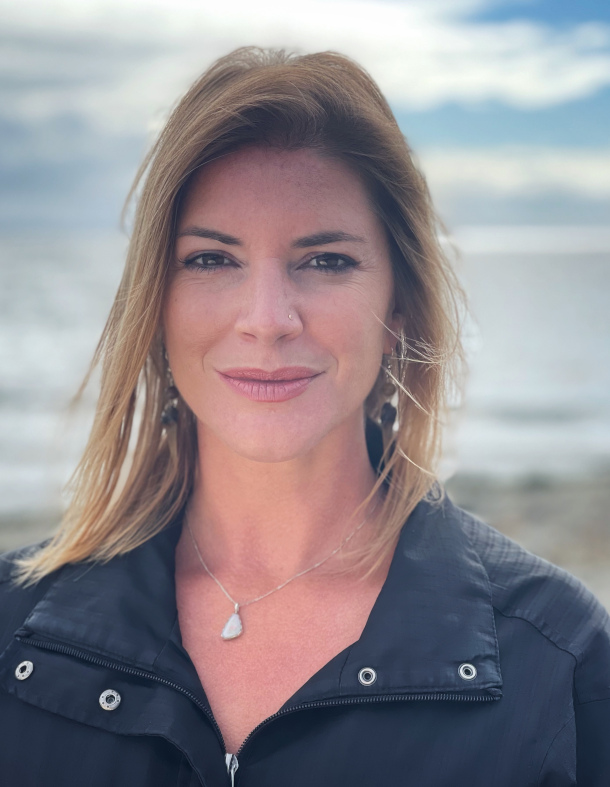
Teresa Tomassoni is an Oceans Correspondent with our media partner Inside Climate News. (Photo: Andrew Grenier)
TOMASSONI: I would say that these latest findings about there being more climate resilient reefs around the world than previously thought, offer an immense sense of hope that shouldn't be taken for granted, right? Coral reefs, as I said, are still in a dire situation. They are still going to continue to face prolonged, severe marine heat waves, including in the coming months as El Niño hits. We have this window of opportunity to protect what we have left. To go out and identify even more climate resilient reefs that we haven't identified already. To get stakeholders and governments and investors all involved in saying we want to protect these reefs, and we will provide the resources and personnel to do so. And with that, they're not only protecting and safeguarding what we have now, but really paving the way for generations ahead to have healthy reefs in the future.
DOERING: That’s Inside Climate News oceans correspondent Teresa Tomassoni, speaking with Living on Earth’s Aynsley O’Neill.
Related links:
- Inside Climate News | “As Global Warming Threatens Corals Worldwide, Woods Hole Scientists Search for ‘Super Reefs’ That Can Take the Heat”
- Inside Climate News | “More Coral Reefs May Survive Climate Change Than Scientists Once Thought”
- More from Teresa Tomassoni
[MUSIC: Coral Anemone]
Desert of Water

The San Andres Mountains in southern New Mexico feature ancient limestone layers from a Permian seaway. (Photo: © Mark Seth Lender)
BELTRAN: Corals evolved as many as half a billion years ago and they’re so resilient that they made it through the most severe mass extinction in Earth’s history, some 250 million years ago. At the San Andres National Wildlife Refuge in New Mexico, there’s an ancient seabed bearing evidence of this cataclysmic change. And while access to this refuge is restricted because it is surrounded by the White Sands Missile Range, Living on Earth Explorer in Residence Mark Seth Lender was able to visit and bring back this reflection.
"Desert of Water"
Permian Basin
San Andres National Wildlife Refuge
© 2026 Mark Seth Lender
All Rights Reserved

Fossil waves observed in the San Andres Mountains in southern New Mexico. (Photo: © Mark Seth Lender)
LENDER: Here is the memento: Fossil waves, proved in the sandstone where an ancient sea was shallow and the wind blew. You could say not fossil waves, but fossil wind. The impressions of wave crest and wave trough are sharp and clear. The wind was blowing hard, that day. Other than this nothing of record. No tracks. No shells. Just the sandstone itself, the color of cream before the butter is skimmed off and in one corner, obsidian – volcanic glass – poured in an overlay like thick black jam, rounded at the leading edge where it cooled just enough, to slow, and come to a stop. Well below all that limestone charcoal grey. Just like the waves devoid of life. Not a trace. This in the midst of all that water that should have meant Life. 250 million years ago… Waves that look so much what they are, markings left in the sand of any beach when the tide is out that all of us have seen, make that distant past close. Which is frightening. Frightening that such a catastrophe could occur. And that’s exactly what it was. Catastrophe. And as if to drive the point home, there all by itself, a fragment, the calcareous remains of a single crinoid stem. Like a long thin segmented exclamation point. And on close inspection, beside the stem is the calyx that sat on top like a flower of many long petals, though in reality a set of extended arms that fed in the flow of the tides. I picture them swaying, seining sustenance before it all crashed to an end. Only this one. Nothing more.

The desert now blooms in what was once a vast ancient sea. (Photo: © Mark Seth Lender)
The sea never came back. The land all around me now, desert. It rains little, in certain years not at all. And yet, the desert is teaming. Cactus of many shapes in flower, vibrant colors: vermillion, orange, pale violet; Paintbrush in crimson; Desert Primrose cadmium yellow and in white. The insects that come to feed, and black chinned hummingbirds, and hard to believe a Baltimore Oriole! Burrow of pocket mouse. Track of beetle. A garter snake, greenish tan, taking the warmth of the gravel road; the glow of his eyes, the fitted armor of his scales. How hopeful. In the dead center of a long-dry sea.
I never thought of Life as Paradox.
BELTRAN: That’s Living on Earth Explorer in Residence, Mark Seth Lender.
Related links:
- Learn more about Mark Seth Lender
- Learn more about the San Andres National Wildlife Refuge
[MUSIC: Sahara Bloom]
DOERING: Just ahead, Fat Marmot Week and more. Keep listening to Living on Earth!
ANNOUNCER: Support for Living on Earth comes from Hansjörg Wyss in honor of Rosamund Stone Zander. Celebrated painter, environmentalist, and author of The Art of Possibility, who inspired others to see the profound interconnectedness of all living things, and to act with courage and creativity on behalf of our planet. Support also comes from Sailors for the Sea and Oceana. Helping boaters race clean, sail green and protect the seas they love. More information at sailorsforthesea.org
[CUTAWAY MUSIC: Sahara Bloom]
Fat Marmot Week and 'OnlyMarms'

The winner of this year’s Fat Marmot Week was Dawn, pictured above, who not only won the popular vote but was also objectively the fattest marmot. (Photo: Daniel Blumstein)
BELTRAN: It’s Living on Earth, I’m Paloma Beltran.
DOERING: And I’m Jenni Doering.
You may have heard our coverage in recent years of Fat Bear Week, the annual contest where the public gets to vote on who they think is the fattest bear gorging on salmon in Katmai National Park and Preserve, Alaska. In other words, who’s best prepared for a long cold winter. But move over, grizzlies! Because recently the public was also asked to weigh in on the fattest yellow-bellied marmot at the Rocky Mountain Biological Laboratory in Colorado. The researchers of the Marmot Project decided to launch Fat Marmot Week this year to raise awareness of these large ground squirrels, and drum up support for sustaining their decades-long research project. The winner of this contest was a male named Dawn, who not only won the public’s heart but also objectively weighed in as the heaviest marmot in the bracket. Emily Renkey is a Graduate student at UCLA in the Dan Blumstein Lab, which runs the Marmot Project and is coming up with all kinds of creative ways to fundraise and spread a love of yellow-bellied marmots.
RENKEY: So Fat Marmot Week was inspired by Fat Bear Week. They are the OGs for sure. We had been talking about it as a lab for a few years. This year we finally had it come to fruition. And as our first year, we chose eight adult marmots, and they all have their own story. So, they made good competitors for the public.
DOERING: Tell us about the winner. I believe his name is Dawn.

Yellow-bellied marmots often like to lick rocks to ingest the salt on them. (Photo: Eric Phillips)
RENKEY: Yes, Dawn. He is about seven years old. He's kind of the familiar face when we ski in in April. So he's one of the first marmots up usually. And what he'll do is he'll go around and dig out all of his ladies. So he wakes up before them, and then he goes to the hibernaculas or the burrows that the females overwinter in, and he wakes all of them up to start socializing. And he is the father of maybe four litters this year, so he is an impressive father, and he's also a father who sticks around. So he is a very caring dad. We've seen him carry dried plants to his pups, but he also was especially huge this year. So in May, we were talking about how fat he was, and seeing him, it was kind of hard not to do a fat marmot week.
DOERING: I love that. What is his personality like?
RENKEY: In our description, we say Dawn is a very special boy who likes to eat rocks. Marmots really like salt, and sometimes I think they'll chew on rocks to get any of the minerals out of them. He feels very silly when you're watching him, sometimes. He is so large he does not have a neck. He will kind of saunter over to the traps that we will put bait into to try and catch and mark him and collect data, and he really likes to push them over. So he's gotten very good at problem solving when retrieving the bait. He is often seen tail flagging, which is a scent marking behavior that they use to kind of show their dominance, so you can often tell it's him even if he is not marked because he will helicopter his tail as he's walking around from burrow to burrow. So he's very fun to observe.
DOERING: So how do you actually weigh him and study him if he knocks over these traps?

Though the marmots end the season quite fat, they are fairly trim at the beginning of the summer. (Photo: Laura Green)
RENKEY: It is a constant battle. He is always outsmarting us. There are some others that outsmart us as well. We often say the marmots are willing participants in their own research, and he was choosing not to participate for the first part of the summer. But, eventually, he did go into the trap. They know what they're doing when they go into the trap. Sometimes they'll try and step over the plate that triggers the door. But maybe he got a little carried away eating the bait, so he eventually decided to weigh in, which means that he walked into a trap, and then we were able to weigh him from there. Yeah.
DOERING: And just how much weight did he gain?
RENKEY: Yeah, so we estimate his mass in both June and August. So in June he started at about 8.6 pounds, so a little under nine pounds, and then he ended the season... So August 15 is our other estimate, and he ended at about 13 pounds. So that's a pretty impressive number for a yellow-bellied marmot. That's a very large cat.
DOERING: Wow, that is a big cat. That's ultimately all pounds that will help him get through the next winter, right?
RENKEY: Absolutely, he needs all that fat to burn so he can stay warm until next spring.
DOERING: Yeah. I understand that you're a master's student with the Marmot Project, this long-standing research project about yellow-bellied marmots. Just how long has the project been running, and what types of research has the project done?
RENKEY: So I am a first-year master's student, yes, and this is my fourth season with the project. I was a volunteer for a few years, but the project has been running since 1962. So this is about our 65th year monitoring the marmot population at the Rocky Mountain Biological Lab. We have asked a lot of big questions, so a lot of what we've looked at in the past is sociality of marmots. We call marmots flexibly social, or yellow-bellied marmots flexibly social, and that basically means that they vary in their sociality, and it doesn't necessarily impact their survival. Some marmots live alone. Some marmots live in big groups with other marmots, and then some marmots will switch their strategy where they'll live alone one year and then with a bigger group the next year. We also have looked at cumulative adversity in marmots, which basically just means how marmots who experience multiple hardships when they're really young are less likely to survive later in life. So we know that's the case with people, right? If you've experienced a lot of hardship, it can really impact you later in life, and we know now that's true for wild animals as well,. And then we have a paper coming out soon that I'm working on with another current grad student that actually looks at how that cumulative adversity impacts their behavior as well. So not only does it change their survival, but it also changes how they behave as adults.

By August, the yellow-bellied marmots are profoundly rotund and adorable. (Photo: Brian Booher)
DOERING: So you guys have this really long-running project studying yellow-bellied marmots and Fat Marmot Week ended up raising a chunk of money for the project, partially through OnlyFans, which might be surprising to hear. That's a site usually reserved for adult content. Can you talk to me about the OnlyMarms account, how that got started?
RENKEY: Absolutely. The head of our lab, Dan, has been struggling with funding for a few years now, and so one day he was sitting waiting for the marmots to emerge, and he had watched the show Margo's Got Money Troubles the night before with his wife, which is a show about a woman who makes an OnlyFans account to raise money, and she makes a lot of money. And so, I think he kind of was like, "Well, marmots have money troubles, also. Why not start an OnlyFans account for our marmots?" But yeah, we've been using it since. We have about 2600 subscribers at this point. We've made a few $1,000, which is awesome. So it's been really exciting to see the OnlyFans response.
RENKEY: Yeah, so I understand that the OnlyMarms account led to the creation of a meme coin, a type of cryptocurrency. How does that work, and how is it benefiting the Marmot Project?

In order to gain all of that weight, the marmots eat large amounts of food, mostly plants. (Photo: Daniel Blumstein)
RENKEY: Honestly, I feel like it just keeps getting more absurd. These are all things that I did not think I would be talking about in my master's degree, but there are a lot of creative people out there. And the meme coin was by no means our idea. In fact, I did not think that it was real the first few times people reached out to me about it. But a community that exchanges meme coin, which is this form of cryptocurrency based on virality, basically came to us and said they had made this meme coin and that we could claim the meme coin and that would allow us to collect fees when people buy and sell it. And so, I think the legitimacy of us claiming the coin actually led a lot more people to invest in it, and they've made this whole meme coin for good movement, where there's a lot of people I think interested in trading this coin because it helps our project. And so, we've raised over $140,000 at this point in transaction fees, which is a crazy amount of money. What I will say is, it is not the community we expected to rally behind us, but we are very grateful for them, and it has been a really cool opportunity to kind of see people who maybe don't typically engage with wildlife biology really rally behind us.
DOERING: You know, Emily, yellow-bellied marmots– they're not endangered, which is great to hear, when you know these days we hear about so many animals in trouble. They're of least concern in terms of conservation. So why study them if there are so many other species in a lot greater danger of extinction?
RENKEY: Yeah, that's a great question. Working with a population that is of least concern allows us to ask big questions using our marmots as a model system. A model system just means that yellow-bellied marmots share a lot in common with other species. So they're mammals. They hibernate. They're flexibly social, so we can ask a lot of different questions about sociality. And they're relatively easy to study. They live long for a rodent, but not as long as an elephant. So we can understand these shifts in population, right? We're like seeing multiple generations over time. So all of these things allow us to use the marmots to ask these big questions that then we can extrapolate to other populations. And then, in addition to that, they directly help with management of other species.
DOERING: So what's an example of how the marmot model can be used to help other species?
RENKEY: So the Vancouver Island marmot is like a very closely related example of an endangered population that our work can hopefully help inform the management of. So we have done all of this work to understand marmot behavior and marmot survival. And then, we can take that and say, okay, can the Vancouver Island Marmot Recovery Project, which is working with this population of a few dozen animals, so their population almost went extinct. They had just a handful of animals left, and they have taken some of them into captivity, and they can use, in addition to all of their hard work and research that they've done on the Vancouver Island marmot, they have this plethora of knowledge from our study system to inform the recovery plan for the species.
DOERING: So it sounds like yellow-bellied marmots— they're doing okay. At the same time, I mean, our environment is rapidly changing, and Colorado has seen its fair share of wildfires and warming and melting. How is the marmots' environment changing, and and how might that impact them in the future?

Emily Renkey is a graduate student at the University of California, Los Angeles, in the Dan Blumstein Lab. (Photo: Scott Harrison)
RENKEY: So usually when we arrive in April, we ski in to our field station, and this year we walked on bare ground the entire way, which was really crazy. The past winter there was no snow in this part of Colorado, and that led to a huge die-off in our population. We actually ended the fall of last year with 160 animals, approximately, and then we saw about 60 emerge this year. That is in a large part due to the lack of snow cover. The snow acts as this insulating blanket for the marmots, so they're not exposed to dramatic changes in temperature while they're hibernating, versus when there's no snow, the temperature fluctuates pretty dramatically, so that will lead the marmots to burn more fat than they otherwise would to stay warm. And so we had this huge die-off because so many marmots were burning more fat than they typically would have to, and then a lot of them died before they could emerge and start eating again. So I think there are still a lot of questions around how exactly the climate is impacting the marmots, but we have now some examples of what could happen with these more dramatic changes in climate that we're experiencing.
DOERING: What's it like for you working with these animals?
RENKEY: It is very fun to work with the marmots. I think I have a lot of respect for the marmots. You know, they're very clever. Some of them are really good at problem solving. We care a lot about them because they make our research possible. So I owe it all to the marmots.
DOERING: Emily Renkey is a graduate student at the University of California, Los Angeles, in the Dan Blumstein Lab. Thank you so much, Emily.
RENKEY: Thank you so much for having me.
Related links:
- See more images of the Fat Marmot Week contestants
- Explore yellow-bellied marmot research
- Learn more about the meme coin benefitting the Marmot Project, including how you can participate
- Subscribe to the OnlyMarms OnlyFans account
[MUSIC: Front Range Strum]
BELTRAN: Next time on Living on Earth, The power of trees in ecology, history and as metaphors.
MOOR: Trees can really inform our understanding of how to grow old because trees grow old beautifully. They’re always growing throughout their lives and they're always shedding. They're always dropping the limbs that don't work. And so I think studying trees is a way that we can learn to grow old gracefully and creatively and to stay branchy throughout our lives, this is something that neuroscientists will tell you is one of the most important things about growing old in a healthy way is that you got to stay branchy, you got to try new things, you have to take risks. You can't just get winnowed away into these little ruts.
BELTRAN: What we can learn from trees, next time on Living on Earth.
[MUSIC: Front Range Strum]
BELTRAN: Living on Earth is produced by the World Media Foundation. Our crew includes Naomi Arenberg, Abby Edgecumbe, Swayam Gagneja, Mark Kausch, Mark Seth Lender, Don Lyman, Ashanti Mclean, Nhung Nguyen, Aynsley O’Neill, Sophia Pandelidis, Jake Rego, Andrew Skerritt, Bella Smith, and El Wilson. We bid a fond farewell this week to intern Mia DiLorenzo.
DOERING: Tom Tiger engineered our show. Allison Lirish Dean composed our themes. Special thanks this week to San Andres National Wildlife Refuge. You can hear us anytime at L-O-E dot org, Apple Podcasts and YouTube Music, and like us please, on our Facebook page, Living on Earth. Find us on Instagram, Threads and BlueSky at living on earth radio. And we always welcome your feedback at comments at loe.org.
Steve Curwood is our Executive Producer. I’m Jenni Doering.
BELTRAN: And I’m Paloma Beltran. Thanks for listening!
ANNOUNCER: Funding for Living on Earth comes from you, our listeners, and from the University of Massachusetts, Boston, in association with its School for the Environment, developing the next generation of environmental leaders. And from the Grantham Foundation for the protection of the environment, supporting strategic communications and collaboration in solving the world’s most pressing environmental problems.
ANNOUNCER 2: PRX.
Living on Earth wants to hear from you!
Living on Earth
62 Calef Highway, Suite 212
Lee, NH 03861
Telephone: 617-287-4121
E-mail: comments@loe.org
Newsletter [Click here]
Donate to Living on Earth!
Living on Earth is an independent media program and relies entirely on contributions from listeners and institutions supporting public service. Please donate now to preserve an independent environmental voice.
NewsletterLiving on Earth offers a weekly delivery of the show's rundown to your mailbox. Sign up for our newsletter today!
 Sailors For The Sea: Be the change you want to sea.
 The Grantham Foundation for the Protection of the Environment: Committed to protecting and improving the health of the global environment.
 Contribute to Living on Earth and receive, as our gift to you, an archival print of one of Mark Seth Lender's extraordinary wildlife photographs. Follow the link to see Mark's current collection of photographs.
 Buy a signed copy of Mark Seth Lender's book Smeagull the Seagull & support Living on Earth
© Copyright World Media Foundation. All Rights Reserved
Home | Contact | RSS | Donate | Newsletter