

Climate-Resilient “Super Reefs”
Air Date: Week of September 11, 2026

A number of coral reefs show signs of being heat-resilient, which some scientists are saying inspires hope for safeguarding one of the most precarious ecosystems on the planet. One such scientist, Anne Cohen, above, aims to create a corridor of marine protected areas of such “super reefs” throughout the Marshall Islands, Kiribati and Tuvalu. (Photo: Tim Briggs)
As global sea temperatures rise due to climate change, coral reefs around the world are struggling through mass bleaching events. But new research has identified nearly one-third of the world’s coral reefs as climate resilient, three times more than was previously estimated. Teresa Tomassoni is an oceans correspondent with our media partner Inside Climate News who took a reporting trip to the Marshall Islands to cover these “super reefs”, and she spoke with Living on Earth’s Aynsley O’Neill.
Transcript
DOERING: As global sea temperatures rise due to climate change, coral reefs around the world are struggling through mass bleaching events. But the ocean is looking a lot more colorful than scientists previously thought. New research has identified nearly one-third of the world’s coral reefs as climate resilient. That’s three times more than was previously estimated. Teresa Tomassoni is an oceans correspondent with our media partner Inside Climate News who took a reporting trip to the Marshall Islands to cover these “super reefs”. Teresa spoke with Living on Earth’s Aynsley O’Neill.
O'NEILL: So let's set the stage here. On the whole, how are coral reefs faring in the modern day?
TOMASSONI: Coral reefs around the world are experiencing a severe crisis due to rising global temperatures. Around the world, we see reefs that are so stressed that they bleach, they turn white. Just in the last three years, since 2023, more than 80% of coral reefs globally have experienced bleaching, and while some have recovered, most have not.
O'NEILL: Teresa, you're an oceans correspondent, so I'm sure you love the oceans, just generally speaking. But for people whose familiarity with a coral reef might be limited to a Finding Nemo movie, why are coral reefs so important to protect?

Anne Cohen, (left, Woods Hole Oceanographic Institution) and AJ Alike (right, Marshall Islands Conservation Society) collect samples from tabletop corals near Majuro, capital of the Marshall Islands. These corals, which were showing signs of being heat-resilient, will have their samples taken back to a laboratory for further study. (Photo: Teresa Tomassoni)
TOMASSONI: Healthy coral reefs provide habitat, food, nursery, and feeding grounds for up to a quarter of all marine species. We're talking about fish, sea turtles, sharks, and numerous other species. Hundreds of millions of people also depend on these reefs around the world for their livelihoods and to put food on the table. Coral reefs also act as incredible natural barriers against waves, storms, and sea level rise.
O'NEILL: But we're here now to talk about climate resilient reefs. What does that term mean?
TOMASSONI: So these are reefs that are either able to resist the heat altogether, almost as if they're immune, or recover after marine heat waves.
O'NEILL: And so, what are some of the factors that are at play here? You know, why are some of these reefs thriving while their neighbors are bleaching? What's going on?
TOMASSONI: That's a really great question that many scientists who are focused on these climate resilient reefs are still trying to find the answers to. There are coral reefs, for instance, that have survived for generations in hotter than normal temperatures. So maybe they've developed sort of genetic adaptations to hotter temperatures. There are other coral reefs that are naturally shaded or shielded from heat by cooler ocean currents, for example, but really we're at a time where scientists are studying individual coral colonies and entire reefs to find more specific answers. What is it about this genetic makeup for certain corals that allows them to be so resistant or resilient?
O'NEILL: And now, of course, just because a reef doesn't succumb to bleaching, that doesn't mean that it's impervious to all harm. So, what kind of threats are climate resilient reefs seeing?
TOMASSONI: This is a really important and increasingly prominent topic of discussion amongst coral scientists. As you said, coral reefs may be resistant or resilient to higher temperatures, but that doesn't make them immune to fishing, to dredging, to unregulated tourism, right? Corals are very much impacted by sewage, by agricultural runoff, by overfishing, by dropping anchors on the reef, etc. Just recently, a study came out identifying these climate resilient reefs around the world. It says there's really about three times as many coral reefs that are resistant to heat than previously thought, but only 28% of those are actually protected. So that leaves the majority of climate resilient reefs really at risk of being destroyed if we don't actively take effort to protect them.
O'NEILL: Now a few years back, Living on Earth did a story on some coral reefs in the Persian Gulf that were showing signs of resistance to warming waters. What do we know about the possible global range of a climate resilient reef?
TOMASSONI: From that study that I just mentioned, it's called the “50 Reefs Plus” study, scientists have identified many of these climate resilient reefs really across the globe, but the vast majority of those are concentrated in five countries, including Australia, Bahamas, Cuba, Indonesia, and the Philippines.
O'NEILL: And Teresa, you were on location in the Marshall Islands while you were investigating these reefs. So tell me a little about your time there.
TOMASSONI: Earlier this spring, I traveled to the Marshall Islands with Dr. Anne Cohen. She's a coral scientist at the Woods Hole Oceanographic Institution. She's been studying coral reefs for 30 years and really one of those pioneers in studying climate resilient reefs. So I traveled with her specifically to go check out some of these reefs that are surviving, even while reefs around them are bleaching. It really was an incredible experience. I had two weeks of going out on the boat with Dr. Cohen and her team, and being in the water with her, snorkeling beside her, looking at these reefs that were healthy, they were colorful, they were abundant. I kept thinking and feeling as if I were looking at these fields of wildflowers, but underwater, all these pastel colors teeming with juvenile fish everywhere, all different shapes and sizes. It was a completely different scene from those that I am accustomed to seeing in the Caribbean, where I'm based a lot of my time. In the Caribbean, reefs have been decimated by coral bleaching and disease for decades. So for me, this was personally an emotional experience, and even for Dr. Cohen, at one point, I quote her saying this in the article. She says, "I feel like Alice from Alice in Wonderland. It's magical down here.” And truly, it felt like we were witnessing something special because healthy reefs cannot be taken for granted in this day and age.
O'NEILL: So, Teresa, what kind of conservation efforts are you seeing for these reefs?

In some cases, even though a neighboring coral colony has experienced a bleaching event, nearby corals can still thrive. (Photo: Tim Briggs)
TOMASSONI: So around the world, some of us might have heard of these wildlife corridors, these protected areas of land that cross borders, being established to allow for elephants, lions, and other migratory species to cross borders and move between habitats to mate, to feed, to get water, etc. And increasingly, marine scientists have started to apply that strategy to protect migratory pathways for marine megafauna, such as whales, sharks, sea turtles. Now, many people don't even think of corals as perhaps animals, but they are living animals, and while they are stationary for much of their lives in the early stages of their life, when they're larva or when corals spawn and the eggs and sperm are in the water, all of that is traveling, mixing, and moving in ocean currents. So what Dr. Cohen wants to do, she wants to establish what she calls a super reef blue corridor, a network of marine protected areas; those areas that are designated to protect these climate resilient reefs, which she refers to as super reefs, and make sure those protected areas are specifically connected by ocean currents, which would allow the eggs and spawn of heat tolerant corals or the larva that they produce to move through these ocean currents and basically repopulate other reefs in the region.
O'NEILL: Now, how is it that these climate resilient reefs can help other reefs, those that are struggling in these warming waters?
TOMASSONI: Finding these climate resilient reefs is not only important so that we can protect them where they are, right? Scientists are now starting to use corals from those reefs to restore other ones that have been degraded already by bleaching, by disease, by fishing, etc. So they're taking fragments of these corals found along those climate resilient reefs, and then replanting them in underwater coral nurseries, kind of like underwater gardens, and then when those fragments get big enough, they then outplant those fragments onto the natural reefs that have been degraded, with the hopes of restoring them. This is a really new approach, so up until recently, restoration work hasn't necessarily been focused on using these scientifically proven heat-resistant corals, and unfortunately, this has resulted in many coral nurseries bleaching and dying because the same corals that they were using in the nurseries were the ones that were susceptible out on natural reefs to heat. So there's a real push now to prioritize the cultivation of climate resilient corals for future restoration purposes.

Woods Hole Oceanographic Institution is studying heat-resilient reefs near Majuro, in the Marshall Islands. (Photo: Tim Briggs)
O'NEILL: So this is you know, concentrated in the Marshall Islands, but what about neighboring nations? You know, we're talking about these ocean currents; they could be pretty far-reaching. So, how is this working in the sort of local international community?
TOMASSONI: What Dr. Cohen is proposing is establishing that super reef corridor amongst three different island nations, the Marshall Islands, and two other neighboring island nations to the south, Tuvalu and Kiribati. So she has proposed just recently to the Marshall Islands that they really take the lead in reaching out to their neighboring island nations and saying, "Let's produce this. Let's create the first super reef blue corridor." It's still very much in its beginning stages. It will require a lot of negotiations, meetings, consultations, but it has started.
O'NEILL: So many of these must have you know livelihoods, economies that are based on fishing and the ocean. So how do we balance the needs of the people there with the needs of the ocean there?
TOMASSONI: This is a really important question. There's no effective protection without community buy-in. We have seen marine protected areas established in all different places and just become sort of what we call paper parks-they're protected on paper, but not protected in reality. The only way to effectively protect critical marine habitats, including these heat-tolerant reefs, is by getting that community support, that political buy-in, that financial investment.
O'NEILL: And so, Teresa, this year, 2026, we're looking at a super El Niño event. You know, the El Niño is where parts of the Pacific Ocean see a hotter than average sea surface temperature, and a super El Niño means that that average sea surface temperature is two degrees higher than usual. This, of course, could be very dangerous for coral reefs, but I'm curious about what you might know on these climate-resistant reefs, you know, how are they reacting to something like this?
TOMASSONI: I would say scientists are really worried about the potential impacts of this super El Niño. We already know from past El Niño events that these higher than average sea surface temperatures have really bleached and wiped out vast areas of coral reef, including in the Marshall Islands. Dr. Cohen says she wants to go out and see what happens to these climate resilient reefs. That's part of the research. It's part of the research to see just how resilient some reefs are. Do they have a temperature threshold, or will they continue to show signs of tolerance or capabilities of recovering?
O'NEILL: So, how crucial is this time for reef conservation?
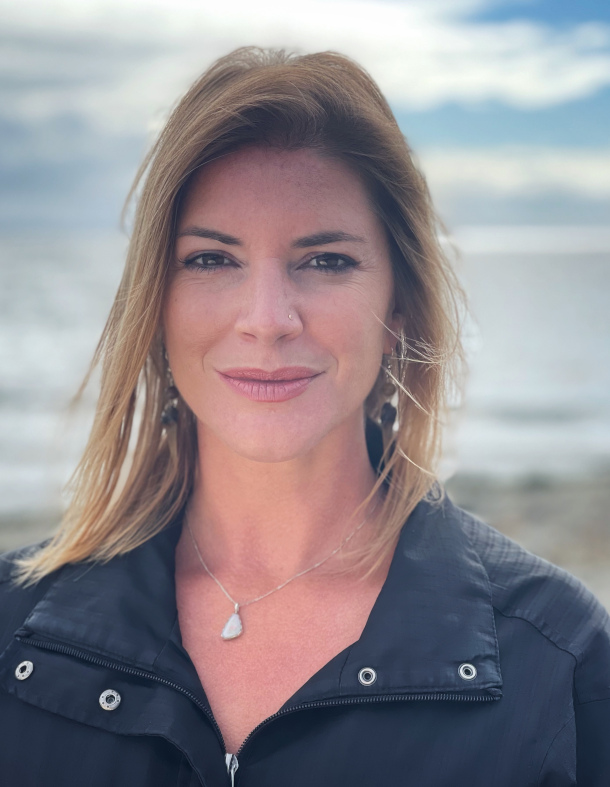
Teresa Tomassoni is an Oceans Correspondent with our media partner Inside Climate News. (Photo: Andrew Grenier)
TOMASSONI: I would say that these latest findings about there being more climate resilient reefs around the world than previously thought, offer an immense sense of hope that shouldn't be taken for granted, right? Coral reefs, as I said, are still in a dire situation. They are still going to continue to face prolonged, severe marine heat waves, including in the coming months as El Niño hits. We have this window of opportunity to protect what we have left. To go out and identify even more climate resilient reefs that we haven't identified already. To get stakeholders and governments and investors all involved in saying we want to protect these reefs, and we will provide the resources and personnel to do so. And with that, they're not only protecting and safeguarding what we have now, but really paving the way for generations ahead to have healthy reefs in the future.
DOERING: That’s Inside Climate News oceans correspondent Teresa Tomassoni, speaking with Living on Earth’s Aynsley O’Neill.
Links
Inside Climate News | “More Coral Reefs May Survive Climate Change Than Scientists Once Thought”
Living on Earth wants to hear from you!
Living on Earth
62 Calef Highway, Suite 212
Lee, NH 03861
Telephone: 617-287-4121
E-mail: comments@loe.org
Newsletter [Click here]
Donate to Living on Earth!
Living on Earth is an independent media program and relies entirely on contributions from listeners and institutions supporting public service. Please donate now to preserve an independent environmental voice.
NewsletterLiving on Earth offers a weekly delivery of the show's rundown to your mailbox. Sign up for our newsletter today!
 Sailors For The Sea: Be the change you want to sea.
 The Grantham Foundation for the Protection of the Environment: Committed to protecting and improving the health of the global environment.
 Contribute to Living on Earth and receive, as our gift to you, an archival print of one of Mark Seth Lender's extraordinary wildlife photographs. Follow the link to see Mark's current collection of photographs.
 Buy a signed copy of Mark Seth Lender's book Smeagull the Seagull & support Living on Earth
© Copyright World Media Foundation. All Rights Reserved
Home | Contact | RSS | Donate | Newsletter