

Desert of Water
Air Date: Week of September 11, 2026

The San Andres Mountains in southern New Mexico feature ancient limestone layers from a Permian seaway. (Photo: © Mark Seth Lender)
At the San Andres National Wildlife Refuge in New Mexico, rock layers bear evidence of the most severe mass extinction in Earth history, some 250 million years ago. And while access to this refuge is restricted because it is surrounded by the White Sands Missile Range, Living on Earth Explorer in Residence Mark Seth Lender was able to visit and bring back this reflection on how today’s desert ecosystem thrives in what was once an ancient sea.
Transcript
BELTRAN: Corals evolved as many as half a billion years ago and they’re so resilient that they made it through the most severe mass extinction in Earth’s history, some 250 million years ago. At the San Andres National Wildlife Refuge in New Mexico, there’s an ancient seabed bearing evidence of this cataclysmic change. And while access to this refuge is restricted because it is surrounded by the White Sands Missile Range, Living on Earth Explorer in Residence Mark Seth Lender was able to visit and bring back this reflection.
"Desert of Water"
Permian Basin
San Andres National Wildlife Refuge
© 2026 Mark Seth Lender
All Rights Reserved

Fossil waves observed in the San Andres Mountains in southern New Mexico. (Photo: © Mark Seth Lender)
LENDER: Here is the memento: Fossil waves, proved in the sandstone where an ancient sea was shallow and the wind blew. You could say not fossil waves, but fossil wind. The impressions of wave crest and wave trough are sharp and clear. The wind was blowing hard, that day. Other than this nothing of record. No tracks. No shells. Just the sandstone itself, the color of cream before the butter is skimmed off and in one corner, obsidian – volcanic glass – poured in an overlay like thick black jam, rounded at the leading edge where it cooled just enough, to slow, and come to a stop. Well below all that limestone charcoal grey. Just like the waves devoid of life. Not a trace. This in the midst of all that water that should have meant Life. 250 million years ago… Waves that look so much what they are, markings left in the sand of any beach when the tide is out that all of us have seen, make that distant past close. Which is frightening. Frightening that such a catastrophe could occur. And that’s exactly what it was. Catastrophe. And as if to drive the point home, there all by itself, a fragment, the calcareous remains of a single crinoid stem. Like a long thin segmented exclamation point. And on close inspection, beside the stem is the calyx that sat on top like a flower of many long petals, though in reality a set of extended arms that fed in the flow of the tides. I picture them swaying, seining sustenance before it all crashed to an end. Only this one. Nothing more.

The desert now blooms in what was once a vast ancient sea. (Photo: © Mark Seth Lender)
The sea never came back. The land all around me now, desert. It rains little, in certain years not at all. And yet, the desert is teaming. Cactus of many shapes in flower, vibrant colors: vermillion, orange, pale violet; Paintbrush in crimson; Desert Primrose cadmium yellow and in white. The insects that come to feed, and black chinned hummingbirds, and hard to believe a Baltimore Oriole! Burrow of pocket mouse. Track of beetle. A garter snake, greenish tan, taking the warmth of the gravel road; the glow of his eyes, the fitted armor of his scales. How hopeful. In the dead center of a long-dry sea.
I never thought of Life as Paradox.
BELTRAN: That’s Living on Earth Explorer in Residence, Mark Seth Lender.
Links
Living on Earth wants to hear from you!
Living on Earth
62 Calef Highway, Suite 212
Lee, NH 03861
Telephone: 617-287-4121
E-mail: comments@loe.org
Newsletter [Click here]
Donate to Living on Earth!
Living on Earth is an independent media program and relies entirely on contributions from listeners and institutions supporting public service. Please donate now to preserve an independent environmental voice.
NewsletterLiving on Earth offers a weekly delivery of the show's rundown to your mailbox. Sign up for our newsletter today!
 Sailors For The Sea: Be the change you want to sea.
 The Grantham Foundation for the Protection of the Environment: Committed to protecting and improving the health of the global environment.
 Contribute to Living on Earth and receive, as our gift to you, an archival print of one of Mark Seth Lender's extraordinary wildlife photographs. Follow the link to see Mark's current collection of photographs.
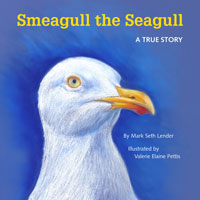 Buy a signed copy of Mark Seth Lender's book Smeagull the Seagull & support Living on Earth
© Copyright World Media Foundation. All Rights Reserved
Home | Contact | RSS | Donate | Newsletter