

Supporting Mass Transit
Air Date: Week of February 27, 2009
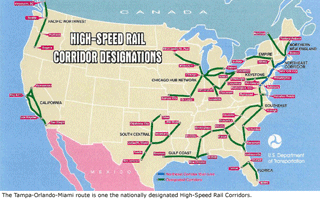
Eleven federally designated high-speed rail corridors have been in the works for years, but funding for the projects was not available until now. (Courtesy of the U.S. House of Representatives)
Americans are riding public transportation in record numbers yet municipalities across the country are struggling to keep up with basic services. The new economic stimulus package will give a much-needed financial boost to public transit systems. Host Bruce Gellerman talks with William Millar, president of the American Public Transportation Association, about what the federal money will mean for public transit.
Transcript
GELLERMAN: From the Jennifer and Ted Stanley Studios in Somerville, Massachusetts - this is Living on Earth. I’m Bruce Gellerman, in for Steve Curwood.
Ridership on the nation’s mass transit systems; subways, buses and light rails, is at an all time high. But while the mass is up – transit, the number of stops and services is dropping dramatically, even while ticket prices are taking a hike. The federal stimulus package will infuse a massive 16 billion dollars into public transit, half of that for high speed rails.
And William Millar, President of the American Public Transportation Association says, the money is arriving right on time.
MILLAR: Well we like to say it’s the best of times and worst of times, as that famous writer once said. In – since that – in 2007 we had reached a modern high of about 10.3 billion times that year Americans used public transit, only to be eclipsed in 2008. Looks like there’ll be at least five percent higher than that.
GELLERMAN: The costs are spiraling out of control. I was looking at St. Louis and they’re gonna have to eliminate 2000 bus stops because they just can’t afford to run buses there.
MILLAR: In most cases the revenue is not able to keep up with the cost. While people think of paying their fare let’s say when they get on the subway line, that fare is designed to only cover perhaps a third, maybe half the cost of the system. The rest comes from a combination of federal, state and local funds, and those funds come from the very sources that we’re seeing the down turn in the economy. So, sales taxes is a frequent way that it happens or property taxes, and, of course, property values are falling throughout the country. Sometimes gasoline taxes, but, of course, we’re using less gasoline than we did. So at the very time we ought to be increasing our public transit use to meet the new demand, we’re finding that many transit systems around the country are having to cut back, having to raise fares, because, of course, we have to balance our budgets just like everyone else does.
GELLERMAN: How do other countries fund their public transportation systems?
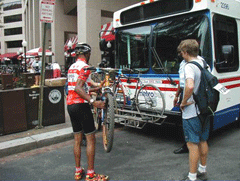
Money from the economic stimulus plan will make more fuel-efficient buses
available to many cities. (The U.S. Department of Transportation Federal Highway Administration.)
MILLAR: In many parts of the world, the national government sets aside a budget for public transportation. You know, in many parts of the developed world the price of a gallon of gasoline is very heavily taxed. Two, three four dollars a gallon is not uncommon. Course in the U.S. the federal tax on gasoline is 18 cents, and the average among the states is maybe an additional 25 or 30 cents on top of that. So we make it very cheap to drive in this country, and, as a result, we don’t raise enough money to keep our roads and our bridges up to snuff. And we don’t raise enough money to fund our public transit systems as well as they should be either.
GELLERMAN: So this 8.4 billion dollars in stimulus money for mass transit, is that going for new stuff or is it going to help commuters pay for their ride?
MILLAR: For the most part it will not be going for what we would call operating expenses which is what the fares help offset. It will be going to replace old buses with new energy efficient buses, which of course, will save money in the long run, as well as be good for the environment and our energy conservation efforts. It will also be used to expand some systems where that’s possible, perhaps new streetcar systems, new bus systems. So it will go for many good things, but unfortunately the Congress did not see fit to make the money available to help cover normal operating expenses.
GELLERMAN: So 8.4 billion dollars for mass transit. Eight billion dollars more for high-speed rail. Where is that going?
Eleven federally designated high-speed rail corridors have been in the works for years, but funding for the projects was not available until now. (Courtesy of the U.S. House of Representatives)
MILLAR: Well, a number of years ago, the Congress designated eleven different corridors around the country for high-speed rail. Some are well known, such as the Northeast Corridor between Washington and Boston, say. Some are less well known, the Cascadia Corridor up in the Great Northwest for example. This money will allow for major improvements in some of those corridors. I certainly predict that if we’re able to try high-speed rail in at least a couple of the corridors and more and more Americans see the advantage of high-speed rail that that will start a revolution akin to what we did with the interstate highway system way back in the 50s when people began to sample what a really good road could mean. Well the same thing with public transit and with intercity rail, high speed rail. Certainly that’s one of the great things about the stimulus package, you can not only create many, many, many thousands of jobs, but we can also move our infrastructure ahead and modernize it, and I think we get a real two-fer when we’re able to do that.
GELLERMAN: Mass transit is good for the air quality – can you quantify that, though?
MILLAR: The transit use that we already have in America saves over 37 million metric tons of carbon dioxide, for example, every year. That’s as if every household in Washington D.C., New York City, Atlanta, Denver and Los Angeles combined suddenly could give up electricity, for example.
GELLERMAN: Well thank you very much. Really appreciate it Mr. Millar.
MILLAR: It was my pleasure to be with you today.
GELLERMAN: William Millar is president of the American Public Transportation Association.
Links
Living on Earth wants to hear from you!
Living on Earth
62 Calef Highway, Suite 212
Lee, NH 03861
Telephone: 617-287-4121
E-mail: comments@loe.org
Newsletter [Click here]
Donate to Living on Earth!
Living on Earth is an independent media program and relies entirely on contributions from listeners and institutions supporting public service. Please donate now to preserve an independent environmental voice.
NewsletterLiving on Earth offers a weekly delivery of the show's rundown to your mailbox. Sign up for our newsletter today!
 Sailors For The Sea: Be the change you want to sea.
 The Grantham Foundation for the Protection of the Environment: Committed to protecting and improving the health of the global environment.
 Contribute to Living on Earth and receive, as our gift to you, an archival print of one of Mark Seth Lender's extraordinary wildlife photographs. Follow the link to see Mark's current collection of photographs.
 Buy a signed copy of Mark Seth Lender's book Smeagull the Seagull & support Living on Earth
© Copyright World Media Foundation. All Rights Reserved
Home | Contact | RSS | Donate | Newsletter