

Why Tropical Forests Fall
Air Date: Week of January 2, 2009
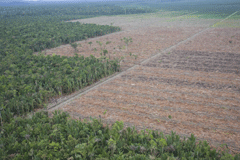
Forests cleared to make way for palm oil plantations in Papua Province, Indonesia. (Photo: Courtesy of Greenpeace Southeast Asia)
Tropical forest is disappearing in Africa’s Congo Basin, in Southeast Asia, and in the Amazon. The reasons for the bulldozing and burning of trees vary by region. Living on Earth’s Ingrid Lobet has this primer.
Transcript
CURWOOD: Just ahead – Tropical forests and climate disruption. Keep listening to Living on Earth!
CURWOOD: It’s Living on Earth, I’m Steve Curwood.
Tropical forests cover about seven percent of the Earth, but the widespread cutting and burning of these forests causes some twenty percent of all global warming gas emissions worldwide. So experts in deforestation, rural development, and climate are all working together to make sure that the next international treaty on climate includes measures to slow the destruction and degradation of forests. Living on Earth's Ingrid Lobet takes a look now at the driving forces of tropical deforestation.
LOBET: Even some veteran environmentalists have been startled to realize how much the cutting and burning of tropical forests is responsible for global warming.
MAATHAI: For me, that was amazing.
LOBET: That's Nobel Laureate Wangari Maathai. The tree-planting movement founder spoke at recent climate change talks in Poznan, Poland.
MAATHAI: Because quite often, we in the developing world, we say we are not contributing much to greenhouse gases. But obviously if you take into account deforestation, land degradation, the fact that the majority of people use wood for lighting or cooking, then obviously they are releasing a lot of greenhouse gases into the atmosphere, far more than I'm sure people are aware of.
LOBET: In Africa, Maathai says, it's often villagers who cut the forest to plant crops.
MAATHAI: And because communities do not have an understanding of how to use the land sustainably, prevent soil erosion, when you fly over Africa, you see a lot of that slash and burn, especially within the Congo Basin forest.
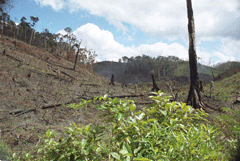
Deforestation. (Photo Jonathan Talbot, World Resources Institute)
LOBET: The Congo Basin forest is second in size only to the Amazon. So preserving it is among the highest priorities of tropical forest experts. Dennis Garrity directs the World Agroforestry Centre or ICRAF, a group with deep tree-planting roots in Africa.
GARRITY: Agriculture is largely responsible for deforestation. And some estimates say that 80 percent of forest conversion is directly related to producing more food.
LOBET: Besides food, another major cause of deforestation in Africa's Congo Basin, says Garrity, is the production of furniture grade wood.
GARRITY: The world is going to have to produce that enormous quantity of wood supply in other ways. Otherwise the sheer demand for wood will swamp any attempts to forestall deforestation.
LOBET: Experts say much of each tall tree cut for furniture wood is left on the ground. On a recent tour of one sustainable timber operation, Wangari Maathai says managers told her their machinery only allowed them to take advantage of 35 percent of the wood they fell.
MAATHAI: The rest is actually taken by local communities and converted into charcoal. That, to me, is just as good as putting the forest on fire.
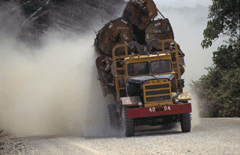
Borneo. (Photo: Claude Barutel)
That's in Africa. But the reasons for deforestation differ sharply across the tropics. Lars Lovold, director of Rainforest Foundation Norway, has worked with indigenous people in forests for 30 years.
LOVOLD: We have all heard from official sources, blaming deforestation on the poor. It is not true. It is the large-scale investments, in oil palms for Asia, in cattle for Central and South America, industrial agriculture taking over from cattle in South America, timber plantations on many continents that really drives deforestation on a large scale.
LOBET: The Brazilian rainforest is being cut largely for two reasons: to graze cattle for beef for domestic and European markets and to grow soybeans for soy oil, soy products and biofuels. Ken Chomitz is senior advisor at the World Bank's Independent Evaluation Group. Like Lovold, he says evidence suggests large-scale players are a big part of the story.
CHOMITZ: Much of the world's tropical deforestation is concentrated in a few areas in the Brazilian frontier and also in Indonesia. And what we know about Brazil suggests that a lot of the clearing in Brazil is done in large chunks: we’re talking a thousand, two thousand acres at a time, which is far too big to be accomplished by anyone but a large industrial interest with bulldozers and machinery.
Forests cleared to make way for palm oil plantations in Papua Province, Indonesia. (Photo: Courtesy of Greenpeace Southeast Asia)
LOBET: In Indonesia, the other major site of tropical tree-razing, the bulldozers are paid for with profits from palm oil, squeezed from the fruit and seeds of the oil palm, grown on plantations.
CHOMITZ: You'll find palm oil in a lot of the processed foods you eat.
LOBET: And in cosmetics, as well. Environmental groups say even people's efforts to make positive changes, for example: avoid transfats… or use biodiesel, are turning forests into palm plantations.
Not only do the reasons for deforestation differ by region, but professionals collaborating on the issue also tend to view it through the lens of their training: as economists, agronomists, environmentalists, and government officials. Here's how Virgilio Viana, former environmental minister for the world's largest tropical forest state, Amazonas, sees it:
VIANA: The most important driver of deforestation in tropical countries is poor governance.
LOBET: Meaning: who owns the forest and who's responsible for protecting it.
And as climate change negotiators prepare for next year's talks in Copenhagen, they'll need to take into account all these reasons for deforestation - if the world hopes to eliminate this fifth of the planet's emissions.
For Living On Earth, I'm Ingrid Lobet.
Links
To learn about reforestation and international climate change negotiations, click here…
For more on efforts to slow deforestation, click here
To hear a story about deforestation in Borneo, click here
For more on how deforestation has affected Haiti, click here
To learn about the role soy beans play in deforestation in Brazil, click here
Living on Earth wants to hear from you!
Living on Earth
62 Calef Highway, Suite 212
Lee, NH 03861
Telephone: 617-287-4121
E-mail: comments@loe.org
Newsletter [Click here]
Donate to Living on Earth!
Living on Earth is an independent media program and relies entirely on contributions from listeners and institutions supporting public service. Please donate now to preserve an independent environmental voice.
NewsletterLiving on Earth offers a weekly delivery of the show's rundown to your mailbox. Sign up for our newsletter today!
 Sailors For The Sea: Be the change you want to sea.
 The Grantham Foundation for the Protection of the Environment: Committed to protecting and improving the health of the global environment.
 Contribute to Living on Earth and receive, as our gift to you, an archival print of one of Mark Seth Lender's extraordinary wildlife photographs. Follow the link to see Mark's current collection of photographs.
 Buy a signed copy of Mark Seth Lender's book Smeagull the Seagull & support Living on Earth
© Copyright World Media Foundation. All Rights Reserved
Home | Contact | RSS | Donate | Newsletter