
Another Dirty Side of Coal
Air Date: Week of January 2, 2009
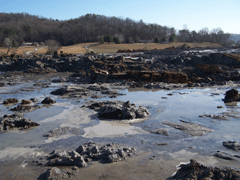
The coal ash sludge oozed over 300 acres in Tennessee. (Photo: Sarah McCoin)
The dirty side of coal surfaced in Kingston, Tennessee in the form of a toxic black sludge last month. Coal ash, a byproduct of coal combustion, burst out of a Tennessee Valley Authority waste site and spilled out over 300 acres, endangering water supplies and public health. David Freeman, former head of the TVA, helped build the Kingston plant. He tells host Steve Curwood why he thinks coal-burning power plants should be phased out.
Transcript
CURWOOD: From the Jennifer and Ted Stanley Studios in Somerville, Massachusetts - this is Living on Earth. I’m Steve Curwood.
Since three days before Christmas we've been learning more and more about the massive spill of toxic coal power plant waste that has made well waters in part of Kingston, Tennessee unsafe to drink. Arsenic and other poisons have now gotten into two nearby rivers.
Local resident Sarah McCoin describes the sludge that’s inundated dozens of homes close to the power plant.
MCCOIN: Charcoal, gray, gooey, nasty, gummy. It looks like the inside of a volcano that has just been active, and it goes as far as the eye can see. The lakes are gone, they're totally consumed.
CURWOOD: The Tennessee Valley Authority, the federal agency that owns and operates the plant, has pledged to clean up the mess but so far there’s no timetable.
And Sarah McCoin still does not feel safe.
MCCOIN: It's a very sick feeling; it certainly brings a tear to your eye. And then obviously I'm worried about my health - my health, my family's health, the health of my friends and neighbors.
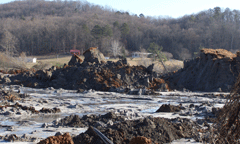
Coal ash, a byproduct of coal burning, contains high levels of heavy metals including arsenic, lead, and cadmium. (Photo: Sarah McCoin)
CURWOOD: Joining us now is the former head of the TVA, S. David Freeman. He was appointed by President Jimmy Carter in 1977, and later ran the Sacramento Municipal Utility District, and the New York Power Authority.
FREEMAN: Let me tell you about this Kingston plant. You’ve happened to have picked a fella that knows a whole lot about it. As a civil engineer for TVA in 1950, I designed the basement floor and the turbine foundations for that power plant. It went online in 1950. You know, the power plants, we thought of as having a twenty-five year life. The thing had lasted for 58 years and gone pretty much full blast the whole time. And the stuff piled up and piled up. If you think of it as water behind a dam, the higher the water gets, the more stress there is on the dam. It – the thing broke down because it obviously was not designed to hold back that much of the stuff. But it’s just a reminder that we are running these old, dirty power plants forever. And it also is a lesson that should be learned about extending the life of these nuclear plants.
CURWOOD: When you were chair of TVA, you closed a number of nuclear power plants …
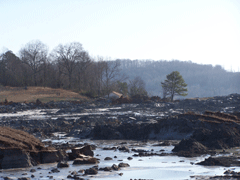
(Photo: Sarah McCoin)
CURWOOD: At that time, how concerned were you that a disaster like this fly ash disaster would happen?
FREEMAN: You know, we were just violating the hell out of the air quality laws, and I’ll have to admit that the back-up of ash was really not on my agenda at the time.
CURWOOD: Now it seemed to me though that there must be some kind of alternative to just dumping the stuff in a big pile. I mean, what alternatives, if any, are there out there?
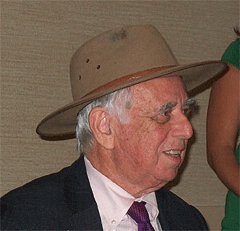
David Freeman, former head of the TVA.
FREEMAN: Well, the best one is to stop burning the coal and shut the plant down and use solar power and wind power. I am not gonna suggest that there is a clean way to control the filthy stuff that’s left over when you burn coal. It’s time that we outlawed new coal-fired plants and start systematically by age, shutting down the old ones. You know, it’s just like with nuclear power. They’ve tried for fifty years and they haven’t figured out what to do with the waste. If we have any morality about ourselves as a civilization, we will stop making waste that we can’t dispose of. You know, this incident needs to be viewed in the totality of the coal cycle, and it’s a reminder that Madison Avenue can buy billions of dollars worth of ads and put the words “clean coal” in the mouth of the president-elect and everybody else, but that doesn’t make the stuff clean.
CURWOOD: It’s well known that coal ash contains high levels of heavy metals such as arsenic and lead, as well as mercury, cadmium, and yet coal ash is regulated like household trash. How logical is that?
FREEMAN: It’s not logical at all. The coal industry has had enormous influence over the EPA, and it’s an outrage that this is continuing, and especially an outrage that the federally-owned Tennessee Valley Authority got away with it. There is a certain religious adherence to low-priced electricity that grew up over the years to where the public power folks felt that anything that would raise the price of electricity was wrong, you know. I was sued by my distributors when I started enforcing the Clean Air Act back then, but they finally gave up. And I used to argue with them that it’s not cheap if it’s at the expense of the environment.
Coal ash, a byproduct of coal burning, contains high levels of heavy metals including arsenic, lead, and cadmium. (Photo: Sarah McCoin)
CURWOOD: Now, Mr. Freeman, what, if anything, does this spill mean for you as somebody who was born in Tennessee?
FREEMAN: Well, it just reminds me of how they have just screwed over my mountains. And I must say that this incident in Tennessee, and I feel sorry for my former friends and neighbors in the Kingston area, and I apologize to them for the extent that I was involved in the beginning, but it is a wake up call that hopefully the whole world will listen to. We have one last clear chance to get off of the fossil fuels and get under renewable energy and we had better take it.
CURWOOD: Mr. Freeman, thanks so very much.
FREEMAN: Well thank you.
CURWOOD: S. David Freeman was head of the Tennessee Valley Authority in the 1970s.
We asked the national mining association for comment. Claiming that coal is the country’s most affordable and plentiful fuel for electric generation they wrote us, “With the economy flat on its back it is irresponsible to use a single incident to denigrate the promise of clean coal technology, or the contributions that coal makes to the economy.”
Links
For more on the case for clean coal, click here
For more on David Freeman, click here
For more on the Tennessee Valley Authority, check out its website
Living on Earth wants to hear from you!
Living on Earth
62 Calef Highway, Suite 212
Lee, NH 03861
Telephone: 617-287-4121
E-mail: comments@loe.org
Newsletter [Click here]
Donate to Living on Earth!
Living on Earth is an independent media program and relies entirely on contributions from listeners and institutions supporting public service. Please donate now to preserve an independent environmental voice.
NewsletterLiving on Earth offers a weekly delivery of the show's rundown to your mailbox. Sign up for our newsletter today!
 Sailors For The Sea: Be the change you want to sea.
 The Grantham Foundation for the Protection of the Environment: Committed to protecting and improving the health of the global environment.
 Contribute to Living on Earth and receive, as our gift to you, an archival print of one of Mark Seth Lender's extraordinary wildlife photographs. Follow the link to see Mark's current collection of photographs.
 Buy a signed copy of Mark Seth Lender's book Smeagull the Seagull & support Living on Earth
© Copyright World Media Foundation. All Rights Reserved
Home | Contact | RSS | Donate | Newsletter