

Solar's Bright Future
Air Date: Week of December 12, 2008
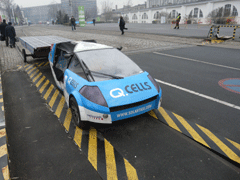
The solar-powered car that went around the world without burning a drop of gasoline. (Photo: Bruce Gellerman)
Renewable energy is a vital and increasingly desirable part of the world’s energy mix if climate change is to be tackled. But at the Poznan summit, discussion about solar power was virtually absent from the agenda. Still, host Steve Curwood reports that some solar advocates are optimistic about the future of harnessing energy from the sun.
Transcript
[STREET SOUNDS]
CURWOOD: Parked in front of the U.N. Climate Conference here in Poznan, Poland is a head-turning vehicle unlike any car you’ve ever seen. It’s a bright blue, two-seater solar taxi - at least that’s what inventor Louis Palmer calls it. Over the past 17 months, Palmer has driven his unique, solar powered vehicle 33,000 miles, through 38 countries.
PALMER: And this is the first time in history the solar powered car is going all the way around the world. And this is to show that this new technologies are ready, affordable, reliable, economical and ecological.
CURWOOD: So around the world without a drop of gas.
PALMER: Absolutely. That is what I wanted to show. And I’ve shown it to the world. And we can even travel around the world without gas. So hey, we can go to school, we can go shopping, we can go to work with this technology. It’s all possible.
CURWOOD: The solar taxi is an ungainly three-wheeler. Hitched to the rear bumper is a flat bed trailer: 60 square feet of solar cells that speed Louis Palmer down the road at 60 miles an hour.
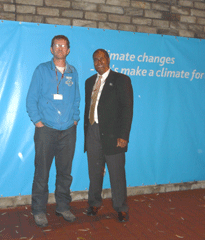
Steve Curwood and Louis Palmer, Swiss inventor of the solar taxi. (Photo: Bruce Gellerman)
CURWOOD: So how soon do you think we will be driving solar cars?
PALMER: That all depends on the will of the people to realize that we have to push these solutions. And it all depends on how long we have the oil lasting. I’m absolutely convinced it could happen tomorrow. In mass production this car could cost 10,000 euro. You put a solar cell’s worth of, let’s say, $5,000 on your roof top, and then you can drive for free for the next 40 years, for free. Every year you could make 10,000 miles.
Around the world without burning a drop of gasoline. (Photo: Bruce Gellerman)
ZHENGRONG: In the last few years actually we’ve proved we can make solar power our future. The dramatic cost reductions in the last few years, and as I say early on, we need only temporary support from governments, maybe three to five years’ time, that solar electricity can reach great parity level. Beyond that we think we can directly compete with generating cost of coal fired electricity plant.
CURWOOD: Suntech’s CEO Shi Zhengrong came to the climate talks here in Poznan, Poland to proselytize for solar technology. But while all manner of alternative power sources have been debated and discussed among delegates, conspicuously absent have been conversations about solar - particularly the conversations about providing money to advance this technology option.
Professor Maciej Nowicki is Poland’s Minister of the Environment and president of the Poznan Climate conference. He had to tell reporters that he wasn’t speaking in an official capacity when he mentioned solar energy’s role in mitigating climate change. He spoke through an interpreter.
NOWICKI: (through interpreter) My personal opinion is what I am giving you now - other nuclear solutions also very expensive but the solar energy will be available to all countries world wide, so for all countries in the world it will be the cheapest available source of clean energy for them to develop, so that’s why I’m talking about solar as the way to go in the future.
CURWOOD: Jeremy Leggett, Executive Chairman of Solar Century, a British solar energy company, and author of “The Carbon War,” took note of the dearth of official discussion about solar by delegates. He says, they lack vision.
LEGGETT: There’s a revolution going on right now, and this is the fastest growing energy business in the world. And yet when you look at the models that tend to come out of these negotiations, the advice that the negotiators get, you don’t see much evidence of people who fully understand that.
CURWOOD: What about the questions of subsidies at this point?
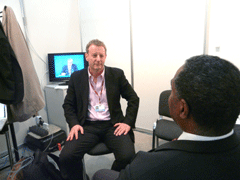
Steve Curwood interviews Jeremy Leggett, founder and executive chairman of SolarCentury.
CURWOOD: Jeremy Leggett, head of the British photovoltaic company: SolarCentury. He came to the Poznan climate talks to urge a broader inclusion of solar in the next international agreement to fight climate change.
Links
Living on Earth wants to hear from you!
Living on Earth
62 Calef Highway, Suite 212
Lee, NH 03861
Telephone: 617-287-4121
E-mail: comments@loe.org
Newsletter [Click here]
Donate to Living on Earth!
Living on Earth is an independent media program and relies entirely on contributions from listeners and institutions supporting public service. Please donate now to preserve an independent environmental voice.
NewsletterLiving on Earth offers a weekly delivery of the show's rundown to your mailbox. Sign up for our newsletter today!
 Sailors For The Sea: Be the change you want to sea.
 The Grantham Foundation for the Protection of the Environment: Committed to protecting and improving the health of the global environment.
 Contribute to Living on Earth and receive, as our gift to you, an archival print of one of Mark Seth Lender's extraordinary wildlife photographs. Follow the link to see Mark's current collection of photographs.
 Buy a signed copy of Mark Seth Lender's book Smeagull the Seagull & support Living on Earth
© Copyright World Media Foundation. All Rights Reserved
Home | Contact | RSS | Donate | Newsletter