
Tipping Point?
Air Date: Week of June 27, 2008

Earth Day at Golden Gate Park. (Courtesy of 350.org)
NASA scientist James Hansen and other leading scientists say 350 parts per million of carbon dioxide in the air should be our target goal to reduce greenhouse gas emissions. Professor Richard Alley of Pennsylvania State University explains to host Bruce Gellerman where that number comes from and how we can get there.
Transcript
GELLERMAN: Today, the amount of CO2 in the atmosphere is 385 parts per million and organizers of a new environmental group called “350 dot org” say that’s got to come down. 350 parts per million maybe the new atmospheric gold standard for some, but Richard Alley, professor of Geosciences at Penn State University says it’s not gospel:
ALLEY: It is certainly not a sacred or a magic number. People have tried asking experts, “How high before you get scared?” “How high before YOU get scared?” And the experts came back and said, “Scared about what?”
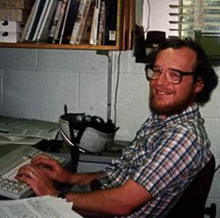
Dr. Richard Alley is the Evan Pugh professor of geosciences at Pennsylvania State University. (Courtesy of Pennsylvania State University)
GELLERMAN: Well right now we’ve got 385 parts per million. We’re looking at a ten percent reduction if they want to go back to 350. So how do we reduce our parts per million from 385 to 350?
ALLEY: There’s this huge recipe of possibilities that you can do. You can take the CO2 out of the air and put it back in the ground. You can take it from the power plant or take it from the air and people are trying to figure out how to do that. You get more economy out of the fossil fuel that you use. You replace the fossil fuel with something else that doesn’t raise CO2.
Earth Day at Golden Gate Park. (Courtesy of 350.org)
ALLEY: We can’t solve the problem by ourselves but I don’t think that the world can solve the problem without us.
GELLERMAN: Well Professor Richard Alley, thank you very much.
ALLEY: A real pleasure, thank you.
GELLERMAN: Richard Alley is a professor of Geosciences at Penn State University.
Links
Living on Earth wants to hear from you!
Living on Earth
62 Calef Highway, Suite 212
Lee, NH 03861
Telephone: 617-287-4121
E-mail: comments@loe.org
Newsletter [Click here]
Donate to Living on Earth!
Living on Earth is an independent media program and relies entirely on contributions from listeners and institutions supporting public service. Please donate now to preserve an independent environmental voice.
NewsletterLiving on Earth offers a weekly delivery of the show's rundown to your mailbox. Sign up for our newsletter today!
 Sailors For The Sea: Be the change you want to sea.
 The Grantham Foundation for the Protection of the Environment: Committed to protecting and improving the health of the global environment.
 Contribute to Living on Earth and receive, as our gift to you, an archival print of one of Mark Seth Lender's extraordinary wildlife photographs. Follow the link to see Mark's current collection of photographs.
 Buy a signed copy of Mark Seth Lender's book Smeagull the Seagull & support Living on Earth
© Copyright World Media Foundation. All Rights Reserved
Home | Contact | RSS | Donate | Newsletter