

Senator McCain’s Climate Record
Air Date: Week of May 16, 2008
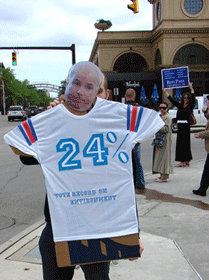
Despite John McCain’s pro-environment rhetoric, protester Bret Thompson thinks McCain’s voting record on the environment merits “24 %.” (Photo: Liza Alwes)
Republican presidential contender John McCain made it clear he's not like President George Bush when it comes to global warming - the candidaten has pledged to limit greenhouse gas emissions. But critics ask why Senator McCain won't do more to support renewable energy. Living on Earth’s Washington correspondent Jeff Young reports from Washington.
Transcript
GELLERMAN: It’s Living on Earth. I’m Bruce Gellerman. On the campaign trail, Republican presidential hopeful John McCain has been talking the talk about energy and environmental issues, and recently putting more and more distance between himself and President Bush on climate change. On the stump, McCain talks passionately about global warming, but is he walking the walk? Living on Earth’s Jeff Young has been investigating McCain’s campaign rhetoric and his voting record in the Senate.
YOUNG: When Senator John McCain focuses on climate change, his campaign managers like to put him in a photo-op friendly setting – like a solar equipment company or, in this case, the Vestas wind turbine facility in Portland, Oregon.
SOBY: Please say hello to Senator McCain. Thank you.
[APPLAUSE]
YOUNG: McCain’s been a leader on climate change. Five years ago he authored the first major carbon cap bill to reach the Senate floor. And he brought climate scientists to the capitol in nearly a dozen congressional hearings. Now he wants independent-minded voters in battleground states like Oregon to know that on global warming, he’s no George W. Bush.
MCCAIN: Good stewardship, prudence and simple common sense demand – demand that we act to meet the challenge and act quickly. I will not shirk the mantle of leadership that the United States bears. I will not permit eight long years to pass without serious action on serious challenges.
YOUNG: But as McCain distances himself from Bush, he also needs to reassure Republicans who remain concerned about the economic effects of a cap on carbon emissions. McCain says his cap and trade approach will work with the free market to encourage innovation and investment in cleaner energy sources. And he would allow CO2-intensive industries to make generous use of carbon offsets: things like paying farmers to capture the methane from animal enclosures. McCain says economists agree with him that offsets can keep the price of carbon emissions – and thus the price of energy – from rising sharply.
MCAIN: We want to turn the American economy toward cleaner and safer energy sources, and you can’t achieve that by imposing costs that the American economy cannot sustain.
YOUNG: McCain says he will use diplomacy and trade to try to bring China into an international agreement on greenhouse gases. And in another break from Bush policy, he says he would not allow China’s inaction to prevent the U.S. from moving ahead.
MCCAIN: If the efforts to negotiate an international solution that includes China and India do not succeed, we still have an obligation to act.
YOUNG: McCain’s targets for greenhouse gas reductions would have the US return to its 1990 level of emissions by the year 2020. By mid century, the U.S. would be 60 percent below that level. McCain policy advisor Doug Holtz-Eakin says it’s a plan designed to strike a balance between climate science and political science.
HOLTZ-EAKIN: So in an effort to make sure we get something done, he’s tailored his proposal to be good on the science, good on the economy and hopefully allow us to have some leadership on this issue in the world.
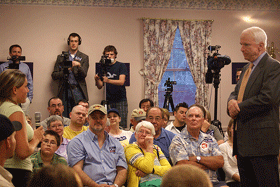
McCain fields a question about global warming while campaigning for the Republican primary in Merrimack, New Hampshire. (Photo: Marc Nozell, under Creative Commons license)
CLAUSSEN: I think he was good on the early date, 2005 levels in 2012, as aggressive as we have seen in the United States. Yes, his 60 percent is less than some of the 80 percents, and we probably do need 80 percent, but there will be lots of time to come back and actually redo that final number as we learn more and more about the science.
YOUNG: Claussen gives McCain’s plan high marks. But other environmentalists are critical, especially when it comes to McCain’s support for nuclear power. McCain says he wants the government to help the nuclear industry build 20 new nuclear reactors by the end of his first term as president. League of Conservation Voters president Gene Karpinski says that’s the wrong place to put scarce government dollars.
KARPINSKI: Well you know one of the ironies is he did his event at a wind power facility, and he’s unfortunately consistently opposed tax credits for wind power. On the other hand, he supports tax subsidies for a 50 year-old industry that doesn’t know what to do with its waste: the nuclear power industry. So that really makes no sense.
YOUNG: Karpinski’s group gives McCain a weak 24 percent rating for his congressional votes on environmental issues. McCain opposed a renewable electricity standard to require utilities to generate ten percent of their power through wind, solar or other clean energy sources. And more recently, McCain missed a chance to deliver the one thing the renewable energy companies need most. Let’s go back to Senator McCain’s speech at the Vestas facility.
SOBY: Wind is modern energy, and Vestas is number one in modern energy.
YOUNG: Just before Vestas America president Jens Soby introduced the senator, he made this appeal for support.
SOBY: We need a long-term energy policy, and we need a short-term extension of the production tax credit. Please say hello…
Despite John McCain’s pro-environment rhetoric, protester Bret Thompson thinks McCain’s voting record on the environment merits “24 %.” (Photo: Liza Alwes)
WEISS: Last December there was a vote to shift about two billion dollars a year in tax breaks for big oil, and invest them instead in clean, renewable energy like wind, solar and geothermal power. That vote failed by one vote. The only person who didn’t vote was John McCain.
YOUNG: McCain advisor Holtz-Eakin blames the busy presidential campaign schedule.
HOLTZ EAKIN: He had campaign commitments; he was unable to attend the vote, and you know, that’s one of many votes where he’s been asked, you know, what would have happened. You can’t relive history.
YOUNG: As it turns out, McCain had a chance to relive that vote just two months later. In February, the same energy tax proposal came up again. Again, just one vote would have made the difference, and again McCain was absent. On the day of that vote McCain was in Washington – about a 15-minute drive from the capitol dome – speaking to the conservative political action conference. Well since then, he’s devoted more of his time to campaign fundraising. Sheila Krumholz tracks campaign money at the non-partisan center for responsive politics, which runs the website Open Secrets. Krumholz says McCain has had remarkable success in recent months getting money from the energy sector, including oil and gas.
KRUMHOLZ: John McCain is now the number one recipient of oil and gas money in this cycle, with 515,000 dollars so far.
YOUNG: She says that’s probably not all the oil and gas money McCain’s getting. Like most campaigns, McCain uses so-called money bundlers to raise cash. These influential people pledge to raise a certain amount from acquaintances. McCain’s bundlers include some big names from big oil, like Houston oilman and former commerce secretary Bob Mosbacher, Kit Moncrief of the Moncrief Oil family, and Texas oil lobbyist Gaylord Hughey, Jr. Together, those three have pledged to raise nearly half a million dollars. Krumholz says that might clash with McCain’s maverick image.
KRUMHOLZ: There will be something of a rhetorical dance explaining both his platform, which has been so stridently opposed to special access for special interests, at the same time that he’s collecting more and more money from these very interests.
YOUNG: There’s no doubt McCain’s been a climate crusader, and his campaign insists he remains committed to the cause. But a weak voting record on clean energy and his newfound friends in Big Oil cloud that image, and could make it tougher for McCain to win over the climate-conscious voters he’s seeking. For Living on Earth, I’m Jeff Young in Washington.
GELLERMAN: To hear more of Jeff’s interview with Senator McCain’s climate adviser, check out our website at l-o-e dot o-r-g.
Links
McCain’s platform on climate change
Living on Earth wants to hear from you!
Living on Earth
62 Calef Highway, Suite 212
Lee, NH 03861
Telephone: 617-287-4121
E-mail: comments@loe.org
Newsletter [Click here]
Donate to Living on Earth!
Living on Earth is an independent media program and relies entirely on contributions from listeners and institutions supporting public service. Please donate now to preserve an independent environmental voice.
NewsletterLiving on Earth offers a weekly delivery of the show's rundown to your mailbox. Sign up for our newsletter today!
 Sailors For The Sea: Be the change you want to sea.
 The Grantham Foundation for the Protection of the Environment: Committed to protecting and improving the health of the global environment.
 Contribute to Living on Earth and receive, as our gift to you, an archival print of one of Mark Seth Lender's extraordinary wildlife photographs. Follow the link to see Mark's current collection of photographs.
 Buy a signed copy of Mark Seth Lender's book Smeagull the Seagull & support Living on Earth
© Copyright World Media Foundation. All Rights Reserved
Home | Contact | RSS | Donate | Newsletter