
Emerging Science Note/Bees
Air Date: Week of March 14, 2008
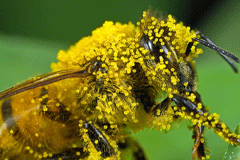
Honeybee covered in pumpkin pollen. (Photo: John Kimbler)
Computer scientists look at bees' dance moves as a model for a better system of web servers. Living on Earth's Annie Jia reports.
Transcript
CURWOOD: It’s Living on Earth. I’m Steve Curwood. Coming up: non-native plants threaten to take over. But first this Note on Emerging Science from Annie Jia.
[Sweet Inspiration music]
JIA: Bees give us many things. Honey, stings – even inspiration for Hollywood B movies. But a better internet? That’s what one group of scientists is devising, thanks to these busy workers—or rather, dancers.
[Science note music]
When bees find new honey, they dance. Their jigging, however, is not for celebrating – it’s to tell their hivemates about the discovery. Bees use boogying to communicate the quality of each flower patch, and with this knowledge they fluidly shift their workforce as nectar supplies change.
Researchers at the Georgia Institute of Technology realized the internet faces a similar challenge as bees. A limited number of web servers provide processing power to many websites, whose traffic constantly changes – just like a limited number of bees collect nectar from many flower patches.
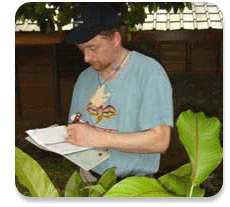
Professor Craig Tovey’s observations of field bees provide clues of better ways to organize server space on the Net. (Photo: Georgia Institute of Technology)
Another upgrade, inspired by bees that stay home on cloudy days when flowers aren’t blooming, would turn off the power to idle servers. This could cut energy use by 20%.
Staying home? Dancing? Sweeeeeet.
That’s this week’s note on emerging science. I’m Annie Jia.
Links
Center for Biologically Inspired Design at the Georgia Institute of Technology
Living on Earth wants to hear from you!
Living on Earth
62 Calef Highway, Suite 212
Lee, NH 03861
Telephone: 617-287-4121
E-mail: comments@loe.org
Newsletter [Click here]
Donate to Living on Earth!
Living on Earth is an independent media program and relies entirely on contributions from listeners and institutions supporting public service. Please donate now to preserve an independent environmental voice.
NewsletterLiving on Earth offers a weekly delivery of the show's rundown to your mailbox. Sign up for our newsletter today!
 Sailors For The Sea: Be the change you want to sea.
 The Grantham Foundation for the Protection of the Environment: Committed to protecting and improving the health of the global environment.
 Contribute to Living on Earth and receive, as our gift to you, an archival print of one of Mark Seth Lender's extraordinary wildlife photographs. Follow the link to see Mark's current collection of photographs.
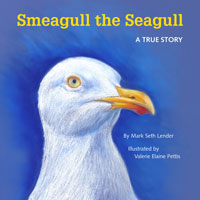 Buy a signed copy of Mark Seth Lender's book Smeagull the Seagull & support Living on Earth
© Copyright World Media Foundation. All Rights Reserved
Home | Contact | RSS | Donate | Newsletter