
Belching Cows
Air Date: Week of February 8, 2008
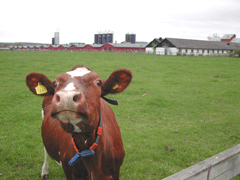
Swedish cows like this already wear collars that electronically identify each animal when she is milked or fed. Bertilsson will equip them with much larger collars to measure methane. (Photo: Jan Bertilsson)
Researchers at the Swedish University for Agricultural Sciences have just received a half million dollars to study belching cows. Believe it or not, methane exits each end of a cow as it consumes grass and grain. With millions of cows on the job, methane, a powerful greenhouse gas, adds up. Professor Jan Bertilsson joins host Bruce Gellerman to talk about how changing a cow's diet might fight climate change.
Transcript
GELLERMAN: Carbon dioxide isn’t the only greenhouse gas that comes from cows—there’s methane as well, and it’s 20 times more damaging to the atmosphere than CO2.
That’s why Swedish scientist Jan Bertilsson is trying to measure just how much methane comes from cows. And it takes some doing. Dr. Bertilsson joins us from his lab at the Swedish University for Agricultural Sciences in Uppsala. Welcome to the show.
BERTILSSON: Hello.
GELLERMAN: How do you measure the methane from a cow?
BERTILSSON: You can do it by putting them into an air-tight room and collect everything that comes out from them but that’s laborious and costly and so on. But there is a method where we use tracer gas. We let out a specified amount of sulfuric fluoride and we can calculate how much methane is produced. But we are collecting the gas all the time. Near the mouth of the animal we have a special collar around the head of the cow where we collect the gas.
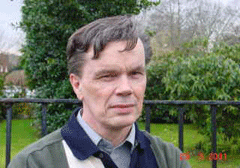
Jan Bertilsson (Courtesy of Jan Bertilsson)
BERTILSSON: Nose—yes. Because 95 percent of the gas comes from the nose. Only five percent comes from the back of the cow.
GELLERMAN: Yeah, I would have thought, actually, that most of it would have come from the other route.
BERTILSSON: No. That’s what people think in general.
GELLERMAN: So what produces the methane? I mean, all cows have to eat.
BERTILSSON: Yeah. It’s when they digest their feed in the stomach there’s no oxygen and in that procedure there is bound to be formed the methane because there are certain microbes in the ruman of the cow.
GELLERMAN: Well, are there things that the cows eat that produces more or less methane?
BERTILSSON: In general we think that it’s grass and grass products would probably be a bit more than grain or, like, corn or that sort of thing. In fact, one of the things we are looking into is feeding more grass products will give more methane. And especially, we have in this country a large interest for organic production and in that sort of production more grass is fed to the cows and one suspicion is that that might give more methane and that’s something we want to check.
Swedish cows like this already wear collars that electronically identify each animal when she is milked or fed. Bertilsson will equip them with much larger collars to measure methane. (Photo: Jan Bertilsson)
BERTILSSON: They do it all the time because they spend most of their days eating and chewing so I would say that at least two thirds of the day they will spend on chewing and ruminating and all that time they will also be gasses let out from their stomachs. Because if they don’t—sometimes if it’s blocked in some way or another then the animal is in danger, she will, in the end she will die if she can’t get rid of all these gases.
GELLERMAN: Who’s interested in your research?
BERTILSSON: There is a demand from the trade. They want to label their products that they have a good effect on the environment and also the environment protection agency in this country. They want to report emissions of greenhouse gases and they want accurate figures on this from animals and from agriculture.
GELLERMAN: Well I want to thank you very much Dr. Bertilsson, it's been a real pleasure.
BERTILSSON: Nice talking to you.
GELLERMAN: Jan Bertilsson studies burping cows at the Swedish University for Agricultural Sciences in Uppsala, Sweden.
[MUSIC: Weird Al Yankovick “Who Let The Cows Out” From You Tube Video]
Links
Living on Earth wants to hear from you!
Living on Earth
62 Calef Highway, Suite 212
Lee, NH 03861
Telephone: 617-287-4121
E-mail: comments@loe.org
Newsletter [Click here]
Donate to Living on Earth!
Living on Earth is an independent media program and relies entirely on contributions from listeners and institutions supporting public service. Please donate now to preserve an independent environmental voice.
NewsletterLiving on Earth offers a weekly delivery of the show's rundown to your mailbox. Sign up for our newsletter today!
 Sailors For The Sea: Be the change you want to sea.
 The Grantham Foundation for the Protection of the Environment: Committed to protecting and improving the health of the global environment.
 Contribute to Living on Earth and receive, as our gift to you, an archival print of one of Mark Seth Lender's extraordinary wildlife photographs. Follow the link to see Mark's current collection of photographs.
 Buy a signed copy of Mark Seth Lender's book Smeagull the Seagull & support Living on Earth
© Copyright World Media Foundation. All Rights Reserved
Home | Contact | RSS | Donate | Newsletter