

McCain on Climate Change
Air Date: Week of December 7, 2007
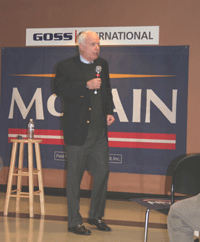
(Photo: Jennifer Stevens)
If he were president, what would John McCain do to combat climate change? Living on Earth host Steve Curwood caught up with Senator McCain on his campaign bus, the Straight Talk Express, in New Hampshire. It’s the third installment of our feature of candidates and their views on one of the most serious global issues.
Transcript
GELLERMAN: It’s Living on Earth. I’m Bruce Gellerman. While scientists warn that climate change threatens our very existence and demands immediate action, it hasn’t been a top issue for Republicans trying to win the GOP presidential nomination. None of the Republican candidates accepted an invitation to speak at last month’s presidential forum on climate change and America’s energy future. But as the primaries get closer, the issue—like the planet—gets hotter.
Living on Earth executive producer Steve Curwood recently caught up with Arizona Senator John McCain in snowy Durham, New Hampshire, where the candidate spoke to a group of workers at Goss International, where they make printing presses. The Senator kicked off with global warming.
[APPLAUSE]
MCCAIN: Thank you. By the way, I’ve been asked by the Phoenix Chamber of Commerce to announce the temperature is 78 degrees in Phoenix today.
[LAUGHTER]
MCCAIN: I just thought I’d—but we have no water in Arizona. You may know California’s stolen all of Arizona’s water. In fact, we have so little water in Arizona the trees chase the dogs—
[LAUGHTER]
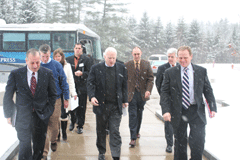
Senator John McCain and his staff brave the snow to campaign in New Hampshire. (Photo: Jennifer Stevens)
And I went back to the Senate and I got involved in the issue and we had hearings and my friends I just want to say to you unequivocally I believe that it’s real. I believe there’s enough evidence out there to convince us at least to try to take action to reduce greenhouse gas emissions and maybe I could put it to you this way: suppose we are wrong, those of us that believe that the large body of scientific evidence indicates that climate change is taking place, suppose that we adopt green technologies and we are wrong. Well all we’ve done is given our kids a cleaner planet with less greenhouse gas emissions. But suppose we are right. Suppose we are right and that there is serious damage being done or can be done to our planet by so called ‘greenhouse gases’ then I think and do nothing. Then I think obviously we would not be proud of what we’re handing on to future generations of Americans. And I’ve traveled all over the world, usually at your expense, and I’ve been to the Arctic, I’ve been to the South Pole, I’ve been to Greenland, I’ve been to other places where I’ve seen manifestations of this. And scientists are notoriously cautious, but most scientists now agree that at least to some degree that it’s taking place.
Now what do we need to do? We don’t have to shiver in the dark. We don’t have to make drastic changes in our lifestyle. But one of the things I think we need to do is expand and reemphasize the need for nuclear power. I believe that nuclear power works. I believe that it is viable. I see an Old Navy man over there who will tell you that for more than 60 years, the United States Navy has sailed ships around the world with nuclear power plants on them. By the way, our friends the French—80 percent of their electricity is generated by nuclear power. We all want to imitate the French, as you know. But the fact is—and by the way the French now have a pro-American president, which shows that if you live long enough, anything can happen in this world—
[LAUGHTER]
MCCAIN: -- as I know you know. So, the question with nuclear power, my friends, is what do you do with the waste? And the fact is we’ve got the worst of all worlds now because we haven’t been able to do anything with it so we’ve got these nuclear waste places all over America—outside the nuclear power plants. So, we need to sit down as a nation and fix it. And I’m for finding a Yucca Mountain or any place else we want but the technology is there, the licensing process should be accelerated, and nuclear power has got to be part of it. Otherwise, we will be building utilities that are emitting greenhouse gases and obviously that’s not something we want for our kids.
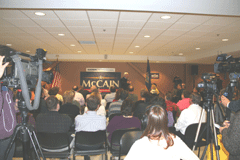
John McCain at a town hall meeting in New Hampshire. (Photo: Jennifer Stevens)
And finally let me remind you—there is a need to reduce our dependence on foreign oil, which joins up with this need to reduce greenhouse gas emissions in my view. A lot of times at town hall meetings I bring a picture of the president of Iran embracing the president of Venezuela. Another picture of President—I use the term loosely—Putin of Russia. Those three people have their hands on a lot of the world’s oil supplies. Not to mention the Iranians, the Nigerians, etcetera. And so there is an absolute requirement for us to reduce our dependency on foreign oil and I think we can do that with our effort to reduce greenhouse gas emissions.
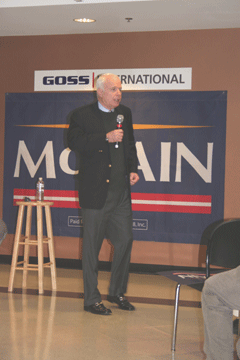
Senator John McCain (R-AZ) speaks to a group of manufacturers at Goss International in New Hampshire. (Photo: Jennifer Stevens)
MCCAIN: On the issue of the last election and the upcoming election: in 2006, Republicans lost the last election and they lost big time here in the state of New Hampshire. I know you know that. Why did Republicans lose so badly? It wasn’t because of the war on Iraq. It was because we Republicans let spending get completely out of control. We came to power in government in 1994 to change government and government changed us. We began a spending spree that resulted in the biggest increase in the size of government since the Great Society. Republicans. Republicans. Conservative Republicans! And our base got alienated and angry, and I don’t blame them. I don’t blame them at all. We spent $3 million of your tax dollars to study the DNA of bears in Montana. I don’t know if that was a paternity issue or a criminal issue.
[LAUGHTER]
MCCAIN: But it was your tax dollars. The turning point—the turning point my friends, of course as many of you know the tipping point was when the $233 million bridge in Alaska to an island with 50 people on it. Next time you’re stuck in traffic think about what we could do with that money. And it led to corruption. I don’t use the word lightly. We now have former members of Congress residing in federal prison. I just want to promise you as president of the United States, I have an old veto pen—this isn’t it—that Ronald Regan gave me years ago—and I’ll veto every pork barrel bill that comes across my desk. I’ll make them famous, and I will stop it. We’ve got to stop these wasteful and outrageous spending practices in Washington.
[APPLAUSE]
[SOUND OF BUS DRIVING AND HONKING]
CURWOOD: After Durham, Senator McCain set off to Dover, New Hampshire in his bus—the Straight Talk Express. I climbed aboard for some straight talking on climate change.
[SOUND OF TALKING INSIDE BUS]
CURWOOD: Please, sit down for a moment. When you talked about climate change in front of the audience today—not a whole lot of reaction. So how do you get a mandate from the public to do the kinds of things that you want to do on climate change?
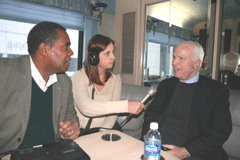
John McCain takes questions from Steve Curwood in the back of the Straight Talk Express. The audio engineer is Bobby Bascomb. (Photo: Jennifer Stevens)
CURWOOD: Let’s be blunt. It doesn’t seem like there are a lot of votes for you when you speak out about climate change.
MCCAIN: It doesn’t matter. (laughs) You know, it’s my obligation. I mean, you’ve got to do what you think is right and keep talking about it. I mean, it’s such a threat to our planet and our future and our children. It’s just an obligation you have.
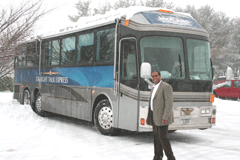
LOE Host Steve Curwood and the Straight Talk Express in New Hampshire. (Photo: Jennifer Stevens)
[IN QUIET ROOM]
CURWOOD: So right now in the U.S. we don’t reprocess nuclear fuel and that means that of say 100 percent of energy that’s in uranium we only take 5 percent out before we call it waste—95 percent of the power is still in it. People have objected to reprocessing because it goes through plutonium and there are security issues with that. How do you feel about reprocessing? If you go do a major nuclear plant as France has or Japan, they do a lot of reprocessing. Would we do that here?
MCCAIN: I’d have the scientific debate but I probably would have the first option and that is to have a place to store it and store it safely. But I’m willing to look at any option that we can sell to the American people. I’m not against anything. I think that storage—because Yucca Mountain is there—and I’ve always believed it could be safely stored there should the option first.
CURWOOD: Typically, members of your party, the Republican Party, have been reluctant to address climate change. Why are you different?
MCCAIN: I think because of my travels, my experience, my studies. As chairman of the commerce committee for six years we had numerous hearings and I’ll tell you, they were not well attended. But I’ve become convinced of it.
CURWOOD: Now, the last three presidents of the United States have made a gesture in office saying that they would deal with global warming. George Bush the elder signed the original framework convention on climate change. President Clinton signed the Kyoto Accord. George Bush in his campaign said that CO2 was a pollutant—changed his mind later. So, what past three presidents have failed really to deal effectively with climate change. How and why would you make a difference?
MCCAIN: Well I know the issue. I’ve studied it. I’ve worked on a bipartisan basis—Joe Lieberman and I have proposed a quote ‘cap and trade,’ which is being employed in Europe, which has been stumbling by the way but still the principal is right. We did the same thing with acid rain. But I think the other factor that will give dramatic impetus to this issue—it’s now tied in my view and I think I can tie it in the minds of the American people—with a need for energy independence.
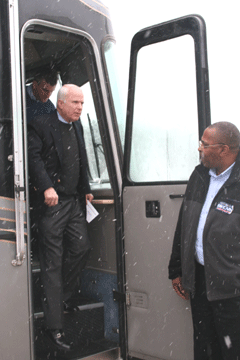
Senator McCain and his campaign vehicle, the Straight Talk Express, in snowy New Hampshire.(Photo: Jennifer Stevens)
CURWOOD: So, how do we restore our credibility on foreign policy in the area of global warming? We signed Kyoto but we pulled out. The rest of the world points to us and says that we’re the last country standing. In fact Australia has now moved forward to ratify Kyoto, so we’re the last industrialized nation that hasn’t gone forward with an international agreement. How do we restore our credibility?
MCCAIN: I’d push hard for an international agreement, but you forgot to mention that India and China aren’t part of it. And India and China must be part of any global effort. The two largest emerging economies have to be a part of it.
CURWOOD: We’ve got a bit of a standoff problem with India and China because in the earlier negotiations the U.S. agreed to go first. So they’re looking at us saying ‘What about you guys?’ and we’re looking at them because of course, the growth in emissions from China and India is going to be quite large in the years ahead. How do you break this impasse? It’s a stalemate, really.
MCCAIN: Uh, look, if India and China want to join they can join. We’ll join together. I mean, that’s a straw man that they’re setting up and the Chinese are very worried about their enormous contributions to pollution. It’s already affecting Los Angeles, so let’s be very clear with China first and also India. Look, it doesn’t matter who goes first. We should all go together. It’s baloney.
CURWOOD: Okay. Let’s fast forward and John McCain is now being sworn in as president of the United States. And if that happens what do you do in your first 100 days to address global warming?
MCCAIN: I think we try to get a cap and trade system through the Congress. I think we use the bully pulpit to explain to the American people about the conjunction of two serious issues—the need for energy independence, and the need—our dependence on foreign oil—and also the need to address the issue of climate change. I would make it a top agenda. I would begin negotiating with other countries. I would join Kyoto or a worldwide agreement, but only if India and China were a part of that agreement. You’ve got to convince them as well. So, and I would devote more effort probably on the governments part to pure R and D and I emphasize pure R and D. The free enterprise system does these things a lot better once you get out of the pure R and D phase. And I’d unleash the millions of Americans—young Americans today, who view this as a threat and challenge to their lives.
CURWOOD: Now, science tells us that already a billion people around the world are going to face the adverse effects of climate change, and most of them are pretty poor. And the changes for these folks is inevitable. We’re seeing the equivalent of Katrina right now in Bangladesh, for example. How would you deal with addressing those folks around the world—the poor around the world who are being impacted by climate change already?
MCCAIN: You know one of the areas that they’re first being addressed are in native Alaskan villages up on the Arctic Circle and in other parts where they’re next to the water, where they’re seeing their villages literally collapse into the ocean. And we’re going to have to go through relocation there. You know, there’s not a lot you can do as far as preventing for example, Bangladesh from having higher and higher sea level because of the progress of this climate change and melting of the polar ice caps. But I would definitely provide disaster relief, etcetera, etcetera. But I would also point out the graphic demonstration. There are island nations in the Pacific, we are told, that may literally disappear or lose a vast majority of their landmass because of this increase in tides and the other thing is that with the violent weather patterns will increase. I think most experts, and I believe, on climate change will tell you it’s not only a case of warming, but it’s also a case of much more violent weather patterns that are going to—and then of course that increases the disasters that befall countries like Bangladesh.
CURWOOD: Senator, before you go, tell me—what personal choices have you made in response to your concern about climate change?
MCCAIN: Oh, we have solar panels up north in our place in Arizona. My daughter drives—has bought a hybrid. But we haven’t done enough. We haven’t done enough. My personal choices are that I ride in one SUV while I see other candidates riding in twelve. (laughs). But the fact is that I haven’t done enough and I’ve got to do more. And all of us Americans have to do more. But I can’t stand before you and tell you I’m an example of good behavior as far as climate change is concerned. That wouldn’t’ be straight talk.
CURWOOD: I want to thank you for taking this time. Arizona Republican Senator John McCain. Thank you, sir.
MCCAIN: Thank you very much. Thanks. I’m sorry we’ve got to run.
GELLERMAN: LOE’s Steve Curwood with Senator John McCain—running in New Hampshire. For more of our coverage of the Presidential candidates’ positions on climate change, check out our website: loe.org. Next in our series of candidates and global warming—Representative Dennis Kucinich.
Links
Living on Earth wants to hear from you!
Living on Earth
62 Calef Highway, Suite 212
Lee, NH 03861
Telephone: 617-287-4121
E-mail: comments@loe.org
Newsletter [Click here]
Donate to Living on Earth!
Living on Earth is an independent media program and relies entirely on contributions from listeners and institutions supporting public service. Please donate now to preserve an independent environmental voice.
NewsletterLiving on Earth offers a weekly delivery of the show's rundown to your mailbox. Sign up for our newsletter today!
 Sailors For The Sea: Be the change you want to sea.
 The Grantham Foundation for the Protection of the Environment: Committed to protecting and improving the health of the global environment.
 Contribute to Living on Earth and receive, as our gift to you, an archival print of one of Mark Seth Lender's extraordinary wildlife photographs. Follow the link to see Mark's current collection of photographs.
 Buy a signed copy of Mark Seth Lender's book Smeagull the Seagull & support Living on Earth
© Copyright World Media Foundation. All Rights Reserved
Home | Contact | RSS | Donate | Newsletter