

Emerging Science Note/Poplars
Air Date: Week of November 16, 2007
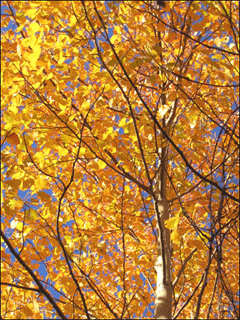
Poplar trees, also known as aspens or Balm of Gileads, turn a dazzling gold during fall in the Ottawa Valley of Eastern Ontario, Canada. (Photo: Flickr/Valley Vistas)
Genetically engineered trees could be used to absorb toxins in water. Alexandra Gutierrez reports.
Transcript
[EMERGING SCIENCE THEME]
GUTIERREZ: What do you get when you cross a tree with a rabbit? A sponge, apparently. By taking a poplar tree, and inserting an enzyme-producing gene from one of the forest’s faster creatures, scientists at the University of Washington have developed a plant that can rapidly soak up toxins from polluted water. These genetically modified trees can then convert the contaminants into harmless byproducts through a process called “phytoremediation” – a word that literally means “restoring balance through plants.”
Poplar trees, also known as aspens or Balm of Gileads, turn a dazzling gold during fall in the Ottawa Valley of Eastern Ontario, Canada. (Photo: Flickr/Valley Vistas)
But while these plants may be an effective solution to cleaning up hazardous spills, it may be a while before poplar forests are planted in polluted areas. Federal laws do not permit commercial growing of genetically modified trees, as there is some concern that they could spread into regular forests.
For now, these poplars will stay in the lab or perhaps monitored government sites. But if University of Washington scientists have their way, a forest of poplars could one day mean cleaner streams.
Living on Earth wants to hear from you!
Living on Earth
62 Calef Highway, Suite 212
Lee, NH 03861
Telephone: 617-287-4121
E-mail: comments@loe.org
Newsletter [Click here]
Donate to Living on Earth!
Living on Earth is an independent media program and relies entirely on contributions from listeners and institutions supporting public service. Please donate now to preserve an independent environmental voice.
NewsletterLiving on Earth offers a weekly delivery of the show's rundown to your mailbox. Sign up for our newsletter today!
 Sailors For The Sea: Be the change you want to sea.
 Creating positive outcomes for future generations.
 Innovating to make the world a better, more sustainable place to live. Listen to the race to 9 billion
 The Grantham Foundation for the Protection of the Environment: Committed to protecting and improving the health of the global environment.
 Contribute to Living on Earth and receive, as our gift to you, an archival print of one of Mark Seth Lender's extraordinary wildlife photographs. Follow the link to see Mark's current collection of photographs.
 Buy a signed copy of Mark Seth Lender's book Smeagull the Seagull & support Living on Earth
© Copyright World Media Foundation. All Rights Reserved
Home | Contact | RSS | Donate | Newsletter