

Give Peace Parks a Chance
Air Date: Week of November 9, 2007
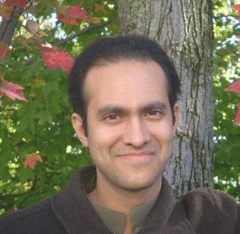
Saleem H. Ali is a Professor of Environmental Policy and Planning at the University of Vermont. (Courtesy of Saleem Ali)
Parks and natural areas can be an important part of international diplomacy and peace building between countries in conflict. That’s according to University of Vermont professor Saleem Ali who edited the new book “Peace Parks: Conservation and Conflict Resolution.” Dr. Ali talked with host Bruce Gellerman.
Transcript
GELLERMAN: Seventy-five years ago this fall, residents along the U.S.-Canadian border began a novel, noble, some might say naive project. They created the world’s first peace park, symbolically uniting National parks divided by a political border. Over the years, cooperation in the Waterton–Glacier International Peace Park has helped restore vegetation, fight wildfires and rescue lost hikers.
Today there are scores of Peace Parks around the world but advocates believe they can serve a new role—as tools of diplomacy in war zones. Saleem Ali is an associate professor of environmental policy at the University of Vermont and editor of a new book: “Peace Parks: Conservation and Conflict Resolution.”
ALI: A peace park is a place where the environment is being instrumentally used to resolve conflict—territorial conflicts as well as ethno-religious conflicts. In fact, conflicts, which may have nothing to do with the environment, could be resolved through environmental peace building. Peace parks definitely work and it’s an underutilized mechanism in our diplomatic efforts.
GELLERMAN: Well let’s talk about say, Iraq. How could you put a peace park in Iraq?
ALI: Between Iraq and Iran, there has been of course, a territorial dispute, which led to the Iraq-Iran war. There is also a region in southern Mesopotamia which is environmentally very sensitive and so there is consciousness of the environmental value of that region in Iran. In Iraq, that area has been very special for cultural reasons. The Marsh Arabs were a community which developed a very unique culture in those wetlands and in fact during the Saddam regime, they were deliberately targeted because they had opposed some of Saddam’s policies. And so, the wetlands there were dewatered deliberately. Now one of the very few success stories of the current conflict in fact, is that those wetlands have been replenished through a program which the United Nations Environmental Program started.
GELLERMAN: So how could this place between Iraq and Iran be designated a peace park? How can that make things more peaceful?
Saleem H. Ali is a Professor of Environmental Policy and Planning at the University of Vermont. (Courtesy of Saleem Ali)
I can give you one more example from my ethnic homeland, Pakistan, where both India and Pakistan have been involved in violent conflict since 1947—three major wars. But there was an international agreement between them—the Indus-Basin agreement on water issues. And that cooperation over water was able to endure any other kind of violent conflict. And in fact, in the most recent conflict, which was potentially going to erupt in the late 90s, the Indus-Basin agreement helped both countries open a communication channel that was able to prevent that further escalation from occurring, even though one million troops had assembled on each side of the border.
GELLERMAN: What about a place like Korea, the DMZ, the demilitarized zone between north and south? Peace park potential?
ALI: Absolutely. This is an area where both sides would like to establish a peace park because it’s a no-win situation for either side. It’s an area, which, by default, has been made into a high-biodiversity region because there’s no development there. And if we’re able to get enough momentum in terms of the six-party talks to move this forward, this might be the first real territorial dispute resolution on the Korean peninsula.
GELLERMAN: Do you think realistically both sides of a conflict that are armed to the teeth, they’ve got their tanks facing each other and they approach this peace park—are they just going to stop?
ALI: I think there’s a psychological dimension, which we have to consider first of all. Anytime you bring the environment into the conversation you create a zone of potential commonality. They may not have common interests but the fact that they have a common aversion, they can move forward with it. I use the example with my students of two cars on an intersection. Both of them have divergent interests; they’re going in different directions, but they have a common aversion, which is to get into a car accident and so they’re much more likely to cooperate over that and that’s what we’re framing the peace park narrative with.
GELLERMAN: What about people who live in these areas that you want to turn into peace parks. What happens to them?
ALI: This is a very important concern because we do have a history of conservation being manipulated by a powerful elite in various contexts, such as our own national park system where Native Americans were disenfranchised. But those are issues of management. I don’t consider them to be a hindrance in terms of the concept of peace parks per se. But if they are not implemented correctly, even a bright idea can be wrongfully manipulated.
GELERMAN: I wouldn’t be the first one to say all you’re saying is give peace parks a chance.
ALI: No. That’s right. But apart from that I would also say that there’s much more which we can do, especially with conflicts in the Middle East and Iraq and Afghanistan. We have now enough empirical evidence to suggest that there is a direct connection between environmental cooperation and resolving intractable conflict.
GELLERMAN: Professor Ali, thank you very much.
ALI: Thank you so much, Bruce.
GELLERMAN: University of Vermont Professor Saleem Ali is editor of “Peace Parks: Conservation and Conflict Resolution.”
Links
Living on Earth wants to hear from you!
Living on Earth
62 Calef Highway, Suite 212
Lee, NH 03861
Telephone: 617-287-4121
E-mail: comments@loe.org
Newsletter [Click here]
Donate to Living on Earth!
Living on Earth is an independent media program and relies entirely on contributions from listeners and institutions supporting public service. Please donate now to preserve an independent environmental voice.
NewsletterLiving on Earth offers a weekly delivery of the show's rundown to your mailbox. Sign up for our newsletter today!
 Sailors For The Sea: Be the change you want to sea.
 The Grantham Foundation for the Protection of the Environment: Committed to protecting and improving the health of the global environment.
 Contribute to Living on Earth and receive, as our gift to you, an archival print of one of Mark Seth Lender's extraordinary wildlife photographs. Follow the link to see Mark's current collection of photographs.
 Buy a signed copy of Mark Seth Lender's book Smeagull the Seagull & support Living on Earth
© Copyright World Media Foundation. All Rights Reserved
Home | Contact | RSS | Donate | Newsletter