
Waste Not, Store Not
Air Date: Week of November 9, 2007
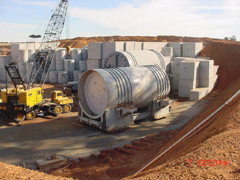
A container of low-level radioactive waste from Connecticut is stored at the Barnwell dump. (Courtesy of South Carolina Energy Office)
Barnwell County in South Carolina has been a disposal site for much of the nation's low-level nuclear waste for the past 36 years. But by July of next year, the waste site will close to most of the nation - forcing many states to store their own radioactive garbage and raising concerns that many companies, universities and hospitals aren't fit to do so. Associated Press reporter Seanna Adcox has been covering the story and talks with host Bruce Gellerman.
Transcript
[THEME]
GELLERMAN: From the Jennifer and Ted Stanley Studios in Somerville, Massachusetts, this is Living on Earth. I’m Bruce Gellerman, in for Steve Curwood.
Barnwell County South Carolina is famous for two things.
[MUSIC: James Brown “I Got You (I Feel Good)” from ‘20 All Time Greatest Hits’ (Polygram—1991)]
GELLERMAN: First, James Brown, the king of Soul, was born in Barnwell County. The second thing it’s famous for: nuclear waste. For the past 36 years, Barnwell County has been the place much of the nation’s low-level nuclear waste has been dumped—everything from radioactive mops and test tubes to reactor containment vessels. In all, some 27 million cubic feet of radioactive waste have landed in Barnwell County’s dump. But while it’s low-level waste, Diane D’Arrigo of the Nuclear Information and Resource Service says that doesn’t mean it’s low risk.
D’ARRIGO: Plutonium is in low-level waste. Iodine-129 is in so-called low-level waste. Plutonium is hazardous for a quarter to a half a million years and Iodine-129 is hazardous 170-340 million years. That’s why the title of the waste is such a misnomer.
GELLERMAN: Thirty-six states have been permitted to use the Barnwell waste site. But by the middle of next year, all but three will have to find someplace else for their radioactive garbage. Associated Press reporter Seanna Adcox has been covering the closing of the Barnwell County dump.
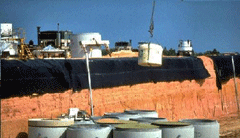
An "active" trench at the Barnwell dumping site.(Courtesy of South Carolina Energy Office)
GELLERMAN: So now states don’t have any other place for this low-level nuclear waste. What are they going to do?
ADCOX: Correct. Well, there’s 36 states that can’t send it anywhere so they’ll have to store it on site. There is a company down in Texas that will—they have a license to store it long term. But the thought is that most won’t pay for that to be done. They’ll find someplace to put it on their own site.
GELLERMAN: So there seems to be an irony here. I mean, these states are sending it to you in Barnwell County, South Carolina, because they didn’t want it in their backyard. Now this stuff has to stay in their backyard.
ADCOX: That’s correct. That’s the concern.
GELLERMAN: Is it safe to keep this on site? So, most of this stuff is produced at nuclear power plants—some at universities, some at companies, some at hospitals—but mostly, this stuff is coming from nuclear power plants.
ADCOX: Right.
GELLERMAN: Now you’ve got all these places located around the country. Are there any concerns about the safety?
A container of low-level radioactive waster from Connecticut is stored at the Barnwell dump.(Courtesy of South Carolina Energy Office)
They’re more worried about the littler folks, the people that don’t have anywhere to store it, that may have very little to store, but aren’t used to storing it. And they’re also they’re very worried about the very small sources—the gages, things that can easily get lost track of, that can fall into the wrong hands possibly. Some people are afraid that it will get put in a warehouse and be forgotten about—the company will be sold or there will be employee turnover, and no one will remember that it’s radioactive and it’ll be sent to a smelter. But, the environmentalists actually think that it’s the better option to store on site because if that place is already contaminated, why take it somewhere else to be contaminated?
GELLERMAN: It’s interesting that most of the country, or most of the attention to radioactive waste has been focused on Yucca Mountain and high-level waste—the fuel rods themselves—and yet it could be low-level waste that proves to be very problematic for the nuclear industry.
ADCOX: Yeah. There are those who fear that those small sources can be made into—not nuclear bombs, certainly, but dirty bombs—that they get enough of the little stuff together and it could spread radioactivity.
GELLERMAN: Have you been to the Barnwell County dumpsite?
ADCOX: I have. I went earlier this year.
GELLERMAN: Do you think it’s safe? And the reason I ask that is because since they’re going to have less customers; they’re going to be making less money. Will they have the funds to maintain the safety and security of this site?
ADCOX: They won’t, actually. They just had a meeting a couple of weeks ago to figure out how to make sure the site can break even instead of making a profit for the state, which it has been doing. And also remember that SRS, which is Savannah River Site, which takes up about a third of Barnwell County, is very much right next-door.
GELLERMAN: That’s the place where they produce nuclear weapons?
ADCOX: Right, it used to be—the locals used to refer to it as the bomb plant. And they have to store stuff on site there so the locals say ‘it doesn’t really matter what variant of nuclear if we’ve got SRS right next door.’
GELLERMAN: Seanna, what about the local people in Barnwell County? What do they say about the closing of this site?
ADCOX: Well, they fear what it will do to their tax base, which has eroded over the years anyway.
GELLERMAN: So locals want it to stay open?
ADCOX: Mainly. I’m sure there are some locals who don’t. But mostly, yes.
GELLERMAN: Well, Seanna, thank you very much.
ADCOX: Thank you.
GELLERMAN: Seanna Adcox reports for the Associated Press from Columbia, South Carolina.
Links
South Carolina Energy Office: Radioactive Waste Disposal Program
Living on Earth wants to hear from you!
Living on Earth
62 Calef Highway, Suite 212
Lee, NH 03861
Telephone: 617-287-4121
E-mail: comments@loe.org
Newsletter [Click here]
Donate to Living on Earth!
Living on Earth is an independent media program and relies entirely on contributions from listeners and institutions supporting public service. Please donate now to preserve an independent environmental voice.
NewsletterLiving on Earth offers a weekly delivery of the show's rundown to your mailbox. Sign up for our newsletter today!
 Sailors For The Sea: Be the change you want to sea.
 The Grantham Foundation for the Protection of the Environment: Committed to protecting and improving the health of the global environment.
 Contribute to Living on Earth and receive, as our gift to you, an archival print of one of Mark Seth Lender's extraordinary wildlife photographs. Follow the link to see Mark's current collection of photographs.
 Buy a signed copy of Mark Seth Lender's book Smeagull the Seagull & support Living on Earth
© Copyright World Media Foundation. All Rights Reserved
Home | Contact | RSS | Donate | Newsletter