

DDT and Breast Cancer
Air Date: Week of October 5, 2007
Exposure to DDT at a young age may indicate a greater risk for developing breast cancer, according to new research by Dr. Barbara Cohn of the Public Health Institute in Berkeley, California. Dr. Cohn speaks with host Steve Curwood.
Transcript
CURWOOD: From the Jennifer and Ted Stanley studios in Somerville, Massachusetts, this is Living on Earth. I’m Steve Curwood. For years the pesticide DDT has been a major suspect in the breast cancer epidemic. But studies looking at DDT residues in the tissue of women with breast cancer have been contradictory.
A new study published in Environmental Health Perspectives is based on actual blood samples preserved from as long as 40 years ago and the results are startling. It shows that if a female is exposed to DDT before puberty, she is five times as likely to get breast cancer as a woman who is exposed to DDT later in life. And virtually every female in the U.S. who was a child between 1945 and 1965, when DDT was widely used, is in a high-risk category. Dr. Barbara Cohn from the Public Health Institute in Berkeley, California was the lead author of the study. I asked her how she was able to get her data.
COHN: Well we had begun a very long-term, 40-year follow-up of a large group of women who had originally lived in Oakland, California. And as part of this study we had taken blood samples and archived those blood samples during the 1960s. And as you know, in the United States DDT wasn’t banned until 1972 and for that reason these archived blood samples were taken from women at a time when DDT was in very active use.
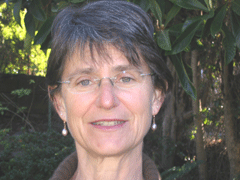
Dr. Barbara Cohn (Courtesy of Dr. Barbara Cohn)
COHN: The existing data that we have on animals suggest that some tissues in the body are much more sensitive to toxic exposures at a young age and even sometimes before birth. The other piece of evidence that is very important is regarding the only known strong environmental risk factor for breast cancer and that is radiation. And what we know about radiation comes to us from the very horrible experience of Hiroshima and Nagasaki; the atomic bomb blasts there. And what we learned from that work is that when women were young when exposed to radiation at the time of the blasts, they had an excess risk of breast cancer. But when women were not young at that time of the blast, the excess risk of breast cancer was small or not present. And so that’s the strongest evidence we have that the age that you are may determine whether the breast is vulnerable to a toxin or an insult that might cause breast cancer.
CURWOOD: Let’s say a girl is exposed to DDT at age six or seven. It’s not very likely she’d see the breast cancer develop until what—she’s in her fifties? Why does it take so long?
COHN: That’s an excellent question. From what we seem to know, especially again, from the atomic bomb blasts data, that when women did experience an excess risk of breast cancer after the bomb it was at the age when breast cancer is expected to develop—not at a particularly earlier time. And what we think is, is that the body has defenses against the development of abnormal growth, which is what cancer is, and that as we age those defenses are not as good and begin to break down. And for that reason, cancer is more common in older individuals.
CURWOOD: So, how were these girls exposed to DDT?
COHN: We can’t say for sure. We don’t have that information. But we do know that there was a very large use of DDT in the United States during this period, peaking around 1959, according to the EPA report on just the tonnage, and probably in the diet, peaking around 1965. The use was very broad for many, many different—agricultural, pests, and in gardens, and all around communities. So the levels that we measured in the blood of our women were actually quite high but they weren’t special individuals, they weren’t agricultural workers, they didn’t particularly have a history of living on the farm. They were just women who were living in the Oakland, California area in the 1960s.
CURWOOD: So DDT gets introduced for broad use in 1945, and looking at your study you estimate that the peak dietary exposure was in 1965. So that would mean today that these women are 62-42 years old. For women in this age group listening right now—what do you recommend that they do?
COHN: That’s the best question of all. There are some things that we can’t change: we can’t change our family history, and we can’t change the history of our DDT exposure, either. And so, there wouldn’t be much point in being tested for what was in your blood now because what is in your blood now probably wouldn’t tell us what you were exposed to when you were young. So the most practical advice that I can give is to try to control the characteristics or the risk factors that you can control. The newest data to come out is on alcohol use and there has been a recommendation that women who might be in a higher risk group—perhaps people with a family history—might want to review and consider how much alcohol that they drink. And our motivation in doing this work is to provide information to improve the health of the public and to hopefully be able, eventually, to treat, conquer, and prevent the health problems that so plague us.
CURWOOD: Dr. Barbara Cohn is center director of the Child Health and Development Studies at the Public Health Institute in Berkeley. Thank you so much.
COHN: You’re welcome.
Links
Child Health and Development Studies
"Any Type of Alcohol Drink Raises Breast Cancer Risk, New Study"
Living on Earth wants to hear from you!
Living on Earth
62 Calef Highway, Suite 212
Lee, NH 03861
Telephone: 617-287-4121
E-mail: comments@loe.org
Newsletter [Click here]
Donate to Living on Earth!
Living on Earth is an independent media program and relies entirely on contributions from listeners and institutions supporting public service. Please donate now to preserve an independent environmental voice.
NewsletterLiving on Earth offers a weekly delivery of the show's rundown to your mailbox. Sign up for our newsletter today!
 Sailors For The Sea: Be the change you want to sea.
 The Grantham Foundation for the Protection of the Environment: Committed to protecting and improving the health of the global environment.
 Contribute to Living on Earth and receive, as our gift to you, an archival print of one of Mark Seth Lender's extraordinary wildlife photographs. Follow the link to see Mark's current collection of photographs.
 Buy a signed copy of Mark Seth Lender's book Smeagull the Seagull & support Living on Earth
© Copyright World Media Foundation. All Rights Reserved
Home | Contact | RSS | Donate | Newsletter