
Oil or Birds
Air Date: Week of September 28, 2007
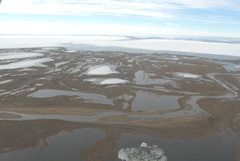
The wetlands around Teshekpuk Lake are among the most important in the Arctic and attract millions of migratory birds. (Photo: Steve Zack/Wildlife Conservation Society)
The Bureau of Land Management hopes to lease the last untouched part of Alaska’s North Slope to oil and gas drilling companies. Host Bruce Gellerman speaks with Stan Senner, executive director of Audubon Alaska, about Teshekpuk Lake, which is a critical nesting and mating ground for migratory birds and other species, and could soon be developed.
Transcript
GELLERMAN: Alaska is also where you’ll find Teshekpuk Lake. It’s on the North Slope 300 miles above the Arctic Circle, and it’s famous for two things: One is oil; the other: birds. It’s got a lot of both. Teshekpuk Lake lies in the National Petroleum Reserve –where it’s estimated there are two billion barrels of oil buried beneath the freshwater lake and marshy wetlands. It’s enough oil to fuel the U.S. economy for three months. As for birds—according to one expert—"it’s got a million of ‘em." In the spring, when the frozen Arctic wetlands begin to thaw, things really heat up as migratory waterfowl turn Teshekpuk Lake into party central. So far, the area is protected and the petroleum off-limits to drilling, but the Bush administration wants to lease the lake to oil companies.
The Bureau of Land Management—under federal court order—recently issued a report on drilling in the area and the agency is now accepting public comments. Stan Senner, executive director for Audubon Alaska in Anchorage, has visited Teshekpuk Lake many times.
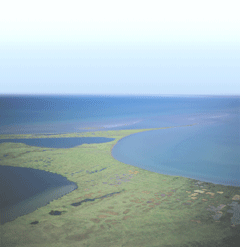
Teshekpuk Lake is in the northeastern part of the National Petroleum Reserve-Alaska.
(Photo: Gary Braasch/Audubon Alaska)
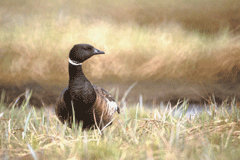
As many as thirty percent of the small geese known as Brant in the Pacific flyway gather near Teshekpuk Lake in summer to molt. While molting the birds are flightless and easily disturbed. (Photo: Tim Bowman/US Fish and Wildlife Service)
GELLERMAN: Some people are going to think, you know—there’s oil, there’s gas there and there’s birds. I’m getting my oil from the Middle East and Iraq and it’s troubled and people are dying there. You know on balance—I need my oil. And well, maybe that’s not such a bad thing. Okay, so we lose the birds.
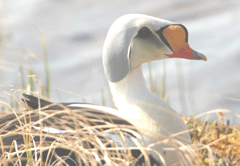
The King Eider nests in high densities near Teshekpuk Lake, and is an important subsistence food for Alaska Natives on the North Slope.
(Photo: Steve Zack/Wildlife Conservation Society)
GELLERMAN: Have you ever seen bird behavior changed around the developments on the North Slope?
The wetlands around Teshekpuk Lake are among the most important in the Arctic and attract millions of migratory birds. (Steve Zack/Wildlife Conservation Society)
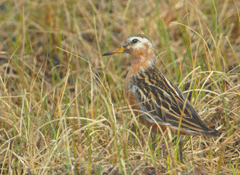
Red Phalarope nests and young are vulnerable to predation by gulls, ravens, foxes and grizzlies attracted to oilfields. (Steve Zack/Wildlife Conservation Society)
SENNER: Well, what we usually see is when birds are displaced out of a prime nesting area it ultimately results in a smaller population and so this idea- that if they’re pushed out of one place and that they have the chance to go somewhere else- doesn’t really hold water. The geese for example, that use the area north of the lake for their annual molt, which is to replace their feathers, they’ve been coming there for many many hundreds or thousands of years. If they’re not able to go there they just may not be returning at all in the future.
GELLERMAN: Well, Mr. Senner, thank you very much.
SENNER: You’re welcome. I’m glad to be here.
Links
Living on Earth wants to hear from you!
Living on Earth
62 Calef Highway, Suite 212
Lee, NH 03861
Telephone: 617-287-4121
E-mail: comments@loe.org
Newsletter [Click here]
Donate to Living on Earth!
Living on Earth is an independent media program and relies entirely on contributions from listeners and institutions supporting public service. Please donate now to preserve an independent environmental voice.
NewsletterLiving on Earth offers a weekly delivery of the show's rundown to your mailbox. Sign up for our newsletter today!
 Sailors For The Sea: Be the change you want to sea.
 The Grantham Foundation for the Protection of the Environment: Committed to protecting and improving the health of the global environment.
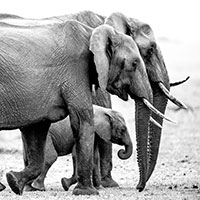 Contribute to Living on Earth and receive, as our gift to you, an archival print of one of Mark Seth Lender's extraordinary wildlife photographs. Follow the link to see Mark's current collection of photographs.
 Buy a signed copy of Mark Seth Lender's book Smeagull the Seagull & support Living on Earth
© Copyright World Media Foundation. All Rights Reserved
Home | Contact | RSS | Donate | Newsletter